From Wisconsin To Wall Street, An Economic Reckoning
The comparisons were inevitable. As Occupy Wall Street gathers momentum and new allies, progressives have quickly connected it with the other headline-grabbing uprising this year: The mass protests in Wisconsin against Gov. Scott Walker’s attack on labor unions. A statement from leaders of the American Federation of State, County, and Municipal Employees union, which endorsed Occupy Wall Street this week, was typical: “Just as a message was sent to politicians in Wisconsin, a clear message is now being sent to Wall Street: Priority number one should be rebuilding Main Street, not fueling the power of corporate CEOs and their marionette politicians.”
The essential theme connecting events in Madison and New York City is unmistakable. Both represent an economic reckoning at a time of grim unemployment rates and stagnant wages for middle-class Americans. “Both the defense of unions [in Wisconsin] and Occupy Wall Street, which is broader in its definition of the problem, are responding to two or three decades of increasing economic inequality and, until fairly recently, the inability of progressives to address those things,” says Georgetown University historian Michael Kazin, author of American Dreamers: How the Left Changed a Nation.
But the Wisconsin-Occupy Wall Street comparison is a more complicated one in its specifics. The two don’t fit neatly side by side and, in some ways, bear no resemblance at all. Here is a look at how two of the biggest populist protests of the year stack up:
The Organizers
As I reported from Madison in March, labor unions and community activist groups were, from the very beginning, the driving force in the Wisconsin protests. On November 3, 2010, the day after Republicans reclaimed the state Legislature and the governor’s mansion, union leaders began plotting how to respond to the looming assault on organized labor. And when Gov. Scott Walker unveiled his anti-union budget repair bill, and later threatened to sic the National Guard on those protesting his bill, unions marshaled their resources and called every member in their ranks. From their command center in Madison’s only unionized hotel, labor turned out more than a 100,000 supporters in a span of weeks.
Occupy Wall Street is not union-made. It was the anti-capitalist Adbusters magazine that put out the initial call for protesters to flood downtown Manhattan on September 17. Since then the protests have grown almost entirely without institutional support, an organic groundswell without leaders or executive boards or much structure at all. In recent days, unions have endorsed Occupy Wall Street, marched with them, and provided food, drinks, clothing, and more. But the protests remain a loosely organized, essentially leaderless effort.
Goals of the Movement
“Kill the bill! Kill the bill!” Wading among the crowd in Madison in February, you couldn’t go more than 10 minutes without that chant breaking out. It captured exactly what the protesters wanted: the death of Scott Walker’s anti-union bill. (They didn’t get it.) Later, those demands broadened to include fewer cuts to funding for education and social services by Walker and Wisconsin Republicans, but for much of the protests, it was perfectly clear what the angry cheeseheads wanted.
Occupy Wall Street so far has had no clear set of demands—and intentionally so, it seems. A post at OccupyWallSt.org demanded that supporters stop listing demands for fear of making protesters “look like extremist nut jobs.” The post went on, “You don’t speak for everyone in this.” The vague intentions have raised eyebrows, but they also have had the effect of welcoming a diverse group of supporters without alienating them. “The protesters have been eloquent in rejecting the idea that they produce ‘one demand’ and also in articulating in broad terms what they want,” says Robert Weissman, president of Public Citizen.
Spreading the Word
Like the protesters in Iran’s “Green Revolution” and Egypt’s Tahrir Square uprising, Wisconsin and Occupy Wall Street have made savvy use of social media for everything from rallying supporters and organizing marches to asking for food. Take Twitter: Both uprisings have built lively, if contentious, forums for debate with the hash tags #wiunion and #occupywallstreet. So many tweets poured in during Wednesday’s Occupy Wall Street march that it was impossible to keep up.
Other forms of online organizing have been pivotal. There are more than 230 Facebook pages promoting Occupy events from Tacoma, Washington, to Marfa, Texas, to Milwaukee, just as Facebook helped energize protesters in Wisconsin. And for those who couldn’t make it in person, livestreaming has brought supporters from around the country and the world closer to the action on the ground.
Laying Down the Law
Scott Walker’s bill exempted police officers from the most draconian crackdowns on workers’ rights. That put cops in a tight spot, because it was the job of the police to contain and, when necessary, crack down on the crowds of public workers who occupied the state Capitol rotunda and protested in the surrounding streets. But throughout the months-long protests, police arrested very few, allowed the occupiers to remain inside the Capitol for weeks, and generally treated angry demonstrators as best as could be hoped. Off-duty cops from around the state even joined the protesters in Madison.
Actions by law enforcement in Manhattan against Occupy Wall Street have at some turns been a very different story, with police crackdowns stealing the spotlight. This video of an NYPD deputy inspector using pepper spray on a handful of female protesters sparked outrage, added a streak of sensationalism to the story, and was picked up by mainstream news outlets. The arrest of more than 700 people who marched on the Brooklyn Bridge last weekend similarly made national headlines, leading to heaps of criticism and a class-action lawsuit against the NYPD.
Pizza for Protesters
Supporters called in pizza orders from around the world for the hearty crew of Capitol occupiers in Wisconsin. The same is happening for those camped out in Zuccotti Park, blocks from Wall Street. Pizza: It’s the nosh of choice for American uprisings in 2011.
By: Andy Kroll, Mother Jones, October 6, 2011
Why The Rich Should Pay Higher Taxes
Wealthy Americans will recoil at the suggestion, likely responding with the tired mantra that the top earners pay most of the income tax. But two points can be made in response to that: (1) federal income tax is only a small part of the burden on the middle class.
Based on data from the Institute on Taxation and Economic Policy, the total of all state and local taxes, social security taxes, and excise taxes (gasoline, alcohol, tobacco) consumes 21% of the annual incomes of the poorest half of America. For the richest 1% of Americans, the same taxes consume 7% of their incomes. And (2) the richest people pay most of the federal income taxes because they’ve made ALMOST ALL the new income over the past 30 years. Based on Tax Foundation figures, the richest 1% has TRIPLED ITS SHARE of America’s income since 1980, AFTER TAXES.
But there are better reasons why the rich should pay higher taxes.
The very rich benefit most from national security, government-funded research, infrastructure, and property laws. Defending the country benefits the rich more, because they have more to defend. Taxpayer-funded research at the Defense Advanced Research Projects Agency (the Internet), the National Institute of Health (pharmaceuticals), and the National Science Foundation (the Digital Library Initiative) has laid a half-century foundation for their idea-building. The interstates and airports and FAA and TSA benefit people who have the money to travel.
Over a hundred years ago, Teddy Roosevelt, facing an epidemic of inequality not unlike today, reminded us that “Great corporations exist only because they are created and safeguarded by [democratic] institutions; and it is therefore our right and our duty to see that they work in harmony with these institutions.”
Here’s another good reason for the rich to pay more taxes: With the drop in tax revenue, funding for the preservation of American culture is disappearing. Do we want our national treasures deprived of maintenance because of budget cuts, as is currently happening in Italy? Do we want our national parks sold to billionaires? Do we want programs for music and the arts eliminated from schools, so that only children of the wealthy can participate in them?
The 1912 book “Promised Land” by Mary Antin revealed the wonder of a Russian immigrant coming to the U.S.: “In America, then, everything was free…light was free…music was free.”
Not that capitalist markets don’t have their place. But the current view of democracy has gone to the other extreme, in which individualism and personal gain trump societal responsibility, and growing inequality makes community support and safeguards unnecessary for the privileged elite.
Finally, back to the tax statistics. Why should financial earnings (i.e., capital gains) be taxed less than wage earnings from actual work? The richest 10% of Americans own over 80% of the stocks, the gains from which are taxed at a 15% rate. Most wage earners pay more.
Furthermore, over the past 15 years millionaires have seen their income tax rates drop from 30% to 22%. During approximately the same time period, American economic growth declined from an annual 3.2 percent rate to 1.7 percent. Lower taxes for the rich do not lead to productivity.
Will the rich stop investing or move to another country if their taxes are increased? Not likely. They have it too good here. As Warren Buffett recently stated, “I have worked with investors for 60 years and I have yet to see anyone – not even when capital gains rates were 39.9 percent in 1976-77 – shy away from a sensible investment because of the tax rate on the potential gain.”
Mr. Buffett is admitting what everyone else is beginning to realize. The rich take much more than they pay for.
By: Paul Buchheit, CommonDreams.org, August 22, 2011
Age Gap: The GOP’s Generational Weapon In The Medicare Fight
To senior citizens at town hall meetings angry or worried about their plan to convert Medicare to a private insurance scheme, Republicans have a simple answer: It’s not about you. You’ll be fine. This is for “the next generation.”
The next generation is everyone 55 or under, since the plan would not start for ten years and would affect only newly eligible seniors. The stated logic of the ten-year delay is that it takes time to put the system in place and that people need time to plan. But if “premium support” (a euphemism right up there with “enhanced interrogation”) were ever going to work, it could be implemented as quickly as the Affordable Care Act (four years) or Medicare’s prescription drug coverage (two years). Presumably, the delay is mostly a political kludge, intended to avoid a backlash from those now or soon to be dependent on Medicare by affecting only those young enough to be giving little thought to retirement health coverage.
But the line they chose is more than a gimmick: The 55-and-over cutoff marks a sharp and significant generational divide. Those over 55 will continue to benefit from one of the triumphs of social insurance in the Great Society, while the rest of us will be on our own, with a coupon for private health insurance. If you consider what it means to be 55 years old in 2011, you’ll see the significance of the line.
Today’s 55-year-old was born in 1956. That’s not generally considered a major break in the generations. It’s smack in the middle of the Baby Boom (the peak of the boom, in fact), with almost a decade to go before the first Gen-Xers were born, dreaming of Winona Ryder. But the difference between early and later Boomers, especially in their experience of the economy, is dramatic.
A baby born in 1956 would have graduated from high school in about 1974, from college in 1978 or so. Look at almost any historical chart of the American economy, and you see two sharp breaks in the 1970s. First, in 1974, household incomes, which had been rising since World War II, flattened. Real wages started to stagnate. The poverty rate stopped falling. Health insurance coverage stopped rising. Those trends have continued ever since.
Second, a little later in the decade, around the time today’s 55-year-olds graduated from college (if they did—fewer than 30 percent have a four-year degree), inequality began its sharp rise, and the share of national income going to the bottom 40 percent began to fall. Productivity and wages, which had tended to keep pace, began to diverge, meaning that workers began seeing little of the benefits of their own productivity gains. The number of jobs in manufacturing peaked and began to drop sharply. Defined benefit pensions, which provide a secure base of income in retirement, began to give way to 401(k)s and similar schemes that depend on the worker to save and the stock market to perform. While the benefits of higher education rose, college tuitions started to rise even faster. Those trends, too, have continued.
If there was ever going to be a generational war in this country, that high school class of ’74 would be its Mason-Dixon line. It’s the moment when Bill Clinton’s promise—“if you work hard and play by the rules you’ll get ahead”—began to lose its value. Today’s seniors and near-seniors spent much of their working lives in that postwar world, with their incomes rising, investments gaining, their health increasingly secure, and their retirements predictable. Everyone 55 and younger spent his or her entire working life in an economy where all those trends had stalled or reversed. To borrow former White House economist Jared Bernstein’s phrase, it was the “You’re On Your Own” economy. Finally, those 55-year-olds are spending several of what should be their peak earning years, years when they should be salting away money in their 401(k)s and IRAs, in a period of deep recession and very slow recovery.
The Ryan plan, in other words, delivers to the older generation exactly what they’ve had all their lives—secure and predictable benefits—and to the next generation, more of what they’ve known—insecurity and risk. It’s hardly the first generational fight the GOP has started. The previous one was just last fall, when they campaigned for Medicare, and against the $500 billion in cuts (mostly by getting rid of the overgenerous subsidies to private insurers in an experimental program) passed as part of the Affordable Care Act. With an off-year electorate that was overwhelmingly older, they could put all their bets on the older side, knowing that seniors would see little benefit from the Affordable Care Act and were naturally worried about any change to the health system they enjoyed.
Heading into the 2012 election, however, the electorate is likely to shift back to one in which younger and middle-aged voters vote in proportion to their share of the population, so a “Mediscare” campaign won’t work. This time, the GOP hopes to play both sides of the generational war, gambling that while seniors want security, younger voters never expected the certainty of Medicare, just as they don’t expect reliable pensions or Social Security benefits, and thus will embrace a plan that sounds innovative, flexible, and market-based. Contending that the only alternative to premium support is the end of Medicare entirely, they are offering a generation that is accustomed to getting less than their parents a little bit, rather than nothing.
This strategy is a variation on the generational conflict the Bush Administration tried to launch in 2005 over Social Security privatization. Although it never reached the level of specificity that Ryan achieved, the calculus was the same: Younger voters would welcome the opportunity to take advantage of the stock market for their retirement, rather than the stodgy and predictable system their parents and grandparents liked.
That wager didn’t work, however: It turned out that older voters were terrified of Social Security privatization and younger voters unenthusiastic. Within five months, the radical move that every pundit thought was a near-certainty when George W. Bush declared “I’ve got political capital and I intend to use it,” had disappeared, never even introduced as legislation. And despite this week’s relaunch of the Ryan plan, it’s likely to end in the same result. If Social Security is any precedent, younger voters will be indifferent, while older voters won’t believe they’re exempt. The Republicans will again walk away from the conflict, hoping to get credit for being “serious” without bearing a political price for the error.
For Democrats, the defeat of the Ryan plan, like the failed Social Security privatization before it, will be regarded as a great victory, and an opportunity to get a fresh start with worried older voters. But they should not ignore the generational divide revealed by Ryan’s cutoff. If progressive politics has nothing to offer the late Boomers and the generations that follow except the same old programs, and nothing that responds to their distinctive experience of the economy, then eventually they’ll fall for one of these gimmicks from the right.
By: Mark Schmitt, The New Republic; Senior Fellow, Roosevelt Institute, May 20, 2011
A Vision Of Optimism And Equal Opportunity: What It Means To Be A Democrat
I’m glad I waited for President Obama’s heralded budget speech Wednesday before criticizing it (such a novel idea); there was much to praise in it and little to challenge. The best news: Obama laid out the kind of sweeping “story” of American democracy, and the bold vision of how we grow together, that I thought was too much to ask for even yesterday. He even talked about the scariest fact of American inequality: The dangerous hold the top 1 percent of Americans has on wealth, income and (he didn’t say this) politics. He pushed back on the cruel GOP deficit plan, made his toughest case yet for tax hikes on the richest, and stayed away from the worst ideas floated by his own deficit commission. The devil will be in the deficit-cutting details, and frankly, there weren’t a whole lot of them in the speech. But the president came out fighting with firmness, and with a rhetoric of social justice and equality, that I haven’t seen enough of these last two years.
Obama acknowledged our American history as “rugged individualists, a self-reliant people with a healthy skepticism of too much government.” But he quickly identified “another thread running throughout our history”:
A belief that we are all connected; and that there are some things we can only do together, as a nation. We believe, in the words of our first Republican president, Abraham Lincoln, that through government, we should do together what we cannot do as well for ourselves. And so we’ve built a strong military to keep us secure, and public schools and universities to educate our citizens. We’ve laid down railroads and highways to facilitate travel and commerce. We’ve supported the work of scientists and researchers whose discoveries have saved lives, unleashed repeated technological revolutions, and led to countless new jobs and entire industries. Each of us has benefited from these investments, and we are a more prosperous country as a result.
Part of this American belief that we are all connected also expresses itself in a conviction that each one of us deserves some basic measure of security. We recognize that no matter how responsibly we live our lives, hard times or bad luck, a crippling illness or a layoff, may strike any one of us. “There but for the grace of God go I,” we say to ourselves, and so we contribute to programs like Medicare and Social Security, which guarantee us health care and a measure of basic income after a lifetime of hard work; unemployment insurance, which protects us against unexpected job loss; and Medicaid, which provides care for millions of seniors in nursing homes, poor children, and those with disabilities. We are a better country because of these commitments. I’ll go further – we would not be a great country without those commitments.
So far, so good. It got even better when Obama took direct aim at Paul Ryan’s cruel and ludicrous budget plan. He laid out its many cuts, and concluded:
These are the kind of cuts that tell us we can’t afford the America we believe in. And they paint a vision of our future that’s deeply pessimistic. It’s a vision that says if our roads crumble and our bridges collapse, we can’t afford to fix them. If there are bright young Americans who have the drive and the will but not the money to go to college, we can’t afford to send them. Go to China and you’ll see businesses opening research labs and solar facilities. South Korean children are outpacing our kids in math and science. Brazil is investing billions in new infrastructure and can run half their cars not on high-priced gasoline, but biofuels. And yet, we are presented with a vision that says the United States of America – the greatest nation on Earth – can’t afford any of this.
Then he attacked the Gilded Age social inequality and tax cuts that have helped create our troubles:
Think about it. In the last decade, the average income of the bottom 90% of all working Americans actually declined. The top 1% saw their income rise by an average of more than a quarter of a million dollars each. And that’s who needs to pay less taxes? They want to give people like me a two hundred thousand dollar tax cut that’s paid for by asking thirty three seniors to each pay six thousand dollars more in health costs? That’s not right, and it’s not going to happen as long as I’m President.
Indulge me here, because this is how Democrats should be talking, and rarely do:
The America I know is generous and compassionate; a land of opportunity and optimism. We take responsibility for ourselves and each other; for the country we want and the future we share. We are the nation that built a railroad across a continent and brought light to communities shrouded in darkness. We sent a generation to college on the GI bill and saved millions of seniors from poverty with Social Security and Medicare. We have led the world in scientific research and technological breakthroughs that have transformed millions of lives.
This is who we are. This is the America I know. We don’t have to choose between a future of spiraling debt and one where we forfeit investments in our people and our country. To meet our fiscal challenge, we will need to make reforms. We will all need to make sacrifices. But we do not have to sacrifice the America we believe in. And as long as I’m President, we won’t.
That’s the president I voted for.
On the meat of the president’s plan to cut the deficit: He deserves credit for rejecting Medicare vouchers, for turning aside specific talk about Social Security (even though it has nothing to do with the federal deficit, the privatizers and Obama’s friends on his deficit commission wanted it thrown on the table in a grand bargain that can only be bad news for Democrats and working people; Obama seemed not to be willing to do that); for promising that reforms and innovations already part of the Affordable Care Act will bring down the costs of Medicare and Medicaid; and for saying we need bigger defense cuts than so far proposed.
(Small point: I liked the way Obama trashed Ryan without mentioning him — you don’t fight down — but I wish he’d been a tiny bit more confrontational on exactly what Ryan’s “Medicare vouchers” would do; if seniors could afford insurance at all, which is debatable, they’d certainly be at the mercy of privatized “death panels” refusing care over its costs. I say that because I’m sure some GOP prevaricator will bring back the “death panel” lie now that Obama has committed to curbing costs in Medicare. I hope I’m wrong.)
My quibbles? I’m still concerned that Obama has agreed to freeze the 12 percent of the budget that goes to “discretionary spending.” And I’m assuming that freeze includes the cuts made this week. I don’t like his promise of $3 in spending cuts for every dollar raised in revenue via tax hikes. In a statement, AFL-CIO president Richard Trumka praised the speech but added: “President Obama does not yet have the balance right between spending cuts and new revenue.” I also never like it when Obama undermines himself by saying things like:
I don’t expect the details in any final agreement to look exactly like the approach I laid out today. I’m eager to hear other ideas from all ends of the political spectrum.
I know, I know, he thinks it makes him sound reasonable to independents; I worry he sounds weak to Republicans. If Obama thinks the plan he laid out is as far to the left as Ryan’s plan is to the right, and that the answer is to meet in the glorious middle, we’re all in trouble.
But for today, I’ll take him at his word. After the speech, pundits called it the opening salvo of the Obama 2012 reelection campaign, as though there was something wrong with that. If these are the founding principles of the president’s 2012 campaign, Democrats and the country will be better off than we’ve been in a while.
By: Joan Walsh, Editor at Large, Salon, April 13, 2011
What Does The Tea Party Want?….The New Litmus Test
Jim VandeHei and Mike Allen argue that the Tea Party redefined the purpose of the GOP as opposition to spending:
The Republican Party is undergoing a messy but unmistakable 20-month transformation from fanatically anti-Obama to fanatically anti-spending, providing top party officials a new and intriguing playbook for recapturing the White House in 2012.
To understand the current evolution, flash back to late spring of 2009. The GOP was disoriented and adrift, its leadership void filled by the bombastic voices of Palin, Beck and Rush Limbaugh. There was no common conservative cause, beyond fear and loathing of Obama. No wonder swing voters were so down on them.
But the tea party, treated at first by the media as exotics, forced Republicans to focus almost exclusively on the size of government. By the time the 2010 elections rolled around, tea party activists and most independent voters were completely aligned on the need to cut, cut, cut.
Midterm election results showed that this approach offers the GOP its best – and maybe only – hope of keeping the interests of independents and tea party activists aligned enough to beat Obama.
The new litmus tests for GOP presidential hopefuls are support for repealing “Obamacare” and taking a cleaver to government spending. If a presidential candidate could harness the smaller-government conservatism, temper it enough to avoid a blatant overreach and articulate a vision for a prosperous future for the country, it’s not hard to imagine swing voters finding such a person appealing.
There’s a superficial appeal to this story. But the evidence that Tea Party activists want to cut spending — at least actual spending programs — is sparse. Polls show that Tea Party supports overwhelmingly oppose cuts to Social Security and Medicare. The main thrust of Tea Party opinion is not the belief that Obama has spent too much money, but the belief that Obama has spent too much money on people unlike them:
More than half say the policies of the administration favor the poor, and 25 percent think that the administration favors blacks over whites — compared with 11 percent of the general public.
They are more likely than the general public, and Republicans, to say that too much has been made of the problems facing black people.
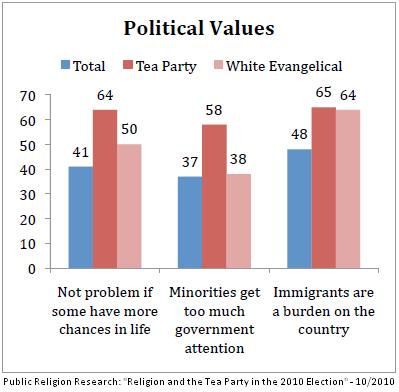
Here’s another cut, showing the Tea Party’s greater comfort with inequality of opportunity and stronger belief that the government devotes too many resources to minorities:
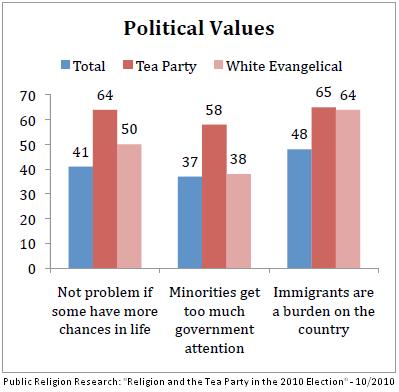
It’s a revolt against the composition of government much more than the level.
Now, it’s true that Republicans aren’t exactly translating this blueprint into action, but they’re not exactly flouting it, either. There is always a generalized antipathy toward spending amongst Republican and swing voters, but it disappears when the subject turns to actual government programs. Usually Republicans decide to just cut taxes for the rich instead. Here’s is the one part of the article proposing a defined policy change:
Even Ralph Reed, the Republican operative most tapped in to evangelicals, reflected the new GOP mindset when he gave this surprising wish list for the next presidential race: “In a perfect world, I’d like to hear the Republican nominee run on a platform that takes the capital gains tax to zero over five years.” Reed, who summoned several of the presidential candidates to Iowa for his Faith & Freedom Coalition this week, made it clear that Christian conservatives will still need to be catered to, but added that his side will understand the nominee’s need to focus on swing voters.
So an article putatively about the GOP redefining itself as an anti-spending party has one actual programmatic detail, and it’s: a zeroing out of the capital gains tax. In the name of appealing to swing voters — who, in fact, oppose tax cuts for the rich. Meet the new boss…
By: Jonathan Chait, The New Republic, March 14, 2011
Share This Blog


 Unknown Feed
- An error has occurred; the feed is probably down. Try again later.
 mykeystrokes.com

You must be logged in to post a comment.