Rick Perry has been governor of Texas since before I was old enough to vote. As a native Texan born in the millennial age, I put Rick Perry in the same category as a cassette player or an AOL subscription — something that has seemingly always been around, but has long since lost its purpose. Coming of age as a woman in Rick Perry’s Texas is sort of like living in the wild, wild west, like an Annie Ovary of women’s health, dodging old men wielding vaginal probes and vaccine mandates. With a governor who has a women’s health record that’s a bumpy country mile long possibly becoming our next president, what would it mean for women across America? Allow me.
First order of business in the Perry presidency would be the creation of the Department of Interior Contraception, or DIC. DIC would oversee approved contraceptive devices under Perry’s watchful eye, the top item on the list being the most widely accepted, reliable option available to God-fearing Americans these days: abstinence. Now, while it’s true Texas has the 3rd highest teen birth rate in the country and also true that a 2005 study found teens in Texas were actually having more sex after undergoing an abstinence-only program, Rick Perry still stands by the practice. Why? Not because there are actually any studies backing him up but “from my own personal life,” Perry told the Texas Tribune’s Evan Smith in an interview earlier this year. Comforting, isn’t it? Rather than President Perry making decisions based on studies and figures, the free world will instead hinge on the regularity of his wife’s cycles.
But don’t take Rick Perry’s word for it. Starting in 2012, women (and their partners — suddenly that cowboy vote doesn’t sound so good, does it gentlemen?) will get their very own chance to practice an abstinence-only approach when the recent law that requires health insurance companies to cover birth control will no doubt be rolled back by President Perry.
That brings us to the question of how Perry plans to punish women who don’t fall into line with his tried and true abstinence methods. After all, without threat of punishment, I think it’s safe to say Perry will probably be the only person in America abstaining from sex. For the sinners, Perry has already started a little pilot program right here in Texas.
The state now requires mandatory transvaginal sonograms for women who are 8 to 10 weeks pregnant and seeking abortions. The bill, which Perry declared a piece of “emergency legislation” during the last legislative session, requires the doctor to describe the fetus and play audio of the heartbeat prior to the abortion procedure. President Perry’s version of this bill will include an amendment to play Lee Greenwood’s “God Bless the U.S.A.” during the procedure.
Alas, if all of this has you feeling down, ladies, don’t fret. Think of all those cute babies we’ll get to have. But in Rick Perry’s America, you may want to home school. Texas ranks first in the nation in adults without high school diplomas. The future also doesn’t look so bright for all those precious little ones when it comes to health insurance and potential jobs: Texas boasts another first in the nation in the percentage of children without health insurance and, in 2010, Texas tied with Mississippi for the highest percentage of workers employed in minimum-wage jobs. No wonder Governor Perry wants Texas to secede. It’d sure make us look less stupid.
At a speech given to the United for Life group in June, Perry bragged about Texas’s recently-passed sonogram law and told attendees, “In Texas we have pursued policies to protect unborn children whenever possible.” And you can bet your left Fallopian tube that, if elected, he’ll continue to do the same for the unborn children of America. I just hope there’s a Plan B pill for what happens when all these children grow up — because President Perry, just like Governor Perry, certainly doesn’t plan to care for them.
After all, where Rick Perry comes from, that’s women’s work.
By: Rachel Farris, AlterNet, August 19, 2011: This essay originally
appeared at MeanRachel.com.
August 22, 2011
Posted by raemd95 |
Class Warfare, Conservatives, Education, Elections, Equal Rights, Freedom, GOP, Governors, Ideologues, Ideology, Insurance Companies, Jobs, Politics, Republicans, Right Wing, State Legislatures, States, Teaparty, Women, Women's Health, Womens Rights | Abstinence, Contraception, Cowboys, Gov Rick Perry, Home Schooling, Insurers, Minimum Wage, Secession, Sonograms, Teen Birth Rates, Texas |
Leave a comment
After Gov. Scott Walker, a Republican in his first months in office, announced early this year that he wanted to cut collective bargaining rights for public workers, relations between political parties in his newly red State Capitol fell into a long, deep frost.
But after six months of bruising partisan fights, Mr. Walker seemed to issue an utterly different message this month. He said he wanted to meet with Democrats and to find shared agenda items — an invitation that has been met with polite acceptance and deep skepticism.
“My thought is, you start out with small things, you build trust, you move forward, you keep working on things and you try and pick as many things that are things that people can clearly work together on,” Mr. Walker, who may face a recall election next year, said in an interview.
In the months after a flurry of Republican wins of governors’ offices and state legislatures in 2010, perhaps nowhere was the partisan rancor more pronounced than in the nation’s middle — places like Wisconsin and Ohio, where fights over labor unions exploded. But now, at least in those states, there are signs that the same Republicans see a need to show, at least publicly, a desire to play well with others.
In both states, critics dismiss the moves as desperate attempts to shore up sinking popularity ratings or disingenuous, tardy strategies to appear agreeable after already ramming through their agendas.
“It’s all P.R. — none of it is substantive,” Mark Miller, the Democrats’ minority leader in the Wisconsin State Senate, said earlier this month, before Mr. Walker held what some described as a “cordial” meeting with the Democratic leaders last week.
Whatever the true substance of the offers, the recent tones in Ohio and Wisconsin do appear to show one thing: With threats of recalls and bill repeals, with public dismay in recent months over the partisan stalemate in Washington on the debt ceiling, and with battleground-state presidential politics looming in 2012, governing with majorities has turned out in some states to be more complicated than it may have first appeared.
Across the nation, partisan relations in statehouses where Republicans made significant gains last fall have varied widely, and in many cases there are no signs of softening messages — or even the need for such a thing. But leaders in other states, including some that are expected to consider limits to unions in the months ahead, are closely watching what unfolds now in Ohio and Wisconsin, the states that became the unexpected battle zones for an earlier season of discontent.
In Columbus, Democrats and union leaders were enraged this year when Gov. John R. Kasich, another first-term Republican governor, and the Republicans who now control both chambers of the legislature pushed through — mostly along partisan lines— a law that would limit the rights of public workers to bargain collectively.
Republicans in Ohio advocated for the measure as the logical response to shrunken budgets in towns, cities and counties. But union leaders and Democrats — and a group calling itself We Are Ohio — spent months collecting more than 900,000 valid signatures (hundreds of thousands more than needed) to put the law to a vote in a statewide referendum in November. A campaign, which is expected to draw significant interest and spending from political groups in Ohio and nationwide, is likely to begin in earnest soon.
Last week, Mr. Kasich and Republican leaders sent a letter to the union organizers, calling for a meeting to discuss a compromise. The leaders said they still believed in the law they had passed, and a spokesman for Mr. Kasich would not say precisely what areas the Republicans were willing to give in on. “We are prepared to move forward immediately with legislative action to implement any agreement on changes we are able to reach together,” the letter read.
“We ought to get to the table and we ought to talk about it,” Mr. Kasich told reporters on Friday, meeting with them in a room full of empty seats and placards for the absent organizers, although the organizers said they had turned down the invitation. “Is it too late?” Mr. Kasich asked. “It’s never too late.”
Rob Nichols, a spokesman for Mr. Kasich, said the new invitation did not mark any shift in Mr. Kasich’s approach; the governor had sought to talk to labor groups during the legislative fight, Mr. Nichols said, and some representatives had engaged in private discussions over the issue again in June before the unions ended those talks, he said. “He, more than most, has a long history of working across party lines,” Mr. Nichols said.
But critics balked at the notion that any real talks had been offered before or that any true, concrete compromises — not just photo opportunities for a public fatigued by partisan rancor — were being offered now.
“If they’re honestly coming forward for a compromise, repeal the bill and then we’ll talk,” said Melissa Fazekas, a spokeswoman for We Are Ohio, explaining why representatives for the group had declined to meet with Mr. Kasich on Friday. “If they wanted to get along, they probably should have tried to during the legislative process instead of locking people out.”
In Wisconsin, partisan relations — and that state’s fight over limits to collective bargaining — have proved still uglier.
In the weeks after Mr. Walker proposed the limits in February, state lawmakers, newly dominated by Republicans in the Capitol, split in two. The minority Senate Democrats fled the state to try to block a vote on the measure. The Republicans issued the lawmaking equivalent of warrants against them, and at one point, threatened that the Democrats had to collect their paychecks in person — or not get them at all. And, as protesters screamed outside his closed office door, Mr. Walker firmly defended the bargaining cuts and said his administration was “certainly looking at all legal options” against the other party.
But after a summer of expensive, brutal recall election efforts against nine state senators — Democrats for having fled the state, and Republicans for having supported the bargaining cuts — Mr. Walker seemed to be sounding a different, softer note. He said he had called Democratic leaders in the Legislature even before the polls closed in some of this month’s recalls, which, in the end, maintained the Republican majorities in both legislative chambers, though by a slimmer margin of 17 to 16 in the Senate.
Democrats in the state had harsh theories about what was behind Mr. Walker’s sudden wish to get along. Some said he had already accomplished a stunningly partisan agenda, including the bargaining cuts, an austere budget, a voter identification law, a concealed-firearms provision and a redistricting map that favored Republicans, and was now hoping to appear to be reaching out. Others said he feared a different recall election effort — against him — next year, as well as creating a drag in the state on any Republican presidential ticket.
“This is totally phony — a totally unbelievable act of desperation,” said Graeme Zielinski, a spokesman for the state Democratic Party. “It will fade away and return soon enough to the scorched-earth method that has marked his career.”
Reflecting on the start of his term, Mr. Walker said that he wished he had spent more time “building a case” with the public for why collective bargaining cuts could shore up budgets, but that he remained a firm supporter of the cuts themselves — a fact that seems certain to complicate any effort for bipartisanship now.
“I’m not thinking that just because we snap our fingers that suddenly everybody’s going to run out and work together and it’s all going to work perfectly,” the governor said.
By: Monica Davey, The New York Times, August 21, 2011
August 22, 2011
Posted by raemd95 |
Class Warfare, Collective Bargaining, Conservatives, Democracy, Democrats, Elections, GOP, Gov John Kasich, Gov Scott Walker, Government, Governors, Ideologues, Ideology, Labor, Lawmakers, Middle Class, Politics, Public, Public Employees, Public Opinion, Republicans, Right Wing, State Legislatures, States, Teaparty, Union Busting, Unions, Voters | Anti-Union, Ohio, Ohio Legislature, Partisanship, Politicians, Public Workers, Recall Walker, Recalls, Redistricting, Voter ID Laws, We Are Ohio, We Are Wisconsin, Wisconsin, Wisconsin Legislature, Wisconsin Recall |
Leave a comment
The last two Wisconsin recalls ended in victory for two incumbent Democrats, leaving the Republicans with a 17-to-16 majority in the State Senate.
The Democrats prevailed handily last night — State Sen. Bob Wirch won in southeastern Wisconsin with 58 percent of the vote and Democratic Sen. Jim Holperin won in the northern part of the state with 55 percent.
The bottom line: Two Republicans were recalled from the Senate, while not one Democrat lost a recall race. Republican had hoped there would be a backlash against Democratic senators who left the state to prevent a quorum during the battles earlier this year over Republican Gov. Scott Walker’s proposals to strip away the collective-bargaining rights of public employee unions. That backlash did not materialize.
What’s clear is that the fight has moved public opinion the Democrats’ way, but not as fast or as dramatically as the Democrats had hoped. Wisconsin’s premier progressive political writer, John Nichols, noted that Walker’s opponents “have prevailed in the majority of recall elections and claimed the majority of votes cast in what many saw as a statewide referendum on Walker’s policies.”
Nichols acknowledged that the Democrats’ majority in these races was narrow — roughly 243,000 votes to 239,000 — but he added that “Walker won these districts in 2010, and . . . Republican Senate candidates easily won six of them in 2008.”
So will there be a recall campaign against Walker? My hunch is yes, but Walker seems to be trying to blunt this prospect by sounding uncharacteristically moderate. And at least one moderate Republican in the State Senate could give Democrats the ability to block any further legislation that veers too far right. This could lower the political temperature and that, paradoxically, could help Walker slip by a recall.
But anybody who thinks that the country is still in the same mood as it was in November 2010 should consult these results. In Wisconsin, there was a backlash against a right-wing that overreached. National polls suggest the same thing is happening to conservatives in the House of Representatives. Wisconsin is not a right-wing state, and this is not a right-wing country. That’s the message of recall summer.
By: E. J. Dionne, Jr., Opinion Writer, The Washington Post, August 17, 2011
August 18, 2011
Posted by raemd95 |
Collective Bargaining, Conservatives, Democracy, Democrats, Elections, GOP, Gov Scott Walker, Governors, Ideologues, Ideology, Labor, Politics, Public, Public Employees, Public Opinion, Republicans, Right Wing, State Legislatures, States, Union Busting, Unions, Wisconsin, Wisconsin Republicans | Wisconsin, Wisconsin Democrats, Wisconsin Legislature, Wisconsin Recall, Wisconsin Senate |
Leave a comment
Gov. Rick Perry (R-TX), since he launched his presidential campaign on Saturday, has paraded around the stat that “since June of 2009, Texas is responsible for more than 40 percent of all of the new jobs created in America.” “Now think about that. We’re home to less than 10 percent of the population in America, but 40 percent of all the new jobs were created in that state,” Perry says.
This stat leaves out a lot of the story. The Federal Reserve Bank of Dallas has promoted the number, but “it acknowledges that the number comes out different depending on whether one compares Texas to all states or just to states that are adding jobs.” Between 2008 and 2010, jobs actually grew at a faster pace in Massachusetts than in Texas.
In fact, “Texas has done worse than the rest of the country since the peak of national unemployment in October 2009.” The unemployment rate in Texas has been steadily increasing throughout the recession, and went from 7.7 to 8.2 percent while the state was supposedly creating 40 percent of all the new jobs in the U.S.
How is this possible, since Texas has created over 126,000 jobs since the depths of the recession in February 2009? The fact of the matter is that looking purely at job creation misses a key point, namely that Texas has also experienced incredibly rapid population and labor force growth (due to a series of factors, including that Texas weathered the housing bubble reasonably well due to strict mortgage lending regulations). When this is taken into account, Texas’ job creation looks decidedly less impressive:
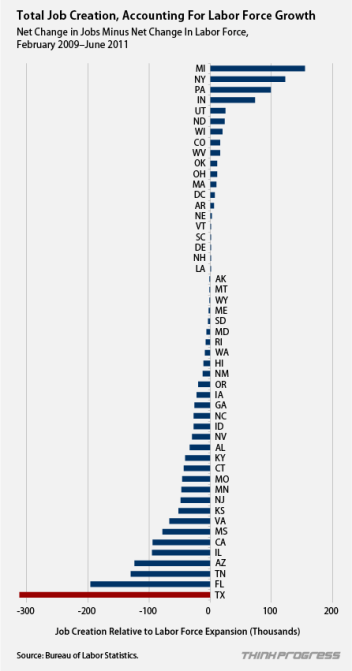
Clearly, there is no miracle for Texas here. While over 126,000 net jobs were created in Texas over the last two and a half years, the labor force expanded by over 437,000, meaning that overall Texas has added unemployed workers at a rate much faster than it has created jobs. And although states like Michigan have lost jobs (29,200 since February 2009), the state’s labor force has shrunk by over 185,000 since then. As a result, while there are fewer jobs, there are significantly less workers looking for them.
As Paul Krugman put it, “several factors underlie [Texas’] rapid population growth: a high birth rate, immigration from Mexico, and inward migration of Americans from other states, who are attracted to Texas by its warm weather and low cost of living, low housing costs in particular.” But they have little to do with Perry’s policies.
Now that certainly doesn’t make the situation in Michigan a good one, as contraction of the labor force is one side effect of the prolonged recession and unemployment there is still 10.6 percent. However if there is a real “miracle” here, it is North Dakota, which has seen over 27,000 new jobs and a labor force expansion of only 3,700, resulting in about 24,000 new jobs for workers who previously had none. But no one is proclaiming the “North Dakota miracle” and saying that Gov. Jack Dalrymple (R-ND) should be running for President.
By: Think Progress, August 17, 2011. Data for this post was compiled by Matt Separa, Research Assistant with the Economic Policy Team at the Center for American Progress Action Fund
August 18, 2011
Posted by raemd95 |
Class Warfare, Conservatives, Economic Recovery, Economy, GOP, Government, Governors, Ideologues, Ideology, Immigrants, Income Gap, Jobs, Labor, Middle Class, Politics, Republicans, Right Wing, States, Teaparty, Unemployed, Unemployment, Unions | Birth Rate, Federal Reserve Bank of Dallas, Gov Jack Dalrymple, Gov Rick Perry, Housing, Job Creation, Labor Force, Labor Force Growth, Massachusetts, Michigan, Migration, North Dakota, Population Growth, Recession, Texas, Workers |
Leave a comment
When Texas Gov. Rick Perry kicked off his Republican presidential campaign yesterday, his speech buried the needle on the Cliche-O-Meter, offering up one generic, predictable GOP theme after another. There was, however, one line in particular that stood out as interesting.
“We’re dismayed at the injustice that nearly half of all Americans don’t even pay any income tax. And you know the liberals out there are saying that we need to pay more.”
In this context, “we” refers to Perry and everyone who shares his worldview.
The oddity, of course, is that the governor seems to be arguing that Americans don’t pay enough in income taxes. Or more accurately, it’s unjust that more Americans aren’t paying income taxes.
This is an increasingly popular argument in right-wing circles — Michele Bachmann, one of Perry’s presidential rivals, has pushed the same line — though it’s entirely counter-intuitive. The argument isn’t even subtle: far-right Republicans are annoyed that many Americans don’t make enough money to be eligible to pay income taxes, so they believe it’s important to get more of these lower- and middle-income Americans paying more to the government.
In case anyone’s forgotten, the relevant details matters here: millions of Americans may be exempt from income taxes, but they still pay sales taxes, state taxes, local taxes, Social Security taxes, Medicare/Medicaid taxes, and in many instances, property taxes.
It’s not as if these folks are getting away with something — the existing tax structure leaves them out of the income tax system because they don’t make enough money to qualify.
Perry considers this an “injustice,” one which he apparently intends to fix, and which he feels strongly enough about to include in his closely-watched kick-off speech.
This should make for quite a 2012 debate, shouldn’t it? Some of the most far-right candidates want Americans with less to pay more in taxes. Seriously.
By: Steve Benen, Contributing Writer, Political Animal, Washington Monthly, August 14, 2011
August 17, 2011
Posted by raemd95 |
Class Warfare, Conservatives, Deficits, Economic Recovery, Economy, Elections, GOP, Government, Governors, Ideologues, Ideology, Income Gap, Politics, Republicans, Right Wing, Tax Loopholes, Taxes, Teaparty, Wealthy | Gov Rick Perry, Income Taxes, Liberals, Low Income, Medicare, Rep Michele Bachmann, Social Security Taxes, Tax Code, Tax Exemptions, Tax Revenue |
Leave a comment


 Unknown Feed
 mykeystrokes.com
You must be logged in to post a comment.