Let’s Repeal 2010

Gail Collins-Photo:Tony Cenicola/The New York Times
This has been a bad summer for almost everybody — celebrities, shrimpers, Washington insiders, Tea Party outsiders, people who prefer pleasant weather. So far, my list of who did well only includes the Spanish soccer team and Paul the prophetic octopus. Plus, according to Senator Jim Bunning, George Steinbrenner. The Kentucky Republican praised the Yankee owner in the Senate Finance Committee for being “smart enough to die in 2010,” when the estate tax is temporarily suspended.
This week, Congress passed the huge reform of the financial industry that it had been working on for nearly two years. You’d think there would have been cheering from coast to coast, but the left was disheartened to discover that contrary to all previous precedent, Congress had passed a bill that was imperfect.
“Ending debate on the bill is finishing before the job is done,” said Senator Russ Feingold of Wisconsin, the only Democrat to vote no.
Great idea. I think I speak for us all when I say that there is absolutely nothing I would like better than additional talking in the Senate. It always seems to make things better. Meanwhile, down in the House, John Boehner, the Republican leader, raised the ante, calling for repeal.
Who says that Boehner just hangs out at bars and tanning parlors and doesn’t work hard? The man is tireless! Everybody else was exhausted, but he wanted to start over.
“There are common sense things we should do to plug the holes in the regulatory system … and to bring more transparency to financial transactions. Because transparency is like sunlight and sunlight is the best disinfectant,” he said.
This is an exciting new analogy for Boehner. Just a couple of weeks ago he was leading the opposition to a bill that would require groups that pay for political attack ads to reveal their true identities. Boehner called it a “back-room deal to shred our Constitution.” In this case, transparency was a dangerous concept that would strip away all protective covering and allow vicious ultraviolet rays to stream through the window and burn away our precious freedoms.
Most Republicans are not joining Boehner in his call to repeal the financial reform bill because they are too busy calling for the repeal of health care reform. “The bill should be scrapped and replaced with much better ideas,” said Mario Rubio, the Republican Senate candidate in Florida.
Rubio’s own idea is to eliminate the requirement that healthy people have insurance, but keep the part that says insurance companies have to cover people with pre-existing conditions. This sounds like the ideal solution — no one would have to buy insurance until they got sick, and then they could make the companies sell them a whole bunch of coverage. I don’t know why nobody thought of this before.
With all these great ideas around — debate more, start over, don’t clean the windows — it’s a wonder that Washington hasn’t become the image of Athens in the age of Pericles. But instead, all Barack Obama’s critics have been able to do is make the country feel gloomy about Barack Obama. He’s passed more major legislation than anybody since Franklin Roosevelt and he’s got popularity ratings that look more like Martin Van Buren’s.
This week, there was an enormous outcry at the news that the president was going to take his wife and children to Maine for the weekend. This is the third time he and his family went away for a weekend since the gulf oil crisis. Three weekends in three months!
“Presidents are certainly entitled to vacation, just like everybody else, but there is a fine line as to when presidents should do it, what they should and where they should do it,” a former member of George W. Bush’s staff told CNN. The staff member in question, Brad Blakeman, was in charge of appointments and scheduling. Surely there is nobody better qualified to discuss this important subject than the man who helped the previous president get out of town for a third of his entire time in office.
The Republicans have now set up a site called “Golf or Gulf” that lists all the things Obama has been doing for the last three months when he could have been sitting around worrying about the oil spill. He had Paul McCartney over to the White House. And he played golf 10 times!
Let’s repeal the oil spill and start all over. The right way to handle the disaster, it appears from the many, many critiques, would have been to:
— Call all the oil company executives together to come up with a plan.
— Denounce all the oil companies.
— Apologize to the oil companies.
— Tell Paul McCartney he cannot sing in the White House until all the pelicans are clean.
By GAIL COLLINS-Op-Ed Columnist/NYT
Published: July 16, 2010
Republicans: A Party of Unemployment

Sen Orrin Hatch-"Drug test the unemployed"
From now until 2 November, the Republican party will be the party of unemployment. The logic is straightforward: the more people who are unemployed on election day, the better the prospects for Republicans in the fall election. They expect, with good cause, that voters will hold the Democrats responsible for the state of the economy. Therefore, anything that the Republicans can do to make the economy worse between now and then will help their election prospects.
While it may be bad taste to accuse a major national political party of deliberately wanting to throw people out of jobs, there is no other plausible explanation for the Republicans’ behaviour. They have balked at supporting nearly every bill that had any serious hope of creating or keeping jobs, most recently filibustering on bills that provided aid to state and local governments and extending unemployment benefits. The result of the Republicans’ actions, unless they are reversed quickly, is that hundreds of thousands more workers will be thrown out of work by the mid-terms.
The story is straightforward. Nearly every state and local government across the country is looking at large budget shortfalls for their 2011 fiscal years, most of which begin on 1 July 2010. Since they are generally required by state constitutions or local charters to balance their budgets, they will have no choice except to raise taxes and/or make large cutbacks and lay off workers to bring spending and revenue into line.
State and local governments have cut their workforce by an average of 65,000 a month over the last three months. Without substantial aid from the federal government, this pace is likely to accelerate. The Republican agenda in blocking aid to the states may add another 300,000 people to the unemployment rolls by early November.
The blocking of extended unemployment benefits promises similar dividends. As Paul Krugman rightly notes this week, unemployment benefits are not just about providing income support to those who are out of work, they also provide a boost to the economy. Since unemployed workers generally have little other than their benefits to support themselves, this is money that will almost immediately be spent. The benefits paid to workers are income to food stores and other retail outlets.
Unemployment insurance provides the sort of boost to demand that the economy desperately needs. That is why neutral parties such as the congressional budget office or economist Mark Zandi, a top adviser to John McCain’s presidential bid, always list unemployment benefits as one of the best forms of stimulus.
Republicans give two reasons for opposing benefits. First, they claim that benefits discourage people from working. Second, they object that the Democrats’ proposal will add to the national debt.
On the first point there is a considerable amount of economic research. Most indicates that in periods when the economy is operating near its capacity, more generous benefits may modestly increase the unemployment rate. However, they are less likely to have that effect now. The reason is simple: the economy does not have enough jobs. The latest data from the labour department shows that there are five unemployed workers for every job opening.
In this context, unemployment benefits may give some workers the option to remain unemployed longer to find a job that better fits their skills, but they are unlikely to affect the total number of unemployed. In other words, a $300 weekly unemployment cheque may allow an experienced teacher the luxury of looking for another teaching job, rather than being forced to grab a job at Wal-Mart.
However, if the teacher took the job at Wal-Mart, then this would simply displace a recent high-school graduate who has no other job opportunities. That might be a great turn of events in Republican-econ land, but it does not reduce the overall unemployment rate, nor does it benefit the overall economy in any obvious way.
The other argument the Republicans give is that these bills would add to the national debt. For example, the latest extension of unemployment benefits would have added $22bn to the debt by the end of 2011. This means that the debt would be $9,807,000,000 instead of $9,785,000,000 at the end of fiscal 2011, an increase of the debt-to-GDP ratio from 65.3% to 65.4%.
It is possible that Congressional Republicans, who were willing to vote for hundreds of billions of dollars of war expenditures without paying for them, or trillions of dollars of tax cuts without paying for them, are actually concerned about this sort of increase in the national debt. It is possible that this is true, but not very plausible.
The more likely explanation is that the Republicans want to block anything that can boost the economy and create jobs. Throwing people out of work may not be pretty, but politics was never pretty, and it is getting less so by the day.
Dean Baker is the co-director of the Center for Economic and Policy Research (CEPR). 2010 Guardian News and Media Limited. Published on Tuesday, July 6, 2010 by The Guardian/UK
Punishing the Jobless
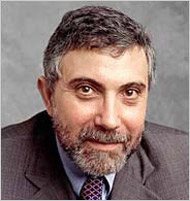
Paul Krugman-Nobel Prize Winner in Economics
There was a time when everyone took it for granted that unemployment insurance, which normally terminates after 26 weeks, would be extended in times of persistent joblessness. It was, most people agreed, the decent thing to do.
But that was then. Today, American workers face the worst job market since the Great Depression, with five job seekers for every job opening, with the average spell of unemployment now at 35 weeks. Yet the Senate went home for the holiday weekend without extending benefits. How was that possible?
The answer is that we’re facing a coalition of the heartless, the clueless and the confused. Nothing can be done about the first group, and probably not much about the second. But maybe it’s possible to clear up some of the confusion.
By the heartless, I mean Republicans who have made the cynical calculation that blocking anything President Obama tries to do — including, or perhaps especially, anything that might alleviate the nation’s economic pain — improves their chances in the midterm elections. Don’t pretend to be shocked: you know they’re out there, and make up a large share of the G.O.P. caucus.
By the clueless I mean people like Sharron Angle, the Republican candidate for senator from Nevada, who has repeatedly insisted that the unemployed are deliberately choosing to stay jobless, so that they can keep collecting benefits. A sample remark: “You can make more money on unemployment than you can going down and getting one of those jobs that is an honest job but it doesn’t pay as much. We’ve put in so much entitlement into our government that we really have spoiled our citizenry.”
Now, I don’t have the impression that unemployed Americans are spoiled; desperate seems more like it. One doubts, however, that any amount of evidence could change Ms. Angle’s view of the world — and there are, unfortunately, a lot of people in our political class just like her.
But there are also, one hopes, at least a few political players who are honestly misinformed about what unemployment benefits do — who believe, for example, that Senator Jon Kyl, Republican of Arizona, was making sense when he declared that extending benefits would make unemployment worse, because “continuing to pay people unemployment compensation is a disincentive for them to seek new work.” So let’s talk about why that belief is dead wrong.
Do unemployment benefits reduce the incentive to seek work? Yes: workers receiving unemployment benefits aren’t quite as desperate as workers without benefits, and are likely to be slightly more choosy about accepting new jobs. The operative word here is “slightly”: recent economic research suggests that the effect of unemployment benefits on worker behavior is much weaker than was previously believed. Still, it’s a real effect when the economy is doing well.
But it’s an effect that is completely irrelevant to our current situation. When the economy is booming, and lack of sufficient willing workers is limiting growth, generous unemployment benefits may keep employment lower than it would have been otherwise. But as you may have noticed, right now the economy isn’t booming — again, there are five unemployed workers for every job opening. Cutting off benefits to the unemployed will make them even more desperate for work — but they can’t take jobs that aren’t there.
Wait: there’s more. One main reason there aren’t enough jobs right now is weak consumer demand. Helping the unemployed, by putting money in the pockets of people who badly need it, helps support consumer spending. That’s why the Congressional Budget Office rates aid to the unemployed as a highly cost-effective form of economic stimulus. And unlike, say, large infrastructure projects, aid to the unemployed creates jobs quickly — while allowing that aid to lapse, which is what is happening right now, is a recipe for even weaker job growth, not in the distant future but over the next few months.
But won’t extending unemployment benefits worsen the budget deficit? Yes, slightly — but as I and others have been arguing at length, penny-pinching in the midst of a severely depressed economy is no way to deal with our long-run budget problems. And penny-pinching at the expense of the unemployed is cruel as well as misguided.
So, is there any chance that these arguments will get through? Not, I fear, to Republicans: “It is difficult to get a man to understand something,” said Upton Sinclair, “when his salary” — or, in this case, his hope of retaking Congress — “depends upon his not understanding it.” But there are also centrist Democrats who have bought into the arguments against helping the unemployed. It’s up to them to step back, realize that they have been misled — and do the right thing by passing extended benefits.
By PAUL KRUGMAN-Published: July 4, 2010 NYT Op-ED
Photo:Fred R. Conrad/The New York Times
“Hypocrisy,” Say Morons

Elephants and facts just don't seem to go together
Republicans plan to hammer the debt and deficit hypocrisy theme in the days and weeks ahead. White House economic adviser Larry Summers has lectured Congressional Democrats that now is a good time for the federal government to borrow to “stimulate demand” because interest rates are low. Yet the President keeps insisting that fiscal responsibility is an important priority of the White House. Republicans are having a field day. A recent email blast reminded supporters of a statement made by President Obama on November 18th: “It is important though to recognize if we keep on adding to the debt, even in the midst of this recession, that at some point, people could lose confidence in the U.S. economy in a way that could actually cause a double dip recession.”
Fiscal schizophrenia reigns in the White House.
Okay, let’s go back and read what Obama said last November 18th:
There may be some tax provisions that can encourage businesses to hire sooner rather than sitting on the sidelines; so, we’re taking a look at those. I think it is important though to recognize that if we keep on adding to the debt, even in the midst of this recovery, that at some point, people could lose confidence in the US economy in a way that could actually lead to a double-dip recession.
And so one of the trickiest things we’re doing right now, is to on the one hand make sure the recovery is supported and not withdraw a lot of money either with tax increases or big spending cuts – and states, for example, need a lot of support to keep hiring teachers and so forth – at the same time, making sure that we’re setting up a pathway longterm for deficit reduction.
Got that? Obama was saying the same thing he’s saying now. In the short run, we have an economic crisis that requires deficits. In the long-run, we’ll need to reduce the deficit. (And the long-term costs of temporary stimulus are pretty low.) Indeed, taking steps that increase long-term deficits could actually hurt in the short run. These are not contradictory ideas. Indeed, in his November interview, Obama endorsed the very notion (helping states mitigate budget cuts for teachers and other things) that he’s pushing for right now.
Moore and the Republicans think it’s “hypocrisy” to be for high deficits during a liquidity crisis but against them during a recovery. Really. The whole Republican message is based on not understanding this distinction.
By: Jonathan Chait-The New Republic-June 18, 2010
First “Obama’s Katrina,” Now “Obama’s Watergate”

On May 8, 1973, the Senate Watergate Committee began its nationally televised hearings. Archibald Cox served as the Justice Department's special prosecutor for the case.
It appears that the Republican Party and the conservative chattering classes are determined to identify Barack Obama with every famous conservative disaster of recent history. BP’s Gulf Oil spill, we are told incessantly, is “Obama’s Katrina,” presumably because of the common geographic location, and now we hear that the silly, contrived “scandal” over alleged job offers to Democratic primary candidates will be “Obama’s Watergate.” What’s next: Obama’s Iraq? Obama’s U.S. Attorney Scandal? Obama’s Plamegate? Obama’s Illegitimate Election? (Oh, sorry, I forgot, Republicans have already used that one!).In any event, the “Watergate” analogy is insane, unless maybe you are too young or too poorly read to remember what Watergate entailed. As Joe Conason explains at Salon:
“Watergate” was the place where the president’s henchmen staged a “third-rate burglary” of the Democratic National Committee headquarters on a June night in 1972, but its historical definition is the vast gangsterism of the Nixon regime. Watergate involved no political job offers, but a series of burglaries, warrantless domestic wiretaps, illegal spying, campaign dirty tricks, and assorted acts of thuggery by a group of goons whose leaders included G. Gordon Liddy and the late E. Howard Hunt. Watergate meant a coverup of those felonies with more felonies, set up by lawyers and bureaucrats who collected cash payoffs from major corporations and then handed out hush money and secret campaign slush funds. Watergate implicated dozens of perps, from Hunt and Liddy all the way up to the president, his palace guard, and his crooked minions at the highest levels of the Justice Department, the FBI and the CIA.
The allegations against the White House today involve alleged discussions of administration jobs for Democrats running in two Democratic primaries, who turned them down without consequences. Does that sound like Watergate in any way, shape or form?
But that even assumes there was anything wrong with the discussions, other than their political clumsiness. Yes, one defense is that the same thing has been done by federal, state and local executives from time immemorial, but even that concedes too much to the critics. The federal statute being invoked by conservatives in this situation makes it a crime to offer a job in exchange for “a political act.” But in this case, “the political act” is simply taking the job. If that’s illegal, then it’s illegal to offer appointments to anyone who is or might be running for office.
It’s not surprising that Republicans are seizing on this silliness, enabled by a bored press corps; not only does it contribute to the constant drumbeat of charges that Obama’s imploding politically and doomed to disaster in 2010 and/or 2012, but it’s also a handy weapon to use against Joe Sestak, who is well-positioned to beat one of the Right’s true heartthrobs, Pat Toomey, in November.
That’s all politics-as-usual, of course. But let’s not get hallucinogenic by comparing this to the wide-ranging use of federal power to raise money illegally and intimidate “enemies” characterized by Watergate.
Posted by Ed Kilgore on June 4, 2010-Photo: Marion Trikosko for USN and WR.
Share This Blog


 Unknown Feed
- An error has occurred; the feed is probably down. Try again later.


You must be logged in to post a comment.