The Cleansing of the GOP

"Ditto" or the Highway: Republican Democracy
The purification process — hard-core and uncompromising partisans driving heretics from their ranks — has been going on for a long time. Saturday’s Republican convention in Utah, the one in which conservative Senator Robert Bennett was defeated for being not conservative enough (despite an 84 percent approval rating from the American Conservative Union), is just one more step in a decades-long effort to drive independent thought from the political decisionmaking process.
This year, of course, attention has been focused primarily on Marco Rubio’s success in driving Florida Governor Charlie Crist out of the Republican Party (he’s now running for the Senate as an Independent) and former Congressman Pat Toomey’s success in converting Republican Senator Arlen Specter into a Democrat. But in both of those cases one can argue that the targeted incumbent was simply too far out of step with his own party. The same ACU ratings index on which Bennett scored an 84 gave Specter a 40. The ratings only measure members of Congress but Crist had more than once angered party members with his support of initiatives that were fiercely opposed by most Republicans. But given Bennett’s long embrace of conservative positions, with relatively few departures from the party-line script over a period of nearly two decades, what happened in Utah was something of a very different and disturbing nature. It was checklist politics, a demand for suspension of judgment and lockstep adherence to an ideological instruction manual that would brook no deviation.
That is important in assessing what is happening in the political wars. When Jeff Bell, a member of the American Conservative Union’s board of directors, took on and defeated incumbent Republican Senator Clifford Case in a party primary in 1978, it was because Bell’s views were, in Republican terms, more mainstream than those of the liberal Case. It was not a matter of the extremes knocking off the middle but of a traditional conservative ousting a Republican who was, for all practical purposes, not a Republican at all. Similarly, two years later, Alfonse D’Amato knocked off incumbent Republican Senator Jacob Javits, another liberal, in a New York primary.
When Ned Lamont defeated incumbent Senator Joseph Lieberman in Connecticut’s Democratic Senate primary — after Lieberman had been his party’s vice presidential nominee — it was because one overriding issue — war — was of sufficient weight to overshadow the rest of Lieberman’s record and his Democratic credentials. War is a trump card; absent Lieberman’s support for the invasion of Iraq, it is unlikely that he would have been challenged by a fellow Democrat, much less be defeated, even though he had long been known for speaking his own mind (as witnessed by his forceful condemnation of Bill Clinton in the wake of the Lewinsky affair).
To be clear, Bennett’s defeat in Utah was not an unprecedented challenge of an incumbent who was just not as conservative as his opponent. Ronald Reagan almost defeated the generally conservative Gerald Ford in 1976 when Ford was seeking the Republican nomination to succeed himself in the White House. But for the most part, parties have been willing to allow some departure from the party line if a legislator’s overall record has been sufficiently on key.
Signs that this is changing were seen recently within the governing ranks of the GOP, with local party leaders attempting to force National Chairman Michael Steele to adopt a “purity” test to determine which Republican candidates would receive the party’s financial support. Steele refused to go along but it is the same sentiment that has now ended Robert Bennett’s Senate career.
When the voters send a man or woman to write the laws, in Washington or a state capitol, that legislator is obligated to weigh seriously the views of his or her constituents, to examine thoroughly the important issues of the day and the proposals to deal with them, and to consult the relevant constitution (federal or state) and then act accordingly. Increasingly, the last two items on that list — intelligent assessment and constitutional constraint — are being driven from the process. One is expected to listen — and to obey — the preferences, indeed the demands, not of “constituents” but of that small band of constituents who dominate party primaries and party conventions.
Ironically, those who demand such mindless conformity cry out a demand for adherence to the Constitution, even as they undermine the most important principles of rational constitutional self-government.
Original post by Mickey Edwards-The Cleansing: The Atlantic-May 10, 2010
GOP Desperate to Sink Finance Reform — Sound Familiar?
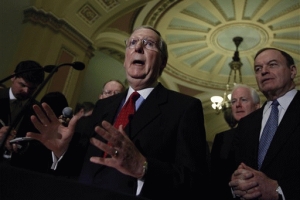
Sen Mitch "Let's scrap this one too" McConnell
Senate Minority Leader Mitch McConnell (R-Ky.) flew to New York two weeks ago for a private, behind-closed-doors meeting with hedge fund managers, bankers, and other Wall Street elites. It was after this meeting — where McConnell reportedly sought campaign contributions — that the Republican Senate leader returned to D.C. determined to kill the legislation that would bring some accountability to the same industry whose recklessness nearly destroyed the global financial system.
McConnell was asked on CNN this morning what, specifically, was said at the gathering about the Wall Street reform bill. The conservative Kentuckian was evasive — imagine that — and instead of answering the questions, he talked about scrapping the legislation altogether.
“We ought to go back to the drawing board and fix it.”
It’s like deja vu all over again — Democrats tackle a pressing national issue, negotiate with Republicans in good faith, craft a reasonable, middle-of-the-road legislative package that deserves bipartisan support, lobbyists tell Republicans to kill it, and McConnell voices his support for killing the legislation and going “back to the drawing board.”
Is it me or does this sound familiar?
McConnell’s principal (but not principled) concern is over the legislation’s liquidation fund, which would impose a fee on large financial institutions, collecting money that would be used to cover the costs of closing firms that fail. McConnell, who doesn’t know what he’s talking about, has characterized this provision as “institutionalizing bailouts.”
Fine, the Obama administration said. If it will help create bipartisan support for the bill, and end talk of a Republican filibuster, the provision on the liquidation fund can be scuttled. So, problem solved? Hardly.
[W]hen asked if he would support the bill if Democrats removed that fund, McConnell told CNN’s “State of the Union” he would still have other issues with the legislation, though he did not say what those qualms were.
Again, we’ve seen these genuinely stupid tactics before.
“Republicans can’t support the reasonable legislation Democrats want because it has a provision we’re pretending not to like.”
“Fine, we’ll get rid of the provision.”
“Republicans still can’t support the legislation, and we don’t want to tell you why.”
I know Republicans want to be taken seriously on public policy, but I can’t figure out why anyone would.
By: Steve Benen-Washington Monthly-April 18, 2010
McCain: I Was a ‘Maverick,’ Now I’m a ‘Partisan’
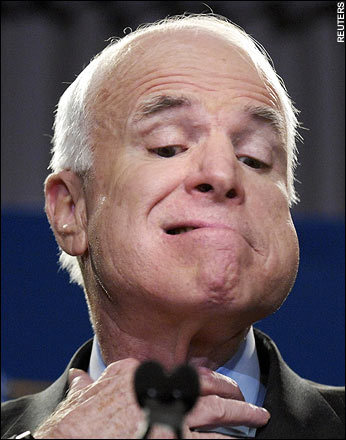
John McCain "the partisan"-even hard for him to swallow!
Arizona Sen. John McCain, trying to fend off a primary challenger trying to outflank him on the right, also found himself trying Sunday to put straight whether he was a “maverick” or not.
McCain’s “maverick” reputation and his past willingness to work with Democrats on issues like the environment, campaign finance reform and immigration before his run for President in 2008 often frustrated or angered fellow Republicans and he has lately made it appear like it’s a moniker he’d like people to forget.
McCain startled many political observers when he told Newsweek magazine “I never considered myself a maverick” — even as Sarah Palin was describing him that way in a campaign appearance late last month in Arizona for her old running mate.
When he appeared on Fox News Sunday, host Chris Wallace pressed McCain on the point, playing a 2008 campaign ad that called him “the original maverick” and showing McCain saying, ” If you want real reform and if you want change, send a team of mavericks. And what maverick really means, what this team of maverick really means, is we understand who we work for.”
Hayworth labels himself the “consistent conservative” on his campaign web site and he has had fun poking McCain over the “maverick” quote. Hayworth told the Politico, “To the extent that he can encourage amnesia in the electorate, that’s what he’s aiming to do.”
A Rasmussen Reports poll conducted April 13 showed that Hayworth had pulled within 5 points of McCain, with McCain leading him 47 percent to 42 percent among likely Republican voters. The margin of error was 4 points. The primary is August 24.
By: Bruce Drake, Contributing Editor-Politics Daily, April 18, 2010
Republicans Play Us For Dupes on Financial Reform

Senate Minority Leader Mitch McConnell gestures while meeting with reporters on Capitol Hill in Washington
Conservatives are representing themselves as anti-bailout populists, while serving Wall Street.
Senate Republicans today debuted their new strategy for financial reform: Refuse to cooperate with Democrats on grounds that the Dems are too willing to give Wall Street what it wants.
I’m not making this up.
In a Senate floor speech, Minority Leader Mitch McConnell said Republicans couldn’t support the legislation that emerged from Chris Dodd’s banking committee because it “institutionalizes” future taxpayer bailouts of the Street, giving the Federal Reserve “enhanced emergency lending authority that is far too open to abuse.” Senator Bob Corker, a senior Republican on the committee who had spent many weeks negotiating the bill with Dodd, huffed that Dodd’s final bill provides “the ability to have bailouts.”
Sen. Lamar Alexander, a member of the Senate Republican leadership, blasted Dodd for partisanship — “Dodd jerked the rug out from under Sen. Corker and went back into a partisan bill” — that is, partisanship toward Wall Street. Alexander said Republicans will hold out for a plan “that would end the practice of too big to fail and that would make certain that we don’t perpetually use taxpayer dollars to bail out Wall Street.”
Republicans have been looking for a way to oppose Senate Dems on financial reform without looking like patsies for the Street. And now they think they’ve found it — by trying to make Democrats look like patsies for the Street. The strategy is surely the handiwork of Republican pollster Frank Luntz who for months has been telling Republicans “the single best way to kill any legislation is to link it to the Big Bank Bailout.” (See Luntz’s memo.)
Let’s be clear: The Dodd bill doesn’t go nearly far enough to rein in the Street. It allows so-called “specialized” derivatives to be traded without regulatory oversight; its capital requirements are weak; it gives far too much discretion to regulators, who, as we’ve seen, can fall asleep at the switch; it does nothing about conflicts of interest within credit rating agencies that rate the issues of the companies that put food on their plates; it puts a consumer protection agency inside the Fed whose consumer bureau didn’t protect consumers; it doesn’t do anything to control the size of banks; it delays dealing with other hard issues by assigning them to vaguely-defined “studies”; and, yes, it preserves the possibility that the Fed could launch another bank bailout.
But the Street thinks the Dodd bill goes way too far, and wants its Republican allies to water it down with more loopholes, studies, and regulatory discretion. Republicans figure they can accommodate the Street by refusing to give the Dems the votes they need unless the Dems agree to weaken the bill — while Republicans simultaneously tell the public they’re strengthening the bill and reducing the likelihood of future bailouts.
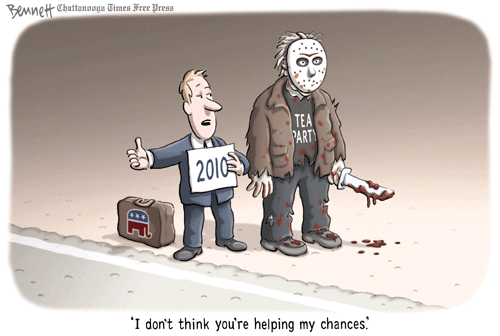
It’s a bizarre balancing act for the Republicans, reflecting the two opposing constituencies they have to appease — big business and Wall Street, on the one hand, and the emerging Tea Partiers, on the other. The Tea Partiers hate the Wall Street bailout as much as the left does. It was the bailout that “really got this ball rolling,” says Joseph Farah, publisher of WorldNetDaily, a website popular among Tea Party adherents. “That’s where the anger, where the frustration took root.”
The awkward fact, of course, is that the bank bailout originated with George W. Bush and a Republican congress. “Without this rescue plan,” Bush told the nation in September 2008, “the costs to the American economy could be disastrous.” New Hampshire Senator Judd Gregg, the leading Republican negotiator of the bailout bill, warned that without the bank bailout, “the trauma, the chaos, and the disruption to everyday Americans’ lives would be overwhelming.”
Republicans figure the public’s attention span is so short they won’t remember, and that the public understands so little about the details of financial reform that Republicans can weaken the Dodd bill without leaving any fingerprints.
I have a suggestion for Senate Democrats: Don’t let them get away with it. Smoke the Republicans out. Respond to their criticism that the Dodd bill leaves open the possibility that some future bank will become too big to fail by amending the bill to limit the size of banks to $100 billion of assets — so no bank can become too big, period. Challenge the Republicans to join you in voting for the amendment. If they decline, force them to explain themselves to their local Tea Partiers.
By Robert Reich April 14, 2010, Salon; Photo-AP/Manuel Balce Ceneta
Historic Achievement For A More Perfect Union
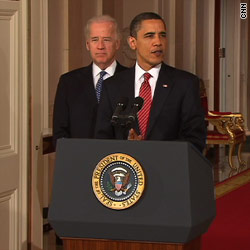
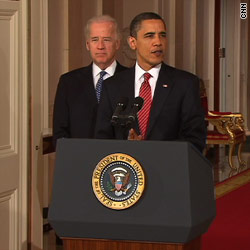
President Obama speaking on passage of Historic Health Reform Bill
“Mr. Speaker, I ask unanimous consent to revise and extend my remarks in opposition to this flawed health care bill”….We heard this canned statement over and over and over again tonight. We heard about the “Cornhusker kickback, the Louisiana Purchase, the Gator aid. We heard that this bill, if it passes, will make Americans less free. We heard that members of the military would loose their health coverage, that abortions would be paid for, that Medicare would be slashed. We heard from John Boehner that this was not the time to create bureaucracies, that there was no transparency, that there was not time to read the bill, that the people do not want this bill. His remarks continued to accent his distress over the process. If I had not been watching and only listening to his remarks over the radio, one would certainly have gotten the distinct impression that he was a very, very angry man. The tone and inflections in his voice gave one to believe that John Boehner just might be a little bit concerned that history was about to pass him by.
Health reform has been talked about and debated dating back to Theodore Roosevelt’s Bull Moose party which called for health insurance for industry. In his first term, President Roosevelt appointed a committee which was to report a program that addressed old-age and unemployment issues, medical care and health insurance. President Truman proposed a single insurance system that would cover all Americans with public subsidies to pay for the poor.
During nearly every Presidential election cycle since those days, every candidate has campaigned on the slogan of “health care for all”. At the end of that cycle, nothing gets done and the cycle continues. We immediately resort back to the status quo. The numbers of uninsured rise, the cost of insurance premiums skyrocket, rescissions continue, out of pocket expenses increase, denials for pre-existing conditions fall off the scales and even children are dropped from coverage.
Well, the time for change is long overdue. Republicans, for too long, have played politics with the lives of all Americans. At every turn, they have denied, delayed, obstructed, lied outright and instilled fear in the hearts and minds of the populace. As Speaker Pelosi said tonight, “all politics are personal”. After tonight, there will be no more politics of fear, no more politics of intimidation, no more threats of personal destruction. All of the talk about process, and all of the whining from republicans with bruised egos, don’t mean a heck of a lot now. What matters to those with no insurance, to those who are uninsured and those who have been bankrupted or lost their homes because of medical bills, simply stated, are results.
Many had given up on health reform with the Senate election results in Massachusetts earlier this year. Many have talked wildly about the upcoming November elections. The insurance companies became emboldened and Sen. Mitch McConnell and Rep. John Boehner actually began to believe their own words. Their repeated echo’s of “No” with the brazen 30-60% premium increases by Anthem and other insurers, re-awakened a cautious Democratic party. I want to personally thank Sen McConnell, Rep. Boehner and the insurance companies for their inadvertent contributions to the cause of health care reform.
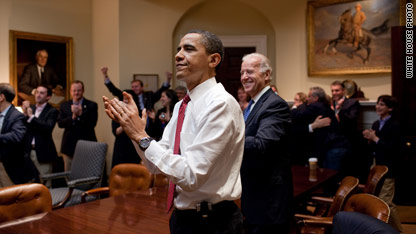
In November 2008, America elected a President who said that he would get health reform done. For this President, it was not just a “slogan”. He took flack from all sides…Republicans and Democrats alike. With a determined Speaker of the House in Nancy Pelosi, President Obama and the U.S. House of Representatives delivered for the good of the American people.
When the sun rises in the east tomorrow, the earth will still be turning on it‘s axis, the American economy will not have collapsed, America will still be free, and there will be no Waterloo….the only thing that will be different tomorrow is that historic health reform for all Americans was passed tonight. History is now on the side of the American people.
Share This Blog


 Unknown Feed
- An error has occurred; the feed is probably down. Try again later.



You must be logged in to post a comment.