Fear and Favor-A note to Tea Party activists: This is not the movie you think it is.
A note to Tea Party activists: This is not the movie you think it is. You probably imagine that you’re starring in “The Birth of a Nation,” but you’re actually just extras in a remake of “Citizen Kane.”True, there have been some changes in the plot. In the original, Kane tried to buy high political office for himself. In the new version, he just puts politicians on his payroll.
I mean that literally. As Politico recently pointed out, every major contender for the 2012 Republican presidential nomination who isn’t currently holding office and isn’t named Mitt Romney is now a paid contributor to Fox News. Now, media moguls have often promoted the careers and campaigns of politicians they believe will serve their interests. But directly cutting checks to political favorites takes it to a whole new level of blatancy.
Arguably, this shouldn’t be surprising. Modern American conservatism is, in large part, a movement shaped by billionaires and their bank accounts, and assured paychecks for the ideologically loyal are an important part of the system. Scientists willing to deny the existence of man-made climate change, economists willing to declare that tax cuts for the rich are essential to growth, strategic thinkers willing to provide rationales for wars of choice, lawyers willing to provide defenses of torture, all can count on support from a network of organizations that may seem independent on the surface but are largely financed by a handful of ultrawealthy families.
And these organizations have long provided havens for conservative political figures not currently in office. Thus when Senator Rick Santorum was defeated in 2006, he got a new job as head of the America’s Enemies program at the Ethics and Public Policy Center, a think tank that has received funding from the usual sources: the Koch brothers, the Coors family, and so on.
Now Mr. Santorum is one of those paid Fox contributors contemplating a presidential run. What’s the difference?
Well, for one thing, Fox News seems to have decided that it no longer needs to maintain even the pretense of being nonpartisan.
Nobody who was paying attention has ever doubted that Fox is, in reality, a part of the Republican political machine; but the network — with its Orwellian slogan, “fair and balanced” — has always denied the obvious. Officially, it still does. But by hiring those G.O.P. candidates, while at the same time making million-dollar contributions to the Republican Governors Association and the rabidly anti-Obama United States Chamber of Commerce, Rupert Murdoch’s News Corporation, which owns Fox, is signaling that it no longer feels the need to make any effort to keep up appearances.
Something else has changed, too: increasingly, Fox News has gone from merely supporting Republican candidates to anointing them. Christine O’Donnell, the upset winner of the G.O.P. Senate primary in Delaware, is often described as the Tea Party candidate, but given the publicity the network gave her, she could equally well be described as the Fox News candidate. Anyway, there’s not much difference: the Tea Party movement owes much of its rise to enthusiastic Fox coverage.
As the Republican political analyst David Frum put it, “Republicans originally thought that Fox worked for us, and now we are discovering we work for Fox” — literally, in the case of all those non-Mitt-Romney presidential hopefuls. It was days later, by the way, that Mr. Frum was fired by the American Enterprise Institute. Conservatives criticize Fox at their peril.
So the Ministry of Propaganda has, in effect, seized control of the Politburo. What are the implications?
Perhaps the most important thing to realize is that when billionaires put their might behind “grass roots” right-wing action, it’s not just about ideology: it’s also about business. What the Koch brothers have bought with their huge political outlays is, above all, freedom to pollute. What Mr. Murdoch is acquiring with his expanded political role is the kind of influence that lets his media empire make its own rules.
Thus in Britain, a reporter at one of Mr. Murdoch’s papers, News of the World, was caught hacking into the voice mail of prominent citizens, including members of the royal family. But Scotland Yard showed little interest in getting to the bottom of the story. Now the editor who ran the paper when the hacking was taking place is chief of communications for the Conservative government — and that government is talking about slashing the budget of the BBC, which competes with the News Corporation.
So think of those paychecks to Sarah Palin and others as smart investments. After all, if you’re a media mogul, it’s always good to have friends in high places. And the most reliable friends are the ones who know they owe it all to you.
By PAUL KRUGMAN: New York Times Op-Ed Columnist, Oct. 3, 2010
The Tea Party’s Big Money
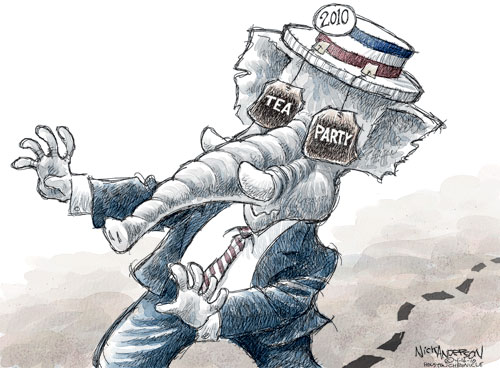
"Establishment Republicans"
Tea Party supporters and their candidates like to imagine themselves as insurgents, crashing the barricades of Washington to establish a new order of clean and frugal government. In earthbound reality, many of the people pulling the Tea Party’s strings are establishment Republican operatives and lobbyists. Some have made money off the party for years.
One example is Sal Russo, a gun-for-hire who has worked for former President Ronald Reagan, former Gov. George Deukmejian of California, former Gov. Christine Todd Whitman of New Jersey, former Gov. George Pataki of New York, and many other Republicans. As The Times reported on Sunday, Mr. Russo saw a sure thing last year, establishing a group called the Tea Party Express to support candidates in the midterm elections and raise cash at the same time.
The group has spent nearly $1 million in an effort to replace Harry Reid of Nevada, the Democratic Senate leader. It spent nearly $350,000 to elect Senator Scott Brown of Massachusetts. It is pouring money into Alaska to support Joe Miller’s Senate bid. And it has spent $250,000 in Delaware on behalf of Christine O’Donnell, now the Republican nominee for the United States Senate. Mr. Russo held a fund-raiser for Ms. O’Donnell and organized a rally.
In all, Mr. Russo and his group have raised $5.2 million and are the biggest independent supporters of Tea Party candidates. Of that, $3 million to buy advertising went to his political consulting firm or one controlled by his wife. Of course, he takes a substantial cut of each buy.
Dick Armey, the former House Republican leader, considers himself a godfather of the Tea Party and is co-author of the book, “Give Us Liberty: a Tea Party Manifesto.” Writing in The Wall Street Journal, he called for a “hostile takeover” of the Republican Party, which sounds so very revolutionary until one remembers that he helped lead that party for many years, guiding its policies and raising its money. When he left office in 2003, he cashed in on his connections to become a very high-paid lobbyist at DLA Piper, one of Washington’s biggest law firms, which has clients that include health-care companies, energy producers and foreign governments.
Then there is Carl Paladino, the Tea Party-backed Republican nominee for governor of New York. His bloodcurdling denunciations of Albany never seem to mention that he is one of the biggest landlords of state agencies, owning properties with $85 million in taxpayer leases in Buffalo alone that provide him with income of more than $5 million a year. He is the biggest property owner in Buffalo, and much of his empire has been constructed with state development incentives and tax breaks. An adviser is Roger Stone, an operator for Republicans since Richard Nixon’s re-election campaign.
There are undoubtedly thousands of Tea Partiers who would love to purge Washington of well-connected lobbyists, high-priced political consultants and others who take millions of taxpayer dollars while condemning the lawmakers who spend it. They should take a long look at the leaders and candidates who are driving their movement and decide whether purging begins at home.
New York Times-Editorial: Published Sept. 23, 2010
Tea Bags, Wind Bags, and Moneybags

Born Again Baggers?: Joe Wilson, Jim DeMint, Rick Scott, Sharon Angle (clockwise from top left)
So let’s say you’re a Republican politician who’s been working the far right side of the political highway for years, getting little national attention other than the occasional shout-out in Human Events. Or let’s say you’re a sketchy business buccaneer with a few million smackers burning a hole in your pocket, and you’ve decided that you’d like to live in the governor’s mansion for a while, but you can’t get the local GOP to see you as anything more than a walking checkbook who funds other people’s dreams.
What do you do? That’s easy: Get yourself in front of the loudest parade in town by becoming a Tea Party Activist!
There has been incessant discussion over the last year about the size, character, and intentions of the Tea Party rank-and-file. But, by and large, the political discussion has passed over another defining phenomenon: The beatific capacity of Tea Party membership, which enables virtually anyone with ambition to whitewash his hackishness—and transform from a has-been or huckster into an idealist on a crusade.
After all, to become a “Tea Party favorite” or a “Tea Party loyalist,” all a politician has to do is say that he or she is one—and maybe grab an endorsement from one of many hundreds of local groups around the country. It’s even possible to become indentified as the “Tea Party” candidate simply by entering a primary against a Republican who voted for TARP, the Medicare Prescription Drug bill, or No Child Left Behind. It’s not like there’s much upside to distancing oneself from the movement. Most Republican pols are as friendly as can be to the Tea Party; and it’s a rare, self-destructive elephant who would emulate Lindsey Graham’s dismissal of it all as a passing fad (in public at least).
Here, we’ll take a look at two specific types of politicians who have been especially eager to embrace the Tea Party movement: the fringier of conservative ideologues, for one, and also the self-funded ego freaks who can easily pose as “outsiders,” because no “insiders” would take them seriously. Let’s call these, respectively, the windbags and the moneybags.
By “fringier” conservative ideologues, I mean those who have argued, year in and year out, sometimes for decades, that even the conservative Republican Party simply is not conservative enough. Many of these politicians would be considered washed-up and isolated, or at least eccentric, in an era when “Party Wrecking” was still treated as a cardinal GOP sin. But now it’s as if they’ve been granted a license to kill. One classic example of this type is South Carolina Senator Jim DeMint, who was considered such a crank in the Senate that he was often stuck eating lunch alone as recently as 2008. His views, for example that Social Security and public schools are symbols of the seduction of Americans by socialism, were not long ago considered far outside the GOP mainstream. Now, in no small part because of his identification with the Tea Party Movement, DeMint has become an avenging angel roaming across the country to smite RINOs in Republican primaries, his imprimatur sought by candidates far from the Palmetto State.
Then there’s the new House Tea Party Caucus, chaired by Michele Bachmann of Minnesota, best known for suggesting that House Democrats be investigated for treason. Its members include a rich assortment of long-time conservative cranks, including Steve (“Racial profiling is an important part of law enforcement”) King, Joe (“You lie!”) Wilson, Paul (“We’ve elected a Marxist to be President of the United States”) Broun, Dan (Vince Foster Was Murdered!) Burton, and Phil (National Journal’s Most Conservative House Member in 2007) Gingrey. The key here is that these are not freshly minted “outsiders”: Burton has been in Congress for 28 years, Wilson for ten, King and Gingrey for eight. The oldest member of the House, Ralph Hall of Texas, who has been around for 30 years, is also a member of the caucus.
Even some of the younger Tea Party firebrands didn’t exactly emerge from their living rooms on April 15, 2009, to battle the stimulus legislation and Obamacare. Marco Rubio of Florida, after all, was first elected to the state legislature ten years ago and served as House Speaker under the protective wing of his political godfather, Jeb Bush. Sharron Angle first ran for office 20 years ago, and was elected to the Nevada legislature twelve years back. And of course the Pauls, father and son, are hardly political neophytes—they have just begun to look relevant again because the Tea Party movement has shifted the GOP in their direction
And, in addition to the hard-right pols who’ve emerged into the sunshine of GOP respectability, the “outsider” meme surrounding the Tea Party movement has also created running room for well-funded opportunists—the “moneybags.”
These are epitomized by Rick Scott of Florida, who probably would not have passed the most rudimentary smell test in a “normal” election year. While there are always self-funding egomaniacs running for office—California’s Meg Whitman comes to mind along with Connecticut’s Linda McMahon—the former hospital executive presents a unique test case for the whitewashing power of Tea Party identification. He has managed to overcome a deeply embarrassing embroilment in the largest Medicare fraud case in history by taking his golden parachute from Columbia-HCA and becoming a right-wing crusader against health care reform, helping to make that a central cause for the Tea Party movement. (Scott was forced out of his position as head of the for-profit hospital chain, which he tried to build into the “McDonald’s of health care,” and the organization was fined $1.7 billion for overcharging the federal government.)
Pushed out of his job after the fraud decision, Scott decided to found the Conservatives for Patients’ Rights (CPR) group that exploded onto the national scene early in 2009 with a series of inflammatory TV ads attacking health reform, employing the same firm that crafted the Swiftboat Veterans for Truth spots against John Kerry in 2004. CPR also played a major role in organizing the town hall meeting protests in the summer of 2009, which marked the Tea Party movement’s transition from a focus on TARP and the economic stimulus bill to a broader conservative agenda.
So when Scott (a Missouri native who moved to Florida in 2003) suddenly jumped into the Florda governor’s race early in 2010, the cleansing power of tea had already transformed his image among conservatives, making his improbable campaign possible.
On the wrong side of this dynamic was Florida Attorney General Bill McCollum, a former congressman and sturdy, if conventional, conservative who had paid his dues by twice running unsuccessfully for the Senate. McCollum had apparently all but locked up the nomination when Scott, in mid-April, leapt into the ring with ads calling himself a “conservative outsider” who would “run our state like a business,” while tarring McCollum as the candidate of “Tallahassee insiders” responsible for “the failed policies of the past.” Then came a torrent of advertising from Scott ($22 million by mid-July, more than anyone’s ever spent in Florida in an entire primary/general-election cycle) blasting McCollum for alleged corruption, for insufficient hostility toward illegal immigration, for being soft on abortion providers. The assault voided a lifetime of McCollum’s toil in the party vineyards, vaulting the previously unknown Scott into the lead in polls by early June. Worse yet, from a Republican point of view, Scott drove up McCollum’s negatives, and increasingly his own, to toxic levels, handing Democrat Alex Sink the lead in a July general election poll. And now McCollum, fighting for his life, is striking back, drawing as much publicity as he can to Scott’s questionable past, especially the Medicare fraud case against Columbia-HCA.
So the question is: Would Rick Scott have been in a position to carry out what is beginning to look like a murder-suicide pact on the GOP’s gubernatorial prospects if he hadn’t been able to identify himself as an “outsider conservative” with close ties to the Tea Party? That’s not likely, but it’s no less likely than the remarkable epiphanies that have made career pols of marginal relevance such as Jim DeMint and Sharron Angle into apostles of an exciting new citizens’ movement. So the next time you hear a candidate posturing on behalf of the Tea Party, squint and try to imagine what they were like in their former lives. Many of them have only found respectability through the healing power of tea.
By: Ed Kilgore-The New Republic, Aug 5, 2010
Still Making Things Worse: An Updated Critique of Conservative Health Policy Proposals

Repeal of health care would mean that approximately 15 million Americans would do without the help they need to pay for their health insurance premiums, and another 15 million would be denied Medicaid coverage.
Introduction
Less than six months after passage of the Affordable Care Act—landmark legislation that will expand coverage to 31 million Americans, reduce the growth of health care spending, and reduce the federal deficit over the coming decade— conservative think tanks, pundits, and politicians are urging Congress to repeal, or repeal and replace, the new law. But how would these pundits and policymakers address the problems of cost, coverage, and access that have festered in our health care system for decades? Would their proposals solve this puzzle?
A careful look makes clear they would not. Most of those who advocate repeal of the Affordable Care Act, or ACA, are really calling for a “do-nothing” approach. Their “solution” is for today’s myriad health care problems to continue to fester and grow, saddling future generations of Americans with unsustainable federal budget deficits and leaving the American people paying more each year for health insurance—if they are fortunate enough to have health insurance at all.
Even worse, though, are proposals offered by some conservatives. Whether small or large in scope, these approaches would exacerbate already existing problems in our health care system while failing to rein in ever-rising health care costs. These conservative “solutions” would hurt the average family budget and those left out of our health care system altogether. But let’s look at both of these conservative options—simply returning to the status quo of 2009, or doing even more harm—in more detail. Neither approach offers the health care prescription our nation needs.
Preserving the status quo
Prior to passage of the Affordable Care Act, the U.S. health care system was broken. Even after passage of the new law, much work will be necessary to effectively implement this legislation. In the year before passage of comprehensive health care reform, more than 46 million people in our country lacked health care coverage, while health care premiums were growing three times faster than wages and four times faster than inflation. Quality of care varied widely, and many Americans either received too little care or care inappropriate to their needs. And the nation’s public health insurance programs—primarily Medicare, Medicaid, and the Children’s Health Insurance Program, which provide coverage to more than 90 million people—could not, with their existing eligibility rules, serve as safety nets for millions of low-income, uninsured Americans. Until the new law is fully implemented, many of these dynamics remain.
This scenario, in short, was untenable. Escalating health care costs put health insurance out of reach for many Americans without health coverage. As Congress was considering the new law, four out of five people without health insurance lived in working families, but these families earn too little to purchase coverage on their own. Employers, who provide coverage to 163 million workers and their dependents, struggled to absorb rising health insurance premiums, which have grown 131 percent in the last decade. And individuals who purchased coverage on their own often experienced unpredictable jumps in their health insurance premiums. One high-profile example—Wellpoint’s Anthem Blue Cross company in California, which initially tried to increase premiums by up to 39 percent for individual policyholders—emerged during final consideration of the new law.
Nationwide, at the beginning of ACA implementation, we continue to spend more than 17 percent of gross domestic product on health care, and health care costs account for nearly 20 percent of household consumption. Among Americans with below-average incomes, more than half have unmet health care needs due to the high cost of care.
In addition, many individuals and families are unable to purchase health insurance because of insurance company practices. In most states, insurers can deny coverage to people with preexisting conditions or rescind insurance from policy holders who become sick. A recent survey reveals that over the course of three years, insurance companies denied coverage to 12.6 million Americans who sought health insurance in individual market. And for those who are able to get coverage on the individual market, policies can be very costly, particularly for people with health problems. In many instances, these policies do not cover certain services, and they commonly impose annual or lifetime limits on how much policyholders can spend on care.
The U.S. health care system also is riddled with inefficiency and poor quality care. The Institute of Medicine, part of the National Academies of Science, estimates that up to 98,000 people die each year due to medical errors—more than the number of people who die in motor vehicle accidents, or from breast cancer or AIDS. One in five Medicare beneficiaries have unplanned re-hospitalizations within 30 days of a discharge. Others receive more care than they need—a costly inefficiency the nation can ill afford.
Overutilization of health care services in our country is driven in part by a payment system that rewards the volume and complexity of services rendered rather than the suitability and quality of those services. At the same time, doctors and patients have little information on which treatment, drug, or medical device is best suited for a given condition. Taken together, the prevailing payment system and this dearth of comparative information fuel an inclination to provide the most expensive service or treatment, even if it’s no better than an older, cheaper one.
Finally, looming health workforce shortages in nursing and certain physician specialties, such as primary care and general surgery, also threaten future access to basic care. The Health Resources and Services Administration estimates that by 2020 there will be a shortfall of 49,000 physicians and more than 800,000 nurses. Those Americans who lack access to providers—especially primary care providers—often do not receive treatment for preventable conditions. Limited access to primary care providers, in addition to lack of insurance, is a leading cause of nonurgent emergency room utilization.
As bleak as the status quo looked in 2009, the picture only appeared darker when we looked to the future. Researchers estimated that by 2019, many employers would see their health premiums more than double, thus limiting their ability to provide coverage and add workers. Health care benefits would represent 17 percent of total worker compensation, up from roughly 10 percent, and families would face out-of-pocket costs that grow by 35 percent or more. And the ranks of Americans without health insurance would have swollen to more than 65 million.
The ACA took concrete steps to alter these trends and deliver the lower-cost growth, increased coverage, and improved quality necessary for transforming our nation’s health care system. In particular, the new law improves the availability of health coverage by transforming the national health insurance market. Health plans will no longer be allowed to deny coverage or charge higher premiums to people with health problems, or to rescind coverage when policyholders get sick.
At the same time, the new law establishes health insurance exchanges, a new marketplace that will enable individuals and families who do not have coverage through an employer, and who do not qualify for public insurance, to find high quality, comprehensive coverage. In this exchange, consumers will be able to comparison-shop across policies, making apples-to-apples comparisons of benefits, likely out-of-pocket costs, and other important variables.
The ACA also ensures that health coverage is affordable for all Americans. It strengthens and expands the Medicaid program, which previously provided a health care safety net for many, but not nearly all, low-income Americans. It also provides real help with premiums and co-payments for individuals and families who do not have employer coverage and can’t afford the full cost on their own.
The new law invests in our healthcare workforce to ensure our nation has enough primary care doctors and nurse-practitioners and the tools these providers need, such as research on which treatments work best and technology that can help them manage care. It also ensures that all Americans enjoy easy access to preventive care, and can develop the knowledge and skills they need to manage their own health.
Finally, provisions of the new law bring a new focus to cost containment, creating real financial incentives for health care providers to improve care for people with chronic conditions by improving the quality and efficiency of care. They combine the market muscle of the Medicare program with the innovation capacity of private payers to prompt greater changes than either sector could manage on its own, and ensure that successful payment reforms and delivery system strategies are duplicated across the country.
Through a Medicare innovation center, and a public-private commission dedicated to reducing growth in health care costs, the ACA ensures that payment innovation will take root and grow. The new law also takes steps to reduce the prevalence of high-end insurance plans and the overuse of services that they encourage through very generous coverage, further enhancing cost-control efforts.
But conservatives who would repeal the law—in particular, Reps. Steve King (R-IA) and Wally Herger (R-CA), as well as Minority Leader John Boehner (R-OH) and other members of the Republican leadership—would return our nation to this untenable status quo. Repealing the Affordable Care Act would enable insurance companies to continue discriminating against individuals with preexisting conditions. Repeal would mean that approximately 15 million Americans would do without the help they need to pay for their health insurance premiums, while another 15 million will be denied Medicaid coverage, simply because their family makeup or modest incomes disqualify them for public health insurance coverage. And repeal would mean that health care costs would continue to grow at an untenable rate, while patients would continue to experience chaotic, episodic, and poorly coordinated care.
In short, repeal means a return to the bad old days that we have only begun to leave behind.
Conservatives’ solutions
But what happens if the Affordable Care Act is repealed and conservative policymakers can pursue their own health reform agenda? The elected officials and health policy experts who have offered up policy solutions to this crisis are often criticized for proposing only “small ideas” in response to our nation’s serious health care crisis. These criticisms correctly identify a grab bag of ideas, common to virtually all conservatives engaged in health care reform, which are intended to make coverage more affordable for small segments of the population. These proposals do nothing to tackle the large, interconnected problems that plague our current health care system.
Consider conservatives’ most cherished reforms: Enabling health insurance companies to sell coverage outside of their licensing state, medical malpractice reform, and enabling small businesses to purchase coverage through business or professional associations. All three proposals are unlikely to make a significant difference in health care costs for the average American family with health insurance or make a meaningful dent in the numbers of Americans without health insurance. And they carry significant risks for patients, small businesses with older and sicker workers, and others.
But these small ideas are not the only ideas advanced by conservative policymakers. Conservative health policy proposals also include some clearly radical ideas, such as changing the tax treatment of health insurance and significantly altering the public health insurance programs that provide coverage today for nearly 90 million people. Taken together, conservative ideas fall into several big themes:
- Promoting the individual health insurance market, where Americans seek coverage on their own instead of benefiting from the buying power of employers and other large groups
- Eliminating the nation’s public health insurance programs so that millions of Americans lose guaranteed health care coverage
- Shifting responsibility for health care cost containment to individuals and families, which means paying more for less health care
Let’s unpack each of these radical ideas in turn.
Promoting the individual market
A major emphasis of conservative health reform proposals is to move Americans from group coverage—typically employer-sponsored health insurance but also public health insurance programs such as Medicaid—to the individual health insurance market. Conservatives argue that Americans would have greater ability to maintain coverage through changes in employment and work status if individuals and families purchased insurance on their own rather than through an employer.
Critics of this idea note that unpredictable costs, limited benefits, and the discriminatory practices characteristic of the individual insurance market would undermine any advantages related to insurance portability. Millions of Americans would face loss of health insurance coverage through preexisting condition exclusions or lose coverage after falling ill as conservative reform proposals shift Americans to individual coverage through a combination of discrete policy changes.
First of all, conservative policymakers propose to unravel employer-based coverage by either eliminating, or severely limiting, current tax treatment for employersponsored health insurance. Today, approximately 163 million workers and their dependents receive health insurance coverage as a tax-free benefit. Under conservative proposals, workers who receive coverage through their jobs would pay income and payroll taxes on some or all of the health insurance premiums paid by their employers. Yet significant research concludes that treating some or all of employer-covered premiums as taxable income would result in the erosion of employer-sponsored coverage because employers’ and employees’ incentives for participating in an employer-based system are reduced.
Undeterred, Rep. Paul Ryan (R-WI), Sens. Judd Gregg (R-NH), and Tom Coburn (R-OK) have all proposed some variation of this idea over the last year. Former Speaker of the House Newt Gingrich, conservative health policy analyst John Goodman, and Minnesota Governor Tim Pawlenty have all floated the idea in the national op-ed pages. In addition, Sen. John McCain (R-AZ) made a similar proposal during the 2008 presidential campaign.
A related concept—often offered in tandem with changing the tax treatment of employer-sponsored coverage—would create new tax breaks for individually purchased health insurance policies. This approach would enable individuals and families who purchase coverage on their own to either receive a refundable tax credit or claim an itemized deduction on their individual income taxes. The value of the credit typically ranges from approximately $2,300 for individuals to $5,700 for families, with some variation across plans, while Sen. Gregg’s proposal for a tax deduction would limit the deduction to the lower of the actual premium, or $11,500 per family and $5,000 per individual.
The actual value of the deduction when translated into reduced tax liability, however, would be significantly smaller. Higher-income families would reduce their taxes by $4,025 if they took the maximum possible deduction of $11,500, while families in lower tax brackets would receive a smaller benefit. Both the proposed tax credits and the Gregg deduction fall short when compared to the cost of comprehensive coverage through a group plan, which averaged $13,375 in 2009. So these proposed credits and deductions do not come close to covering the full cost of comprehensive coverage.
In addition, the buying power of these credits and deductions would diminish over time, as conservative policymakers typically propose using a growth index that falls well below average growth in health care costs. Sen. Coburn and Rep. Ryan, for example, propose growing their tax credits more than 2 percentage points more slowly than expected growth in health care costs.
Finally, a number of conservative policymakers—notably Sens. Gregg and Coburn and Rep. Ryan—propose to move low-income families from Medicaid coverage to the individual market. Under this approach, low-income families would, like other Americans, receive tax credits or other help with purchasing health coverage. This coverage is unlikely to be as comprehensive as the Medicaid benefit package and would entail significant out-of-pocket costs through deductibles, copayments, and uncovered services. These proposals include additional subsidies to these families to help with these costs, but even with this supplement low-income families will face higher health care costs.
Moving millions of people out of group coverage and into the individual market raises a number of thorny issues. First, coverage in the individual market is hard to obtain. Except for insurance companies that operate in the handful of states with comprehensive insurance reform, most insurers subject applicants to underwriting tests, examining their health histories in an effort to determine whether they have preexisting conditions and should therefore be denied coverage. In other cases, the insurance company may offer applicants with health problems coverage that excludes particular treatments or body parts, or the insurer may significantly increase the premium cost.
Between 2004 and 2007, nearly three-quarters of all individuals who sought coverage in this market did not end up purchasing a policy—many could not afford the coverage they were offered while others were denied coverage altogether due to a preexisting condition. Insurers in many states may also “rescind” coverage once they have sold a policy and collected premium payments. Insurers in the individual market also charge highly differentiated premiums based on age or gender.
These problems go largely unaddressed by conservative policymakers. And some of their other proposals, such as allowing insurers to sell policies in any state, would undermine strong insurance industry regulations and other consumer protection laws in the states that have made insurance market reforms.
Some conservative policymakers are divided on the extent to which they seek to reform insurance markets. Rep. Wally Herger (R-CA), for example, recently released a so-called repeal-and-replace bill, which would enact a proposal introduced by Rep. Dave Camp (R-MI). Minority leader John Boehner (R-OH) also offered this proposal—the “Common Sense Health Care Reform and Affordability Act”—as the Republican alternative during last year’s reform debate.
The Common Sense proposal would expand so-called high-risk pools rather than ban preexisting condition exclusions. High-risk pools are arrangements that make some degree of coverage available to individuals with preexisting conditions who cannot purchase coverage in the individual market. These pools currently cover 200,000 individuals, and often refuse to cover the health problem that makes the enrollee eligible for the high-risk pool in the first place. The Common Sense proposal also would prohibit annual or lifetime limits on health benefits and would limit insurers’ ability to rescind coverage once the policy is in force. Rep. Tom Price (R-GA) of the Republican Study Committee employs a similar strategy.
In contrast, Sen. Coburn and Rep. Ryan would enable health plans to continue using annual and lifetime limits, and continue policy rescissions, but would ban exclusions for preexisting conditions. Sen. Gregg would also end those exclusions and annual and lifetime benefit limits, but he does not address rescissions. None of the conservative proposals restrict rate-setting practices. This means insurers can charge people with chronic illnesses and other preexisting conditions exorbitant rates.
In sum, none of these proposals takes a comprehensive approach to reforming the individual insurance market, which means Americans who must turn to this market for health insurance will face some combination of limited access to coverage, inadequate coverage, and unaffordable premiums.
Finally, this move to the individual market would shift a significant portion of health care costs to individuals and families. Insurance policies in the individual market typically carry higher deductibles and co-payments, while covering fewer health care services compared to comprehensive employer-based coverage. Families covered by these skimpier policies must often pay out-of-pocket for uncovered services, and be prepared to lay down significant resources to meet their annual deductible and cost-sharing requirements.
Undermining the nation’s public health insurance programs
Consistent with (and part of) this push toward the individual market, conservative policymakers also propose dismantling critical public health insurance programs, including Medicaid, the Children’s Health Insurance Program, and Medicare. These programs provide publicly funded insurance to a range of individuals and families who cannot access affordable, market-based coverage, including senior citizens, people with disabilities, children living in low-income families, low-income pregnant women, and people with long-term care needs.
As noted earlier, legislation proposed by Rep. Ryan and Sen. Coburn would end Medicaid eligibility for low-income children and families, pregnant women, and low-income seniors, offering a tax credit for use in the individual insurance market in place of Medicaid coverage. In both proposals the standard tax credit would be supplemented by additional income-based subsidies for lower-income populations.
These two bills would also convert the remaining Medicaid program—essentially long-term care services and coverage for low-income people with disabilities—to a block grant program. Under this structure, the federal government would make fixed, formula-driven payments to states, which would then be responsible for providing services to individuals with disabilities and people with long-term care needs. But the states could not rely on federal payments that increase with enrollment or service costs. Individuals who currently rely on Medicaid to provide this coverage would no longer have a guaranteed source of payment for their health care needs.
In his “roadmap plan,” Rep. Ryan also envisions transforming Medicare coverage into a voucher payment, which people eligible for Medicare can use to purchase an individual health insurance policy. Individuals who become eligible for Medicare after January 1, 2021, would receive vouchers, including those who acquire Medicare eligibility by qualifying for Social Security disability benefits (currently 16 percent of individuals with Medicare coverage), individuals with end-stage renal disease, and those who reach the Medicare eligibility age.
These vouchers, according to the Congressional Budget Office, would have a value equivalent to $5,900 in 2009 dollars—far short of the cost of age-rated insurance policies in the individual market. And Rep. Ryan’s legislative language clearly indicates that the disability population would receive vouchers like everyone else, even though the CBO estimate (based on consultation with his staff) assumed otherwise.
These proposals raise a number of serious issues. Low-income individuals who rely on the Medicaid program for comprehensive health insurance coverage would be forced to move to private plans with more limited coverage and higher out-ofpocket costs. And while the Ryan budget roadmap, for example, would provide current Medicaid enrollees with a higher-than-average subsidy to cover premium costs, the total subsidy, $11,000 per year, still falls short of the average premium for comprehensive coverage purchased in the group market.
In some cases, these low-income families may not have the ability to make up the difference between the premium and cost-sharing obligations they would face in the individual market and the help offered to them under this proposal. In addition, the buying power of these subsidies will diminish over time because the subsidy amount typically grows more slowly than expected growth in health care costs.
In addition, without meaningful insurance market reforms, many people with Medicaid, CHIP, and Medicare coverage may experience real difficulty finding a health insurance policy. In 2006, for example, Medicare covered 6.9 million people with disabilities so severe that they cannot work. Unless insurance companies are required to sell a policy to all who seek coverage, and are prohibited from pricing policies based on health status, these individuals are unlikely to find affordable coverage in the individual market. And, as discussed earlier, conservatives typically do not propose such reforms of insurance industry practices.
Finally, proposals to protect the federal government from financial risk related to population growth, economic downturns, and growing health care costs would leave the states extremely vulnerable to unanticipated health care costs. Transforming Medicaid coverage for people with disabilities and Medicaid payment for long-term care costs into a block grant program would leave the states on their own and at financial risk. Medicaid enrollment, for example, grew by 3.3 million individuals from June 2008 to June 2009. The overall Medicaid population would look considerably different under these conservative proposals, but even with enrollment limited to low-income people with disabilities and people with long-term care needs, states could still expect enrollment to grow during economic downturns.
Shifting cost-cutting responsibilities to patients
Conservatives also promote strategies for shifting responsibility for controlling health care costs from insurance companies, public insurance administrators, and health care providers, the latter of whom drive the majority of health care spending through referrals, recommendations, and treatment plans, to patients themselves. In this way, conservatives believe, individual patients will be able to make sophisticated and complex decisions about the costs of their own health care by themselves while also lowering overall health care costs in the United States. They are wrong on both counts.
Consider first conservatives’ favorite idea for controlling costs—health savings accounts. For many years, conservatives have touted high-deductible health insurance plans in combination with health savings accounts as a strategy for reducing health care spending. These arrangements require patients to pay out of their own pocket, or out of their health savings account, until they reach their deductible and full coverage kicks in. This approach will, proponents argue, encourage patients to spend their health care dollars frugally and effectively.
Advocates for health savings accounts believe that paying a greater proportion of their health care spending will drive patients to seek higher-quality providers and shop for lower prices on a given procedure. Today, various conservative policymakers and health policy experts, among them Reps. Herger and Rep. Ryan, propose raising the contribution limits for the savings account component of these arrangements or making other changes to make health savings accounts more attractive to potential enrollees.
Yet to the degree that health savings accounts induce enrollees to reduce their health care spending, these incentives are focused on the health care people use before they meet their deductible. Because 80 percent of all health care spending is dedicated to only 20 percent of the population, this approach will have little impact on total health care spending. The patients who consume most of our nation’s health care dollars—people with catastrophic problems or chronic illnesses—use health care services at levels that far exceed a deductible, including the high deductibles featured in health savings account plans.
So instead of addressing the factors that drive the vast majority of health care spending in the United States, such as poor coordination and poor quality of care for people with chronic disease, this approach simply asks very sick people to pay for a larger proportion of their care themselves.
This emphasis on health savings accounts also assumes that patients can shop for health care just as consumers shop for other goods and services. To be savvy health care consumers, patients would need quality and cost information on providers, comparative research on competing treatment plans, and other information that simply does not exist today. This emphasis on “consumerism” to control health care costs also assumes that people are indifferent to any factor other than price—when in fact patients choose physicians based on long-standing relationships, trusted referrals, location and convenience, and intangible attributes such as personality and compassion.
In addition, nearly half of our national spending on health care services is dedicated to institutional payments to hospitals, nursing homes, and other facilities. In general, when individual consumers need these levels of care, they have very little ability to control the intensity or cost of the services they receive. Their needs are simply too acute or too complex.
Finally, Gingrich and Goodman propose allowing physicians to “repackage and reprice” the services they provide people with Medicare coverage, which would effectively unravel the fee schedule Medicare uses to pay doctors and other providers. This conservative approach is intended to provide some useful flexibility, such as payment for email and telephone consultations, and to create a more price-sensitive market for physician services. But again, this pushes costcontainment responsibility to the consumer.
A flawed approach to health reform
The true challenge of health care policy-making is to address the all-too-real problems of cost, coverage, and quality in our health care system. Improving the availability and affordability of coverage, reining in the growth of health care costs, and making the infrastructure investments necessary to modernize heath care delivery and address developing health care need must be top priorities. To be successful, reforms must offer pragmatic solutions that achieve these goals.
The conservative approach—which promotes the individual insurance market, undermines public health insurance programs, and requires individuals and families to take responsibility for controlling health care costs—fails to meet this standard.
Likely outcomes of conservative proposals
Given the very real problems in our nation’s health care system, how would these conservative proposals address our systemic problems, and what would the U.S. health care system look like if they were implemented? It is impossible to develop precise cost and coverage estimates when considering a range of proposals, but existing research points to some clear probabilities.
Providing tax credits or tax deductions in the place of employer-sponsored insurance and public health insurance coverage would result in millions of Americans moving into the individual insurance market—and millions more who will not be able to find affordable coverage in this market. Recent cost and coverage estimates of these approaches are elusive, but an analysis of Sen. McCain’s 2008 health reform proposal, which featured new tax credits for the purchase of health insurance, and the elimination of the tax exclusion for employer-provided health coverage, estimated that 20 million people would lose employer-sponsored coverage.
Because policies in the individual market are less likely to include comprehensive benefits, more families would face high out-of-pocket costs for cost sharing and uncovered services. At the extreme, families may be duped into buying junk insurance, which offers virtually no financial protection but nevertheless proliferates in some poorly regulated markets. Families facing high out-of-pocket costs, or carrying poor insurance, are more likely to face medical bankruptcy, even though they have health insurance.
These conservative proposals also are likely to result in larger numbers of uninsured Americans. Families who previously held coverage through an employer or through the Medicaid and CHIP programs would find that the new tax credits or deductions do not provide enough help for them to purchase coverage on their own. Some small business owners and their employees also are likely to find coverage less affordable because association health plans—which create group purchasing options for small businesses—enable businesses with younger, healthier employees to find advantageous employer-provided health insurance plans, leaving those with older, sicker workers in the current small group market where their premiums will spiral up once the good risks and healthy workers have been siphoned off to association health plans.
Finally, health care costs overall would continue growing at unsustainable rates, since individual patients will have little ability to induce doctors, hospitals, and other providers to improve efficiency, improve coordination for people with chronic illnesses, and upgrade the quality of care they deliver. Nor could individual patients, largely through the dollars they would spend on services they consume before they meet their deductible, create the kind of financial incentives that would induce providers to develop the new types of health care organizations most experts think are needed to truly improve health care delivery and control the growth of health care costs.
A specific example—repeal and replace
The consequences of the conservative approach can be best understood through a thorough examination of one specific proposal—the Common Sense plan. Rep. Camp introduced this plan on November 6, 2009, and Minority Leader Boehner offered the same language as the so-called House leadership alternative to the Democratic proposal in during floor debate in mid-November. Boehner has since signaled that he would like to replace the law with this plan. In short, the plan has all the main ingredients of the conservative approach to health care reform: it shifts the costs and risks of insurance onto individuals, and divides the already fragmented insurance market into low-cost plans for the healthy and high-cost insurance for the sick.
To insure sicker individuals who are currently uninsured and can’t find affordable coverage in the unregulated individual market, the bill requires states to establish high-risk pools with the aid of $15 billion in federal funding. But like most pools designed to insure very sick and costly beneficiaries, these programs would likely try to control costs by denying coverage for certain chronic conditions. The bill does abolish waiting lists and specifies that the pools must provide at least two coverage options (one of which must be a high deductible plan with a health savings account), but it does not require states to cover all preexisting conditions. Given the limited federal funding and the cap on premiums—they could be set no higher than 150 percent of the state average—this cannot be a permanent solution for providing coverage.
For Americans moving from group to individual coverage, the legislation eliminates the Health Insurance Portability and Accountability Act requirement of having creditable coverage in the past 18 months to receive individual insurance. Annual or lifetime spending caps are also eliminated and insurers will no longer be able to rescind coverage. But since insurers could still deny coverage for preexisting conditions and charge very different rates based on gender and age, these plans would only be open to healthier and younger Americans who can survive the tedious underwriting process.
Under this bill, insurers selling products in the individual health care market will no longer be confined by the consumer protections of a particular state. Instead, they will be able to choose their own rules and regulations by declaring a state as their “primary” state. From that locale, issuers can sell to customers in all other states and the District of Columbia. This is the plan’s signature proposal and it’s worth examining further.
Conservatives claim that they are empowering individuals by giving everyone a choice of plans across the United States. But in reality this provision is a thinly veiled attempted to free insurers from any rules or regulations. The plan not only undermines state sovereignty by stripping states of their power to set insurance rates and conditions, but also tilts the balance of power in the regulator-issuerbeneficiary relationship toward the issuer.
The Common Sense proposal also explicitly expands the definition of “state” to include not just D.C. and Puerto Rico, but also the Virgin Islands, Guam, American Samoa and the Northern Marianas. Companies can designate the Northern Marianas as the “primary state” for their plan—and then have that island’s nonexistent regulatory authority serve as the company’s sole regulator. This provision would not only empower the issuer, but it could also set off a race to the bottom among the states, many of which would undoubtedly lower their consumer protections standards to attract businesses and jobs.
In fact, the bill seems to recognize this reality and requires insurers to carry a “buyer beware” label, warning consumers that the plan is “not subject to all of the consumer protection laws or restrictions on rate changes of the state.”
The bill’s cost-control provisions are even less impressive than its coverage proposals. All in all, the Common Sense proposal would establish state innovation program grants to reward states for lowering the cost of their premiums, build a website to help consumers navigate through their coverage options, cap noneconomic damages in malpractice lawsuits at $250,000, and specify that all claims must be filed within three years.
These efforts would have a minimal impact on health spending and coverage expansion. The Congressional Budget Office found that under this $61 billion proposal, three million Americans would gain coverage, while the total number of uninsured Americans would actually increase to 52 million by 2019, and millions of Americans would continue to pay skyrocketing premiums. The proposal would, however, decrease the deficit by $68 billion over the 2010–2019 period. It would also reduce premiums for healthy Americans who can purchase coverage independently by 10 to 13 percent.
In fact, it’s unlikely that Rep. Boehner would be able to find affordable insurance under his own proposal should he choose to give up his government-sponsored plans for his own set of conservative reforms. He is 60 and by virtue of his age is more susceptible to cardiovascular disease, different cancers, high blood pressure, and host of other chronic diseases.
The Common Sense proposal would allow insurers to discriminate against these conditions and price the Republican leader out of the market. Specifically, Rep. Boehner:
Would not find coverage in the individual market
The Common Sense proposal aims to increase access to coverage in the individual market by giving individuals the opportunity to purchase insurance licensed in different states. But it’s unlikely that Boehner would be able to find an affordable coverage option, particularly since insurers will now have the option of selecting a deregulated U.S. territory in the Caribbean Sea or Pacific Ocean as their “primary state” and will likely compete on risk selection.
Would not find adequate coverage in high-risk pools
When Rep. Boehner is denied coverage in the individual market, he could apply for insurance in expanded state-based high-risk pools, which typically provide very expensive coverage for the so-called “uninsurables.” But his legislation does not adequately fund these pools and would compel states to limit services, deny coverage for preexisting conditions, and impose high cost sharing.
Would not find stable coverage in association health plans
If Rep. Boehner can’t purchase affordable coverage from state-run high-risk pools, he could join an association-sponsored plan. Unfortunately, under his own legislation, associations are not required to provide a standard package of benefits and have an incentive to craft skimpy policies that attract healthier applicants. See table for a general comparison of the Common Sense Plan and the Affordable Care Act. His alternative would not provide adequate or affordable coverage to Americans who need it most.
Conclusion
The Affordable Care Act made landmark improvements in the American health care system. By reforming the health insurance marketplace, creating new coverage opportunities through expanded Medicaid eligibility and new help with private health insurance for moderate income families, and creating a new platform for controlling health care costs by changing payment incentives and improving the delivery system, the new law takes on the fundamental flaws in American health care.
By Karen Davenport, Igor Volsky | August 5, 2010-Karen Davenport is the Director of Health Policy and Igor Volsky is a Health Care Researcher and Blogger at American Progress. Photo: AP/Jacquelyn Martin
How To Fight The Tax Cut Wars
The next big fight in Congress revolves around extending the Bush tax cuts. Unlike issues like climate change or stimulus, where the public does not accept the Democrats’ basic analysis of the problem, on the tax cuts the Democrats hold the whip hand. The question is whether they emerge with a political win, a public policy win, or both.
Let’s review a few basic facts about the Bush tax cuts. When Republicans took control of government in 2001, their top priority was reducing tax rates on high income earners. Since tax cuts for the rich were unpopular, they had to pair those cuts with middle-class tax cuts in order to make them politically salable. That’s how they pressured Democrats into supporting them. By packaging the whole thing together, they could accuse Democrats of opposing tax cuts for the middle class if they voted no.
Now, ten years later — and what a decade of bountiful economic growth we’ve enjoyed with the energies of investors and entrepreneurs finally unleashed from restrictive Clinton-era tax rates! — the Bush tax cuts are scheduled to expire. Republicans want to extend the whole thing. Democrats just want to extend the parts that benefit people who earn less than $250,000 a year.
Now, here’s the underlying dynamic. Raising taxes on the middle class is unpopular. But raising taxes on the rich is wildly popular. The truth is that neither party cares very much about the portion of the Bush tax cuts that benefit the middle class. Republicans just threw that in to sell the upper-bracket tax cuts, which is what they care about. Democrats might prefer a more progressive tax code with lower middle-class taxes, but most of them would rather have the revenue instead. But Democrats promised not to raise taxes on people earning less than $250,000 a year — a promise they felt they had to make in order to win. And they can’t break that promise without suffering political consequences.
Republicans, on the other hand, don’t want to pass an extension of the middle-class Bush tax cuts without the upper-bracket tax cuts. That would leave the federal tax code more progressive than it was under Bill Clinton — you’d have a combination of Clinton-era tax rates on the rich and Bush-era tax rates on the middle class. Conservatives have been fretting about such a result for more than a year, warning ominously about a country in which half the population pays no income tax. (They’d still pay other taxes, but the central Republican goal is to minimize the progressivity of the tax code.)
So we’re down to a game of chicken. Here’s why the Democrats hold the whip hand. They can pass an extension of the middle-class Bush tax cuts through the House. If Republicans let the bill pass, then they’ve lost their leverage to extend the unpopular Bush upper-income tax cuts. If they filibuster it, then Democrats can blame them for raising taxes on middle-class Americans. It would let Democrats out of their pledge. (Hey, they tried to keep the middle-class tax cuts.) Then nothing would pass, and we’d instantly revert to Clinton-era rates across the board.
What kind of effect would that have on the deficit? A huge one:
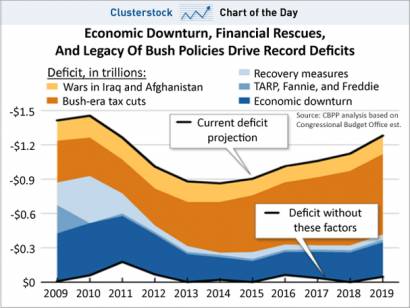
That dark orange stripe is the portion of the deficit attributable to the Bush tax cuts. That would be wiped out. Ending the tax cuts would basically solve the medium-term deficit problem.
The key factor here is that, just as Republicans got to frame the debate in 2001 by combining the tax cuts into an up or down vote, Democrats can frame the debate now by separating the policies Republicans pretend to care about from the ones they actually care about. Republicans want to have a vote on the whole collection of Bush-era tax cuts. Democrats shouldn’t give it to them. You hold a separate vote on the middle class portion and dare them to oppose it.
This seems to be the plan:
“The Senate will move first, and it will be a test to see whether Republicans filibuster” to block the bill in a bid to also win tax cuts for higher earners, said Rep. Chris Van Hollen of Maryland, head of the House Democrats’ re-election effort.
“If you can’t get it out of the Senate, then you take it to the election,” Mr. Van Hollen said in a recent interview. “You say to the American people that Republicans want to continue to hold middle-class tax relief hostage for an extension of tax breaks for [the well-to-do]. That will be the debate.”
Republicans have followed a strategy of opposing nearly everything the Democrats do. It’s worked very well. But the peculiar dynamic of this debate puts the Republicans in a position where they can’t win, and obstructing the Democrats is probably their worst move.
By: Jonathan Chait, Senior Editor, The New Republic-July 26, 2010
Share This Blog


 Unknown Feed
- An error has occurred; the feed is probably down. Try again later.


You must be logged in to post a comment.