We hear a lot of talk from politicians in Lansing about creating jobs and making education a top priority, but Michigan’s middle class families know talk is cheap.
Last year our elected officials cut more than $1 billion from our K-12 schools, community colleges and universities so they could provide a $1.7 billion tax cut for businesses. These cuts won’t reduce class size, they won’t address barriers to student success, and they won’t put people back to work.
Now a small group of anti-union politicians and corporate special interests like the Mackinac Center for Public Policy are trying to make Michigan a so-called right-to-work state.
Let’s be clear. This is nothing more than a blatant power grab that will weaken the middle class and won’t create jobs.
As Dr. Martin Luther King Jr. once said, “It is a law to rob us of our civil rights and job rights.”
A right-to-work law in Michigan would give even more profits to CEOs at the expense of our jobs, our retirement security and our kids’ future.
In states with right-to-work laws, employees earn an average of $1,500 less per year, have a lower standard of living and no job security. Currently, six of the 10 states with the highest unemployment rates in the nation have right-to-work laws on the books.
Of course, we all know this isn’t really about rebuilding Michigan’s economy. If it were, middle class families in states that have passed right-to-work laws would be better off, but that’s simply not the case.
In fact, in right-to-work states like Mississippi, Texas and Idaho, workers’ pensions were gutted. Thousands of workers who had been contributing to their pensions for decades were left with broken promises and no retirement security.
The politicians and corporate special interests who are pushing this unfair legislation know that unions are a check on corporate greed, and they are working overtime to silence the collective voice of our teachers, nurses and firefighters.
Corporate CEOs spent more than $1 billion to elect politicians who are willing to do their bidding and give them free rein over our economy.
If these attacks succeed in weakening unions, what will be left to check corporate power and fight outsourcing? CEOs will be able to rob workers of their voice, to lower wages and to ship even more jobs to China.
Gov. Rick Snyder has said he doesn’t want Michigan to become a right-to-work state, and I couldn’t agree more.
This issue is far too divisive, and will tear Michigan apart at a time when we should be focused on creating jobs and investing in public education to give our kids a better future.
When it comes to rebuilding our economy, talk is cheap. And since right-to-work is all about shortchanging workers, it’s clear this flawed proposal is wrong for Michigan.
By: David Hecker, Guest Columnist, Detroit Free Press, February 12, 2012
February 12, 2012
Posted by raemd95 |
Collective Bargaining, Union Busting | Anti-Union, Education, Jobs, Michigan, Middle Class, Politics, Rick Snyder, Right-to-work law |
Leave a comment
One of the more clear-cut triumphs of President Obama’s first three years has been the success of his auto-industry rescue. Republicans predicted it would fail miserably. They were wrong and the White House was right.
Bloomberg reported this week that auto plants are operating at a capacity unseen in a long while, adding shifts and creating jobs. The Detroit Free Press reported today that GM has reclaimed the crown of world’s largest automaker. And perhaps best of all, Michigan’s unemployment rate has also dropped to its lowest levels since September 2008, buoyed by the auto industry.
It led Jonathan Cohn to report today that while Michigan is still struggling to get on its feet, “recovery clearly seems to be underway” in the state, “most likely because the auto industry is growing again.”
President Obama and his allies will claim credit for this resurgence. They should — and not just for the obvious reasons.
The decision to rescue the Chrysler and General Motors in early 2009 was not popular: The only way to save the industry was to put up federal dollars, something presumptive Republican nominee Mitt Romney now says he opposed. And that was not what the public, already suffering from “bailout fatigue,” wanted to hear. But the rescue also provoked ambivalence in Michigan. The administration was serious about using the structured bankruptcy to reorganize the companies into leaner, more competitive firms. That meant layoffs and, over the long-term, significantly lower pay for unionized auto workers.
A lot can still go wrong, with the industry and with the economy…. But positive job growth in Michigan is clearly good news — not just for Obama and his allies but also, and more important, for the people of the Midwest.
Remember, dozens of prominent Republican officials, including most of the GOP lawmakers in the House and Senate, as well as the party’s leading presidential candidates, were absolutely certain the rescue would be a disaster. In the midst of an economic crisis, Republicans saw the American automotive industry — one of the central backbones of the nation’s manufacturing sector — teetering on the brink of collapse. The GOP was prepared to simply let it fail, forcing hundreds of thousands of workers into unemployment during an already-severe jobs crisis. Mitt Romney’s infamous phrase was, “Let Detroit go bankrupt.”
What’s more, Republicans were equally certain that Obama’s rescue plan was hopeless. It was a foregone conclusion, they said, since government intervention in the marketplace is always a disaster. Romney called the administration’s plan “tragic” at the time.
Except they were wrong — about literally every aspect of the debate.
By: Steve Benen, Contributing Writer, Washington Monthly Political Animal, January 19, 2012
January 20, 2012
Posted by raemd95 |
Auto Industry | Barack Obama, Economic Recovery, General Motors, Jobs, Michigan, Mitt Romney, Politics, Republicans |
Leave a comment
An “emergency manager” bill allowing a state-appointed executive to unilaterally fire city councils and school boards and cancel union contracts has drawn the ire of Michigan’s labor movement for months. Resistance to the measure, including rallies of a few thousand and a promising repeal effort, have united elements of the state’s labor movement.
The emergency manager law is just the beginning, however. Eighty-five bills now under consideration start from the view that Michigan’s economic problems are the fault of public employees and the poor, rather than driven by a merciless recession and the auto industry’s contraction.
While teachers relaxed over the summer, legislators attacked their tenure and seniority. School boards can now fire teachers for any reason during the first five years of employment. Districts have the power to fire tenured teachers for any reason, not only for “just cause.” Administrators also gained discretion over teacher layoffs and placement, based not on seniority but on “effectiveness.”
Another bill, introduced in October, would make dues checkoff illegal for teacher unions with more than 50,000 members, which means the Michigan Education Association.
MEA drew criticism from lawmakers in April for asking local affiliates whether enough support existed for a strike.
Public employees who use work email for union or political business are threatened with a thousand-dollar fine and a year in prison, under a bill moving through committees. Its author says the law would be enforced by workers reporting on each other.
A school privatization package would rescind the cap on charter schools. Another bill would take away domestic partner benefits for public employees, including those in union contracts.
Unions have staged several rallies, but look to Democrats to stem the tide.
The MEA issued a commercial and website titled “Stand up for kids, not CEOs,” that resembles a 2012 election ad. “It’s time we teach these Republican politicians a lesson,” declares the ad. Seven Democrats, however, voted for the provision facilitating teacher layoffs.
Attacks on workers and the poor go further than legislation. Michigan’s civil service has shrunk by 11,000 employees since 2001, and more devastating cuts to the social safety net are on the way.
Eleven thousand Michigan families will soon be cut off cash assistance, and a recent court ruling jeopardized heating subsidies for low-income households, just in time for winter.
A privatization effort in Grand Rapids has drawn scrutiny from veterans and public employee unions. Hundreds of workers at a state-run veterans’ home are being replaced by underpaid, undertrained contractors. Reports of incompetence and maltreatment are rolling in, and court hearings are scheduled.
Meanwhile, the emergency managers, appointed by the state to run cities and school districts operating in the red, continue to wreak havoc. In Ecorse, near Detroit, the manager forced 60 percent of firefighters to part-time schedules. They lost benefits and nearly half their pay with one day’s notice.
While two ambulances sat in the firehouse collecting dust, an emergency medical contractor took over.
Members of Firefighters Local 684 described an excruciating wait at the scene of a head injury, hearing the siren of the contractor’s ambulance as it searched up and down nearby streets for the location.
“They were holding the guy’s head together with a towel,” said President Scott Douglas. The contractor took more than 20 minutes to arrive. “I still don’t know if the guy made it.”
CIVIL RIGHTS LESSONS
There are signs of progress.
“We’re able to pull together in ways that we haven’t seen in a non-election year,” said Greg Bowens, AFSCME Council 25 spokesperson. Public employee unions entered joint negotiations with the state for the first time.
Community organizations and unions have come together to gather signatures for a fall 2012 referendum on repealing the emergency manager law.
Clergy in Detroit are organizing, too, holding three marches at the governor’s Detroit office ahead of October 1, when the new budget went into effect.
Pastor David Bullock of the Greater St. Matthew Baptist Church in Highland Park is pulling together an anti-poverty summit. Bullock intends to go beyond lobbying to bring lessons from the civil rights movement to the 21st century.
“We lost the point of protesting,” Bullock said. “It’s to disrupt power centers and to challenge them directly.”
By: Evan Rohar, Labor Notes, October 26, 2011
October 31, 2011
Posted by raemd95 |
Collective Bargaining, Conservatives | American Federation of State County and Municipal Employees, Emergency Manager Law, Michigan, Michigan Education Association, Public Employees, Teachers, Unions, Workers |
1 Comment
Gov. Rick Perry (R-TX), since he launched his presidential campaign on Saturday, has paraded around the stat that “since June of 2009, Texas is responsible for more than 40 percent of all of the new jobs created in America.” “Now think about that. We’re home to less than 10 percent of the population in America, but 40 percent of all the new jobs were created in that state,” Perry says.
This stat leaves out a lot of the story. The Federal Reserve Bank of Dallas has promoted the number, but “it acknowledges that the number comes out different depending on whether one compares Texas to all states or just to states that are adding jobs.” Between 2008 and 2010, jobs actually grew at a faster pace in Massachusetts than in Texas.
In fact, “Texas has done worse than the rest of the country since the peak of national unemployment in October 2009.” The unemployment rate in Texas has been steadily increasing throughout the recession, and went from 7.7 to 8.2 percent while the state was supposedly creating 40 percent of all the new jobs in the U.S.
How is this possible, since Texas has created over 126,000 jobs since the depths of the recession in February 2009? The fact of the matter is that looking purely at job creation misses a key point, namely that Texas has also experienced incredibly rapid population and labor force growth (due to a series of factors, including that Texas weathered the housing bubble reasonably well due to strict mortgage lending regulations). When this is taken into account, Texas’ job creation looks decidedly less impressive:
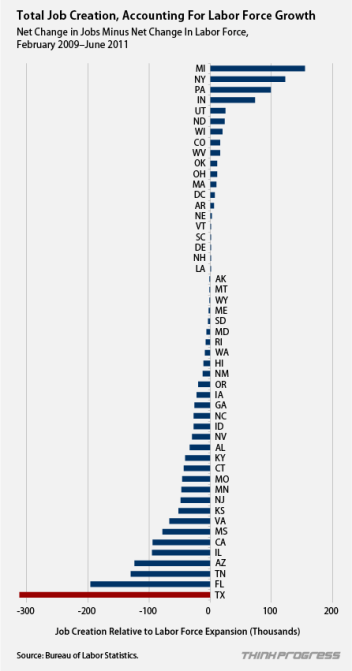
Clearly, there is no miracle for Texas here. While over 126,000 net jobs were created in Texas over the last two and a half years, the labor force expanded by over 437,000, meaning that overall Texas has added unemployed workers at a rate much faster than it has created jobs. And although states like Michigan have lost jobs (29,200 since February 2009), the state’s labor force has shrunk by over 185,000 since then. As a result, while there are fewer jobs, there are significantly less workers looking for them.
As Paul Krugman put it, “several factors underlie [Texas’] rapid population growth: a high birth rate, immigration from Mexico, and inward migration of Americans from other states, who are attracted to Texas by its warm weather and low cost of living, low housing costs in particular.” But they have little to do with Perry’s policies.
Now that certainly doesn’t make the situation in Michigan a good one, as contraction of the labor force is one side effect of the prolonged recession and unemployment there is still 10.6 percent. However if there is a real “miracle” here, it is North Dakota, which has seen over 27,000 new jobs and a labor force expansion of only 3,700, resulting in about 24,000 new jobs for workers who previously had none. But no one is proclaiming the “North Dakota miracle” and saying that Gov. Jack Dalrymple (R-ND) should be running for President.
By: Think Progress, August 17, 2011. Data for this post was compiled by Matt Separa, Research Assistant with the Economic Policy Team at the Center for American Progress Action Fund
August 18, 2011
Posted by raemd95 |
Class Warfare, Conservatives, Economic Recovery, Economy, GOP, Government, Governors, Ideologues, Ideology, Immigrants, Income Gap, Jobs, Labor, Middle Class, Politics, Republicans, Right Wing, States, Teaparty, Unemployed, Unemployment, Unions | Birth Rate, Federal Reserve Bank of Dallas, Gov Jack Dalrymple, Gov Rick Perry, Housing, Job Creation, Labor Force, Labor Force Growth, Massachusetts, Michigan, Migration, North Dakota, Population Growth, Recession, Texas, Workers |
Leave a comment
As we ponder whether Obama’s offering to cut Social Security represents a betrayal of Democratic values, whether it’s an as-of-yet-unexplored opening in yet another 11th-dimensional chess match, whether a decrease of an increase is really a cut or not or whether, in the words of Paul Krugman, the president is executing an “anti-Corleone” by making the Republicans an offer they can’t accept, Democratic values are being systematically destroyed. But the source of the destruction isn’t coming from Washington; instead, it is happening state by state.
The lion’s share of coverage has appropriately focused on the unrelenting extremism of Speaker Boehner’s House majority, but the gains Republicans made in our nation’s statehouses have been no less devastating. In 2010, the GOP made historic gains rivaled only by the wave in 1994. There are now 26 states where Republicans control both legislative chambers; Republicans also occupy the governor’s mansion in 21 of those, compared to 15 and 11 respectively for Democrats. Not coincidentally, 26 states enacted further restrictions on abortion rights. Some of them are particularly odious, such as Louisiana’s measure that would deny malpractice insurance coverage to doctors performing abortions, or a now-blocked law in Kansas that would impose a series of unnecessary licensing restrictions that would have resulted in the closure of two of the three clinics in the state.
At an economic level, the Republican legislators of Wisconsin, Ohio and Michigan are proceeding toward accomplishing at a state level longstanding objectives that they could never realistically accomplish at a federal one: specifically, achieving unilateral political disarmament by hamstringing a key funding source of Democratic campaign funding, or selling off public assets without any bidding process to whichever crony they deem appropriate. In Minnesota, Republicans regained control of the House of Representatives, and won control of the State Senate for the first time in history. The result? A government shutdown that is costing the state and its hardworking public employees just so the richest two percent of Minnesotans don’t have to contribute their fair share to help the state function.
Not that states with Republican-dominated legislatures are the only ones with problems. In California, Republicans dominate the budgetary aspects of the legislature despite having only about 35 percent of the seats in either chamber because of Proposition 13, the absurd rule that a two-thirds vote in each chamber must be required to raise revenues. Because it is as impossible to secure a sane legislative Republican in Sacramento as it is in Washington, California’s budget has been consigned for many years to be a series of ever-deeper cuts to the social safety net, public education, and the state park system.
This is a redistricting cycle, and the change in state lines could change some of these equations, but right now, the number of victories required to stop the damage, if not reverse it, is comparatively small. In California, a takeover of two seats in Assembly and Senate would be enough to prevent the Republican minority from continuing to hold the state hostage during every budget negotiation. In Wisconsin, a net gain of three Senate seats from the nine recall elections on Aug. 9 would stop Gov. Scott Walker from destroying Wisconsin any more than he already has. Retaking the lower chambers in Michigan and Ohio would be a slightly more difficult task, but no less achievable given previous history.
A child in an overcrowded classroom in Los Angeles. A Madison teacher fighting for her economic rights. A maintenance worker in Detroit. A scared, pregnant teenager in Orlando who will soon be required to notify her parents if she wants to exercise her rights. They are all being affected far more by what their state governments are trying to do to them, or cannot do for them, than by anything that Speaker Boehner has done since January.
This isn’t to say that retaking the House, re-electing Barack Obama and holding onto our Senate majority is not important. It most certainly is. But a Democratic Congress would not have stopped these state-level Republicans from attempting to enact their sweeping, destructive agenda. The only way to stop them is to raise enough money and awareness so as to defeat them and undo the massive damage that they have managed to accomplish in only six months of governance. Retaking the Wisconsin Senate on Aug. 9 will be a significant victory, but it must be viewed not as an endgame, but as an important first step in a much larger campaign.
By: Dante Atkins, Daily Kos, July 10, 2011
July 11, 2011
Posted by raemd95 |
Anti-Choice, Class Warfare, Conservatives, Democracy, Democrats, Economy, Elections, GOP, Gov Scott Walker, Government, Governors, Ideologues, Ideology, Lawmakers, Middle Class, Politics, Republicans, Right Wing, State Legislatures, States, Union Busting, Unions, Voters, Women, Womens Rights | Abortion Rights, California, Michigan, Minnesota, Ohio, Rep John Boehner, Wisconsin |
Leave a comment


 Unknown Feed
 mykeystrokes.com
You must be logged in to post a comment.