Rep. Paul Ryan-The Flimflam Man
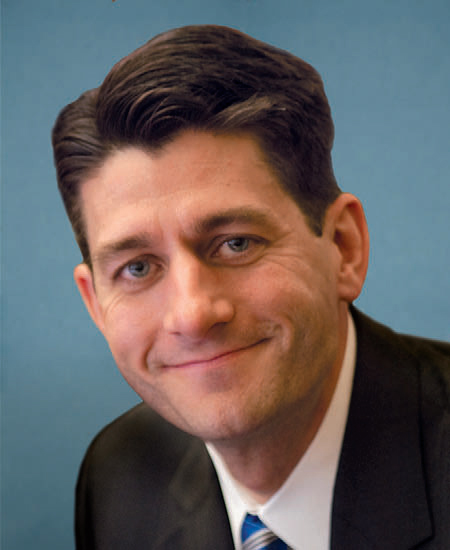
Rep. Paul Ryan
One depressing aspect of American politics is the susceptibility of the political and media establishment to charlatans. You might have thought, given past experience, that D.C. insiders would be on their guard against conservatives with grandiose plans. But no: as long as someone on the right claims to have bold new proposals, he’s hailed as an innovative thinker. And nobody checks his arithmetic.
Which brings me to the innovative thinker du jour: Representative Paul Ryan of Wisconsin.
Mr. Ryan has become the Republican Party’s poster child for new ideas thanks to his “Roadmap for America’s Future,” a plan for a major overhaul of federal spending and taxes. News media coverage has been overwhelmingly favorable; on Monday, The Washington Post put a glowing profile of Mr. Ryan on its front page, portraying him as the G.O.P.’s fiscal conscience. He’s often described with phrases like “intellectually audacious.”
But it’s the audacity of dopes. Mr. Ryan isn’t offering fresh food for thought; he’s serving up leftovers from the 1990s, drenched in flimflam sauce.
Mr. Ryan’s plan calls for steep cuts in both spending and taxes. He’d have you believe that the combined effect would be much lower budget deficits, and, according to that Washington Post report, he speaks about deficits “in apocalyptic terms.” And The Post also tells us that his plan would, indeed, sharply reduce the flow of red ink: “The Congressional Budget Office has estimated that Rep. Paul Ryan’s plan would cut the budget deficit in half by 2020.”
But the budget office has done no such thing. At Mr. Ryan’s request, it produced an estimate of the budget effects of his proposed spending cuts — period. It didn’t address the revenue losses from his tax cuts.
The nonpartisan Tax Policy Center has, however, stepped into the breach. Its numbers indicate that the Ryan plan would reduce revenue by almost $4 trillion over the next decade. If you add these revenue losses to the numbers The Post cites, you get a much larger deficit in 2020, roughly $1.3 trillion.
And that’s about the same as the budget office’s estimate of the 2020 deficit under the Obama administration’s plans. That is, Mr. Ryan may speak about the deficit in apocalyptic terms, but even if you believe that his proposed spending cuts are feasible — which you shouldn’t — the Roadmap wouldn’t reduce the deficit. All it would do is cut benefits for the middle class while slashing taxes on the rich.
And I do mean slash. The Tax Policy Center finds that the Ryan plan would cut taxes on the richest 1 percent of the population in half, giving them 117 percent of the plan’s total tax cuts. That’s not a misprint. Even as it slashed taxes at the top, the plan would raise taxes for 95 percent of the population.
Finally, let’s talk about those spending cuts. In its first decade, most of the alleged savings in the Ryan plan come from assuming zero dollar growth in domestic discretionary spending, which includes everything from energy policy to education to the court system. This would amount to a 25 percent cut once you adjust for inflation and population growth. How would such a severe cut be achieved? What specific programs would be slashed? Mr. Ryan doesn’t say.
After 2020, the main alleged saving would come from sharp cuts in Medicare, achieved by dismantling Medicare as we know it, and instead giving seniors vouchers and telling them to buy their own insurance. Does this sound familiar? It should. It’s the same plan Newt Gingrich tried to sell in 1995.
And we already know, from experience with the Medicare Advantage program, that a voucher system would have higher, not lower, costs than our current system. The only way the Ryan plan could save money would be by making those vouchers too small to pay for adequate coverage. Wealthy older Americans would be able to supplement their vouchers, and get the care they need; everyone else would be out in the cold.
In practice, that probably wouldn’t happen: older Americans would be outraged — and they vote. But this means that the supposed budget savings from the Ryan plan are a sham.
So why have so many in Washington, especially in the news media, been taken in by this flimflam? It’s not just inability to do the math, although that’s part of it. There’s also the unwillingness of self-styled centrists to face up to the realities of the modern Republican Party; they want to pretend, in the teeth of overwhelming evidence, that there are still people in the G.O.P. making sense. And last but not least, there’s deference to power — the G.O.P. is a resurgent political force, so one mustn’t point out that its intellectual heroes have no clothes.
But they don’t. The Ryan plan is a fraud that makes no useful contribution to the debate over America’s fiscal future.
By PAUL KRUGMAN-Op-Ed Columist and Nobel Prize Winner-Economics, The New York Times-Aug 5, 2010; Photo- Wikipedia
Republicans: A Party of Unemployment

Sen Orrin Hatch-"Drug test the unemployed"
From now until 2 November, the Republican party will be the party of unemployment. The logic is straightforward: the more people who are unemployed on election day, the better the prospects for Republicans in the fall election. They expect, with good cause, that voters will hold the Democrats responsible for the state of the economy. Therefore, anything that the Republicans can do to make the economy worse between now and then will help their election prospects.
While it may be bad taste to accuse a major national political party of deliberately wanting to throw people out of jobs, there is no other plausible explanation for the Republicans’ behaviour. They have balked at supporting nearly every bill that had any serious hope of creating or keeping jobs, most recently filibustering on bills that provided aid to state and local governments and extending unemployment benefits. The result of the Republicans’ actions, unless they are reversed quickly, is that hundreds of thousands more workers will be thrown out of work by the mid-terms.
The story is straightforward. Nearly every state and local government across the country is looking at large budget shortfalls for their 2011 fiscal years, most of which begin on 1 July 2010. Since they are generally required by state constitutions or local charters to balance their budgets, they will have no choice except to raise taxes and/or make large cutbacks and lay off workers to bring spending and revenue into line.
State and local governments have cut their workforce by an average of 65,000 a month over the last three months. Without substantial aid from the federal government, this pace is likely to accelerate. The Republican agenda in blocking aid to the states may add another 300,000 people to the unemployment rolls by early November.
The blocking of extended unemployment benefits promises similar dividends. As Paul Krugman rightly notes this week, unemployment benefits are not just about providing income support to those who are out of work, they also provide a boost to the economy. Since unemployed workers generally have little other than their benefits to support themselves, this is money that will almost immediately be spent. The benefits paid to workers are income to food stores and other retail outlets.
Unemployment insurance provides the sort of boost to demand that the economy desperately needs. That is why neutral parties such as the congressional budget office or economist Mark Zandi, a top adviser to John McCain’s presidential bid, always list unemployment benefits as one of the best forms of stimulus.
Republicans give two reasons for opposing benefits. First, they claim that benefits discourage people from working. Second, they object that the Democrats’ proposal will add to the national debt.
On the first point there is a considerable amount of economic research. Most indicates that in periods when the economy is operating near its capacity, more generous benefits may modestly increase the unemployment rate. However, they are less likely to have that effect now. The reason is simple: the economy does not have enough jobs. The latest data from the labour department shows that there are five unemployed workers for every job opening.
In this context, unemployment benefits may give some workers the option to remain unemployed longer to find a job that better fits their skills, but they are unlikely to affect the total number of unemployed. In other words, a $300 weekly unemployment cheque may allow an experienced teacher the luxury of looking for another teaching job, rather than being forced to grab a job at Wal-Mart.
However, if the teacher took the job at Wal-Mart, then this would simply displace a recent high-school graduate who has no other job opportunities. That might be a great turn of events in Republican-econ land, but it does not reduce the overall unemployment rate, nor does it benefit the overall economy in any obvious way.
The other argument the Republicans give is that these bills would add to the national debt. For example, the latest extension of unemployment benefits would have added $22bn to the debt by the end of 2011. This means that the debt would be $9,807,000,000 instead of $9,785,000,000 at the end of fiscal 2011, an increase of the debt-to-GDP ratio from 65.3% to 65.4%.
It is possible that Congressional Republicans, who were willing to vote for hundreds of billions of dollars of war expenditures without paying for them, or trillions of dollars of tax cuts without paying for them, are actually concerned about this sort of increase in the national debt. It is possible that this is true, but not very plausible.
The more likely explanation is that the Republicans want to block anything that can boost the economy and create jobs. Throwing people out of work may not be pretty, but politics was never pretty, and it is getting less so by the day.
Dean Baker is the co-director of the Center for Economic and Policy Research (CEPR). 2010 Guardian News and Media Limited. Published on Tuesday, July 6, 2010 by The Guardian/UK
Punishing the Jobless
Paul Krugman-Nobel Prize Winner in Economics
There was a time when everyone took it for granted that unemployment insurance, which normally terminates after 26 weeks, would be extended in times of persistent joblessness. It was, most people agreed, the decent thing to do.
But that was then. Today, American workers face the worst job market since the Great Depression, with five job seekers for every job opening, with the average spell of unemployment now at 35 weeks. Yet the Senate went home for the holiday weekend without extending benefits. How was that possible?
The answer is that we’re facing a coalition of the heartless, the clueless and the confused. Nothing can be done about the first group, and probably not much about the second. But maybe it’s possible to clear up some of the confusion.
By the heartless, I mean Republicans who have made the cynical calculation that blocking anything President Obama tries to do — including, or perhaps especially, anything that might alleviate the nation’s economic pain — improves their chances in the midterm elections. Don’t pretend to be shocked: you know they’re out there, and make up a large share of the G.O.P. caucus.
By the clueless I mean people like Sharron Angle, the Republican candidate for senator from Nevada, who has repeatedly insisted that the unemployed are deliberately choosing to stay jobless, so that they can keep collecting benefits. A sample remark: “You can make more money on unemployment than you can going down and getting one of those jobs that is an honest job but it doesn’t pay as much. We’ve put in so much entitlement into our government that we really have spoiled our citizenry.”
Now, I don’t have the impression that unemployed Americans are spoiled; desperate seems more like it. One doubts, however, that any amount of evidence could change Ms. Angle’s view of the world — and there are, unfortunately, a lot of people in our political class just like her.
But there are also, one hopes, at least a few political players who are honestly misinformed about what unemployment benefits do — who believe, for example, that Senator Jon Kyl, Republican of Arizona, was making sense when he declared that extending benefits would make unemployment worse, because “continuing to pay people unemployment compensation is a disincentive for them to seek new work.” So let’s talk about why that belief is dead wrong.
Do unemployment benefits reduce the incentive to seek work? Yes: workers receiving unemployment benefits aren’t quite as desperate as workers without benefits, and are likely to be slightly more choosy about accepting new jobs. The operative word here is “slightly”: recent economic research suggests that the effect of unemployment benefits on worker behavior is much weaker than was previously believed. Still, it’s a real effect when the economy is doing well.
But it’s an effect that is completely irrelevant to our current situation. When the economy is booming, and lack of sufficient willing workers is limiting growth, generous unemployment benefits may keep employment lower than it would have been otherwise. But as you may have noticed, right now the economy isn’t booming — again, there are five unemployed workers for every job opening. Cutting off benefits to the unemployed will make them even more desperate for work — but they can’t take jobs that aren’t there.
Wait: there’s more. One main reason there aren’t enough jobs right now is weak consumer demand. Helping the unemployed, by putting money in the pockets of people who badly need it, helps support consumer spending. That’s why the Congressional Budget Office rates aid to the unemployed as a highly cost-effective form of economic stimulus. And unlike, say, large infrastructure projects, aid to the unemployed creates jobs quickly — while allowing that aid to lapse, which is what is happening right now, is a recipe for even weaker job growth, not in the distant future but over the next few months.
But won’t extending unemployment benefits worsen the budget deficit? Yes, slightly — but as I and others have been arguing at length, penny-pinching in the midst of a severely depressed economy is no way to deal with our long-run budget problems. And penny-pinching at the expense of the unemployed is cruel as well as misguided.
So, is there any chance that these arguments will get through? Not, I fear, to Republicans: “It is difficult to get a man to understand something,” said Upton Sinclair, “when his salary” — or, in this case, his hope of retaking Congress — “depends upon his not understanding it.” But there are also centrist Democrats who have bought into the arguments against helping the unemployed. It’s up to them to step back, realize that they have been misled — and do the right thing by passing extended benefits.
By PAUL KRUGMAN-Published: July 4, 2010 NYT Op-ED
Photo:Fred R. Conrad/The New York Times
Narrowly Dodged Bullets: John Roberts’s Dissenting Opinions

Activism at it's best...and you're worried about Elena Kagan?
Yet Roberts’s 5-4 giveaways to corporate America only tell half the story. Indeed, Roberts has authored or joined numerous radical dissents that would give powerful corporate interests sweeping immunity from the law. This stands in stark contrast to his confirmation hearing promise to display “humility” and accept his own “modest role” as a justice.
- Immunity for drug companies: A dangerous drug was injected into the arm of a woman named Diana Levine in 2000, eventually costing her half her right arm and her career as a professional musician. A Vermont jury ordered the drug’s manufacturer to compensate Levine, but Roberts joined a dissent in Wyeth v. Levine that would have held drug companies largely immune from state law. Had this dissent prevailed, states would be powerless to protect women like Levine from drug defects or defective drug labels discovered after the Food and Drug Administration approves a drug for use.
- Protecting rogue banks: Roberts joined a dissent in a similar case, Cuomo v. Clearinghouse, arguing that federal regulators properly gave the banking industry broad immunity from state law—despite no legal basis for doing so. Had Roberts’s views carried just one more vote, state fair-lending laws and many other consumer banking protections would have effectively ceased to exist.
- Justice for sale: After A.T. Massey Coal Company—the same company whose negligent safety record led to the death of 29 miners in a recent explosion—lost a $50 million verdict, its CEO paid $3 million to elect a sympathetic justice to a state supreme court. This justice then cast the deciding vote overturning the verdict against Massey—a 1,667 percent return on the CEO’s investment. Roberts’s dissent in Caperton v. Massey said this bought-and-paid-for judge was under no obligation to recuse himself from Massey’s case.
- Deceptive marketing: Finally, Roberts voted to cut off deceptive advertising claims in Altria v. Good. In his eyes the tobacco industry should have extensive immunity from state laws preventing fraudulent marketing.
Roberts rarely finds himself in dissent since he leads a bloc of conservatives committed to protecting corporate interests. Nevertheless, his few dissenting opinions in corporate immunity cases reveal a willingness to aggrandize corporate power even more so than he already has in cases like Citizens United or Rent-a-Center.
Such zealous advocacy would be entirely appropriate were Roberts still an attorney for corporate interests. He gave up that role, however, when he became a judge. It’s time for him to live up to his promise to be modest and humble in his decision making.
By Ian Millhiser | June 28, 2010-Center For American Progress; Photo-SOURCE: AP/Nick Ut
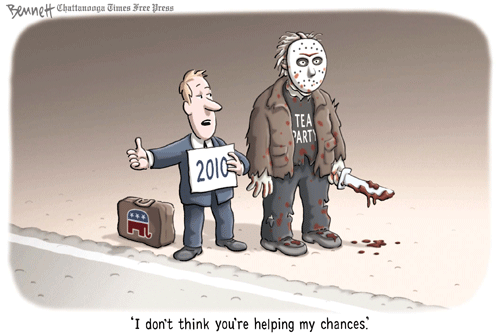
The Cleansing of the GOP

"Ditto" or the Highway: Republican Democracy
The purification process — hard-core and uncompromising partisans driving heretics from their ranks — has been going on for a long time. Saturday’s Republican convention in Utah, the one in which conservative Senator Robert Bennett was defeated for being not conservative enough (despite an 84 percent approval rating from the American Conservative Union), is just one more step in a decades-long effort to drive independent thought from the political decisionmaking process.
This year, of course, attention has been focused primarily on Marco Rubio’s success in driving Florida Governor Charlie Crist out of the Republican Party (he’s now running for the Senate as an Independent) and former Congressman Pat Toomey’s success in converting Republican Senator Arlen Specter into a Democrat. But in both of those cases one can argue that the targeted incumbent was simply too far out of step with his own party. The same ACU ratings index on which Bennett scored an 84 gave Specter a 40. The ratings only measure members of Congress but Crist had more than once angered party members with his support of initiatives that were fiercely opposed by most Republicans. But given Bennett’s long embrace of conservative positions, with relatively few departures from the party-line script over a period of nearly two decades, what happened in Utah was something of a very different and disturbing nature. It was checklist politics, a demand for suspension of judgment and lockstep adherence to an ideological instruction manual that would brook no deviation.
That is important in assessing what is happening in the political wars. When Jeff Bell, a member of the American Conservative Union’s board of directors, took on and defeated incumbent Republican Senator Clifford Case in a party primary in 1978, it was because Bell’s views were, in Republican terms, more mainstream than those of the liberal Case. It was not a matter of the extremes knocking off the middle but of a traditional conservative ousting a Republican who was, for all practical purposes, not a Republican at all. Similarly, two years later, Alfonse D’Amato knocked off incumbent Republican Senator Jacob Javits, another liberal, in a New York primary.
When Ned Lamont defeated incumbent Senator Joseph Lieberman in Connecticut’s Democratic Senate primary — after Lieberman had been his party’s vice presidential nominee — it was because one overriding issue — war — was of sufficient weight to overshadow the rest of Lieberman’s record and his Democratic credentials. War is a trump card; absent Lieberman’s support for the invasion of Iraq, it is unlikely that he would have been challenged by a fellow Democrat, much less be defeated, even though he had long been known for speaking his own mind (as witnessed by his forceful condemnation of Bill Clinton in the wake of the Lewinsky affair).
To be clear, Bennett’s defeat in Utah was not an unprecedented challenge of an incumbent who was just not as conservative as his opponent. Ronald Reagan almost defeated the generally conservative Gerald Ford in 1976 when Ford was seeking the Republican nomination to succeed himself in the White House. But for the most part, parties have been willing to allow some departure from the party line if a legislator’s overall record has been sufficiently on key.
Signs that this is changing were seen recently within the governing ranks of the GOP, with local party leaders attempting to force National Chairman Michael Steele to adopt a “purity” test to determine which Republican candidates would receive the party’s financial support. Steele refused to go along but it is the same sentiment that has now ended Robert Bennett’s Senate career.
When the voters send a man or woman to write the laws, in Washington or a state capitol, that legislator is obligated to weigh seriously the views of his or her constituents, to examine thoroughly the important issues of the day and the proposals to deal with them, and to consult the relevant constitution (federal or state) and then act accordingly. Increasingly, the last two items on that list — intelligent assessment and constitutional constraint — are being driven from the process. One is expected to listen — and to obey — the preferences, indeed the demands, not of “constituents” but of that small band of constituents who dominate party primaries and party conventions.
Ironically, those who demand such mindless conformity cry out a demand for adherence to the Constitution, even as they undermine the most important principles of rational constitutional self-government.
Original post by Mickey Edwards-The Cleansing: The Atlantic-May 10, 2010
Share This Blog


 Unknown Feed
- An error has occurred; the feed is probably down. Try again later.


You must be logged in to post a comment.