Health Care and Freedom

Rep Marsha Blackburn, (R-TN) argues that health reform will make Americans "less free".
“Today is the death of freedom as a cause for celebration,” Rep. Marsha Blackburn just said as she opened the House Republicans’ argument against the health-care bill. Her stem-winder was quick and clean. This bill, she argued, will make Americas less free.
There is a tendency to think this sort of inane hyperbole an innovation of our polarized age. But it isn’t. When Medicare was being considered, the American Medical Association hired Ronald Reagan to record a record housewives could play for their friends. It was called Operation: Coffee Cup, and you can read the text here.
Reagan was a more graceful speaker than Blackburn, but his point was much the same. Kill the bill. “If you don’t do this and if I don’t do it,” he said, “one of these days you and I are going to spend our sunset years telling our children and our children’s children, what it once was like in America when men were free.”
Well, the bill passed. And moments ago, Rep. Paul Ryan was on the floor of the House, bellowing against Democrats who would dare propose “across-the-board cuts to Medicare.” This is breathless opportunism from Ryan — he has proposed far deeper across-the-board cuts to Medicare, and is making arguments against the Democrats’ bill that would be far more potent and accurate if aimed at his own — but leave that aside for a moment. The GOP’s embrace of the program that Ronald Reagan fought, and that Newt Gingrich sought to let “whither on the vine,” is based on the lived experience seniors have had with the bill: It has made them more, rather than less, free.
Blackburn’s introduction aside, people do not “celebrate” the freedom to not be able to afford lifesaving medical care. They don’t want the freedom to weigh whether to pay rent or take their feverish child to the emergency room. They don’t like the freedom to lose their job and then be told by insurers that they’re ineligible for coverage because they were born with a heart arrhythmia.
When faced with the passage of programs that would deliver people from these awful circumstances, the Republicans adopt a very narrow and cruel definition of the word “freedom.” But when faced with the existence of programs like Medicare, and the recognition that their constituents depend on those programs to live lives free of unnecessary fear and illness, they abandon their earlier beliefs, forget their dire warnings and, when convenient, defend these government protections aggressively. There’s nothing much to be done about that. It is, after all, a free country. But Americans should feel free to ignore these discredited hysterics.
By: Ezra Klein-Washington Post | March 21, 2010; 3:02 PM ET
Vital Center: Why are Democrats Fighting for a Republican Health Plan?
Here is the ultimate paradox of the Great Health Care Showdown: Congress will divide along partisan lines to pass a Republican version of health-care reform, and Republicans will vote against it. Yes, Democrats have rallied behind a bill that large numbers of Republicans should love. It is built on a series of principles that Republicans espoused for years.
Republicans have said that they do not want to destroy the private insurance market. This bill not only preserves that market but strengthens it by bringing millions of new customers. The plan before Congress does not call for a government “takeover” of health care. It provides subsidies so more people can buy private insurance.
Republicans always say that they are against “socialized medicine.” Not only is this bill nothing like a “single-payer” health system along Canadian or British lines, but it doesn’t even include the “public option” that would have allowed people voluntarily to buy their insurance from the government. The single-payer idea fell by the wayside long ago, and supporters of the public option—sadly, from my point of view—lost out in December.
They’ll be back, of course. The newly pragmatic Rep. Dennis Kucinich (D-Ohio) was right to say that this is just the first step in a long process. We will see if this market-based system works. If it doesn’t, single-payer plans and public options will look more attractive.
Republican reform advocates have long called for a better insurance market. Our current system provides individuals with little market power in the purchase of health insurance. As a result, they typically pay exorbitant premiums. The new insurance exchanges will pool individuals together and give them a fighting chance at a fair shake.
Republicans now say that they hate the mandate that requires everyone to buy insurance. But an individual mandate was hailed as a form of “personal responsibility” by no less a conservative Republican than Mitt Romney. He was proud of the mandate and proud of the insurance exchange idea, known in Massachusetts as “The Health Connector” (the idea itself came from the conservative Heritage Foundation).
What does it tell us that Republicans are now opposing a bill rooted in so many of their own principles? Why has it fallen to Democrats to push the thing through? The obvious lesson is that the balance of opinion in the Republican Party has swung far to the right of where it used to be. Republicans once believed in market-based government solutions. Now they are suspicious of government solutions altogether. That’s true even in an area such as health care, where government, through Medicare and Medicaid, already plays a necessarily large role.
As for the Democrats, they have been both pragmatic and moderate, despite all the claims that this plan is “left wing” or “socialist.” It is neither. You could argue that Democrats have learned from Republicans. Some might say that Democrats have been less than true to their principles.
But there is a simpler conclusion: Democrats, including President Obama, are so anxious to get everyone health insurance that they are more than willing to try a market-based system and hope it works. It’s a shame the Republicans can no longer take “yes” for an answer.
By: E.J. Dionne, Jr. -author of the recently published Souled Out: Reclaiming Faith and Politics After the Religious Right. He is a Washington Post columnist, a senior fellow at the Brookings Institution, and a professor at Georgetown University. March 20, 2010, The New Republic
For the GOP, Fear is Always the Answer in Thwarting Health Care Reform
With the Congressional Budget Office’s report out, detailing that health care reform will trim the deficit over the next 10 years by $138 billion, Republican resistance to this bill has gone from annoying to downright illogical, and I mean birther-style illogical. It is no longer about cost or policy issues, it is simply an obvious attempt to kill this presidency and damn the citizens in the process.
The Congressional Budget Office’s methods or neutrality on issues have never been questioned until now. It seems that now because reality doesn’t coincide with the Republicans desire to block health care reform, the CBO is playing a shell game.
“Only in Washington, D.C. can people announce they are spending a trillion dollars and reducing the national deficit,” said Mike Pence., R-Indiana, on The Dylan Ratigan show. “The American people know this is growing the government. It’s only going to increase the deficit, increase the debt…This massive government plan, with the CBO report withstanding, is not fooling anyone.”
Then, on the conservative Web site, Redstate.com: “The natural reaction by most Americans to the unofficial and preliminary claim that the $2.5 trillion ObamaCare bill is revenue-neutral is, well, B.S. (There is a card game with the same name.) The second natural reaction is the realization that ObamaCare must cut the guts out of Medicare and raise taxes through the roof.”
What is even more strange and really disappointing is that this “non-logic” appears to be working. Even with the CBO report, Americans are evenly divided on health care reform. Even with the proof that it will reduce, not add to the deficit, recent polling indicates only a slight improvement for passage of the bill. Why? Fear.
These are uncertain times. Jobs are disappearing. The banks are doubling down on fees while demanding more in terms of credit, down payments and collateral. The American Automotive industry is effectively existing only through taxpayer subsidies. Even Toyota—who not so long ago was considered “the standard” in the industry—appears to maybe knowingly have put its customers at risk to save a few bucks.
FOX News has been on a mission for the last year to discredit and derail this administration by misinforming and enraging its viewers. America is at a tipping point. Within the next decade, Caucasians will no longer be the majority. In the next decade, Blacks will no longer be the largest minority in this country. Within the next decade, America loses its prominence as the wealthiest nation to China. In the last 10 years, we have endured terrorism. We are currently engaged in two wars and still in the middle of the most debilitating recession in more than 20 years. These are uncertain times and Americans are fearful.
Past efforts to overhaul the nation’s health care system looked different. The process to reaching the legislation was different. The folks supporting it were different. The folks opposing reform were different. The one common denominator in this effort and every past effort: Fear.
“It’s really a case of deja vu,” Jonathan Oberlander, a political scientist at the University of North Carolina at Chapel Hill said. “You hear in today’s debate echoes of the past that extend all the way to the early part of the 20th century. And I think the reason that people use fear again and again is that it’s effective. It’s worked to stop health reform in the past. And so they’re going to try and use it in the present.”
The very first time in 1915 when America attempted to change its health care system, it was defeated by tying those attempts to our greatest international treat of the time: The German Empire.
Fear was used again in the next effort of the late 1940s. This time the American Medical Association told citizens if the nation adopted national health insurance, the Red army would be marching up and down the streets. Then even later when former President Bill Clinton tried passing health care reform, the health care industry was firmly in place. Their lobbying influence in Congress was apparent and their might in terms of influencing public opinion by flooding the television with misleading advertisements was informidable. Remember Harry and Louise?
This time around it’s the same. They’ve gone back to the well of fear with the death panels claim, fear of big government, fear of socialism, fear of rationing. Then they targeted the politicians themselves, with the fear of losing their next election. Today, the GOP upped the ante of this fear campaign, by telling Democrats that if they vote for reform, and lose their next election, he will personally block them from future governmental appointments. Once again, the obstacle to change is fear.
Fear is something you cannot reason with. You cannot refute. You cannot combat. It’s this primal instinct that, once aroused, simply takes over your brain, rendering you incapable of either reason or logic. A lot of people are pointing to the points where health care reform falls short. Others are pointing to how the president has come up short in terms of selling reform to America and Congress.
Me? I’m just wondering if this will finally be the year that fear no longer works.
By: Devona Walker- TheLoop21.com’s senior financial/political reporter and blogger-March 19, 2010
Discrediting the Legislative Process Itself
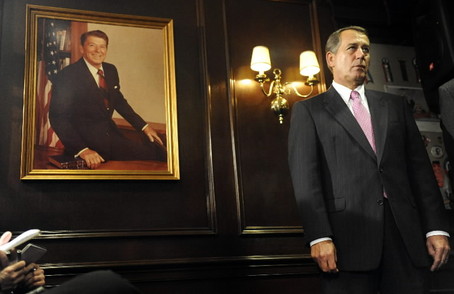
John Boehner-House Minority Leader of "No"
So far in the health-care debate, Republicans have attacked the legitimacy of private negotiations, parochial dealmaking, the budget reconciliation process, self-executing rules, the Congressional Budget Office’s analyses, and even the constitutionality of the legislation. It’s a good theory: Make people hate Washington and mistrust the legislative process and you’ll make people hate and mistrust what emerges from that process.
But it’s also dangerous. As Republicans well know, private negotiations between lawmakers, deals that advantage a state or a district, and a base level of respect for the CBO’s scores have long been central to the lawmaking progress. As the parties have polarized, reconciliation and self-executing rules (like deem and pass) have become more common — and the GOP’s own record, which includes dozens of reconciliation bills and self-executing rules, proves it.
The GOP’s answer to this is that health-care reform is important. Stopping the bill is worth pulling out all the stops. And I’m actually quite sympathetic to this view. Outcomes are, in fact, more important than process. But once you’ve taken the stops out, it’s hard to put them back in. Democrats will launch the very same attacks when they’re consigned to the minority, and maybe think up a few new ones of their own.
The result of this constant assault on how a bill becomes a law — a process that has never before been subject to such 24/7 scrutiny from cable news and blogs and talk radio — will be ever more public cynicism. Evan Bayh put it well in his New York Times op-ed. “Power is constantly sought through the use of means which render its effective use, once acquired, impossible,” he wrote. Republicans, who’re likely to return to power with a majority that’s well below 60 seats in the Senate and a 40-vote margin in the House, will soon find themselves on the wrong end of that calculus.
Photo credit: Melina Mara/Washington Post.
By Ezra Klein | March 19, 2010
The GOP’s Astonishing Hypocrisy on Health Care and ‘reconciliation’
For those who feared that Barack Obama did not have any Lyndon Johnson in him, the president’s determination to press ahead and get health-care reform done in the face of Republican intransigence came as something of a relief.
Obama’s critics have regularly accused him of not being as tough or wily or forceful as LBJ was in pushing through civil rights and the social programs of his Great Society. Obama seemed willing to let Congress go its own way and was so anxious to look bipartisan that he wouldn’t even take his own side in arguments with Republicans.
Those days are over. On Wednesday, the president made clear what he wants in a health care bill, and he urged Congress to pass it by the most expeditious means available.
He was also clear on what bipartisanship should mean — and what it can’t mean. Democrats, who happen to be in the majority, have already added Republican ideas to their proposals. Obama said he was open to four more that came up during the health-care summit.
What he’s unwilling to do, and rightly, is to give the minority veto power over a bill that has deliberately and painfully worked its way through the regular legislative process.
Republicans, however, don’t want to talk much about the substance of health care. They want to discuss process, turn “reconciliation” into a four-letter word, and maintain that Democrats are just “ramming through” a health bill.
It is all, I am sorry to say, one big lie — or, if you’re sensitive, an astonishing exercise in hypocrisy.
All of the Republican claims were helpfully gathered in one place by Sen. Orrin Hatch, R-Utah, in an op-ed in Tuesday’s Washington Post. Right off, the piece was wrong on a core fact. Hatch accused the Democrats of trying to, yes, “ram through the Senate a multitrillion-dollar health-care bill.”
No. The health-care bill passed the Senate last December with 60 votes under the normal process. The only thing that would pass under a simple majority vote would be a series of amendments that fit comfortably under the “reconciliation” rules established to deal with money issues.
Near the very end of his article, Hatch concedes that reconciliation would be used for “only parts” of the bill. But then why didn’t he say that in the first place?
Hatch grandly cites “America’s Founders” as wanting the Senate to be about “deliberation.” But the Founders said nothing in the Constitution about the filibuster, let alone “reconciliation.” Judging from what they put in the actual document, the Founders would be appalled at the idea that every major bill should need the votes of three-fifths of the Senate to pass.
Hatch quotes Sens. Robert Byrd and Kent Conrad, both Democrats, as opposing the use of reconciliation on health care. What he doesn’t say is that Byrd’s comment from a year ago was about passing the entire bill under reconciliation, which no one is proposing to do. As for Conrad, he made clear to The Washington Post’s Ezra Klein this week that it’s perfectly appropriate to use reconciliation “to improve or perfect the package,” which is exactly what Obama is suggesting.
Hatch said that reconciliation should not be used for “substantive legislation” unless the legislation has “significant bipartisan support.”
But surely the 2001 and 2003 Bush tax cuts, which were passed under reconciliation and increased the deficit by $1.7 trillion during his presidency, were “substantive legislation.” The 2003 dividends tax cut could muster only 50 votes. Vice President Dick Cheney had to break the tie. Talk about “ramming through.”
The underlying “principle” here seems to be that it’s fine to pass tax cuts for the wealthy on narrow votes but an outrage to use reconciliation to help middle-income and poor people get health insurance.
I’m disappointed in Hatch, co-sponsor of two of my favorite bills in recent years. One created the State Children’s Health Insurance Program. The other, signed last year by Obama, broadly expanded service opportunities. Hatch worked on both with his dear friend, the late Edward M. Kennedy, after whom the service bill was named.
It was Kennedy, you’ll recall, who insisted that health care was “a fundamental right and not a privilege.” That’s why it’s not just legitimate to use reconciliation to complete the work on health reform. It would be immoral to do otherwise and thereby let a phony argument about process get in the way of health coverage for 30 million Americans.
E. J. Dionne, Jr-Syndicated Columnist-March 4, 2010
Share This Blog


 Unknown Feed
- An error has occurred; the feed is probably down. Try again later.


You must be logged in to post a comment.