Tax-Cut Deal: If It’s Good for Regular Americans, Isn’t That Good Enough for Now?
“Absolute disaster.” “Legislative blackmail.” “Almost moral corruptness.” We get it. Democrats in Congress really, really don’t like President Obama’s tax deal with the Republicans. But is it truly as apocalyptically bad as all that?
— Oh yeah, the rich. They’re getting a 35 percent inheritance tax and an exemption for individual estates under $5 million (Obama and Democrats say both are too generous), and — the part that makes Democrats question their reason for being — the lower Bush-era rates on income above $250,000.
When Democrats finally brought their tax cut package to the floor a few days ago, the Senate couldn’t overcome a filibuster threat. Time was running out. Obama said his top priority is to make sure 2 million long-term unemployed don’t lose their lifelines and “tens of millions of hardworking Americans are not seeing their paychecks shrink on January 1st just because the folks here in Washington are busy trying to score political points.” The agreement gives Washington time to have the political argument over taxes, he said, without doing harm to individuals or the economy as a whole.
Some liberal interest groups have pounced on Obama and branded the deal a complete sellout. “If Obama’s theory is that Independent voters will flock to presidential weakness, mission accomplished,” wrote Adam Green, head of the Progressive Change Campaign Committee. His evidence: An Associated Press dispatch Monday headlined “Republicans achieve top goal in Obama tax-cut plan.” Republicans “largely dictated the terms” of the compromise though they don’t control the House, Senate or White House, the AP said.
Never mind that Republicans would have preferred a permanent extension of the high-end tax cuts instead of the two years they got. Or that they agreed to extend unemployment benefits for an unprecedented 13 months, a $56-billion expense, and did not secure spending cuts to offset the cost. Their insistence on such an offset — even as they said there was no need to offset the 10-year, $700 billion cost of the high-end tax cuts — has repeatedly held up attempts to extend the benefits, including twice since Nov. 30.
By Tuesday, the AP had its economic team on the case. New headline: “Tax deal should help economy, analysts say.” Bill Scher of the very liberal Campaign for America’s Future implored Democrats to “do the deal. For the Jobless. For the Economy.” The liberal Center for American Progress (CAP) said the plan could save or create 2.2 million jobs. The group’s ThinkProgress blog says Obama’s priorities get far more money in the deal and help 32 times as many people as the GOP’s priorities.
Fear and Favor-A note to Tea Party activists: This is not the movie you think it is.
A note to Tea Party activists: This is not the movie you think it is. You probably imagine that you’re starring in “The Birth of a Nation,” but you’re actually just extras in a remake of “Citizen Kane.”True, there have been some changes in the plot. In the original, Kane tried to buy high political office for himself. In the new version, he just puts politicians on his payroll.
I mean that literally. As Politico recently pointed out, every major contender for the 2012 Republican presidential nomination who isn’t currently holding office and isn’t named Mitt Romney is now a paid contributor to Fox News. Now, media moguls have often promoted the careers and campaigns of politicians they believe will serve their interests. But directly cutting checks to political favorites takes it to a whole new level of blatancy.
Arguably, this shouldn’t be surprising. Modern American conservatism is, in large part, a movement shaped by billionaires and their bank accounts, and assured paychecks for the ideologically loyal are an important part of the system. Scientists willing to deny the existence of man-made climate change, economists willing to declare that tax cuts for the rich are essential to growth, strategic thinkers willing to provide rationales for wars of choice, lawyers willing to provide defenses of torture, all can count on support from a network of organizations that may seem independent on the surface but are largely financed by a handful of ultrawealthy families.
And these organizations have long provided havens for conservative political figures not currently in office. Thus when Senator Rick Santorum was defeated in 2006, he got a new job as head of the America’s Enemies program at the Ethics and Public Policy Center, a think tank that has received funding from the usual sources: the Koch brothers, the Coors family, and so on.
Now Mr. Santorum is one of those paid Fox contributors contemplating a presidential run. What’s the difference?
Well, for one thing, Fox News seems to have decided that it no longer needs to maintain even the pretense of being nonpartisan.
Nobody who was paying attention has ever doubted that Fox is, in reality, a part of the Republican political machine; but the network — with its Orwellian slogan, “fair and balanced” — has always denied the obvious. Officially, it still does. But by hiring those G.O.P. candidates, while at the same time making million-dollar contributions to the Republican Governors Association and the rabidly anti-Obama United States Chamber of Commerce, Rupert Murdoch’s News Corporation, which owns Fox, is signaling that it no longer feels the need to make any effort to keep up appearances.
Something else has changed, too: increasingly, Fox News has gone from merely supporting Republican candidates to anointing them. Christine O’Donnell, the upset winner of the G.O.P. Senate primary in Delaware, is often described as the Tea Party candidate, but given the publicity the network gave her, she could equally well be described as the Fox News candidate. Anyway, there’s not much difference: the Tea Party movement owes much of its rise to enthusiastic Fox coverage.
As the Republican political analyst David Frum put it, “Republicans originally thought that Fox worked for us, and now we are discovering we work for Fox” — literally, in the case of all those non-Mitt-Romney presidential hopefuls. It was days later, by the way, that Mr. Frum was fired by the American Enterprise Institute. Conservatives criticize Fox at their peril.
So the Ministry of Propaganda has, in effect, seized control of the Politburo. What are the implications?
Perhaps the most important thing to realize is that when billionaires put their might behind “grass roots” right-wing action, it’s not just about ideology: it’s also about business. What the Koch brothers have bought with their huge political outlays is, above all, freedom to pollute. What Mr. Murdoch is acquiring with his expanded political role is the kind of influence that lets his media empire make its own rules.
Thus in Britain, a reporter at one of Mr. Murdoch’s papers, News of the World, was caught hacking into the voice mail of prominent citizens, including members of the royal family. But Scotland Yard showed little interest in getting to the bottom of the story. Now the editor who ran the paper when the hacking was taking place is chief of communications for the Conservative government — and that government is talking about slashing the budget of the BBC, which competes with the News Corporation.
So think of those paychecks to Sarah Palin and others as smart investments. After all, if you’re a media mogul, it’s always good to have friends in high places. And the most reliable friends are the ones who know they owe it all to you.
By PAUL KRUGMAN: New York Times Op-Ed Columnist, Oct. 3, 2010
Is The Tea Party Just a Big Scam?

E. J. Dionne
Is the tea party one of the most successful scams in American political history?
Before you dismiss the question, note that word “successful.” Judge the tea party purely on the grounds of effectiveness and you have to admire how a very small group has shaken American political life and seized the microphone offered by the media, including the so-called liberal media.
But it’s equally important to recognize that the tea party constitutes a sliver of opinion on the extreme end of politics receiving attention out of all proportion with its numbers.
Yes, there is a lot of discontent in America. But that discontent is better represented by the moderate voters who expressed quiet disillusionment to President Obama at the CNBC town hall meeting on Monday than by tea party ideologues who proclaim the unconstitutionality of the New Deal and everything since.
The tea party drowns out such voices because it has money—some of it from un-populist corporate sources, as Jane Mayer documented last month in The New Yorker—and has used modest numbers strategically in small states to magnify its impact.
Just recently, tea party victories in Alaska and Delaware Senate primaries shook the nation. In Delaware, Christine O’Donnell received 30,563 votes in the Republican primary, 3,542 votes more than moderate Rep. Mike Castle. In Alaska, Joe Miller won 55,878 votes for a margin of 2,006 over incumbent Sen. Lisa Murkowski, who is now running as a write-in candidate.
Do the math. For weeks now, our national political conversation has been driven by 86,441 voters and a margin of 5,548 votes. A bit of perspective: When John McCain lost in 2008, he received 59.9 million votes.
Earlier this year, much was made of the defeat of Sen. Bob Bennett, a Utah conservative insufficiently conservative for the tea party. Bennett lost not in a primary but at a Republican convention attended by all of 3,500 delegates.
Even in larger states, the tea party’s triumphs were built on small shares of the electorate. Rand Paul received 206,986 votes in Kentucky where there are more than 1 million registered Republicans and nearly 2.9 million registered voters. Sharron Angle won with 70,452 votes in Nevada, a state with more than 1 million registered voters.
The media have given substantial coverage to tea party rallies and even small demonstrations. But how many people are actually involved in this movement?
Last April, a New York Times/CBS News poll found that 18 percent of Americans identified themselves as supporters of the tea party movement, but slightly less than a fifth of these sympathizers said they had actually attended a tea party rally or meeting. That means just over 3 percent of Americans can be characterized as tea party activists. A more recent poll by Democracy Corps, just before Labor Day, found that 6 percent of voters said they had attended a tea party rally or meeting.
The tea party is not the only small group in history to wield more power than you’d expect from its numbers. In 2008, Barack Obama did very well in party caucuses, which draw many fewer voters than primaries. And it was Lenin who offered the classic definition of a vanguard party as involving “people who make revolutionary activity their profession” in organizations that “must perforce not be very extensive.”
But something is haywire in our media and our politics. Jill Lepore, a Harvard historian whose new book is “The Whites of Their Eyes: The Tea Party’s Revolution and the Battle Over American History,” observed in an interview that there is a “hall of mirrors” effect created by the rise of “niche” opinion media. They magnify small movements into powerhouses while old-fashioned journalism, which is supposed to put such movements in perspective, reacts to the same niche incentives.
There is also the decline of alternative forces in politics. The Republican establishment, such as it is, has long depended far more on big money than on troops in the field. In search of new battalions, GOP leaders stoked the tea party, stood largely mute in the face of its more outrageous untruths about Obama—and now has to defend candidates like O’Donnell and Angle.
And where are the progressives? Sulking is not an alternative to organizing, and weary resignation is the first step toward capitulation. The tea party may be pulling a fast one on the country and the media. But if it has more audacity than everyone else, it will, I am sorry to say, deserve to get away with it.
E.J. Dionne, Jr. is is a Washington Post columnist, a senior fellow at the Brookings Institution, and a professor at Georgetown University. He is the author of, most recently, Souled Out: Reclaiming Faith and Politics After the Religious Right. Original Post: The New Republic, September 23, 2010.
The Tea Party’s Big Money
"Establishment Republicans"
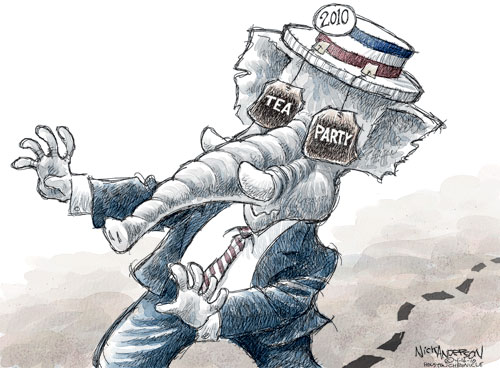
Tea Party supporters and their candidates like to imagine themselves as insurgents, crashing the barricades of Washington to establish a new order of clean and frugal government. In earthbound reality, many of the people pulling the Tea Party’s strings are establishment Republican operatives and lobbyists. Some have made money off the party for years.
One example is Sal Russo, a gun-for-hire who has worked for former President Ronald Reagan, former Gov. George Deukmejian of California, former Gov. Christine Todd Whitman of New Jersey, former Gov. George Pataki of New York, and many other Republicans. As The Times reported on Sunday, Mr. Russo saw a sure thing last year, establishing a group called the Tea Party Express to support candidates in the midterm elections and raise cash at the same time.
The group has spent nearly $1 million in an effort to replace Harry Reid of Nevada, the Democratic Senate leader. It spent nearly $350,000 to elect Senator Scott Brown of Massachusetts. It is pouring money into Alaska to support Joe Miller’s Senate bid. And it has spent $250,000 in Delaware on behalf of Christine O’Donnell, now the Republican nominee for the United States Senate. Mr. Russo held a fund-raiser for Ms. O’Donnell and organized a rally.
In all, Mr. Russo and his group have raised $5.2 million and are the biggest independent supporters of Tea Party candidates. Of that, $3 million to buy advertising went to his political consulting firm or one controlled by his wife. Of course, he takes a substantial cut of each buy.
Dick Armey, the former House Republican leader, considers himself a godfather of the Tea Party and is co-author of the book, “Give Us Liberty: a Tea Party Manifesto.” Writing in The Wall Street Journal, he called for a “hostile takeover” of the Republican Party, which sounds so very revolutionary until one remembers that he helped lead that party for many years, guiding its policies and raising its money. When he left office in 2003, he cashed in on his connections to become a very high-paid lobbyist at DLA Piper, one of Washington’s biggest law firms, which has clients that include health-care companies, energy producers and foreign governments.
Then there is Carl Paladino, the Tea Party-backed Republican nominee for governor of New York. His bloodcurdling denunciations of Albany never seem to mention that he is one of the biggest landlords of state agencies, owning properties with $85 million in taxpayer leases in Buffalo alone that provide him with income of more than $5 million a year. He is the biggest property owner in Buffalo, and much of his empire has been constructed with state development incentives and tax breaks. An adviser is Roger Stone, an operator for Republicans since Richard Nixon’s re-election campaign.
There are undoubtedly thousands of Tea Partiers who would love to purge Washington of well-connected lobbyists, high-priced political consultants and others who take millions of taxpayer dollars while condemning the lawmakers who spend it. They should take a long look at the leaders and candidates who are driving their movement and decide whether purging begins at home.
New York Times-Editorial: Published Sept. 23, 2010
Tea Bags, Wind Bags, and Moneybags

Born Again Baggers?: Joe Wilson, Jim DeMint, Rick Scott, Sharon Angle (clockwise from top left)
So let’s say you’re a Republican politician who’s been working the far right side of the political highway for years, getting little national attention other than the occasional shout-out in Human Events. Or let’s say you’re a sketchy business buccaneer with a few million smackers burning a hole in your pocket, and you’ve decided that you’d like to live in the governor’s mansion for a while, but you can’t get the local GOP to see you as anything more than a walking checkbook who funds other people’s dreams.
What do you do? That’s easy: Get yourself in front of the loudest parade in town by becoming a Tea Party Activist!
There has been incessant discussion over the last year about the size, character, and intentions of the Tea Party rank-and-file. But, by and large, the political discussion has passed over another defining phenomenon: The beatific capacity of Tea Party membership, which enables virtually anyone with ambition to whitewash his hackishness—and transform from a has-been or huckster into an idealist on a crusade.
After all, to become a “Tea Party favorite” or a “Tea Party loyalist,” all a politician has to do is say that he or she is one—and maybe grab an endorsement from one of many hundreds of local groups around the country. It’s even possible to become indentified as the “Tea Party” candidate simply by entering a primary against a Republican who voted for TARP, the Medicare Prescription Drug bill, or No Child Left Behind. It’s not like there’s much upside to distancing oneself from the movement. Most Republican pols are as friendly as can be to the Tea Party; and it’s a rare, self-destructive elephant who would emulate Lindsey Graham’s dismissal of it all as a passing fad (in public at least).
Here, we’ll take a look at two specific types of politicians who have been especially eager to embrace the Tea Party movement: the fringier of conservative ideologues, for one, and also the self-funded ego freaks who can easily pose as “outsiders,” because no “insiders” would take them seriously. Let’s call these, respectively, the windbags and the moneybags.
By “fringier” conservative ideologues, I mean those who have argued, year in and year out, sometimes for decades, that even the conservative Republican Party simply is not conservative enough. Many of these politicians would be considered washed-up and isolated, or at least eccentric, in an era when “Party Wrecking” was still treated as a cardinal GOP sin. But now it’s as if they’ve been granted a license to kill. One classic example of this type is South Carolina Senator Jim DeMint, who was considered such a crank in the Senate that he was often stuck eating lunch alone as recently as 2008. His views, for example that Social Security and public schools are symbols of the seduction of Americans by socialism, were not long ago considered far outside the GOP mainstream. Now, in no small part because of his identification with the Tea Party Movement, DeMint has become an avenging angel roaming across the country to smite RINOs in Republican primaries, his imprimatur sought by candidates far from the Palmetto State.
Then there’s the new House Tea Party Caucus, chaired by Michele Bachmann of Minnesota, best known for suggesting that House Democrats be investigated for treason. Its members include a rich assortment of long-time conservative cranks, including Steve (“Racial profiling is an important part of law enforcement”) King, Joe (“You lie!”) Wilson, Paul (“We’ve elected a Marxist to be President of the United States”) Broun, Dan (Vince Foster Was Murdered!) Burton, and Phil (National Journal’s Most Conservative House Member in 2007) Gingrey. The key here is that these are not freshly minted “outsiders”: Burton has been in Congress for 28 years, Wilson for ten, King and Gingrey for eight. The oldest member of the House, Ralph Hall of Texas, who has been around for 30 years, is also a member of the caucus.
Even some of the younger Tea Party firebrands didn’t exactly emerge from their living rooms on April 15, 2009, to battle the stimulus legislation and Obamacare. Marco Rubio of Florida, after all, was first elected to the state legislature ten years ago and served as House Speaker under the protective wing of his political godfather, Jeb Bush. Sharron Angle first ran for office 20 years ago, and was elected to the Nevada legislature twelve years back. And of course the Pauls, father and son, are hardly political neophytes—they have just begun to look relevant again because the Tea Party movement has shifted the GOP in their direction
And, in addition to the hard-right pols who’ve emerged into the sunshine of GOP respectability, the “outsider” meme surrounding the Tea Party movement has also created running room for well-funded opportunists—the “moneybags.”
These are epitomized by Rick Scott of Florida, who probably would not have passed the most rudimentary smell test in a “normal” election year. While there are always self-funding egomaniacs running for office—California’s Meg Whitman comes to mind along with Connecticut’s Linda McMahon—the former hospital executive presents a unique test case for the whitewashing power of Tea Party identification. He has managed to overcome a deeply embarrassing embroilment in the largest Medicare fraud case in history by taking his golden parachute from Columbia-HCA and becoming a right-wing crusader against health care reform, helping to make that a central cause for the Tea Party movement. (Scott was forced out of his position as head of the for-profit hospital chain, which he tried to build into the “McDonald’s of health care,” and the organization was fined $1.7 billion for overcharging the federal government.)
Pushed out of his job after the fraud decision, Scott decided to found the Conservatives for Patients’ Rights (CPR) group that exploded onto the national scene early in 2009 with a series of inflammatory TV ads attacking health reform, employing the same firm that crafted the Swiftboat Veterans for Truth spots against John Kerry in 2004. CPR also played a major role in organizing the town hall meeting protests in the summer of 2009, which marked the Tea Party movement’s transition from a focus on TARP and the economic stimulus bill to a broader conservative agenda.
So when Scott (a Missouri native who moved to Florida in 2003) suddenly jumped into the Florda governor’s race early in 2010, the cleansing power of tea had already transformed his image among conservatives, making his improbable campaign possible.
On the wrong side of this dynamic was Florida Attorney General Bill McCollum, a former congressman and sturdy, if conventional, conservative who had paid his dues by twice running unsuccessfully for the Senate. McCollum had apparently all but locked up the nomination when Scott, in mid-April, leapt into the ring with ads calling himself a “conservative outsider” who would “run our state like a business,” while tarring McCollum as the candidate of “Tallahassee insiders” responsible for “the failed policies of the past.” Then came a torrent of advertising from Scott ($22 million by mid-July, more than anyone’s ever spent in Florida in an entire primary/general-election cycle) blasting McCollum for alleged corruption, for insufficient hostility toward illegal immigration, for being soft on abortion providers. The assault voided a lifetime of McCollum’s toil in the party vineyards, vaulting the previously unknown Scott into the lead in polls by early June. Worse yet, from a Republican point of view, Scott drove up McCollum’s negatives, and increasingly his own, to toxic levels, handing Democrat Alex Sink the lead in a July general election poll. And now McCollum, fighting for his life, is striking back, drawing as much publicity as he can to Scott’s questionable past, especially the Medicare fraud case against Columbia-HCA.
So the question is: Would Rick Scott have been in a position to carry out what is beginning to look like a murder-suicide pact on the GOP’s gubernatorial prospects if he hadn’t been able to identify himself as an “outsider conservative” with close ties to the Tea Party? That’s not likely, but it’s no less likely than the remarkable epiphanies that have made career pols of marginal relevance such as Jim DeMint and Sharron Angle into apostles of an exciting new citizens’ movement. So the next time you hear a candidate posturing on behalf of the Tea Party, squint and try to imagine what they were like in their former lives. Many of them have only found respectability through the healing power of tea.
By: Ed Kilgore-The New Republic, Aug 5, 2010
Share This Blog


 Unknown Feed
- An error has occurred; the feed is probably down. Try again later.


You must be logged in to post a comment.