Committing To A New Birth Of Freedom: It’s Time To Leave 9/11 Behind
After we honor the 10th anniversary of the attacks of Sept. 11, 2001, we need to leave the day behind. As a nation we have looked back for too long. We learned lessons from the attacks, but so many of them were wrong. The last decade was a detour that left our nation weaker, more divided and less certain of itself.
Reflections on the meaning of the horror and the years that followed are inevitably inflected by our own political or philosophical leanings. It’s a critique that no doubt applies to my thoughts as well. We see what we choose to see and use the event as we want to use it.
This does nothing to honor those who died and those who sacrificed to prevent even more suffering. In the future, the anniversary will best be reserved as a simple day of remembrance in which all of us humbly offer our respect for the anguish and the heroism of those individuals and their families.
But if we continue to place 9/11 at the center of our national consciousness, we will keep making the same mistakes. Our nation’s future depended on far more than the outcome of a vaguely defined “war on terrorism,” and it still does. Al-Qaeda is a dangerous enemy.
But our country and the world were never threatened by the caliphate of its mad fantasies.
We asked for great sacrifice over the past decade from the very small portion of our population who wear the country’s uniform, particularly the men and women of the Army and the Marine Corps. We should honor them, too. And, yes, we should pay tribute to those in the intelligence services, the FBI and our police forces who have done such painstaking work to thwart another attack.
It was often said that terrorism could not be dealt with through “police work,” as if the difficult and unheralded labor involved was not grand or bold enough to satisfy our longing for clarity in what was largely a struggle in the shadows.
Forgive me, but I find it hard to forget former president George W. Bush’s 2004 response to Sen. John Kerry’s comment that “the war on terror is less of a military operation and far more of an intelligence-gathering and law-enforcement operation.”
Bush retorted: “I disagree — strongly disagree. . . . After the chaos and carnage of September the 11th, it is not enough to serve our enemies with legal papers. With those attacks, the terrorists and their supporters declared war on the United States of America, and war is what they got.” What The Washington Post called “an era of endless war” is what we got, too.
Bush, of course, understood the importance of “intelligence gathering” and “law enforcement.” His administration presided over a great deal of both, and his supporters spoke, with justice, of his success in staving off further acts of terror. Yet he could not resist the temptation to turn on Kerry’s statement of the obvious. Thus was an event that initially united the nation used, over and over, to aggravate our political disharmony. This is also why we must put it behind us.
In the flood of anniversary commentary, notice how often the term “the lost decade” has been invoked. We know now, as we should have known all along, that American strength always depends first on our strength at home — on a vibrant, innovative and sensibly regulated economy, on levelheaded fiscal policies, on the ability of our citizens to find useful work, on the justice of our social arrangements.
This is not “isolationism.” It is a common sense that was pushed aside by the talk of “glory” and “honor,” by utopian schemes to transform the world by abruptly reordering the Middle East — and by our fears. While we worried that we would be destroyed by terrorists, we ignored the larger danger of weakening ourselves by forgetting what made us great.
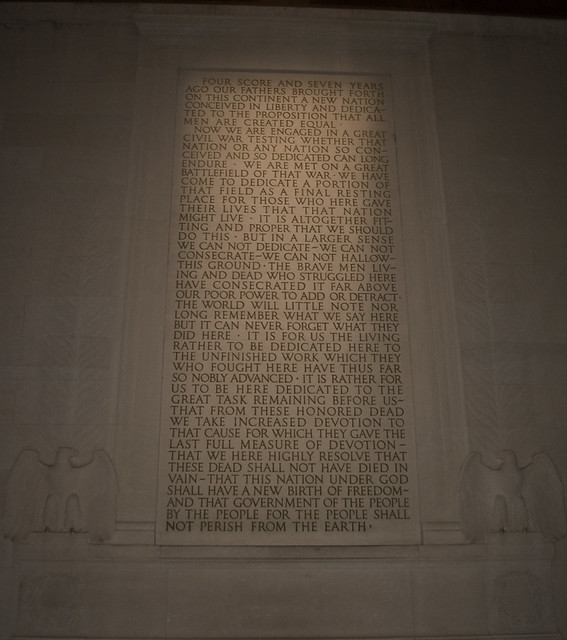
We have no alternative from now on but to look forward and not back. This does not dishonor the fallen heroes, and Lincoln explained why at Gettysburg. “We can not dedicate — we can not consecrate — we can not hallow this ground,” he said. “The brave men, living and dead, who struggled here, have consecrated it, far above our poor power to add or detract.” The best we could do, Lincoln declared, was to commit ourselves to “a new birth of freedom.” This is still our calling.
By: E. J. Dionne, Opinion Writer, The Washington Post, September 7, 2011
Out Of The Shadows: Bush And Cheney Remind Us How We Got Into This Mess
Thank you, George W. Bush and Dick Cheney, for emerging from your secure, undisclosed locations to remind us how we got into this mess: It didn’t happen by accident.
The important thing isn’t what Bush says in his interview with National Geographic or what scores Cheney tries to settle in his memoir. What matters is that as they return to the public eye, they highlight their record of wrongheaded policy choices that helped bring the nation to a sour, penurious state.
Questions about whether President Obama has been combative enough in dealing with the Republican opposition — or sufficiently ambitious in framing his progressive agenda — seem trivial when viewed in this larger context. Obama is tackling enormous problems that took many years to create. His presidential style is important insofar as it boosts or lessens his effectiveness, but its importance pales beside the generally righteous substance of what he’s trying to accomplish.
It was the Bush administration, you will recall, that sent the national debt into the stratosphere and choked off federal revenue to the point of asphyxiation. Bush and Cheney decided to fight two wars without even accounting — let alone paying — for them. Rather than raise taxes to cover the cost of military campaigns in Afghanistan and Iraq, Bush opted to maintain unreasonable and unnecessary tax cuts.
So far, the wars and the tax cuts have cost the Treasury between $4 trillion and $5 trillion. If Bush had just left income tax rates alone, nobody except Ron Paul would be talking about the debt.
My aim isn’t to attack Bush but to attack his philosophy. When he was campaigning for the White House in 2000, the government was anticipating a projected surplus of roughly $6 trillion over the following decade. Bush said repeatedly that he thought this was too much and wanted to bring the surplus down — hence, in 2001, the first of his two big tax cuts.
Bush was hewing to what had already become Republican dogma and by now has become something akin to scripture: Taxes must always be cut because government must always be starved.
The party ascribes this golden rule to Ronald Reagan — conveniently forgetting that Reagan, in his eight years as president, raised taxes 11 times. Reagan may have believed in small government, but he did believe in government itself. Today’s Republicans have perverted Reagan’s philosophy into a kind of anti-government nihilism — an irresponsible, almost childish insistence that the basic laws of arithmetic can be suspended at their will.
The Bush administration also pushed forward Reagan’s policy of deregulation — ignoring, for example, critics who said the ballooning market in mortgage-backed securities needed more oversight. When the 2008 financial crisis hit, Bush did regain his faith in government long enough to throw together the $800 billion TARP bailout for the banks. But he failed to use the leverage of an aid package to exact reforms that would ensure that the financial system served the economy, rather than the other way around.
Faced with similar circumstances, would today’s Republican leadership react at all? Or is it the party’s view that the proper role of government would be to stand aside and watch the world’s financial system crash and burn?
This is a serious question. Just a few weeks ago, the Republican majority in the House threatened to force the United States government to default on its debt obligations — a previously unthinkable act of brinkmanship. Everything is thinkable now.
The Bush administration took Reagan’s tax-cutting, government-starving philosophy much too far. Today’s Republican Party takes it well beyond, into a rigid absolutism that would be comical if it were not so consequential.
We face devastating unemployment. Many conservative economists have joined the chorus calling for more short-term spending by the federal government as a way to boost growth. But the radical Republicans don’t pay attention to conservative economists anymore. The Republicans’ idea of a cure for cancer would be to cut spending and cut taxes.
Perhaps they’re just cynically trying to keep the economy in the doldrums through next year to hurt Obama’s chances of reelection. I worry that their fanaticism is sincere — that one of our major parties has gone completely off the rails. If so, things will get worse before they get better.
Having Bush and Cheney reappear is a reminder to step back and look at what Obama is up against. You might want to cut him a little slack.
Getting to Crazy: The Culmination Of A GOP Process
There aren’t many positive aspects to the looming possibility of a U.S. debt default. But there has been, I have to admit, an element of comic relief — of the black-humor variety — in the spectacle of so many people who have been in denial suddenly waking up and smelling the crazy.
A number of commentators seem shocked at how unreasonable Republicans are being. “Has the G.O.P. gone insane?” they ask.
Why, yes, it has. But this isn’t something that just happened, it’s the culmination of a process that has been going on for decades. Anyone surprised by the extremism and irresponsibility now on display either hasn’t been paying attention, or has been deliberately turning a blind eye.
And may I say to those suddenly agonizing over the mental health of one of our two major parties: People like you bear some responsibility for that party’s current state.
Let’s talk for a minute about what Republican leaders are rejecting.
President Obama has made it clear that he’s willing to sign on to a deficit-reduction deal that consists overwhelmingly of spending cuts, and includes draconian cuts in key social programs, up to and including a rise in the age of Medicare eligibility. These are extraordinary concessions. As The Times’s Nate Silver points out, the president has offered deals that are far to the right of what the average American voter prefers — in fact, if anything, they’re a bit to the right of what the average Republican voter prefers!
Yet Republicans are saying no. Indeed, they’re threatening to force a U.S. default, and create an economic crisis, unless they get a completely one-sided deal. And this was entirely predictable.
First of all, the modern G.O.P. fundamentally does not accept the legitimacy of a Democratic presidency — any Democratic presidency. We saw that under Bill Clinton, and we saw it again as soon as Mr. Obama took office.
As a result, Republicans are automatically against anything the president wants, even if they have supported similar proposals in the past. Mitt Romney’s health care plan became a tyrannical assault on American freedom when put in place by that man in the White House. And the same logic applies to the proposed debt deals.
Put it this way: If a Republican president had managed to extract the kind of concessions on Medicare and Social Security that Mr. Obama is offering, it would have been considered a conservative triumph. But when those concessions come attached to minor increases in revenue, and more important, when they come from a Democratic president, the proposals become unacceptable plans to tax the life out of the U.S. economy.
Beyond that, voodoo economics has taken over the G.O.P.
Supply-side voodoo — which claims that tax cuts pay for themselves and/or that any rise in taxes would lead to economic collapse — has been a powerful force within the G.O.P. ever since Ronald Reagan embraced the concept of the Laffer curve. But the voodoo used to be contained. Reagan himself enacted significant tax increases, offsetting to a considerable extent his initial cuts.
And even the administration of former President George W. Bush refrained from making extravagant claims about tax-cut magic, at least in part for fear that making such claims would raise questions about the administration’s seriousness.
Recently, however, all restraint has vanished — indeed, it has been driven out of the party. Last year Mitch McConnell, the Senate minority leader, asserted that the Bush tax cuts actually increased revenue — a claim completely at odds with the evidence — and also declared that this was “the view of virtually every Republican on that subject.” And it’s true: even Mr. Romney, widely regarded as the most sensible of the contenders for the 2012 presidential nomination, has endorsed the view that tax cuts can actually reduce the deficit.
Which brings me to the culpability of those who are only now facing up to the G.O.P.’s craziness.
Here’s the point: those within the G.O.P. who had misgivings about the embrace of tax-cut fanaticism might have made a stronger stand if there had been any indication that such fanaticism came with a price, if outsiders had been willing to condemn those who took irresponsible positions.
But there has been no such price. Mr. Bush squandered the surplus of the late Clinton years, yet prominent pundits pretend that the two parties share equal blame for our debt problems. Paul Ryan, the chairman of the House Budget Committee, proposed a supposed deficit-reduction plan that included huge tax cuts for corporations and the wealthy, then received an award for fiscal responsibility.
So there has been no pressure on the G.O.P. to show any kind of responsibility, or even rationality — and sure enough, it has gone off the deep end. If you’re surprised, that means that you were part of the problem.
By: Paul Krugman, Op-Ed Writer, The New York Times, July 14, 2011
GOP Jobs Plan: Old Ideas, Fancy New Clip Art
Academic books pack about 600 words to a page. Normal books clock in around
400. Large-print books, you know, the ones for kids or the visually impaired — fit about 250. The House GOP’s jobs plan, however, gets about 200 words to a page. The typeface is fit for giants, and the document’s 10 pages are mostly taken up by pictures. It looks like the staffer in charge forgot the assignment was due on Thursday rather than Friday and cranked up the font to 24 points and began dumping clip art to pad out the plan.
Which is odd, because there’s nothing in this plan that hasn’t been in a thousand other plans. When I asked David Autor, an economist at the Massachusetts Institute of Technology and a specialist on labor markets, to take a look at the substance, he pronounced it a classic case of “what Larry Summers would call ‘now-more-than-everisms.”
“Here’s how it works,” Autor wrote in an e-mail. “1. You have a set of policies that you favor at all times and under all circumstances, e.g., cut taxes, remove regulations, drill-baby-drill, etc. 2. You see a problem that needs fixing (e.g., the economy stinks). 3. You say, ‘We need to enact my favored policies now more than ever.’ I believe that every item in the GOP list that you sent derives from this three-step procedure.
“That’s not to say that there are no reasonable ideas on this list. But there is certainly no original thinking here directed at addressing the employment problem. Or, to put it differently, is there any set of economic circumstances under which the GOP would not actually want to enact every item on this agenda? If the answer is no, then this is clearly now-more-than-everism.”
If you read Autor’s answer and then guessed at what’s included in the plan, you’d probably get it about right. The GOP wants a separate congressional vote on every significant regulation. It wants to cut taxes for corporations and small businesses led by individuals. It wants a tax break on profit that corporations earn overseas. It wants to pass pending trade agreements, increase domestic production of oil and enact spending cuts. The only two proposals you couldn’t have guessed sight unseen are patent reform and visas for the highly skilled.
But even if you think every item on that agenda is a grand idea, this isn’t exactly fast-acting medicine. “At best, an agenda like this is meant to improve long-term growth by a couple of tenths of a percentage point,” says Larry Mishel, president of the Economic Policy Institute. “It takes a really long time to move the dial. It’s not a response to a cyclical downturn.”
That’s okay, because the document doesn’t believe in cyclical downturns. It only believes in deviations from the Republican agenda. The first page sets out the GOP’s narrative of the unemployment crisis. See if you recognize what’s missing here: “For the past four years, Democrats in Washington have enacted policies that undermine these basic concepts which have historically placed America at the forefront of the global marketplace. As a result, most Americans know someone who has recently lost a job, and small businesses and entrepreneurs lack the confidence needed to invest in our economy. Not since the Great Depression has our nation’s unemployment rate been this high this long.”
Four years ago, of course, George W. Bush was president. And he was, as you might remember, a Republican, not a Democrat. As for Wall Street, well, Wall Street who?
But it’s not just that you could read this jobs plan without knowing the financial crisis ever happened. You could read it without knowing the past decade ever happened. As Mishel says, “If lower taxes and less regulation was such good policy, then George W. Bush’s economy would have been a lot better. But under Bush, Republicans cut taxes on business and on investors and high-income people, and they didn’t add many regulations, and that business cycle was the first one in the postwar period where the income for a typical working-class family was lower at the end than at the beginning.”
That, however, is the agenda the House GOP thinks we need. And now more than
ever.
By: Ezra Klein, Columnist, The Washington Post, May 26, 2011
No, Killing Of Bin Laden Does Not Represent ‘Continuity’ With Bush
Conservatives have attempted to credit George W. Bush for President Barack Obama’s success in killing Osama bin Laden in various ways, from exaggerating the role of so-called “enhanced interrogation techniques” to praising Bush’s unsuccessful seven year attempt to do so.
Today, Ross Douthat offers the latest version of this argument: That killing Bin Laden constitutes “the most visible proof” so far of Bush-Obama continuity in matters of national security:
The death of Osama bin Laden, in a raid that operationalized Bush’s famous “dead or alive” dictum, offered the most visible proof of this continuity. But the more important evidence of the Bush-Obama convergence lay elsewhere, in developments from last week that didn’t merit screaming headlines, because they seemed routine rather than remarkable.
This is an odd formulation that ignores that the hunt for bin Laden predated the Bush administration — remember that conservatives accused President Bill Clinton of “wagging the dog” when authorizing missile strikes against al Qaeda in the midst of the Monica Lewinsky scandal. Yet Douthat does not praise Clinton in making this argument about “continuity,” because doing so would acknowledge that any president, regardless of party, would regard it as part of his duty to defend American citizens from terrorism.
While there are indeed many examples of Obama continuing Bush-era policies to the frustration of liberals, killing bin Laden is not one of them. Rather, Obama’s focus on bin Laden represents a departure from his predecessor, who had decided shortly after 9/11 that bin Laden was “just a person who’s been marginalized,” just a small part of a much larger battle. As Michael Hirsh wrote last week, Obama rejected the Bush approach that “conflated all terror threats from al-Qaida to Hamas to Hezbollah,” replacing it with “with a covert, laserlike focus on al-Qaida and its spawn.”
During the 2008 election, Bush mocked Obama for asserting he would target bin Laden if he was hiding in Pakistan. GOP presidential candidate John McCain attacked Obama as “confused and inexperienced” for saying so.” It is a bit rich to regard the results of an operation that Bush and McCain would have opposed as “continuity” with the prior administration. There are a number of disturbing continuities between Bush and Obama on national security, but the singular focus on bin Laden isn’t one of them.
What is notable however, is that the major distinction between Obama and Bush that has formed the basis of GOP criticism of Obama — the President’s rejection of torture — has proven so decisively wrongheaded. Conservatives attempting to attribute successfully killing bin Laden to torture are merely attempting to take credit for what President Bush pointedly failed to do. Far from yielding the necessary intelligence, the two al Qaeda suspects who were waterboarded pointedly resisted identifying the courier whose activities lead to the U.S. discovering Osama bin Laden’s whereabouts. The pro-torture argument ignores the obvious — that if torture was so effective, bin Laden would have been dead long ago. Bin Laden was found through years of painstaking intelligence gathering, not through the barbarous methods supported by many Bush apologists.
One cannot discount how shattering the Obama administration’s killing of Bin Laden has been to the self-image of conservatives who have convinced themselves of that the fight against al Qaeda hinges not just on torture, but on how many times the president says the word “terrorism,” or on Obama’s refusal to engage in juvenile expressions of American toughness.
While we’re far from the moment where terrorism ceases to be a threat, what torture apologists fear most now is a future in which al Qaeda is destroyed without the U.S. embracing the war-on-terror “dark side” that’s become central to their identity. Indeed, having rejected torture, Obama has nevertheless lead the country to its greatest victory in the fight against al Qaeda.
By: Adam Serwer, The Washington Post-The Plum Line, May 9, 2011
Share This Blog


 Unknown Feed
- An error has occurred; the feed is probably down. Try again later.
 mykeystrokes.com