George W. Bush Says “Most Nervous Moment” Of His Presidency Is When He Threw A Ball
Former U.S. president George W. Bush. (REUTERS) Former President George W. Bush might want to drop the superlatives.
In what is at least his second foot-in-the-mouth moment recalling the toughest moments of his presidency, Bush has said “the most nervous moment” of his presidency was throwing the ceremonial first pitch at the 2001 World Series.
According to an interview Bush gave to the producers of “Beyond 9/11: Portraits of Resilience,” a TIME documentary that aired over the weekend, and a clip provided by Gawker, the former president said:
The adrenaline was coursing through my veins, and the ball felt like a shotput. And Todd Greene, the catcher, looked really small. Sixty feet and six inches seemed like a half-mile. And anyway, I took a deep breath and threw it, and thankfully it went over the plate. The response was overwhelming. It was the most nervous I had ever been. It’s the most nervous moment of my entire presidency, it turns out.
The statement was reminiscent of another by Bush last year, in which he said the worst moment of his presidency is when rapper Kanye West called him a racist. “It was a disgusting moment, pure and simple,” Bush had said. “I didn’t appreciate it then [and] I don’t appreciate it now.”
Bush was referring to a Hurricane Katrina live telethon appearance by West in 2005, in which the performer launched into a an angry diatribe about race and aid efforts, including the accusation: “George Bush doesn’t care about black people.”
The Guardian pointed out at the time that the comment came in spite of Bush having led “the U.S. into war and presiding over the beginnings of one of the greatest financial disasters in history.”
This time, Gawker provides a laundry list of things Bush should have found more nerve-wracking than a baseball pitch, including receiving a warning that Osama bin Laden was going to strike the United States or authorizing the torture of detainees in U.S. custody. “That was some … pitch, though,” Gawker writes sarcastically.
Watch the video of Bush’s statement here or his full “Beyond 9/11” video here.
By: Elizabeth Flock, The Washington Post, September 12, 2011
Committing To A New Birth Of Freedom: It’s Time To Leave 9/11 Behind
After we honor the 10th anniversary of the attacks of Sept. 11, 2001, we need to leave the day behind. As a nation we have looked back for too long. We learned lessons from the attacks, but so many of them were wrong. The last decade was a detour that left our nation weaker, more divided and less certain of itself.
Reflections on the meaning of the horror and the years that followed are inevitably inflected by our own political or philosophical leanings. It’s a critique that no doubt applies to my thoughts as well. We see what we choose to see and use the event as we want to use it.
This does nothing to honor those who died and those who sacrificed to prevent even more suffering. In the future, the anniversary will best be reserved as a simple day of remembrance in which all of us humbly offer our respect for the anguish and the heroism of those individuals and their families.
But if we continue to place 9/11 at the center of our national consciousness, we will keep making the same mistakes. Our nation’s future depended on far more than the outcome of a vaguely defined “war on terrorism,” and it still does. Al-Qaeda is a dangerous enemy.
But our country and the world were never threatened by the caliphate of its mad fantasies.
We asked for great sacrifice over the past decade from the very small portion of our population who wear the country’s uniform, particularly the men and women of the Army and the Marine Corps. We should honor them, too. And, yes, we should pay tribute to those in the intelligence services, the FBI and our police forces who have done such painstaking work to thwart another attack.
It was often said that terrorism could not be dealt with through “police work,” as if the difficult and unheralded labor involved was not grand or bold enough to satisfy our longing for clarity in what was largely a struggle in the shadows.
Forgive me, but I find it hard to forget former president George W. Bush’s 2004 response to Sen. John Kerry’s comment that “the war on terror is less of a military operation and far more of an intelligence-gathering and law-enforcement operation.”
Bush retorted: “I disagree — strongly disagree. . . . After the chaos and carnage of September the 11th, it is not enough to serve our enemies with legal papers. With those attacks, the terrorists and their supporters declared war on the United States of America, and war is what they got.” What The Washington Post called “an era of endless war” is what we got, too.
Bush, of course, understood the importance of “intelligence gathering” and “law enforcement.” His administration presided over a great deal of both, and his supporters spoke, with justice, of his success in staving off further acts of terror. Yet he could not resist the temptation to turn on Kerry’s statement of the obvious. Thus was an event that initially united the nation used, over and over, to aggravate our political disharmony. This is also why we must put it behind us.
In the flood of anniversary commentary, notice how often the term “the lost decade” has been invoked. We know now, as we should have known all along, that American strength always depends first on our strength at home — on a vibrant, innovative and sensibly regulated economy, on levelheaded fiscal policies, on the ability of our citizens to find useful work, on the justice of our social arrangements.
This is not “isolationism.” It is a common sense that was pushed aside by the talk of “glory” and “honor,” by utopian schemes to transform the world by abruptly reordering the Middle East — and by our fears. While we worried that we would be destroyed by terrorists, we ignored the larger danger of weakening ourselves by forgetting what made us great.
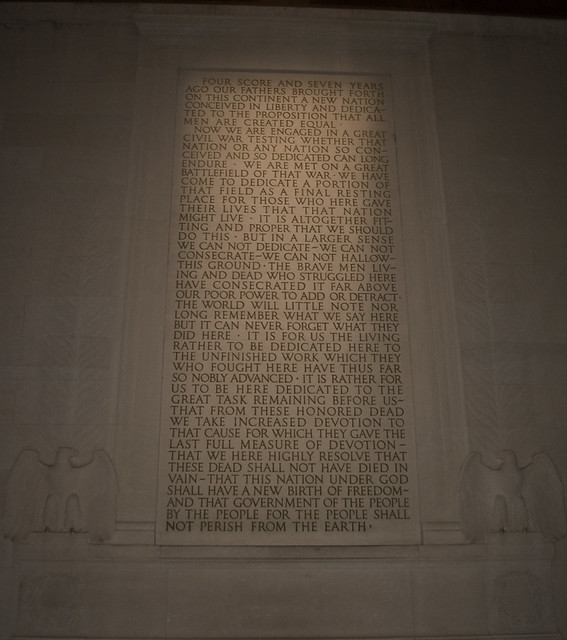
We have no alternative from now on but to look forward and not back. This does not dishonor the fallen heroes, and Lincoln explained why at Gettysburg. “We can not dedicate — we can not consecrate — we can not hallow this ground,” he said. “The brave men, living and dead, who struggled here, have consecrated it, far above our poor power to add or detract.” The best we could do, Lincoln declared, was to commit ourselves to “a new birth of freedom.” This is still our calling.
By: E. J. Dionne, Opinion Writer, The Washington Post, September 7, 2011
Eric Cantor Is A Hypocrite On Disaster Relief Spending
Buried in this Saturday’s Washington Post Metro section was a short piece about the request from conservative Virginia Republican Gov. Robert McDonnell for $39 million in federal disaster relief for his state.
This was an initial request for 22 localities in Virginia hard hit by Hurricane Irene. According to the article, other local governments can request more aid and, in addition, McDonnell also asked for Hazard Mitigation Assistance for all Virginia localities.
This comes from a governor who, along with his Republican congressional counterpart Eric Cantor, rails against Washington and “government spending.”
What makes this quite interesting is the position taken by Cantor last week on Federal Emergency Management funding for disasters. We have had a record 66 natural disasters this year and Hurricane Irene was one of the 10 most costly ever.
Cantor, whose district was hit hard by the earthquake and the hurricane, has said that any spending for FEMA should be tied to cuts elsewhere, dollar for dollar, “Just like any family would operate when it’s struck with disaster,” says Cantor. Funny, that is not how he felt back in 2004 when he appealed for money for his district after another hurricane and voted against the amendment by Republican Rep. Jeb Hensarling of Texas to do require offsets.
Did Eric Cantor ask for dollar for dollar cuts to pay for the wars in Iraq and Afghanistan? Did he ask for dollar for dollar cuts to pay for the Bush tax cuts for the millionaires and billionaires? Did he ask for dollar for dollar cuts to pay for increases to homeland security? How about border agents?
Another very conservative congressman from Virginia, Leonard Lance, totally disagrees with Cantor. Help is needed now. Gov. Chris Christie of New Jersey, no friend of government spending, talks as though Eric Cantor has lost his marbles: “Our people are suffering now, and they need support now. And they [Congress] can all go down there and get back to work and figure out budget cuts later.”
It is time for a host of protesters to go to Cantor’s district office and call him on his absurdity. Does he believe we should help the victims of these disasters? Is that what government has done for over 200 years? Does he just want to play politics and delay help? Does he represent the people of Virginia? Does he care about the others who have been the victims of tornadoes and floods across this country?
It reminds me of a Senate debate where a certain Republican from Idaho was complaining about a bill that included funding for rat control in New York City.
“In Idaho, we take care of our own rats,” to which the New York senator replied, “In New York, we take care of our own forest fires.”
That about sums it up.
By: Peter Fenn, U. S. News and World Report, September 6, 2011
Out Of The Shadows: Bush And Cheney Remind Us How We Got Into This Mess
Thank you, George W. Bush and Dick Cheney, for emerging from your secure, undisclosed locations to remind us how we got into this mess: It didn’t happen by accident.
The important thing isn’t what Bush says in his interview with National Geographic or what scores Cheney tries to settle in his memoir. What matters is that as they return to the public eye, they highlight their record of wrongheaded policy choices that helped bring the nation to a sour, penurious state.
Questions about whether President Obama has been combative enough in dealing with the Republican opposition — or sufficiently ambitious in framing his progressive agenda — seem trivial when viewed in this larger context. Obama is tackling enormous problems that took many years to create. His presidential style is important insofar as it boosts or lessens his effectiveness, but its importance pales beside the generally righteous substance of what he’s trying to accomplish.
It was the Bush administration, you will recall, that sent the national debt into the stratosphere and choked off federal revenue to the point of asphyxiation. Bush and Cheney decided to fight two wars without even accounting — let alone paying — for them. Rather than raise taxes to cover the cost of military campaigns in Afghanistan and Iraq, Bush opted to maintain unreasonable and unnecessary tax cuts.
So far, the wars and the tax cuts have cost the Treasury between $4 trillion and $5 trillion. If Bush had just left income tax rates alone, nobody except Ron Paul would be talking about the debt.
My aim isn’t to attack Bush but to attack his philosophy. When he was campaigning for the White House in 2000, the government was anticipating a projected surplus of roughly $6 trillion over the following decade. Bush said repeatedly that he thought this was too much and wanted to bring the surplus down — hence, in 2001, the first of his two big tax cuts.
Bush was hewing to what had already become Republican dogma and by now has become something akin to scripture: Taxes must always be cut because government must always be starved.
The party ascribes this golden rule to Ronald Reagan — conveniently forgetting that Reagan, in his eight years as president, raised taxes 11 times. Reagan may have believed in small government, but he did believe in government itself. Today’s Republicans have perverted Reagan’s philosophy into a kind of anti-government nihilism — an irresponsible, almost childish insistence that the basic laws of arithmetic can be suspended at their will.
The Bush administration also pushed forward Reagan’s policy of deregulation — ignoring, for example, critics who said the ballooning market in mortgage-backed securities needed more oversight. When the 2008 financial crisis hit, Bush did regain his faith in government long enough to throw together the $800 billion TARP bailout for the banks. But he failed to use the leverage of an aid package to exact reforms that would ensure that the financial system served the economy, rather than the other way around.
Faced with similar circumstances, would today’s Republican leadership react at all? Or is it the party’s view that the proper role of government would be to stand aside and watch the world’s financial system crash and burn?
This is a serious question. Just a few weeks ago, the Republican majority in the House threatened to force the United States government to default on its debt obligations — a previously unthinkable act of brinkmanship. Everything is thinkable now.
The Bush administration took Reagan’s tax-cutting, government-starving philosophy much too far. Today’s Republican Party takes it well beyond, into a rigid absolutism that would be comical if it were not so consequential.
We face devastating unemployment. Many conservative economists have joined the chorus calling for more short-term spending by the federal government as a way to boost growth. But the radical Republicans don’t pay attention to conservative economists anymore. The Republicans’ idea of a cure for cancer would be to cut spending and cut taxes.
Perhaps they’re just cynically trying to keep the economy in the doldrums through next year to hurt Obama’s chances of reelection. I worry that their fanaticism is sincere — that one of our major parties has gone completely off the rails. If so, things will get worse before they get better.
Having Bush and Cheney reappear is a reminder to step back and look at what Obama is up against. You might want to cut him a little slack.
Is Harry Reid Caving Or Calling The GOP Bluff?
If you can still remember the GOP position when the curtain first rose on Debt Ceiling Theater, you will recall that the Congressional Republicans had put forth two goals.
First, an agreement whereby every dollar permitted to be borrowed by a raise in the debt ceiling would be matched by a dollar of cuts in the federal budget; and Second, there could be no tax increases as a result of the process.
Senate Majority Leader Harry Reid (D-NV) is now offering up a plan that ostensibly meets the GOP demands by proposing a $2.7 trillion cut in federal spending to be matched by a like increase in the debt ceiling – with no tax increases or revenue boosts required.
That certainly sounds like a win for the GOP, doesn’t it?
Maybe it is – maybe it isn’t.
If the Republicans take the deal, they will accomplish a few important things.
For starters, in a country where few people read beyond the headlines and often believe what they are told by Fox News, a GOP declaration of victory would likely hold up – even if that victory proves to be little more than a cosmetic win.
Such a deal would also leave many on the left dispirited, believing that the President and the Democrats – by allowing the GOP to wriggle off the hook on revenue increases – will have, once again, caved to the opposition. This would threaten to split the Democrats at the worst possible time as we head into an election year.
But the devil is always in the details – and the details very much skew to the Democratic Party perspective.
Much of the cuts in the Reid plan are tied to reductions in spending on our two wars along with discretionary spending cuts. By structuring the cuts in this way, Reid is creating an incentive for the war supporters in Congress, and the President, to get out of Iraq and Afghanistan once and for all.
Accomplishing this would likely be perceived as a ‘win’ by many American voters who think it is time to bring these wars to a conclusion. Of course, those who are focused on achieving true and well defined cuts to our federal budget would likely see this maneuver as an example of budget trickery intended to create the appearance of a cut where no cut is really is going to take place if we continue our battles overseas.
More importantly from a political perspective, none of the budget reductions in the Reid proposal touch the entitlement programs that are sacrosanct to both the left and the rank-and-file members of Democratic Party, not to mention – if the polls are to be believed- Independents and many Republicans.
Finally, the Reid proposal provides a large enough raise in the debt ceiling to take us beyond the 2012 elections.
While the failure to get any revenue increases would, no doubt, be a black mark against the Democrats and the President, the Reid proposal would permit the Senate Democrats to argue that they succeeded in solving the debt ceiling crisis without impacting on entitlements – something the President was clearly ready to do in trade for revenue increases.
Preserving entitlements will make a lot of people happy and very possibly balance the anger of those who want the Democrats to hang in there until they accomplish some revenue increases by cutting corporate subsidies from the tax code and raising the rates on the wealthiest Americans.
The deal would also preserve to the Democrats the substantial political advantage they gained through the public revulsion to the Ryan budget plan and its dramatic impact on Medicare and Medicaid.
All of this puts the Republicans in a tricky spot.
If they accept Reid’s deal, they can claim a victory and go home.
But they will know that they really have won very little beyond the appearance of a win and some continued protection for the wealthy by holding off any tax increases – for now. Remember that the Bush tax cuts once again expire at the end of 2012. Should Obama win the election – and bring along some Congressional Democrats with him -the story could be very different than it was when Obama was forced to leave the Bush cuts intact in 2010 in order to protect the unemployment insurance payments so badly needed by the millions of out-of-work Americans.
Because of the questionable value of such a deal to those in the Tea Party Caucus, the group that very much appears to be in the driver’s seat these days, the Reid proposal could be a non-starter, forcing Boehner to, once again, pass up a compromise opportunity.
If Boehner is forced to say no, it would seem impossible for the Republicans to avoid blame after having passed up yet another effort on the part of the Democrats to compromise – this time by offering the GOP what they say they wanted in the first place.
You can also expect Democrats to be quick to point out that the war savings Reid is offering in his deal also show up as a budget cut in the Ryan budget – making it look all the worse for the GOP who would appear willing to claim war savings as budget cuts in their own budget but refuse to consider them valid when offered as part of a deal in this instance.
Harry Reid may be showing us that there is more to his strategy skills than what has previously met the nation’s eye.
Stay tuned. There is a long way to go.
By: Rick Ungar, The Policy Page, Forbes, July 25, 2011
Share This Blog


 Unknown Feed
- An error has occurred; the feed is probably down. Try again later.
 mykeystrokes.com