A Great Day: Obama Ends The War In Iraq
This afternoon President Obama announced that at the end of this year, America will withdraw all U.S. forces from Iraq.
Obama began his campaign for president by forcefully, clearly promising to end that war. This afternoon he delivered on that promise.
The timing of his announcement could not have been more symbolically powerful. It comes just a day after the successful conclusion of the operation in Libya — an operation that stands in stark contrast to the disastrous War in Iraq.
The War in Iraq was the product of “bull in the china closet” Neo-Con unilateralism. The war cost a trillion dollars. Nobel prize-winning economist George Stieglitz estimates that after all of the indirect costs to our economy are in — including the care of the over 33,000 wounded and disabled — its ultimate cost to the American economy will be three times that.
It has cost 4,600 American lives, and the lives of hundreds of thousands of Iraqis. It created millions of refugees — both inside Iraq and those who fled to other countries.
The war decimated America’s reputation in the world and legitimated al Qaeda’s narrative that the West was involved in a new Crusade to take over Muslim lands. Images of Abu Ghraib created a powerful recruiting poster for terrorists around the world.
The War stretched America’s military power and weakened our ability to respond to potential threats. It diverted resources from the War in Afghanistan. It empowered Iran.
The War in Iraq not only destroyed America’s reputation, but also American credibility. Who can forget the embarrassing image of General Colin Powell testifying before the United Nations Security Council that the U.S. had incontrovertible evidence that Saddam Hussein had weapons of mass destruction?
Contrast that to yesterday’s conclusion of the successful operation in Libya. That operation is emblematic of an entirely different approach.
Since he took office, Obama has fundamentally reshaped American foreign policy. In place of “bull in the china closet” unilateralism he has initiated a cooperative, multilateral approach to the rest of the world. The fruits of that approach are obvious in the Libyan operation where:
- The Libyans themselves overthrew a dictator;
- America spent a billion dollars — not a trillion dollars, as we have in Iraq;
- America did not lose one soldier in Libya;
- We accomplished our mission after eight months, not eight years;
- Most importantly, America worked cooperatively with our European allies, the Arab League and the Libyan people to achieve a more democratic Middle East.
Obama’s policy toward the Middle East is aimed at helping to empower everyday people in the Muslim world — it is a policy built on respect, not Neo-Con fantasies of imperial power. And it works.
Last month, I spent several weeks in Europe and met with a number of people from our State Department and other foreign policy experts from Europe, the Middle East and the United States. Everyone tells the same story. Since President Obama took office, support for the United States and its policies has massively increased throughout Europe and much of the world.
The BBC conducts a major poll of world public opinion. In March of this year it released its latest report.
Views of the U.S. continued their overall improvement in 2011, according to the annual BBC World Service Country Rating Poll of 27 countries around the world.
Of the countries surveyed, 18 hold predominantly positive views of the U.S., seven hold negative views and two are divided. On average, 49 percent of people have positive views of U.S. influence in the world — up four points from 2010 — and 31 per cent hold negative views. The poll, conducted by GlobeScan/PIPA, asked a total of 28,619 people to rate the influence in the world of 16 major nations, plus the European Union.
In 2007 a slight majority (54%) had a negative view of the United States and only close to three in ten (28%) had a positive view….
In other words, positive opinion of the U.S. had increased by 21% since 2007 – it has almost doubled.
Obama understands that in an increasingly democratic world, the opinions of our fellow human beings matter. They affect America’s ability to achieve America’s goals.
And Obama understands that it matters that young people in the Middle East, who are struggling to create meaningful lives, think of America as a leader they respect, rather than as a power with imperial designs on their land and their lives.
But, at the same time, there is no question that President Obama is not afraid to act — to take risks to advance American interests. The operation that got Bin Laden was a bold move. It was very well planned — but not without risks.
Obama is a leader who makes cold, hard calculations about how to achieve his goals. He plans carefully and then doesn’t hesitate to act decisively. And as it turns out, he usually succeeds. Ask Bin Laden, Anwar al-Awlaki, and Gaddafi.
Obama received a good deal of criticism from the Republicans for his operation in Libya. But by taking action, he first prevented Benghazi from becoming another Rwanda — and then supported a movement that ended the reign of a tyrant who had dominated the Libyan people for 42 years and had personally ordered the destruction of an American airliner.
For the vast number of Americas who ultimately opposed the War in Iraq, today should be at day of celebration. And it is a day of vindication for the courageous public officials who opposed the war from the start. That includes the 60% of House Democrats who voted against the resolution to support Bush’s invasion of Iraq.
It is also a day when someone ought to have the decency to tell the Republican chorus of Obama foreign policy critics that it’s time to stop embarrassing themselves.
From the first day of the Obama Presidency, former Vice President Dick Cheney has accused President Obama of “dithering” — “afraid to make a decision” — of “endangering American security.”
Even after the death of Muammar Gaddafi, Senator Lindsey Graham criticized the president for “leading from behind.”
You’d think that a guy who two years ago traveled to Libya to meet and make nice with Gaddafi would want to keep a low profile, now that the revolution Obama supported there has been successful at toppling this dictator who ordered the downing of American airliner.
Well, as least Graham isn’t saddled with having tweeted fawningly like his fellow traveler, John McCain, who upon visiting Gaddafi wrote: “Late evening with Col. Qadhafi at his “ranch” in Libya — interesting meeting with an interesting man.”
Let’s face it, with the death of Gaddafi, the knee-jerk Republican critics of his Libya policy basically look like fools.
Mitt Romney in the early months of the effort: “It is apparent that our military is engaged in much more than enforcing a no-fly zone. What we are watching in real time is another example of mission creep and mission muddle.”
Republican Presidential Candidate Michele Bachmann: “President Obama’s policy of leading from behind is an outrage and people should be outraged at the foolishness of the President’s decision” and also asking “what in the world are we doing in Libya if we don’t know what our military goal is?”
Of course, the very idea that Dick Cheney is given any credibility at all by the media is really outrageous.
Here is a guy who made some of the most disastrous foreign policy mistakes in American history. He has the gall to criticize Obama’s clear foreign policy successes? Those successes allowed America to recover much stature and power in the world that were squandered by Dick Cheney and George W. Bush. Someone needs to ask, what is anyone thinking who takes this guy the least bit seriously?
Someone needs to remind him and his Neo-con friends that:
- The worst attack on American soil took place on their watch;
- They failed to stop Osama bin Laden;
- They began two massive land wars in the Middle East that have drained massive sums from our economy, killed thousands of Americans and wounded tens of thousands of others;
- They underfunded an effort in Afghanistan so they could begin their War in Iraq that had nothing whatsoever to do with the terrorist threat from Al Qaeda;
- They brought U.S. credibility in the world to a new low by lying about weapons of mass destruction in Iraq, violating our core human rights principles and acting unilaterally without any concern for the opinions or needs of other nations;
- Through their War in Iraq they legitimated Al Qaeda’s narrative that the United States was waging a crusade to take over Muslim lands – and with their policies at Guantanamo and Abu Ghraib, they created recruiting posters for Al Qaeda that did enormous harm to American security;
- Through their recklessness and incompetence they stretched American military resources and weakened our ability to respond to crises;
- When they left office, American credibility and our support in the world had fallen to new lows.
Republicans in Congress supported all of this like robots.
With a record like this, you’d think they would want to slink off into a closet and hope that people just forget.
But Americans won’t forget. History won’t forget.
And generations from now, Americans will thank Barack Obama for restoring American leadership — for once again making our country a leader in the struggle to create a world where war is a relic of the past and everyone on our small planet can aspire to a future full of possibility and hope.
By: Robert Creamer, Huffington Post, October 21, 2011
Committing To A New Birth Of Freedom: It’s Time To Leave 9/11 Behind
After we honor the 10th anniversary of the attacks of Sept. 11, 2001, we need to leave the day behind. As a nation we have looked back for too long. We learned lessons from the attacks, but so many of them were wrong. The last decade was a detour that left our nation weaker, more divided and less certain of itself.
Reflections on the meaning of the horror and the years that followed are inevitably inflected by our own political or philosophical leanings. It’s a critique that no doubt applies to my thoughts as well. We see what we choose to see and use the event as we want to use it.
This does nothing to honor those who died and those who sacrificed to prevent even more suffering. In the future, the anniversary will best be reserved as a simple day of remembrance in which all of us humbly offer our respect for the anguish and the heroism of those individuals and their families.
But if we continue to place 9/11 at the center of our national consciousness, we will keep making the same mistakes. Our nation’s future depended on far more than the outcome of a vaguely defined “war on terrorism,” and it still does. Al-Qaeda is a dangerous enemy.
But our country and the world were never threatened by the caliphate of its mad fantasies.
We asked for great sacrifice over the past decade from the very small portion of our population who wear the country’s uniform, particularly the men and women of the Army and the Marine Corps. We should honor them, too. And, yes, we should pay tribute to those in the intelligence services, the FBI and our police forces who have done such painstaking work to thwart another attack.
It was often said that terrorism could not be dealt with through “police work,” as if the difficult and unheralded labor involved was not grand or bold enough to satisfy our longing for clarity in what was largely a struggle in the shadows.
Forgive me, but I find it hard to forget former president George W. Bush’s 2004 response to Sen. John Kerry’s comment that “the war on terror is less of a military operation and far more of an intelligence-gathering and law-enforcement operation.”
Bush retorted: “I disagree — strongly disagree. . . . After the chaos and carnage of September the 11th, it is not enough to serve our enemies with legal papers. With those attacks, the terrorists and their supporters declared war on the United States of America, and war is what they got.” What The Washington Post called “an era of endless war” is what we got, too.
Bush, of course, understood the importance of “intelligence gathering” and “law enforcement.” His administration presided over a great deal of both, and his supporters spoke, with justice, of his success in staving off further acts of terror. Yet he could not resist the temptation to turn on Kerry’s statement of the obvious. Thus was an event that initially united the nation used, over and over, to aggravate our political disharmony. This is also why we must put it behind us.
In the flood of anniversary commentary, notice how often the term “the lost decade” has been invoked. We know now, as we should have known all along, that American strength always depends first on our strength at home — on a vibrant, innovative and sensibly regulated economy, on levelheaded fiscal policies, on the ability of our citizens to find useful work, on the justice of our social arrangements.
This is not “isolationism.” It is a common sense that was pushed aside by the talk of “glory” and “honor,” by utopian schemes to transform the world by abruptly reordering the Middle East — and by our fears. While we worried that we would be destroyed by terrorists, we ignored the larger danger of weakening ourselves by forgetting what made us great.
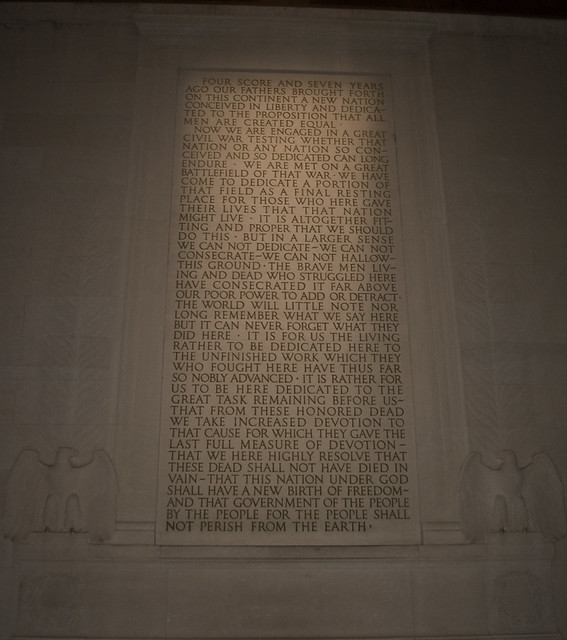
We have no alternative from now on but to look forward and not back. This does not dishonor the fallen heroes, and Lincoln explained why at Gettysburg. “We can not dedicate — we can not consecrate — we can not hallow this ground,” he said. “The brave men, living and dead, who struggled here, have consecrated it, far above our poor power to add or detract.” The best we could do, Lincoln declared, was to commit ourselves to “a new birth of freedom.” This is still our calling.
By: E. J. Dionne, Opinion Writer, The Washington Post, September 7, 2011
Politics Without Purpose: September 11 Should Not Be Another Media Event
It was another one of those weeks in the capital when our leaders debated matters crucial to the survival of American civilization.
Did President Obama try to upstage the Republican presidential debate by asking to address a joint session of Congress that same night? And did House Speaker John Boehner dis the president, and the presidency, by denying him that slot?
Tempted though I was to weigh in on this important matter, I decided instead to head over to the Smithsonian’s National Museum of American History, to preview a small but immensely powerful exhibit marking the 10th anniversary of the Sept. 11 attacks.
There, displayed for the first time, are sacred relics of 9/11: the crumpled piece of the fuselage where the American flag had been painted on the Boeing 757 that crashed in a Pennsylvania field, a flight-attendant call button from the plane, a window shade, a landing gear strut, and a log book with the pages intact. The exhibit is simple and raw, without glass or showcases. Some dried mud caked on an airplane seatbelt was flaking off onto a tablecloth.
Nearby is the door from a fire truck crushed at Ground Zero and the beeper of a man who died in the South Tower. There’s a Pentagon clock frozen at about the time American Airlines Flight 77 struck the complex and the phone on which Ted Olson received the last call from his wife on the doomed plane. Most poignant, perhaps, is the postcard from another passenger, written to her sister the day before the crash to give the address of a new home in which she would never live.
The spare exhibit brought back the horror of that time. But it also reminded me of the pride in what followed, the national unity and sense of purpose.
The warm feelings didn’t last long, of course, destroyed by the war in Iraq and the politicization of homeland security. By now, we have lost all sense of purpose in politics, alternately distracted by Sarah Palin’s bus tours, Anthony Weiner’s private parts, David Wu’s tiger suit, Donald Trump’s birth-certificate campaign, and Dick Cheney’s broadsides.
Obama, whose uncertain trumpet has ceased to rally even his own troops, contemplated his long-delayed jobs agenda while lounging on Martha’s Vineyard last month. His leading Republican rival for the presidency talks of treason and secession. Another challenger arranges to quadruple the size of his California home (his defense: He’s only doubling the living space). Lawmakers play games with the debt ceiling and wound the nation’s credit rating but can’t agree on anything to put Americans back to work.
The political extraneousness of the moment, in other words, is like that of early September 2001. We spent those days amusing ourselves with Gary Condit and shark attacks. President George W. Bush spent August on a record-long ranch vacation. The biggest issue under debate: stem-cell research. Warnings about Osama bin Laden were ignored while the administration obsessed over rewriting a missile treaty with Russia.
What will it require to end the drift this time? A depression? Another attack? Or is there a less painful way to regain national purpose?
“For most people,” curator David Allison told me as I toured the Smithsonian exhibit, “Sept. 11 is only a media event.” The exhibit is a modest attempt at changing that, taking that day’s ruins out of storage and rekindling memory. The lucky few who see the exhibit during its short run will be reminded that there are things more important than whether the president addresses Congress on a Wednesday or a Thursday.
Consider the simple postcard, written by Georgetown economist Leslie Whittington to her sister and brother-in-law, as Whittington, her husband and their 8- and 3-year-old daughters headed off to Australia for a sabbatical. The card, postmarked Sept. 12 at Dulles Airport, must have been mailed just before the family boarded American Flight 77. The note says, in its entirety:
9/10/01
Dear Sara & Jay,
Well, we’re off to Australia. When we return we will have a new address (as of 11/30): 8034 Glendale Rd. Chevy Chase, MD 20815
We don’t know our phone # yet. While we are in “Oz”, email will work best for contacting us: whittinl@georgetown.edu.
Love, Leslie, Chas, Zoe & Dana
I thought about Sara receiving that postcard from her dead sister, and about those little girls who never made it to Glendale Road – because of 19 evil men and a government distracted by less important things.
Then I went out onto Constitution Avenue, where, across from the museum, a bus labeled “Extreme Makeover: Home Edition” had just parked.
By: Dana Milbank, Opinion Writer, The Washington Post, September 2, 2011
Share This Blog


 Unknown Feed
- An error has occurred; the feed is probably down. Try again later.
 mykeystrokes.com