Harsh state judicial campaigns financed by ever larger amounts of special interest money are eating away at public faith in judicial impartiality. There are few places where the spectacle is more shameful than Wisconsin, where over-the-top campaigning, self-interested rulings, and a complete breakdown of courthouse collegiality and ethics is destroying trust in its Supreme Court.
On Monday, a special prosecutor was named to investigate an altercation between two justices on opposite sides of the court’s bitter ideological divide. Ann Walsh Bradley, a member of the court’s liberal wing, has charged that David Prosser, a conservative, put her in a chokehold during a heated exchange shortly before the court upheld the new state law eliminating most collective-bargaining rights for public employees.
Justice Prosser has disputed Justice Bradley’s version of what occurred, and the facts remain unclear. What is certain is that Justice Prosser should have recused himself from that ruling. His vote to uphold the law occurred shortly after his re-election campaign in which he benefited from heavy anti-union independent spending.
Justice Prosser won the April election by a very small margin, prompting a recount. The Milwaukee Journal Sentinel reported that he then raised more than $270,000 for the recount, much of it in $50,000 chunks. (The contribution limits that apply under Wisconsin’s public financing system for judicial races do not extend to recounts.) Some $75,000 of the haul was used to pay fees to a law firm led by an attorney representing conservative groups in a case challenging state campaign disclosure rules, which is scheduled to be heard by the court next month.
Given the lawyer’s role in Justice Prosser’s recent recount success, a reasonable person might well question the judge’s impartiality on that case, too. After first saying he had no intention of recusing himself, Justice Prosser on Thursday asked the parties in the campaign finance case to file memos stating their views about recusal. It should not take a formal request for him to step aside.
A contentious 4-to-3 decision by the court last month declared recusal decisions by the justices to be unreviewable. In another sign of the court’s dysfunction, the deciding vote came from Justice Patience Roggensack, whose involvement in an earlier case was the subject of the disqualification motion that the court was reviewing. Like the ruling itself, Justice Roggensack’s participation in judging her own conduct showed astounding disregard for legal ethics and every litigant’s right to impartial justice. The problems don’t even stop there. A year ago, by another 4-to-3 vote along ideological lines, the court weakened the recusal standard by adopting a rule saying that campaign fund-raising or expenditures can never be the sole basis for a judge’s disqualification. The rule was largely written by a business group that has spent lavishly in judicial campaigns.
Members of Wisconsin’s top court need to focus on restoring civility and public trust. For starters, they should scrap last year’s decision on campaign money in favor of strict disclosure requirements for lawyers and litigants. They should also adopt an appeals process for recusals, so the final decision is no longer left to the judge whose impartiality is being questioned. The court’s credibility, and justice in Wisconsin, are on the line.
By: New York Times Editorial, August 19, 2011
August 20, 2011
Posted by raemd95 |
Businesses, Collective Bargaining, Conservatives, Corporations, Democracy, Democrats, Elections, GOP, Ideologues, Ideology, Justice, Politics, Public, Republicans, Right Wing, States, Teaparty, Union Busting, Unions, Voters, Wisconsin, Wisconsin Republicans | Anti-Union, Campaign Financing, Citizens United, Ethics, Gov Scott Walker, Judicial Campaigns, Judiciary, Justice Ann Walsh Bradley, Justice David Prosser, Justice Patience Roggensack, Liberals, Public Trust, Recusal, Wisconsin Supreme Court |
Leave a comment
With the Battle of Wisconsin reaching a temporary lull after the recent recall elections, attention is shifting to another midwestern state, where opponents of recently enacted union-bashing legislation have far exceeded the threshold of petitions needed to get a referendum repealing the measure on a November ballot.
With polls consistently showing Ohio voters favoring the repeal initiative (by 50-39 in a new PPP poll, and by larger margins in earlier polls), Gov. John Kasich and Republican legislative leaders are suddenly asking for meetings to seek a compromise on Senate Bill 5, which was enacted in March on a party-line vote.
Kasich hurried to sign the bill soon after it passed in order to force opponents to seek a referendum this year rather than in the higher-turnout 2012 presidential cycle.
But now Republicans are seeking to head off the referendum, or (since SB 5 opponents have made it clear that total repeal of the bill is a precondition to talks about how it might be replaced with compromise legislation) more likely, trying to strengthen their hand in the referendum fight by appearing reasonable. It’s a little late for that.
So the referendum fight is fully on, and as November approaches, you can expect the kind of national labor/progressive coalition that mobilized for the Wisconsin recalls to focus on Ohio.
By: Democratic Strategist Staff, August 19, 2011
August 19, 2011
Posted by raemd95 |
Businesses, Class Warfare, Collective Bargaining, Conservatives, Democracy, Democrats, Elections, GOP, Gov John Kasich, Government, Ideologues, Ideology, Jobs, Labor, Lawmakers, Middle Class, Politics, Public Employees, Republicans, Right Wing, State Legislatures, States, Teaparty, Union Busting, Unions, Voters, Wisconsin | Anti-Labor, Anti-Union, Ohio, Ohio Democrats, Ohio Legislature, Ohio Republicans, Ohio Senate, Ohio Senate Bill 5, Public Referendums, Recall Elections |
Leave a comment
As my Philadelphia Phillies idled through a two-hour rain delay Thursday night, I curled up with some light reading: a Texas Review of Law & Politics article by the legal team, led by Virginia Attorney General Ken Cuccinelli, that’s challenging the new healthcare individual mandate in the U.S. Court of Appeals for the Fourth Circuit.
It’s fascinating stuff.
Cuccinelli and co. follow a long trail from the 18th century British jurist William Blackstone to the Dred Scott case to the New Deal to the present day. The conservative team, at first, makes a tight, prudential case against the Obamacare mandate that I, in my nonprofessional capacity, happen to favor.
In their words:
No existing case needs to be overruled and no existing doctrine needs to be curtailed or expanded for Virginia to prevail on the merits. Nor does Virginia remotely suggest that the United States lacks the power to erect a system of national healthcare. Virginia expressly pled that Congress has the authority to act under the taxing and spending powers as it did with respect to Social Security and Medicare, but that Congress in this instance lacked the political capital and will to do so. No challenge has been mounted by Virginia to the vast sweep and scope of the Patient Protection and Affordable Care Act (PPACA). Instead, only the mandate and penalty were challenged because the claimed power is tantamount to a national police power inasmuch as it lacks principled limits.
In plainer, get-to-the-point English: We grant you the social safety net established under the “Roosevelt Settlement.” We recognize Congress’s power to regulate interstate commerce. We even grant that this power could conceivably deliver universal healthcare. But for Pete’s sake, don’t try to include “inactivity”—that is, not buying a health insurance plan on the private market—under its purview.
Because, once you regulate the act of doing nothing, what’s left to regulate?
Er, nothing.
Thus, does the state’s power to tax and police become theoretically unlimited?
But, later in the body of the piece, Team Cuccinelli begins to play other, more presently familiar cards. Glenn Beck fans will recognize the faces in the rogue’s gallery: Justice Oliver Wendell Holmes, progressive philosopher John Dewey, and others who, this argument goes, created the post-New Deal legal and philosophical edifice.
Wouldn’t you know it, this welfare-state stuff constitutes a violation of natural law—which, ipso facto, means economic laissez-faire—and a lurch into moral chaos. Echoing the newly popular Hayek, Cuccinelli’s article asserts the primacy of economic rights while characterizing as relativistic the not-exclusively-liberal jurisprudential argument that personhood and dignity precede the marketplace. (Last I checked, I’ve never seen an unborn baby sign a contract.)
Come conclusion time, the piece sounds eerily like it’s not merely advocating the curtailment of an otherwise defensible attempt to advance the national interest, but rather like a full-throated libertarian manifesto:
The Progressive Meliorists had argued that they should be accorded constitutional space in which to make a social experiment, agreeing in turn to be judged by the results. The New Dealers carried the experiment forward. Seventy years later, results are in suggesting that the experiment is living beyond its means. The statist heirs to the experiment say that it cannot and must not be curtailed, so now they claim this new power.
Social Security and Medicare—an experiment! Just a temporary, 70-year blip on the radar!
So, in 46 pages, we proceed from modest and reasonable to deeply crazy.
It behooves us to ask, what’s Cuccinelli’s endgame?
I think we’ve seen this movie before.
By: Scott Galupo, U. S. News and World Report, August 18, 2011
August 19, 2011
Posted by raemd95 |
Affordable Care Act, Congress, Conservatives, Constitution, Consumers, Democrats, GOP, Government, Health Care, Health Reform, Human Rights, Ideologues, Ideology, Individual Mandate, Medicare, Politics, President Obama, Public, Regulations, Republicans, Right Wing, Social Security, States, Taxes, Teaparty | Courts, Glen Beck, Inactivity, Ken Cuccinelli, Lawsuits, Libertarians, National Healthcare, New Deal, ObamaCare, Personhood, Taxation, U. S. Appeals Court, Universal Healthcare, Virginia |
Leave a comment
The last two Wisconsin recalls ended in victory for two incumbent Democrats, leaving the Republicans with a 17-to-16 majority in the State Senate.
The Democrats prevailed handily last night — State Sen. Bob Wirch won in southeastern Wisconsin with 58 percent of the vote and Democratic Sen. Jim Holperin won in the northern part of the state with 55 percent.
The bottom line: Two Republicans were recalled from the Senate, while not one Democrat lost a recall race. Republican had hoped there would be a backlash against Democratic senators who left the state to prevent a quorum during the battles earlier this year over Republican Gov. Scott Walker’s proposals to strip away the collective-bargaining rights of public employee unions. That backlash did not materialize.
What’s clear is that the fight has moved public opinion the Democrats’ way, but not as fast or as dramatically as the Democrats had hoped. Wisconsin’s premier progressive political writer, John Nichols, noted that Walker’s opponents “have prevailed in the majority of recall elections and claimed the majority of votes cast in what many saw as a statewide referendum on Walker’s policies.”
Nichols acknowledged that the Democrats’ majority in these races was narrow — roughly 243,000 votes to 239,000 — but he added that “Walker won these districts in 2010, and . . . Republican Senate candidates easily won six of them in 2008.”
So will there be a recall campaign against Walker? My hunch is yes, but Walker seems to be trying to blunt this prospect by sounding uncharacteristically moderate. And at least one moderate Republican in the State Senate could give Democrats the ability to block any further legislation that veers too far right. This could lower the political temperature and that, paradoxically, could help Walker slip by a recall.
But anybody who thinks that the country is still in the same mood as it was in November 2010 should consult these results. In Wisconsin, there was a backlash against a right-wing that overreached. National polls suggest the same thing is happening to conservatives in the House of Representatives. Wisconsin is not a right-wing state, and this is not a right-wing country. That’s the message of recall summer.
By: E. J. Dionne, Jr., Opinion Writer, The Washington Post, August 17, 2011
August 18, 2011
Posted by raemd95 |
Collective Bargaining, Conservatives, Democracy, Democrats, Elections, GOP, Gov Scott Walker, Governors, Ideologues, Ideology, Labor, Politics, Public, Public Employees, Public Opinion, Republicans, Right Wing, State Legislatures, States, Union Busting, Unions, Wisconsin, Wisconsin Republicans | Wisconsin, Wisconsin Democrats, Wisconsin Legislature, Wisconsin Recall, Wisconsin Senate |
Leave a comment
Gov. Rick Perry (R-TX), since he launched his presidential campaign on Saturday, has paraded around the stat that “since June of 2009, Texas is responsible for more than 40 percent of all of the new jobs created in America.” “Now think about that. We’re home to less than 10 percent of the population in America, but 40 percent of all the new jobs were created in that state,” Perry says.
This stat leaves out a lot of the story. The Federal Reserve Bank of Dallas has promoted the number, but “it acknowledges that the number comes out different depending on whether one compares Texas to all states or just to states that are adding jobs.” Between 2008 and 2010, jobs actually grew at a faster pace in Massachusetts than in Texas.
In fact, “Texas has done worse than the rest of the country since the peak of national unemployment in October 2009.” The unemployment rate in Texas has been steadily increasing throughout the recession, and went from 7.7 to 8.2 percent while the state was supposedly creating 40 percent of all the new jobs in the U.S.
How is this possible, since Texas has created over 126,000 jobs since the depths of the recession in February 2009? The fact of the matter is that looking purely at job creation misses a key point, namely that Texas has also experienced incredibly rapid population and labor force growth (due to a series of factors, including that Texas weathered the housing bubble reasonably well due to strict mortgage lending regulations). When this is taken into account, Texas’ job creation looks decidedly less impressive:
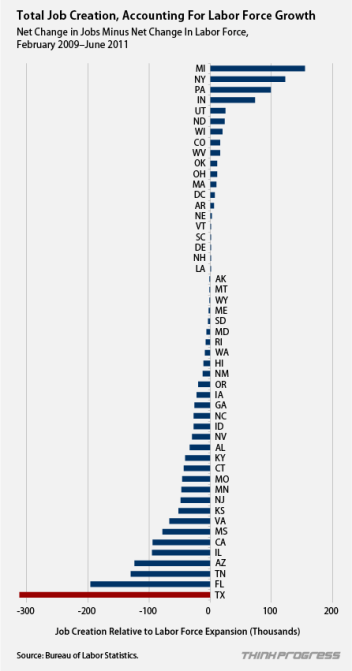
Clearly, there is no miracle for Texas here. While over 126,000 net jobs were created in Texas over the last two and a half years, the labor force expanded by over 437,000, meaning that overall Texas has added unemployed workers at a rate much faster than it has created jobs. And although states like Michigan have lost jobs (29,200 since February 2009), the state’s labor force has shrunk by over 185,000 since then. As a result, while there are fewer jobs, there are significantly less workers looking for them.
As Paul Krugman put it, “several factors underlie [Texas’] rapid population growth: a high birth rate, immigration from Mexico, and inward migration of Americans from other states, who are attracted to Texas by its warm weather and low cost of living, low housing costs in particular.” But they have little to do with Perry’s policies.
Now that certainly doesn’t make the situation in Michigan a good one, as contraction of the labor force is one side effect of the prolonged recession and unemployment there is still 10.6 percent. However if there is a real “miracle” here, it is North Dakota, which has seen over 27,000 new jobs and a labor force expansion of only 3,700, resulting in about 24,000 new jobs for workers who previously had none. But no one is proclaiming the “North Dakota miracle” and saying that Gov. Jack Dalrymple (R-ND) should be running for President.
By: Think Progress, August 17, 2011. Data for this post was compiled by Matt Separa, Research Assistant with the Economic Policy Team at the Center for American Progress Action Fund
August 18, 2011
Posted by raemd95 |
Class Warfare, Conservatives, Economic Recovery, Economy, GOP, Government, Governors, Ideologues, Ideology, Immigrants, Income Gap, Jobs, Labor, Middle Class, Politics, Republicans, Right Wing, States, Teaparty, Unemployed, Unemployment, Unions | Birth Rate, Federal Reserve Bank of Dallas, Gov Jack Dalrymple, Gov Rick Perry, Housing, Job Creation, Labor Force, Labor Force Growth, Massachusetts, Michigan, Migration, North Dakota, Population Growth, Recession, Texas, Workers |
Leave a comment


 Unknown Feed
 mykeystrokes.com
You must be logged in to post a comment.