Recall Elections Enhance Democracy: Wisconsinites Are Holding Their Elected Officials Accountable
It’s true that the recall election was never intended to replace our representative form of government, and it’s most certainly not a tool to be used lightly. However, when elected officials subvert the will of those they represent, enacting a radical agenda that seeks to concentrate power in the hands of the very few and jeopardizing the livelihoods of the people they are supposed to protect, the exercise of the constitutionally guaranteed right to force a recall election is a just and proper tool to hold those elected officials accountable for their actions.
And, although the use of the recall election is an appropriate expression of voter outrage, the fact remains that the actual undertaking of a recall election is an incredibly daunting task that requires collecting a great amount of signatures in a relatively short period of time. Here in Wisconsin, the number of valid signatures required to trigger a recall election is equal to 25 percent of the number of persons who voted in the last election for the office of governor within the electoral district of the officer sought to be recalled. Even more of a challenge, these signatures, numbering in the thousands, or possibly even hundreds of thousands, must be collected in a mere 60 days.
These requirements are incredibly stringent, and in being so, protect the integrity of the electoral process by ensuring that the recall election is not used to undermine representative democracy. Prior to the historic recall filings of the past few weeks, Wisconsin has only had four recalls of state officials, dating back to 1926, when, at the very heart of the Progressive movement, the Wisconsin Constitution was amended to provide for the recall of elected officials. Two of those four were successful.
The unprecedented efforts of thousands of engaged citizens only serve to illustrate the significance of the events of recent weeks, where the tremendous momentum against Republican legislators who enabled Gov. Scott Walker’s extreme power grab continues unabated, and where Wisconsinites continue to express their outrage over record cuts to education, healthcare, and support for our seniors and the most vulnerable, while granting tax cuts for the very rich.
It’s clear that the tide is turning in Wisconsin. The people have sent an unmistakable signal to an intransigent governor and his rubber-stamp legislature that their divisive methods and preference for placing narrow and partisan corporate interests over the people they represent have been rejected, and there is no choice now but to know that the voices of thousands of working Wisconsin families will be heard.
The actions of the Republican legislators facing recall are extreme, dangerous, and way out of step with Wisconsin values. Through the power of their ballots in recall elections, Wisconsinites have the opportunity to hold their elected officials accountable and effect immediate change so they are no longer subject to the will of politicians more concerned with promoting the agenda of their party bosses than with keeping their promises to represent the will of their constituents.
Recall elections send a direct message to elected officials—that they will be held responsible for the promises they make to the people they represent, and if they fail to keep those promises, they risk drawing the ire of the electorate.
Recall is undoubtedly a powerful tool, but it does not weaken democracy. If anything, it enhances it.
By: Mike Tate, U. S. News and World Report, May 10, 2011
Share this:
- Share on Facebook (Opens in new window) Facebook
- Share on X (Opens in new window) X
- Share on Newsvine (Opens in new window) Newsvine
- Share on Tumblr (Opens in new window) Tumblr
- Share on Reddit (Opens in new window) Reddit
- Share on Pinterest (Opens in new window) Pinterest
- Share on LinkedIn (Opens in new window) LinkedIn
- Print (Opens in new window) Print
- Email a link to a friend (Opens in new window) Email
May 10, 2011 Posted by raemd95 | Collective Bargaining, Conservatives, Constitution, Corporations, Democracy, GOP, Gov Scott Walker, Government, Lawmakers, Liberty, Politics, Public Employees, Republicans, Right Wing, State Legislatures, States, Union Busting, Unions, Wisconsin, Wisconsin Republicans | Accountability, Citizens, Education, Elected Officials, Elections, Electorate, Electorial Process, Politicians, Recalls, Seniors, Tax cuts, Wisconsin Legislature | Leave a comment
Wisconsin Recall Election Threat Prompts State Republicans To Rush Agenda
Wisconsin Republican Gov. Scott Walker and GOP leaders have launched a push to ram several years’ worth of conservative agenda items through the Legislature this spring before recall elections threaten to end the party’s control of state government.
Republicans, in a rapid sequence of votes over the next eight weeks, plan to legalize concealed weapons, deregulate the telephone industry, require voters to show photo identification at the polls, expand school vouchers and undo an early release for prisoners.
Lawmakers may also act again on Walker’s controversial plan stripping public employee unions of their collective bargaining rights. An earlier version, which led to massive protest demonstrations at the Capitol, has been left in limbo by legal challenges.
“Everything’s been accelerated,” said Republican Rep. Gary Tauchen, who is working on the photo ID bill. “We’ve got a lot of big bills we’re trying to get done.”
The speed-up is the latest move in a tumultuous legislative session that followed last fall’s midterm elections in which Republicans won the governorship and control of both houses of the Legislature. In other states where conservatives won major victories, such as Ohio, Florida and Michigan, the GOP has moved more deliberatively.
Walker got off to a fast start in January, passing a slew of measures before he unveiled a two-year budget designed to plug a $3.6 billion shortfall. That legislation, involving deep cuts to a wide range of programs, was expected to consume months. Other measures were on tap for next year. But a three-week boycott by Democrats in the winter and recall efforts targeting nine legislators have changed the strategy.
“They know there’s a very strong possibility their days of controlling every level of government are numbered,” Democratic Assembly Leader Peter Barca said. “You’re moving forward huge pieces of legislation that dramatically change the direction and traditions and values of this state. Generally, doing that takes much longer.”
Recall campaigns likely will force six Republican senators to defend their seats this summer. Three Democrats may also be on recall ballots. A net victory of three seats would give the Democrats control of the Senate, which the GOP now controls 19-14. The first elections are scheduled for July 12.
At least publicly, Wisconsin Republicans deny they’re rushing legislation for fear of losing their majority.
“Right now, I don’t foresee (losing the majority),” Assembly Speaker Jeff Fitzgerald said. “Obviously, I’m sure it will be in the back of your mind, but you’ll have to see how that plays out later this summer.”
But Rep. Robin Vos, co-chairman of the Legislature’s budget-writing committee, which will attempt to handle two months of budget legislation in half the usual time, acknowledged, “It’s a factor. For the budget, yeah, I want to get it done by June 30.”
Four of the 12 Republicans on the committee are targets of the recall.
The blitz has created an almost frantic atmosphere in the Capitol.
Major bills, like the one to legalize concealed weapons, were introduced just days before public hearings. A major revision to the photo ID proposal was released late on a Friday afternoon, just four days before a committee passed it, prompting complaints from the nonpartisan board that oversees elections.
“There has been no time for the careful evaluation and vetting needed to ensure the best options for voters and election officials is enacted,” wrote Kevin Kennedy, head of the nonpartisan Government Accountability Board.
Republican leaders scheduled a full Assembly vote on a bill deregulating the telecommunications industry only a week after a hearing, leaving little opportunity for public comment.
Walker said his plan to move his agenda is unchanged. “From our standpoint, it’s really been about being aggressive from the beginning,” he said in an interview.
At the same time lawmakers are pushing through conservative policies, they will be wrestling with Walker’s budget proposal. Walker wants to cut roughly $1 billion from schools and local governments, split the Madison campus from the University of Wisconsin System and slow the growth of Medicaid by $500 million.
The Legislature also may try to quickly pass a redistricting plan, a politically charged process that would reshape congressional and legislative districts with new 2010 census data.
If the Legislature votes again on Walker’s plan stripping public workers of their union negotiating rights, it can sidestep the legal challenges to the first vote, which came after 14 Senate Democrats fled to Illinois to deprive the Senate of a quorum. Unions and Democrats claim the original vote violated the open meetings law and the state constitution’s quorum requirement. The case is pending before the state Supreme Court.
Senate Majority Leader Scott Fitzgerald said he and other leaders are just trying to make up the time lost during the earlier turmoil. “There is an expectation that some of these bills would be completed early on,” he said.
By: Scott Bauer, Huffington Post, May 7, 2011
Share this:
- Share on Facebook (Opens in new window) Facebook
- Share on X (Opens in new window) X
- Share on Newsvine (Opens in new window) Newsvine
- Share on Tumblr (Opens in new window) Tumblr
- Share on Reddit (Opens in new window) Reddit
- Share on Pinterest (Opens in new window) Pinterest
- Share on LinkedIn (Opens in new window) LinkedIn
- Print (Opens in new window) Print
- Email a link to a friend (Opens in new window) Email
May 8, 2011 Posted by raemd95 | Class Warfare, Collective Bargaining, Conservatives, Democracy, Economy, Education, Elections, Gov Scott Walker, Government, Ideologues, Lawmakers, Medicaid, Middle Class, Politics, Public Employees, State Legislatures, States, Wisconsin, Wisconsin Republicans | Concealed Weapons, Deregulation, Government Accountability Board, Open Meetings, Recalls, Rep Gary Tauchen, School Vouchers, Telecommunications, Unions, Voter ID, Wisconsin Legislature | Leave a comment
Gov. Walker Signs Bill Blocking Milwaukee’s Paid Sick Leave Law
In 2008, Milwaukee, Wisconsin became the third city in America to guarantee workers paid sick leave, joining Washington D.C. and San Fransisco. These cities are stepping up to fill a void left by the federal government, which is content to leave America as one of the only countriesin the developed world that does not guarantee workers paid time off if they are sick.
The sick leave law was approved by referendum — with nearly 70 percent of voters in favor — and was upheld a few weeks ago by the state’s court of appeals. However, Republicans in the Wisconsin state legislature passed a bill preempting the city’s law and ensuring that no jurisdiction within the state of Wisconsin is allowed to decide it wants to mandate paid sick days. Gov. Scott Walker (R-WI) — who gained notoriety for proposing a law stripping public sector workers of their collective bargaining rights and sparking mass protests — signed the anti-sick leave bill into law today:
Gov. Scott Walker has signed a bill that prohibits local governments from passing ordinances guaranteeing workers’ paid sick and family leave…Walker, a Republican, says in a statement the bill removes another barrier to creating jobs.
But Walker’s concern about job-loss is overblown. The Drum Major Institute conducted a study examining San Francisco’s paid sick leave law and found “no evidence that businesses in San Francisco have been negatively impacted by the enactment of paid sick leave.” In fact, the U.S. economy as a whole loses $180 billion in productivity annually due to sick employees attending work and infecting other workers.
Despite Walker’s misguided action, as the National Association of Working Women noted, plenty of other cities are forging ahead with paid sick leave legislation:
In Philadelphia, a paid sick days bill was passed out of a City Council committee a few weeks ago, and in Connecticut, the state legislature is moving forward on a bill with bipartisan support. Paid sick days legislation in New York City has 35 City Council sponsors, legislation is about to be introduced in Seattle, and more than a dozen states have coalitions advocating actively for paid sick days and paid family leave policies. San Francisco and Washington, DC have already implemented paid sick days laws.
In the end, repealing Milwaukee’s paid sick leave law is simply one more way in which Walker is undertaking his assault on Wisconsin’s workers.
By: Pat Garofalo, The Wonk Room, Think Progress, May 5, 2011
Share this:
- Share on Facebook (Opens in new window) Facebook
- Share on X (Opens in new window) X
- Share on Newsvine (Opens in new window) Newsvine
- Share on Tumblr (Opens in new window) Tumblr
- Share on Reddit (Opens in new window) Reddit
- Share on Pinterest (Opens in new window) Pinterest
- Share on LinkedIn (Opens in new window) LinkedIn
- Print (Opens in new window) Print
- Email a link to a friend (Opens in new window) Email
May 6, 2011 Posted by raemd95 | Collective Bargaining, Conservatives, Democracy, Economy, GOP, Gov Scott Walker, Governors, Ideology, Jobs, Lawmakers, Middle Class, Politics, Republicans, Right Wing, State Legislatures, States, Unions, Wisconsin, Wisconsin Republicans, Women, Womens Rights | Connecticut Legislature, D. C., Local Governments, National Association of Working Women, NWC City Council, Philadelphia, San Francisco, Sick Leave, Washington, Wisconsin Court of Appeals, Wisconsin Legislature, Workers, Workers Rights | Leave a comment
Wisconsin Recalls Are Heating Up
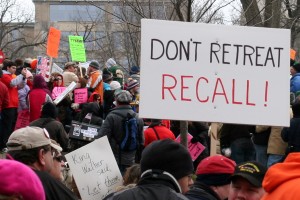
Recent protests at WI capitol
Recall elections loom on the horizon as petitions against nine Wisconsin state senators were recently submitted to the Government Accountability Board (GAB). Each successful petition must include 25 percent of the total number of votes cast in that senate district in the last election.
The recall efforts of Republican senators who supported Gov. Scott Walker’s Budget Repair Bill, and the Democratic senators who left the state to delay voting on the bill, are a result of the political firestorm that quickly flared up over the bill that sought to eliminate almost all collective bargaining rights for public workers.
Currently, the Republican senators who are facing a recall election are Alberta Darling, Robert Cowles, Sheila Harsdorf, Luther Olsen, Randy Hopper and Dan Kapanke. Democrats are facing recall efforts are — Dave Hansen, Jim Holperin and Robert Wirch.
The Milwaukee Journal Sentinel reported that there have also been petitions that didn’t have enough signatures on them to spark a recall. Democratic senators Lena Taylor and Spencer Coggs (both from Milwaukee), Senate Minority Mark Miller (Monona) and Fred Risser (Madison) all have all survived the recall attempts against them. Recall efforts against Republicans Glenn Grothman (West Bend) and Mary Lazich (New Berlin) also failed to garner sufficient support.
Circulators hired by the state Republican Party have submitted “hundreds if not thousands of invalid signatures” in recall drives targeting three Democratic state senators. Volunteers have been working overtime to enter each name into a data base and cross-check it with the phone book and other record. One man who signed a recall petition was Bill Pocan, the deceased father of State Representative Marc Pocan. The Wisconsin Democratic Party (DPW) is formally challenging all three of the recall petitions filed against Democrat senators.
Republicans have filed challenges against “all petitions targeting GOP senators. In addition to their individual signature challenges, they claim the GAB should throw out the petitions because the recall organizers did not properly register with the state.” The elections for recalled legislators with completed petitions will likely be held July 12, 2011.
By: Jennifer Page, Center for Media and Democracy, May 6, 2011
Share this:
- Share on Facebook (Opens in new window) Facebook
- Share on X (Opens in new window) X
- Share on Newsvine (Opens in new window) Newsvine
- Share on Tumblr (Opens in new window) Tumblr
- Share on Reddit (Opens in new window) Reddit
- Share on Pinterest (Opens in new window) Pinterest
- Share on LinkedIn (Opens in new window) LinkedIn
- Print (Opens in new window) Print
- Email a link to a friend (Opens in new window) Email
May 6, 2011 Posted by raemd95 | Collective Bargaining, Democracy, Elections, Gov Scott Walker, Politics, Public Employees, State Legislatures, Union Busting, Unions, Wisconsin | Activism, Government Accountability Board, Milwaukee Journal Sentinel, Recalls, Wisconsin Democratic Party, Wisconsin Legislature, Wisconsin Republicans, Wisconsin Senate | Leave a comment
Justice Delayed: Wisconsin Recall Elections To Be Held July 12
A Dane County, WI judge has approved a request by the state Government Accountability Board (GAB), which oversees elections in the state, to delay some state Senate recall elections and consolidate them into one day on July 12. In the course of making that decision, the judge turned back Democratic objections that some of their recalls should proceed as quickly as possible in June.
The Milwaukee Journal Sentinel reports:
Signatures were filed against senators starting April 1, and under tight timelines in the statutes, the first election could have been scheduled in mid-June. But Dane County Judge John W. Markson agreed to give the accountability board more time to evaluate the petitions and schedule the elections.
He agreed the board needed more time because of the unprecedented demands on evaluating tens of thousands of signatures for each recall attempt. He also noted the board is bogged down by a statewide recount in the April 5 election for state Supreme Court.
The GAB had sought the extension primarily on the grounds that the extraordinary number of recalls was straining their capacity to review signatures. On the other hand, as WisPolitics reported on Thursday, Democratic Party attorney Jeremy Levinson had argued in a court filing that delaying any of the recalls would do damage to the Dems, and create political space for the Republicans to do mischief with the extra time:
Levinson argues delaying the matter would give the incumbents an “extra-statutory” fundraising advantage, and leave representation of those districts “an open and pending question.”
In addition, Levinson argues that delaying the recall elections may result in laws being enacted that would not be if the recalls are held in the time frame permitted by statute.
“The rush to put ‘Voter ID’ and the concealed carry of firearms before the legislature — to say nothing of the pending budget — confirm that this is an entirely concrete concern,” Levinson writes.
In addition, as Jessica Arp from the local CBS affiliate reported from Judge Markson’s court hearing, Levinson also argued that the earliest petitions, against state Sen. Dan Kapanke and state Sen. Randy Hopper, were filed so quickly as a deliberate decision on the Dems’ part, in order to have the recalls move forward quickly while the issues are still fresh in the public mind.
Ultimately, though, Markson declared that it had become difficult or impossible for the GAB to meet the statutory deadline, and that the public would be better served by having the recalls held on a single day.
The state Senate currently has a 19-14 Republican majority, with Democrats hoping to pick up three seats in recall elections and win a majority, in a backlash against Gov. Scott Walker’s anti-public employee union legislation. In order to initiate a recall, signatures of at least 25 percent of the number of voters in the previous gubernatorial election, within the targeted district, must be collected in a 60-day window.
Democrats have filed recall signatures against six Republicans: Dan Kapanke, Randy Hopper, Luther Olsen, Sheila Harsdorf, Alberta Darling and Rob Cowles. Republicans have filed recall signatures against three Democrats: Dave Hansen, Jim Holperin and Robert Wirch.
Under Wisconsin’s recall law, elected officials must have served at least one year of their term before being recalled — thus exempting the half of the Senate that was just elected in 2010. In addition, Dems have also declared their intention to recall Walker himself next year, when the one-year exemption runs out.
By: Eric Kleefeld, Talking Points Memo, April 29, 2011
Share this:
- Share on Facebook (Opens in new window) Facebook
- Share on X (Opens in new window) X
- Share on Newsvine (Opens in new window) Newsvine
- Share on Tumblr (Opens in new window) Tumblr
- Share on Reddit (Opens in new window) Reddit
- Share on Pinterest (Opens in new window) Pinterest
- Share on LinkedIn (Opens in new window) LinkedIn
- Print (Opens in new window) Print
- Email a link to a friend (Opens in new window) Email
April 30, 2011 Posted by raemd95 | Collective Bargaining, Elections, Gov Scott Walker, Politics, Public Employees, State Legislatures, Unions, Voters, Wisconsin, Wisconsin Republicans | Dane County, Judge John Markson, Madison WI, Milwaukee Journal Sentinel, Randy Hopper, Recalls, Voter ID, Wisconsin Government Accountability Board, Wisconsin Legislature, Wisconsin Politics | Leave a comment
Pages
-
Join 943 other subscribers
Share This Blog


 Unknown Feed
- An error has occurred; the feed is probably down. Try again later.
Top Posts
- "A Democrat That Can Win Is What We Need": Translating Values Into Governance And Delivering The Goods
- "Is He Is, Or Is He Ain't": Will A Birther Lawsuit Derail Ted Cruz?
- "Democrats, Don’t Blow It": Ask Yourselves, Whom Would You Prefer To Name Future Supreme Court Judges?
- "A Paradox In The Making": For The GOP, Donald Trump May Be Evil Incarnate — Literally
- "Hillary Got The Debate Of Her Dreams": Showed That She’s Well Armed For Any GOP Fight
- "Romney Wants Credit For Obamacare": Mitt, 'Without Romneycare, I Don’t Think We Would Have Obamacare'
- Affordable Care Act African Americans Bain Capital Citizens United Congress Conservatives Contraception Corporations Debt Ceiling Democracy Democrats Donald Trump Economic inequality Economy Foreign Policy Fox News George W. Bush GOP GOP Presidential Candidates Government Shutdown Gun Control Gun Violence Health Exchanges Health Insurance Hillary Clinton House Republicans Immigration Immigration Reform Iraq War ISIS Jeb Bush Jobs John Boehner John McCain Koch Brothers Lindsey Graham Marco Rubio media Medicaid Medicare Middle Class Middle East Minorities Mitch McConnell Mitt Romney National Security Newt Gingrich NRA ObamaCare Paul Ryan Politics Poor and Low Income Poverty Progressives Racism Rand Paul Republicans Rick Santorum Right Wing Ronald Reagan Rush Limbaugh Scott Walker SCOTUS Senate Spending Cuts Tax cuts Taxes Tea-party Teaparty Ted Cruz Terrorism uninsured Voter Suppression Wall Street Wealthy
Categories
Archives
April 2026 M T W T F S S 1 2 3 4 5 6 7 8 9 10 11 12 13 14 15 16 17 18 19 20 21 22 23 24 25 26 27 28 29 30 Twitter Timeline
Tweets by raemd95Blog Stats
- 340,102 hits
 mykeystrokes.com
You must be logged in to post a comment.