Corporations Can Show Their Patriotism By Hiring
Former President Bush was roundly derided a decade ago for urging Americans traumatized by the September 11 attacks to go shopping. He may, in fact, have been onto something.
Certainly, shopping on its own is a facile and inadequate response to a tragedy that required a new assessment of our national security procedures and how much of our revered American civil liberties we were willing to give up to achieve security—or perhaps, a sense of security. That conversation needs to continue, especially in the area of civil liberties retrenchment.
But Bush was right about something, and that is that ours is a consumer-driven economy. This is arguably a bad basis for a modern economy; there is only so much we can consume (the obesity epidemic is only one sign of our over-indulgence). And people were foolishly taking out home equity loans on wildly over-valued properties and then using the money not to improve the property (thus, theoretically, increasing its value), but to buy other things. This is not sensible. But the reality is, our economy runs on people buying things, and with the economy in the state it’s in, people aren’t shopping anymore. Since people aren’t buying, companies aren’t creating jobs. Many corporations are making record profits and holding huge amounts of cash, but they don’t want to take on more workers because the demand is not there.
So, here’s a 10-years-after tweak of Bush’s suggestion: if corporate America wants to shows its collective patriotism, its leaders should hire someone. Hire even a dozen people, if you run a large company, or even one employee, if you own a small business. Some public officials are worried about raising taxes on the wealthy, arguing that the well-off are job creators. Well, create some jobs, first, and that argument will have more merit. And remember: taking on another employee isn’t a cash loss, ultimately, because it creates a new customer (and a taxpayer who won’t be getting unemployment insurance anymore, either). If shopping was the answer a decade ago, hiring someone is the answer now. It’s the patriotic thing to do.
By: Susan Milligan, U. S. News and World Report, September 12, 2011
Debt Ceiling: What Killed The Deal And What Might Make One Happen This Week
There are a lot of good articles running through what happened between Thursday night, when a deal seemed likely, and Friday evening, when the talks fell apart. New reports suggest that Boehner is trying to prepare a deal by tomorrow evening, to prevent the markets from dropping Monday. So here’s the short version of what just happened, and where we’re likely to be going:
On Tuesday, the Gang of Six proposed a deal that would raise tax revenues by $2 trillion — which showed there was support among Senate Republicans for a deal that raised taxes by about $2 trillion. On Thursday, congressional Democrats rebelled over reports that the deal Boehner and Obama were negotiating had only $800 billion in new revenue, and it wasn’t even clear how those would be achieved. That night, Obama called Boehner looking for about $400 billion more in revenue to have something he could sell to Democrats. That would have brought the deal from $800 billion in revenue to $1.2 trillion in revenue. He didn’t get a call back until the next day at 5:30 p.m. — by which point the call was unnecessary. Boehner had already told the media that he was leaving the talks.
Republicans are emphasizing that the White House went from asking for $800 billion in revenue to $1.2 trillion. The word you’re hearing from them is “reneged,” but the White House emphasizes that negotiations were ongoing, and both sides were asking for more as they tried to figure out what they could both agree on and pass through Congress. Boehner, for instance, wanted further cuts to Medicaid, a trigger that would repeal the individual mandate and the Independent Payment Advisory Board if the entitlement cuts didn’t come through, and a tighter cap on discretionary spending. “They make it seem like the president made some ultimatum on $1.2 trillion in revenue,” says a senior administration official. “He didn’t. He said, ‘If you can’t do this, let’s figure out what we can do.’ ”
The “what we can do” would probably have been to ratchet back the entitlement cuts. Or maybe another solution would have been found. It’s hard to say because Boehner didn’t come back with a counteroffer. He simply left the negotiations.
But let’s zoom out on where the negotiations left off. Spending cuts would have totaled about $3 trillion, with a bit less than a trillion dollars of that coming from entitlements and other forms of mandatory spending. Revenue increases — none of which would have come from raising marginal tax rates — would have been between $800 billion and $1.2 trillion. The package would have extended the unemployment insurance and payroll tax cut provisions passed in the 2010 tax deal. All in all, that’s about a trillion dollars less in revenues than the Simpson-Bowles/Gang of Six deals advocated, and about $2.6 trillion less in revenue than simply letting the Bush tax cuts expire in 2012.
There’s a question as to whether this was the very best deal Republicans could get or simply close to it. But it’s hard to believe that it was so bad that it ended the talks. What seems likelier is that Boehner spent some time between Thursday and Friday talking to his members and found that his party simply didn’t support a deal with the White House. For one thing, a deal would include some amount of revenue, and that was a hard sell under any circumstances. For another, letting the president look like a dealmaker would potentially dim the GOP’s chances of retaking the White House in 2012. As my colleague George Will put it Thursday, a deal “would enable President Obama to run away from his record and run as a debt-reducing centrist.”
And so Boehner walked. Fundamentally, this looks like the same calculation that ended the last round of talks over a 4 trillion deal. What’s different this time is Boehner’s plan B: The Speaker of the House appears to believe that a deal struck between congressional leadership would perhaps be easier to sell to his members. Since it’s hard to see Nancy Pelosi and Harry Reid making deeper concessions than Obama did, it’s hard to see why that would be true, save that the deal might not look like such a victory for the White House.
Perhaps taking the benefit for Obama off the table will be enough. I’m doubtful. It’s more likely that what we’re really doing now is wasting time until the markets plummet and Boehner’s members decide that a deal is better than no deal. And there’s a very good chance that the first major show of market concern could come tomorrow night, when the Asian markets open. Boehner is hoping to present a plan by then, but a plan is very different from a deal. A plan is something politicians can come up with. A deal, we’re increasingly finding, is something that we need the markets to force.
By: Ezra Klein, Columnist, The Washington Post, July 23, 2011
//
Republican Balanced Budget Amendment: The Worst Idea In Washington
Bruce Bartlett takes a look at the Balanced Budget Amendment all 47 Republicans signed their names to and pronounces it “quite possibly the stupidest constitutional amendment I think I have ever seen. It looks like it was drafted by a couple of interns on the back of a napkin.”
I think “stupid” is the wrong word. “Dangerous” is more like it. And maybe “radical.” This isn’t just a Balanced Budget Amendment. It also includes a provision saying that tax increases would require a two-thirds majority in both houses of Congress — so, it includes a provision making it harder to balance the budget — and another saying that total spending couldn’t exceed 18 percent of GDP. No allowances are made for recessions, though allowances are made for wars. Not a single year of the Bush administration would qualify as constitutional under this amendment. Nor would a single year of the Reagan administration. The Clinton administration would’ve had exactly two years in which it wasn’t in violation.
Read that again: Every single Senate Republican has endorsed a constitutional amendment that would’ve made Ronald Reagan’s fiscal policy unconstitutional. That’s how far to the right the modern GOP has swung.
But the problem isn’t simply that the proposed amendment is extreme. It’s also unworkable. The baby boomers are retiring and health costs are rising. Unless you have a way to stop one or the other from happening — and no one does — spending as a percentage of GDP is going to have to rise. This proposal doesn’t interrupt those trends. It simply refuses to acknowledge them — or, to be more generous, it rules them unconstitutional. This is the equivalent of trying to keep your kid cute by passing a law saying he’s not allowed to grow up.
Another problem: In a recession, tax revenue plummets and GDP stops growing, but spending has to be sustained, or even increased, to a) give people unemployment insurance and Medicaid and other services they need and b) keep the economy from contracting violently. This amendments includes no provisions for recessions, meaning that when the economy contracted, the government would have to contract as well. That is to say, we’re still not out of one of the deepest recessions in American history, and every Senate Republican has co-sponsored a constitutional amendment to make future recessions worse. It’s just breathtaking.
A world in which this amendment is added to the Constitution is a world in which America effectively becomes California. It’s a world where the procedural impediments to passing budgets and raising revenues are so immense that effective fiscal management is essentially impossible; it’s a world where we can’t make public investments or sustain the safety net; it’s a world where recessions are much worse than they currently are and the government has to do more of its work off-budget through regulation and gimmickry. I would like to say something positive about this proposal, say there’s some silver lining here. But there isn’t. This is economic demagoguery, and nothing more. It’s so unrealistic that it would’ve ruled all but two of the last 30 years unconstitutional, which means it’s so unrealistic that there has not yet been a Republican president who has proven it can be done. And that doesn’t just suggest it can’t be done: It suggests that when Republicans are actually in power and have control of the budget, they know perfectly well that it shouldn’t be done. They’re just pretending otherwise for the moment.
By: Ezra Klein, The Washington Post, April 1, 2011
Punishing the Jobless
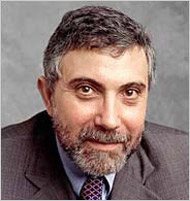
Paul Krugman-Nobel Prize Winner in Economics
There was a time when everyone took it for granted that unemployment insurance, which normally terminates after 26 weeks, would be extended in times of persistent joblessness. It was, most people agreed, the decent thing to do.
But that was then. Today, American workers face the worst job market since the Great Depression, with five job seekers for every job opening, with the average spell of unemployment now at 35 weeks. Yet the Senate went home for the holiday weekend without extending benefits. How was that possible?
The answer is that we’re facing a coalition of the heartless, the clueless and the confused. Nothing can be done about the first group, and probably not much about the second. But maybe it’s possible to clear up some of the confusion.
By the heartless, I mean Republicans who have made the cynical calculation that blocking anything President Obama tries to do — including, or perhaps especially, anything that might alleviate the nation’s economic pain — improves their chances in the midterm elections. Don’t pretend to be shocked: you know they’re out there, and make up a large share of the G.O.P. caucus.
By the clueless I mean people like Sharron Angle, the Republican candidate for senator from Nevada, who has repeatedly insisted that the unemployed are deliberately choosing to stay jobless, so that they can keep collecting benefits. A sample remark: “You can make more money on unemployment than you can going down and getting one of those jobs that is an honest job but it doesn’t pay as much. We’ve put in so much entitlement into our government that we really have spoiled our citizenry.”
Now, I don’t have the impression that unemployed Americans are spoiled; desperate seems more like it. One doubts, however, that any amount of evidence could change Ms. Angle’s view of the world — and there are, unfortunately, a lot of people in our political class just like her.
But there are also, one hopes, at least a few political players who are honestly misinformed about what unemployment benefits do — who believe, for example, that Senator Jon Kyl, Republican of Arizona, was making sense when he declared that extending benefits would make unemployment worse, because “continuing to pay people unemployment compensation is a disincentive for them to seek new work.” So let’s talk about why that belief is dead wrong.
Do unemployment benefits reduce the incentive to seek work? Yes: workers receiving unemployment benefits aren’t quite as desperate as workers without benefits, and are likely to be slightly more choosy about accepting new jobs. The operative word here is “slightly”: recent economic research suggests that the effect of unemployment benefits on worker behavior is much weaker than was previously believed. Still, it’s a real effect when the economy is doing well.
But it’s an effect that is completely irrelevant to our current situation. When the economy is booming, and lack of sufficient willing workers is limiting growth, generous unemployment benefits may keep employment lower than it would have been otherwise. But as you may have noticed, right now the economy isn’t booming — again, there are five unemployed workers for every job opening. Cutting off benefits to the unemployed will make them even more desperate for work — but they can’t take jobs that aren’t there.
Wait: there’s more. One main reason there aren’t enough jobs right now is weak consumer demand. Helping the unemployed, by putting money in the pockets of people who badly need it, helps support consumer spending. That’s why the Congressional Budget Office rates aid to the unemployed as a highly cost-effective form of economic stimulus. And unlike, say, large infrastructure projects, aid to the unemployed creates jobs quickly — while allowing that aid to lapse, which is what is happening right now, is a recipe for even weaker job growth, not in the distant future but over the next few months.
But won’t extending unemployment benefits worsen the budget deficit? Yes, slightly — but as I and others have been arguing at length, penny-pinching in the midst of a severely depressed economy is no way to deal with our long-run budget problems. And penny-pinching at the expense of the unemployed is cruel as well as misguided.
So, is there any chance that these arguments will get through? Not, I fear, to Republicans: “It is difficult to get a man to understand something,” said Upton Sinclair, “when his salary” — or, in this case, his hope of retaking Congress — “depends upon his not understanding it.” But there are also centrist Democrats who have bought into the arguments against helping the unemployed. It’s up to them to step back, realize that they have been misled — and do the right thing by passing extended benefits.
By PAUL KRUGMAN-Published: July 4, 2010 NYT Op-ED
Photo:Fred R. Conrad/The New York Times
Share This Blog


 Unknown Feed
- An error has occurred; the feed is probably down. Try again later.
 mykeystrokes.com
You must be logged in to post a comment.