“Elected Official Edition”: Lindsey Graham Presents The Worst Response To Boston So Far
Sen. Lindsey Graham (R-The Worst) has some helpful suggestions for the Obama administration and, I guess, the thousands of FBI agents and police officers currently searching for Boston Marathon bomb suspect Dzhokhar Tsarnaev, in case any of them follow him on Twitter: Don’t read Tsarnaev his rights, if you catch him alive, because terror:
The last thing we may want to do is read Boston suspect Miranda Rights telling him to “remain silent.”
— Lindsey Graham (@GrahamBlog) April 19, 2013
If captured, I hope Administration will at least consider holding the Boston suspect as enemy combatant for intelligence gathering purposes.
— Lindsey Graham (@GrahamBlog) April 19, 2013
If the #Boston suspect has ties to overseas terror organizations he could be treasure trove ofinformation.
— Lindsey Graham (@GrahamBlog) April 19, 2013
Graham wasn’t done, telling the Washington Post’s Jennifer Rubin (sigh): “This is Exhibit A of why the homeland is the battlefield.”
That is just the worst, dumbest, least helpful, wonderful (and totally predictable) response to a terror attack, Senator Graham. Making America “the battlefield” is sort of the point of terrorism (well, the point is also “killing Americans” and often “somehow causing America’s foreign policy to change in a way that is actually the opposite of the way that terrorism always makes America’s foreign policy change” but most terrorists aren’t great strategic thinkers, that is why they fucking bomb civilians).
So Tzarnaev is an American citizen, and while he may be a terrorist, terrorism is a crime. In America, when we arrest people for crimes we are required to inform the criminals that they have certain rights under the Constitution — the Constitution is this old list of rules that people like Sen. Lindsey Graham claim to revere — and we do this not just to make the criminal justice process fairer but also so that prosecutions don’t fall apart because of police misconduct.
This “don’t read terrorists their rights” line is weird nonsense even if you do think “terrorism” is a magical word that turns crime into super-crime-where-the-Constitution-doesn’t-count. Tsarnaev may be doing poorly in college, but he’s presumably watched enough television that if police tell him his rights he will not be surprised to hear them.
Anyway, Graham doesn’t even have to worry because the Supreme Court and the Justice Department have already basically rolled back Miranda to the point where once you say “terror” you basically only have to read someone their rights if you feel like it.)
Graham also told Rubin that it would be “nice to have a drone up there” because yeah what is impeding this investigation so far is that no one has access to any airborne cameras. IF ONLY WE HAD AIRBORNE CAMERAS.
This will remain the dumbest response to this week’s chaos until John McCain urges war with Russia and/or Liz Cheney urges war on Chechnya.
By: Alex Pareene, Salon, April 19, 2013
“Let’s Not Be Terrorized”: Let’s Honor Boston By Returning To Normal
Tragedies amplify the human tendencies toward both selflessness and assholishness. From a distance, watching horrible things happen (and happen, and happen) on TV, it can be much easier to see the assholishness. Yesterday an asshole planted bombs at the Boston Marathon — the Boston Marathon, for chrissakes — and today three people are confirmed dead with many, many more injured, in some cases horrifically.
That horrible situation, though, led to a great deal of examples of how Boston, and much of the U.S., is a pretty damn nice place full of impressive and great people. There was amazing journalism from Boston journalists, and a heroic response from Boston first responders, paramedics, doctors and surgeons. Boston blood banks filled up immediately and the Red Cross and Google both helped people find their loved ones. The Internet and the press even acquitted themselves reasonably well. It was amazing to see, within hours of the attack, eyewitness video from amateurs and professionals. The live stream of WBUR, Boston’s NPR news station, was compelling, restrained and informative. Fox News’ Shepard Smith was incredibly composed and also very careful not to speculate irresponsibly. The Boston Globe dropped its pay wall and put its heartbreaking and useful liveblog on the front page.
It wasn’t all good. There was no reason for Neil Cavuto to interview Joe Arpaio, at any point yesterday, and yet that happened. This was a particularly obnoxious reminder that Fox News can only turn off its shtick when a grown-up, like Shepard Smith, is running the show. (Smith returned to anchor coverage later, thankfully.) CNN’s political reporters were similarly unable to break out of their self-created shell of inanity and just react like human beings, with Wolf Blitzer and company fixated on the semantics of the president’s brief statement. The New York Post, always happy to out-ghoul the competition, was running poorly sourced bullshit all day.
That poorly sourced bullshit tends to stick around, too. The “Saudi national” “person of interest,” the New York Post’s “law enforcement source” and the “explosion” at the John F. Kennedy library. These are the random bits of information, usually false, that circulate during disasters and, inevitably, lead to conspiracy theories. This isn’t a brand-new, Internet-created problem. Morsels of misinformation broadcast on TV or the radio in the immediate aftermath of 9/11 and even the Kennedy assassination survive forever.
We still know next to nothing about what happened yesterday. The “ball bearings” that doctors are finding in victims might just be shrapnel. It seems now that there weren’t any additional unexploded devices in the area. People should probably be clearer, in the future, about the unreliability of information from emergency services scanners. Now we’ll see if the press jumps on every law enforcement lead and manages to convict innocent people in the court of public opinion, as has happened way too many times in the past following bombings and terroristic violence. Basically, be skeptical of what you see and read over the next few months.
Weirdly and probably inappropriately, I kept thinking yesterday of the 2007 incident in which Boston police closed the trains and the Charles River because a guerrilla marketing firm placed a series of LED ads for “Aqua Teen Hunger Force” around the city. It seemed at the time like the height of ridiculous post-9/11 paranoid hysterical overreaction. These were effectively LITE-BRITEs with cute cartoon aliens on them, but because they matched some idiotic police description of the characteristics of IEDs they were treated as a threat. I did not hold back in mocking them. Now, following an actual IED attack on Boston, it’s an embarrassing memory.
But here’s the thing: In terms of “sophistication,” the bombs that went off yesterday could hardly have been any more powerful than the bomb that exploded on Wall Street in 1920, which killed 38 people and injured 143. More people, many more, could die or be confirmed dead in this attack, but right now tornadoes in Mississippi and Missouri last week were just as deadly, and MBTA trains are deadlier. Whoever it turns out did this and whatever their motive, he or they sucked at being a terrorist. That is something that should be made clear, loudly and forcefully, this week. This guy was an embarrassment to terrorists and as a result we will not be terrorized.
Here is what I’m hoping happens, next: I hope Americans as a whole do nothing, besides find and punish the person responsible. As Bruce Schneier says, if we acknowledge that terrorism isn’t an existential threat to the American way of life, or to our freedom, or anything else, we can take reasonable steps to mitigate the threat without freaking out and, say, getting every flight with people who look Middle Eastern grounded, banning backpacks from public spaces or launching any wars. There is no way of stopping dedicated assholes from putting crappy little bombs in trash bins on street corners. Thankfully, it barely ever happens in the United States.
So while I feel a great deal of affection for the city of Boston and its residents today, and while I might be listening to the Modern Lovers and remembering how great the whole Mark Wahlberg arc in “The Departed” is, and while we all have every reason to be incredibly pissed off at the asshole that killed at least one child and hurt so many more innocent people, it is our responsibility to that fine American city to help it get back, as soon as possible, to normal.
Which is why as an American, and a resident of New York, I am most looking forward to when Boston returns to despising us and our stupid city and the goddamn overpaid, ancient Yankees, and we return the sentiment. That will be a return to normalcy and a message that this asshole didn’t accomplish a damn thing. In the first round of the NBA playoffs, beginning this weekend, the Boston Celtics will face the New York Knicks. There will be patriotism and solidarity on display, and certainly a tribute to the victims of yesterday’s attack. That’s understandable. Let’s also hope there is a healthy amount of booing, vulgar heckling and signs referencing Cheerios sneaked into the arena. Let the cops catch the asshole that did this; we have lives to live.
By: Alex Pareene, Salon, April 16, 2013
“Pity The Poor Immigrant”: How Jeb Bush Prevented Deportation Of An Illegal Alien And Terrorist
Between today and the first Republican primary of 2016, Jeb Bush surely will tell America exactly how government should cope with undocumented workers and their families. The former Florida governor, whose wife was born in Mexico, prompted headlines this week when his new book, Immigration Wars, seemed to abandon his earlier support for a “path to citizenship” in immigration reform and to adopt a much harder line — which he promptly dropped as well.
Unsurprisingly, Bush’s opinions on immigration are confused and confusing, not to mention ill-informed, which probably makes him a perfect leader for his party. He favored a path to citizenship for the undocumented when most Republicans opposed it; then his book warned that such a provision would encourage a renewed wave of illegal immigration; and now, as Republicans complain that he is out of step with their effort to court Latino voters, he is squirming away from his own book’s argument.
But no matter which direction Bush ultimately takes in the immigration debate, he can cite at least one Latino immigrant whose deportation he strived successfully to prevent, almost a quarter-century ago, when his father was president. The only drawback to this heartwarming humanitarian story is that the man whose cause Bush advocated was a bloodthirsty terrorist who was almost certainly responsible for the brutal murder of scores of innocent victims
In 1989, the Justice Department was seeking to deport one Orlando Bosch, a Cuban exile and anti-Castro militant who was then imprisoned for entering the United States illegally. Leaders of the Cuban-American community were agitating for Bosch’s release, although US law enforcement and intelligence authorities held Bosch culpable in many acts of brazen terror. Along with his suspected (and sometimes confessed) responsibility for various bombings and attacks on civilian and diplomatic targets, Bosch was believed to have overseen the sabotage of a Cuban airliner. The resulting explosion killed all 76 civilians aboard, including all the young members of Cuba’s Olympic fencing team, several passengers from other countries, and a pregnant mother. Corrupt Venezuelan prosecutors had failed to convict Bosch of this crime, but he publicly sought to justify the airliner bombing, almost to boast of it, when he wasn’t proffering unpersuasive denials. (He was also strongly suspected of running the conspiracy that blew up a car in Washington, D.C. in 1976 — an incident that killed Chilean diplomat Orlando Letelier and his assistant, American citizen Ronni Moffitt, in perhaps the most infamous assassination carried out by foreigners on American soil.)
Miami’s Cuban leaders considered Bosch their greatest hero and turned to Jeb Bush, then a budding businessman seeking real estate deals in South Florida, to prevent his deportation.
The Bush Justice Department wanted to deport Bosch because, according to the FBI, he had “repeatedly expressed and demonstrated a willingness to cause indiscriminate injury and death.” Attorney General Richard Thornburgh, a Bush appointee, denounced Bosch as “an unrepentant terrorist.” None of this deterred Jeb Bush from lobbying against Bosch’s deportation – and in the end, from persuading his father to pardon Bosch, which meant he could live freely and comfortably in Miami until his death in 2011 at the age of 85.
Eight years later, with the help of the same wealthy Cuban-Americans who had implored him to help Bosch, Jeb Bush had become a wealthy man and newly elected governor of Florida.
Now Bush has adopted a hard line against those who have disobeyed America’s immigration statutes. But his outrage over the flouting of those laws seems extremely selective: For the ordinary worker with impoverished family, no mercy; for the demented terrorist with powerful friends, no effort spared.
By: Joe Conason, The National Memo, March 7, 2013
Committing To A New Birth Of Freedom: It’s Time To Leave 9/11 Behind
After we honor the 10th anniversary of the attacks of Sept. 11, 2001, we need to leave the day behind. As a nation we have looked back for too long. We learned lessons from the attacks, but so many of them were wrong. The last decade was a detour that left our nation weaker, more divided and less certain of itself.
Reflections on the meaning of the horror and the years that followed are inevitably inflected by our own political or philosophical leanings. It’s a critique that no doubt applies to my thoughts as well. We see what we choose to see and use the event as we want to use it.
This does nothing to honor those who died and those who sacrificed to prevent even more suffering. In the future, the anniversary will best be reserved as a simple day of remembrance in which all of us humbly offer our respect for the anguish and the heroism of those individuals and their families.
But if we continue to place 9/11 at the center of our national consciousness, we will keep making the same mistakes. Our nation’s future depended on far more than the outcome of a vaguely defined “war on terrorism,” and it still does. Al-Qaeda is a dangerous enemy.
But our country and the world were never threatened by the caliphate of its mad fantasies.
We asked for great sacrifice over the past decade from the very small portion of our population who wear the country’s uniform, particularly the men and women of the Army and the Marine Corps. We should honor them, too. And, yes, we should pay tribute to those in the intelligence services, the FBI and our police forces who have done such painstaking work to thwart another attack.
It was often said that terrorism could not be dealt with through “police work,” as if the difficult and unheralded labor involved was not grand or bold enough to satisfy our longing for clarity in what was largely a struggle in the shadows.
Forgive me, but I find it hard to forget former president George W. Bush’s 2004 response to Sen. John Kerry’s comment that “the war on terror is less of a military operation and far more of an intelligence-gathering and law-enforcement operation.”
Bush retorted: “I disagree — strongly disagree. . . . After the chaos and carnage of September the 11th, it is not enough to serve our enemies with legal papers. With those attacks, the terrorists and their supporters declared war on the United States of America, and war is what they got.” What The Washington Post called “an era of endless war” is what we got, too.
Bush, of course, understood the importance of “intelligence gathering” and “law enforcement.” His administration presided over a great deal of both, and his supporters spoke, with justice, of his success in staving off further acts of terror. Yet he could not resist the temptation to turn on Kerry’s statement of the obvious. Thus was an event that initially united the nation used, over and over, to aggravate our political disharmony. This is also why we must put it behind us.
In the flood of anniversary commentary, notice how often the term “the lost decade” has been invoked. We know now, as we should have known all along, that American strength always depends first on our strength at home — on a vibrant, innovative and sensibly regulated economy, on levelheaded fiscal policies, on the ability of our citizens to find useful work, on the justice of our social arrangements.
This is not “isolationism.” It is a common sense that was pushed aside by the talk of “glory” and “honor,” by utopian schemes to transform the world by abruptly reordering the Middle East — and by our fears. While we worried that we would be destroyed by terrorists, we ignored the larger danger of weakening ourselves by forgetting what made us great.
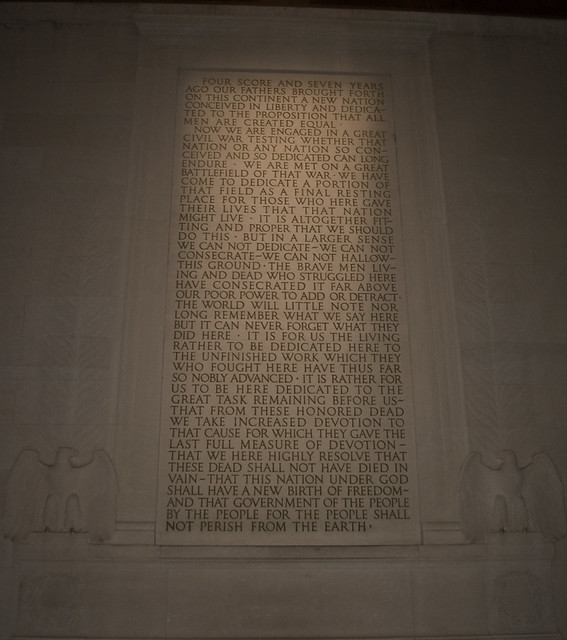
We have no alternative from now on but to look forward and not back. This does not dishonor the fallen heroes, and Lincoln explained why at Gettysburg. “We can not dedicate — we can not consecrate — we can not hallow this ground,” he said. “The brave men, living and dead, who struggled here, have consecrated it, far above our poor power to add or detract.” The best we could do, Lincoln declared, was to commit ourselves to “a new birth of freedom.” This is still our calling.
By: E. J. Dionne, Opinion Writer, The Washington Post, September 7, 2011
Dick Cheney’s Book Is Less Memoir Than Caricature
Self-reflection is not something we have come to expect in elected officials, particularly those who have left office fairly recently. But could former Vice President Dick Cheney have not even made the slightest effort to convince people he didn’t deserve the “Darth Vader” moniker assigned by his foes?
Cheney’s memoir, written with his daughter, Liz Cheney, is so unapologetic as to be a caricature. One could hardly imagine that Cheney—or even anyone from the recently-departed Bush administration—would suddenly decide that the war in Iraq had been a mistake, based on lies. But he might have acknowledged that the basis for going to war—even if one believes that it was an honest misunderstanding, instead of a craven lie—turned out to be (oops!) not true. He chides the nation for failing to live within its means, but fails to consider the fiscal impact of two wars, massive tax cuts and a huge Medicare drug entitlement program. And his no-apology book tour confirms the theme; Cheney told the Today show that he thinks waterboarding is an acceptable way for the United States to get information out of suspected terrorists, but says he’d object if another nation did it to a U.S. citizens.
Former President George Bush certainly offered no apologies in his memoir, and that’s to be expected. But Bush wasn’t mean or angry in his book. He even told a rather charming story of how an African-American staffer had brought his two young boys to the White House during the waning days of the presidency, and that one of the boys had asked, “Where’s Barack Obama?” There is characteristically nothing kind or charming or insightful to be found in Cheney’s tome. Even the cover is daunting—a grimacing Cheney inside the White House, looking like he’s deliberately trying to scare away the tourists.
The shot against former Secretary of State Condoleezza Rice is inexcusable: Cheney tells a story about how Rice had “tearfully” admitted to him that she was wrong to tell Bush that he should have apologized for misleading the American public about Saddam Hussein’s alleged attempt to secure yellowcake uranium from Niger. Whether Rice broke down before Cheney, we may never know. But to turn an accomplished woman like Rice into some silly, weak little girl is unforgivable. Agree with Rice or not. Slam her for misstating or misreading intelligence before and after 9-11 or not. But she is brilliant; she has dedicated her life to scholarship and public service, and she deserves to be treated better.
Former Secretary of State Colin Powell—who preceded Rice, and whom Cheney seems to believe was somehow hounded from office, although Powell said he had always intended to stay just one term—offers the best summation: Cheney took some “cheap shots” in the book. That’s not the reflective mindset necessary for a memoir.
By: Susan Milligan, U.S. News and World Report, August 30, 2011
Share This Blog


 Unknown Feed
- An error has occurred; the feed is probably down. Try again later.
 mykeystrokes.com