Banks May Have Illegally Foreclosed On 5,000 Members Of The Military
For months, major banks have been dealing with the fallout of the “robo-signing” scandal, following reports that the banks were improperly foreclosing on homeowners and, in many instances, falsifying paperwork that they were submitting to courts. Banks have been forced to go back and re-examine foreclosures to ensure that homeowners did not lose their homes unlawfully.
In the latest episode of this mess, the Office of the Comptroller of the Currency has found that banks — including Bank of America, Wells Fargo, and Citigroup — may have improperly foreclosed on up to 5,000 active members of the military:
Ten leading US lenders may have unlawfully foreclosed on the mortgages of nearly 5,000 active-duty members of the US military in recent years, according to data released by a federal regulator. […]
The data released by the OCC are based on estimates prepared by lenders and their consultants. BofA said it is reviewing 2,400 foreclosures involving active-duty military families to see if they were conducted properly. Wells Fargo is reviewing 870 foreclosures and Citigroup is looking at 700 cases.
Also under review are 575 foreclosures at OneWest, formerly known as IndyMac; 87 at HSBC; 80 at US Bancorp; 56 at Aurora, formerly known as Lehman Brothers Bank; 25 at MetLife; six at Sovereign; and three at EverBank.
Back in April, JPMorgan Chase, which was not one of the 10 banks that the OCC examined, agreed to a $56 million settlement over allegations that it had overcharged members of the military on their mortgages. Chase Bank has even auctioned off the home of a military member the very day that he returned from Iraq. Two other mortgage servicers agreed in May to settle charges of improperly foreclosing on servicemembers.
Even without the banks illegally foreclosing, military members have been hard hit by the foreclosure crisis. Last year alone, 20,000 members of the military faced foreclosure, a 32 percent increase over 2008. The newly created Consumer Financial Protection Bureau is tasked with ensuring that military members are treated fairly by financial services companies — a job that is obviously necessary — but Republicans in Congress have, so far, refused to confirm a director for the agency, leaving it unable to fulfill all of its responsibilities.
By: Pat Garofalo, Think Progress, November 29, 2011
Committing To A New Birth Of Freedom: It’s Time To Leave 9/11 Behind
After we honor the 10th anniversary of the attacks of Sept. 11, 2001, we need to leave the day behind. As a nation we have looked back for too long. We learned lessons from the attacks, but so many of them were wrong. The last decade was a detour that left our nation weaker, more divided and less certain of itself.
Reflections on the meaning of the horror and the years that followed are inevitably inflected by our own political or philosophical leanings. It’s a critique that no doubt applies to my thoughts as well. We see what we choose to see and use the event as we want to use it.
This does nothing to honor those who died and those who sacrificed to prevent even more suffering. In the future, the anniversary will best be reserved as a simple day of remembrance in which all of us humbly offer our respect for the anguish and the heroism of those individuals and their families.
But if we continue to place 9/11 at the center of our national consciousness, we will keep making the same mistakes. Our nation’s future depended on far more than the outcome of a vaguely defined “war on terrorism,” and it still does. Al-Qaeda is a dangerous enemy.
But our country and the world were never threatened by the caliphate of its mad fantasies.
We asked for great sacrifice over the past decade from the very small portion of our population who wear the country’s uniform, particularly the men and women of the Army and the Marine Corps. We should honor them, too. And, yes, we should pay tribute to those in the intelligence services, the FBI and our police forces who have done such painstaking work to thwart another attack.
It was often said that terrorism could not be dealt with through “police work,” as if the difficult and unheralded labor involved was not grand or bold enough to satisfy our longing for clarity in what was largely a struggle in the shadows.
Forgive me, but I find it hard to forget former president George W. Bush’s 2004 response to Sen. John Kerry’s comment that “the war on terror is less of a military operation and far more of an intelligence-gathering and law-enforcement operation.”
Bush retorted: “I disagree — strongly disagree. . . . After the chaos and carnage of September the 11th, it is not enough to serve our enemies with legal papers. With those attacks, the terrorists and their supporters declared war on the United States of America, and war is what they got.” What The Washington Post called “an era of endless war” is what we got, too.
Bush, of course, understood the importance of “intelligence gathering” and “law enforcement.” His administration presided over a great deal of both, and his supporters spoke, with justice, of his success in staving off further acts of terror. Yet he could not resist the temptation to turn on Kerry’s statement of the obvious. Thus was an event that initially united the nation used, over and over, to aggravate our political disharmony. This is also why we must put it behind us.
In the flood of anniversary commentary, notice how often the term “the lost decade” has been invoked. We know now, as we should have known all along, that American strength always depends first on our strength at home — on a vibrant, innovative and sensibly regulated economy, on levelheaded fiscal policies, on the ability of our citizens to find useful work, on the justice of our social arrangements.
This is not “isolationism.” It is a common sense that was pushed aside by the talk of “glory” and “honor,” by utopian schemes to transform the world by abruptly reordering the Middle East — and by our fears. While we worried that we would be destroyed by terrorists, we ignored the larger danger of weakening ourselves by forgetting what made us great.
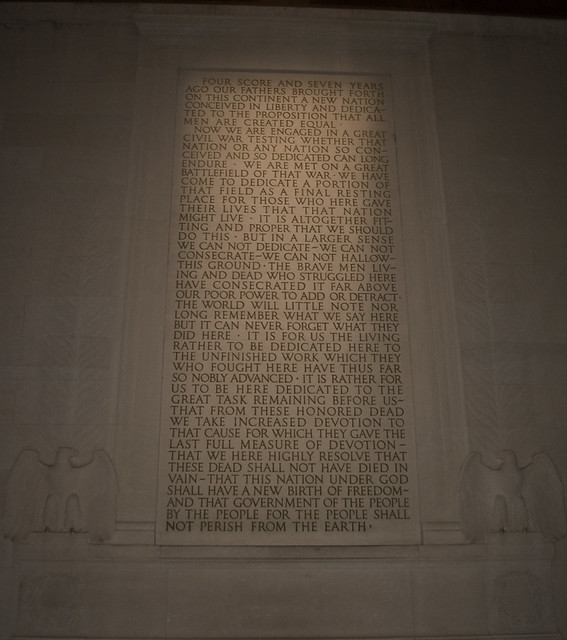
We have no alternative from now on but to look forward and not back. This does not dishonor the fallen heroes, and Lincoln explained why at Gettysburg. “We can not dedicate — we can not consecrate — we can not hallow this ground,” he said. “The brave men, living and dead, who struggled here, have consecrated it, far above our poor power to add or detract.” The best we could do, Lincoln declared, was to commit ourselves to “a new birth of freedom.” This is still our calling.
By: E. J. Dionne, Opinion Writer, The Washington Post, September 7, 2011
The GOP Is Fed Up With Its Choices
In theory, Democrats should be nervous about Texas Gov. Rick Perry’s decision to enter the presidential race. In practice, though, it’s Republicans who have zoomed up the anxiety ladder into freak-out mode.
To clarify, not all Republicans are reaching for the Xanax, just those who believe the party has to appeal to centrist independents if it hopes to defeat President Obama next year. Also, those who believe that calling Social Security “an illegal Ponzi scheme” and suggesting that Medicare is unconstitutional might not be the best way to win the votes of senior citizens.
These and other wild-eyed views are set out in Perry’s book “Fed Up!” His campaign has already begun trying to distance the governor from his words, with communications director Ray Sullivan saying last week that the book “is a look back, not a path forward” — that “Fed Up!” was intended “as a review and critique of 50 years of federal excesses, not in any way as a 2012 campaign blueprint or manifesto.”
One problem with this attempted explanation is that the book was published way back in . . . the fall of 2010. It’s reasonable to assume that if Perry held a bunch of radical, loony views less than a year ago, he holds them today.
Another problem is that as recently as Aug. 14, according to the Wall Street Journal, Perry responded to an Iowa voter who asked how he would fix entitlement programs by saying, “Have you read my book, ‘Fed Up!’? Get a copy and read it.”
But Perry doesn’t give us time to plow through his tome, what with his frequent newsmaking forays onto the rhetorical fringe. He had barely been in the race for 48 hours when he announced it would be “treasonous” for Federal Reserve Chairman Ben Bernanke to increase the money supply before the 2012 election. If Bernanke did so, Perry said, “we would treat him pretty ugly down in Texas.”
The outburst allowed Ron Paul, who has spent years calling for the Fed to be abolished, to say of Perry: “He makes me look like a moderate.”
Perry made no attempt to disavow his remarks about Bernanke. Whatever his campaign staff might wish, the candidate apparently does not warm to the task of disavowal.
Soon Perry moved on to the science of climate change, which “Fed Up!” dismisses as a “contrived phony mess.” Perry told an audience in New Hampshire that “a substantial number of scientists” have acted in bad faith, manipulating data “so that they will have dollars rolling in to their projects.” Perry added that “we’re seeing almost weekly, or even daily, scientists who are coming forward and questioning the original idea that man-made global warming is what is causing the climate to change.”
None of that is true. There is overwhelming consensus among climate scientists that human activity — especially the burning of fossil fuels — is contributing to climate change. Multiple investigations have found no evidence of fraud or manipulation of data. Unless Perry is ready to publish fundamental new insights into physical and chemical processes at the molecular level, his swaggering stance against climate science is all hat and no cattle.
“The minute that the Republican Party becomes the anti-science party, we have a huge problem,” candidate Jon Huntsman said Sunday on ABC’s “This Week” — a declaration that makes me wonder how familiar Huntsman is with the political organization he seeks to lead.
Also in his first week of campaigning, Perry suggested that the military doesn’t respect Obama as commander in chief — and, when asked whether he believes Obama loves America, told a reporter that “you need to ask him.” This is music to the ears of the hate-Obama crowd on the far right. But mainstream voters, whether or not they support Obama’s policies, generally like the president, do not question his patriotism and want him to succeed.
“I think when you find yourself at an extreme end of the Republican Party,” Huntsman said of Perry, “you make yourself unelectable.”
He’s correct. But maybe we shouldn’t take his word for it, or Ron Paul’s word — after all, they’re Perry’s opponents. Maybe we also shouldn’t take the word of Karl Rove, who called Perry’s remarks “unpresidential,” since Texas apparently isn’t big enough for the George W. Bush camp and the Rick Perry camp to coexist without feuding.
Suffice it to note that two weeks ago, GOP luminaries were scrambling to find new candidates. And now, after Perry’s debut? Still scrambling, I’m afraid.
By: Eugene Robinson, Opinion Writer, The Washington Post, August 22, 2011
Rep Peter King’s “Mockumentary”: Investigation Into Bin Laden Movie Is About 2012
The 2012 campaign is now in full force. And it’s not because there have been several GOP primary debates, or that a Republican candidate has already dropped out of the race, or even because President Obama has interrupted his can’t-we-all-act-like-adults bit to criticize Congress.
It’s because a congressman has called for an investigation into a Hollywood movie.
Kathryn Bigelow and Mark Boal, the director and screenwriter who made the Academy Award-winning film The Hurt Locker, are now at work on a movie about Osama bin Laden. This is not only understandable but predictable. Hollywood is in business to make money, and while Bigelow and Boal are surely many levels above the filmmakers who produce movies with men acting like frat boys and grown women paralyzed by inexplicable insecurity, this movie will certainly draw a crowd. But what House Homeland Security Committee Chairman Peter King worries about is that the Obama administration is providing the filmmakers with classified information to help them make the film.
White House spokesman Jay Carney dismissed the concerns as “ridiculous,” and while we can’t know for sure, it does seem a little silly. The military operation itself required intense secrecy and protection of classified information to be successful. Why release classified information now? And why would the filmmakers need classified information? We know how it started, and we know how it ended—with bin Laden shot by a U.S. Navy SEAL. That’s a pretty good movie right there, and one Americans exhausted by the toll of two wars and a recession will likely flock to see.
The real question here is not whether classified information is being given to Hollywood, but whether King’s genuine concern is timing. The movie is set to be released before the 2012 elections, arguably giving the embattled president a public relations boost right when he may need one. But does a movie make the difference? It’s unthinkable that the Obama campaign will not remind people of the huge military success of killing the most hated man in America; they don’t need Hollywood to do it. There may well be many films whose sourcing and facts are suspect—those would be the mockumentaries undoubtedly being created under the loose campaign finance rules in place since the Citizens United case was decided by the U.S. Supreme Court. Now, that’s something worth a congressional investigation.
By: Susan Milligan, U. S. News and World Report, August 16, 2011
Share This Blog


 Unknown Feed
- An error has occurred; the feed is probably down. Try again later.
 mykeystrokes.com