A Plea To Fellow Republicans — Stop Defending Sarah Palin
As a Republican, it pains my heart to watch the response to Sarah Palin’s latest gaffe. Like so many times before, Palin has put herself on the hot plate and shown that she does not know when to be quiet.
From the beginning, Republicans have squirmed through every public appearance she makes. From the 2008 debates to this current joke of a bus tour, Palin has shown she lacks the basic skills to handle pressure.
This is not a good sign in a potential candidate for the Republican nomination for president.
Why then, does Palin continue to get support from Republicans?
The latest situation with Palin messing up the history of Paul Revere is a perfect example. It is clear to anyone that saw the video that Palin had no clue what she was talking about.
It was a moment of verbal vomit that made her seem like she had never attended grade school. The entire episode could have been prevented any number of ways. Palin could have simply ignored the question and kept walking. Palin could have changed the subject.
More importantly, Palin could have actually took a moment to read about Revere before visiting so that she would be prepared for the gaggle of reporters that were sure to follow her. That would have been novel for her.
What makes the entire situation so bad, however, is the aftermath. Like so many Palin “situations” in the past, Palin is now coming out and saying she was right. She is trying to use semantics to say that the British were warned because Revere confessed to them.
Republicans are actually following suit and trying to latch onto that argument for her. That makes the party look completely ignorant right beside her.
Revere did not warn the British. Revere warned the colonists and confessed to the British. Revere did not ring bells or shoot warning shots, as this would have drawn attention and squashed the revolt before it even began.
It is clear that Palin simply tried to fake her way through this and messed up like she always does when she attempts such folly.
After a couple of years of defending and trying to make sense of Sarah Palin, it is time for Republicans to say enough. Sarah Palin had a chance to come out and say she messed up. Sarah was too arrogant to do so.
Perhaps it is time that we Republicans simply admit we messed up in backing Palin and move forward. Liberals are not afraid of Sarah Palin. That is wishful thinking to say the least.
They pray for her nomination.
By: Rodney Southern, Yahoo Contributor Network, June 6, 2011
Driving Ms. Bachmann: The Most Embarrassing Republican Presidential Candidates Of The Modern Era
For respectable Republicans, the embarrassment potential may be at an all-time high. The party is a year away from picking its next presidential candidate and never in the modern era has it faced a vacuum like this.
Sure, the odds are still strong that the GOP will ultimately settle on a “harmless enough” general election candidate — someone sufficiently generic and inoffensive to ensure that the party doesn’t fall far below its natural level of support in the fall of 2012. But the road from here to the convention looks unusually — and, if you’re a Democrat, comically — rocky for Republicans.
The party’s base — which nominated several utterly unelectable candidates in several high-stakes Senate races last year — is in revolt, thirsting for purity and likely to accede to a Romney or Pawlenty nomination only with reluctance. Before then, it figures to be tempted by an atypically large collection of red meat-spouting long shots: Michele Bachman, Newt Gingrich, John Bolton, Rick Santorum, maybe even Sarah Palin or (why not?) Herman Cain — personally and politically polarizing extremists who validate a damaging stereotype of the Obama-era GOP. It’s not impossible that one of these ideologues will fare surprisingly well in one or more of the early nominating contests next year (most likely activist-dominated Iowa).
It is this possibility that makes 2012 potentially different from previous Republican contests, in which the party has generally — but not always — succeeded in keeping the embarrassments to a minimum. Here’s a look at the most embarrassing Republican candidates to be taken (at least somewhat) seriously by the media since 1980:
1. Rep. Phil Crane — 1980
The heir to Donald Rumsfeld’s old House seat, Crane came to Congress in 1969, a Goldwater campaign veteran made good. He spent the ’70s racking up one of the most conservative voting records in the House and, in the wake of Ronald Reagan’s unsuccessful 1976 White House bid, set out to run for the presidency himself in 1980. (His theory was that Reagan, because of age and his two failed bids for the GOP nod, would end up passing on ’80, leaving Crane to gobble up “New Right” support.)
Crane’s politics weren’t really more conservative than Reagan’s, but unlike the Gipper, he didn’t know how to mask his extremism with warmth and charm. Instead, he conformed to the popular image of a far-right whacko, purchasing (for instance) 30-minute blocks of time to air a speech in which he held up the Bible and quoted from it in an effort to establish America’s Christian roots. He also attracted unwanted attention when, at the height of the campaign, he was sued by Richard Viguerie, the direct mail pioneer, for unpaid bills.
More damaging, though, was the wrath of Bill Loeb, the notoriously vengeful publisher of New Hampshire’s largest (and most conservative) newspaper, the Union-Leader. Fearful that Crane’s presence in the race would hurt Reagan, Loeb skewered him in a series of front-page editorials, then commissioned a devastating story that used anonymous sources to portray Crane as a serial philanderer with a drinking problem. The story attracted national attention and helped Loeb achieve his goal: Crane finished a distant fifth in Iowa and won only 2 percent in New Hampshire. (Years later, he would publicly admit to a drinking problem and seek treatment.)
2. Pat Robertson — 1988
The pioneering televangelist’s candidacy was the logical consequence of the rise of the Christian right, which emerged as a force and embraced the Republican Party during Jimmy Carter’s presidency.
But Robertson, the founder and president of the Christian Broadcasting Network, was a particularly kooky frontman for this movement. By the time he announced his candidacy for the ’88 GOP nod, he already had one false Armageddon prediction under his belt (1982 would be the year, he’d forecasted in ’76) and had also taken credit for using prayer to steer Hurricane Gloria away from New York City in 1985. As a candidate, he sought to present himself as a businessman more than a religious leader, bristling at suggestions that he had “followers” and accusing Tom Brokaw of religious bigotry for calling him a “televangelist” during one debate.
You can imagine, then, the profound embarrassment — and fear — that mainstream Republicans felt on the night of February 8, 1988, when Robertson finished 6 points ahead of Vice President George H.W. Bush to claim a shocking second place in the Iowa caucuses. Robertson quickly ran out of momentum — he finished dead last in New Hampshire a week later, behind even Pierre S. du Pont IV — and was blown out in South Carolina. But the Christian Coalition that he founded in the wake of his campaign played an instrumental role in creating the Republican Party that we know today.
3. Pat Buchanan — 1992 and 1996
Less than two months before announcing his challenge to Bush for the ’92 GOP nomination, Buchanan wrote a column offering advice to his party on how to win in the future: “Take a hard look” at the “portfolio of winning issues” being championed by … David Duke, the ex-Klansman who, in the fall of 1991, had won a place in Louisiana’s gubernatorial runoff (in which he was thumped by Edwin Edwards).
This was par for the course for Buchanan, who had also used his media platform to opine that women were “less equipped psychologically” than men to handle the business world and to defend accused Nazi war criminals — most notably John Demjanjuk. In the 1980s, he had also ridiculed third-world nations pushing for sanctions against apartheid South Africa, arguing that they were motivated by “racism and the resentment that failure always feels for success.”
Buchanan went on to fare alarmingly well in the ’92 New Hampshire primary, powered by the GOP electorate’s frustration with the economy and Bush’s broken “no new taxes” pledge. It was the high-water mark for Buchanan’s ’92 campaign, although it also helped him earn a prime-time speaking slot at the ’92 convention — a speech best remembered for Buchanan’s divisive declaration of “culture war” and his long-windedness, which knocked Ronald Reagan’s speech out of prime time.
Four years later, Buchanan gave the GOP an even bigger headache when he finished a close second in Iowa and then won New Hampshire, although his momentum was quickly arrested as a panicked party establishment rallied around Bob Dole.
(Note: Duke himself also sought the ’92 GOP nod, although he’s not included in this list on the grounds that — unlike the others — he was thoroughly isolated and shunned by the party’s establishment. No one respectable would touch him, not even Buchanan.)
4. Rep. Robert Dornan — 1996
A few highlights of the political career that preceded “B-1 Bob’s” absurd 1996 White House bid:
* On the House floor in 1985, he attacked fellow Rep. Tom Downey as “a draft-dodging wimp,” then grabbed the New York Democrat by his collar. Downey claimed that Dornan threatened him physically; Dornan said he’d merely been trying to straighten his tie.
* In 1993, he took the House floor to accuse President Clinton of giving “aid and comfort to the enemy” during the Vietnam War. He also branded the president “a flawed human being” and “a draft-dodging adulterer not fit to lace the boots” of America’s troops.
* In 1994, he outed fellow Rep. Steve Gunderson on the House floor, making reference to the “revolving closet door” on the Wisconsin Republican’s closet.
* During his 1992 House campaign, he bragged that “every lesbian spear-chucker in this country is hoping I get defeated.” And when Dornan was confronted by AIDS activists at a public event, his wife snapped, “Shut up, fag!”
* Court records made public in 1994 indicated that Dornan had been convicted and ordered to jail in 1996 for physically attacking his wife (although there was no record he’d actually done time). Dornan and his wife denied that any abuse had occurred and blamed the case on a drug problem she had at the time.
Dornan ran on the slogan “Faith, Family and Freedom” but struggled to raise money and assembled a staff that consisted primarily of family members. One of his final acts as a candidate came at a New Hampshire party dinner the weekend before that state’s primary. He literally begged the audience for sympathy votes, so that he would avoid the indignity of finishing with 0 percent. He didn’t get his wish.
5. Alan Keyes — 1996 and 2000
Described in one of Al Franken’s books as a “Reagan administration functionary,” Keyes entered politics in 1988, waging a hopeless Senate campaign against Democratic incumbent Paul Sarbanes in Maryland. He was trounced, but tried again four years later against Barbara Mikulski. He was slaughtered again, but this time he made national news — for taking the unusual step of giving himself a salary of $8,500 per month with campaign funds. A few years later, he set out to run for president.
Keyes ran on a platform of Puritanical morality, lashing out at America’s “licentious, self-indulgent culture,” lashing out at the Clinton administration and its “condom czars” and focusing almost obsessively on abortion. He also had this exchange with a local right-wing radio host, as reported by the Chicago Tribune:
Muller says slavery has been misconstrued by many blacks. “This whole slavery thing has been bastardized into ‘Oh, we were oppressed. Now we don’t have to do anything because of what happened 300 years ago.'” Keyes, who is black, agrees, saying the devastation imposed on black families by liberal government programs, such as welfare, has been worse than slavery.
By: Steve Kornacki, News Editor, Salon, March 31, 2011
Realism Or Politics: The Council On Foreign Relations Richard Haass Has A Credibility Problem
Meet The Press had a very interesting cast of characters today for their round table discussion on the events occuring in Libya. Panelists included Helen Cooper, White House Correspondent for the New York Times; Andrea Mitchell, NBC News Chief Foreign Affairs Correspondent; Michael Hayden, Former Director of the NSA and CIA; John Miklaszewski, NBC News Chief Pentagon Correspondent; and Richard Haass, President of The Council on Foreign Relations.
None of the input by these elitist panelist’s came as a surprise. In fact many of their responses were predictable. Cooper, Mitchell and Miklaszewski obviously wanted to use their airtime to promote their next story..to keep the news cycle going. That’s their job so more power to them. Hayden, as a George W. Bush appointee, surely would not suddenly have a change of heart and say anything contrary to the proven failed policies of that administration. Richard Haass, in symphony with Hayden, played his “bad cop” role to the hilt. Haass never seemed to miss a step in his criticism of the Obama administrations handling of Libya (excerpted comments):
David Gregory, the host (and I use that term lightly) of Meet The Press, Began the discussion: I want to talk, however, about how much is on the president’s plate right now. You talk about crisis management and a confluence of crisis. We’ve pulled together some cover stories from Time magazine–I want to put it up there on the screen–“Target Gaddafi.” The next one, “Hitting Home: Tripoli Under Attack.” And the next one, “Meltdown.”
MR. RICHARD HAASS: It’s a lot to manage, but also it raises the importance of an administration having its priorities. You’ve got a lot to manage with Japan, you’ve got a lot to manage with what’s going on in the broader Middle East, you’ve got a lot to manage what’s going on in the United States in terms of our economy and our deficit. So one of the real questions is why are we doing as much are we are doing in Libya? So many of your guests are talking about too little too late. Let me give you another idea, David, too much too late. In times of crisis and multiple crisis, administrations have to figure out their priorities. They got to do some triage. The–to me, the big problem is not what we haven’t done, it is what we are doing.
MR. GREGORY: Richard, you, you just have broad concerns as you, as you penned a piece in the Wall Street Journal earlier this month, “The US should keep out of Libya.”
MR. HAASS: Again, our interests aren’t vital. We’re talking about 2 percent of the world’s oil. Yes, there’s a humanitarian situation on, but at the risk of seeming a bit cold, it is not a humanitarian crisis on the scale say of Rwanda. We don’t have nearly 100–a million people, innocent men, women and children whose lives are threatened. This is something much more modest. This is a civil war. In civil wars, people get killed, unfortunately. But we shouldn’t kid ourselves. This is not a humanitarian intervention, this is U.S. political, military intervention in a civil conflict which, by the way, history suggests, often prolongs the civil conflict. And, as several people have already pointed out, what is step B? Whether Gadhafi complies with what we want or whether he resists successfully, either way, we are going to be stuck with the aftermath of essentially having to take ownership of Libya with others. And just because others are willing to share in something, as so many people point out, doesn’t make it a better policy. It just means the costs are going to be distributed. But the policy itself is seriously flawed.
MR. GREGORY: The big ideas and are we getting them right?
MR. HAASS: Mike Mullen says the big idea, the biggest single national security threat facing the United States is our economy, it’s our fiscal situation. This will not make it better. Instead, we are ignoring a previous secretary of state, John Quincy Adams, someone you haven’t had on the show in awhile. We are going abroad in search of monsters to destroy. There’s any number of monsters. But is this, right now, something that’s strategically necessary and vital for the United States, given all that’s happening in places like Egypt, Bahrain, Saudi Arabia, around the world, with all that we need to repair at home? The answer, I would think, is not. And that’s the big idea the administration’s missing. It’s not enough to simply want to do good around the world wherever we see bad. We’ve got to ask ourselves, where can we do good, at what cost, against what else we might have to do?
All of Haass’ comments gave me a flashback. Iran immediately came to mind. Haass, Iran..Haass, Iran. When is enough actually enough..when is enough not enough?
The answer is Mr. Haass, you’ve got a credibility problem. The following article appeared in Newsweek on January 22, 2010. It was written by none other than Richard Haass:
Enough Is Enough
Why we can no longer remain on the sidelines in the struggle for regime change in Iran.
Two schools of thought have traditionally competed to determine how America should approach the world. Realists believe we should care most about what states do beyond their borders—that influencing their foreign policy ought to be Washington’s priority. Neoconservatives often contend the opposite: they argue that what matters most is the nature of other countries, what happens inside their borders. The neocons believe this both for moral reasons and because democracies (at least mature ones) treat their neighbors better than do authoritarian regimes.
I am a card-carrying realist on the grounds that ousting regimes and replacing them with something better is easier said than done. I also believe that Washington, in most cases, doesn’t have the luxury of trying. The United States must, for example, work with undemocratic China to rein in North Korea and with autocratic Russia to reduce each side’s nuclear arsenal. This debate is anything but academic. It’s at the core of what is likely to be the most compelling international story of 2010: Iran.
In the wake of 9/11, the Bush administration judged incorrectly that Iran was on the verge of revolution and decided that dealing directly with Tehran would provide a lifeline to an evil government soon to be swept away by history’s tide. A valuable opportunity to limit Iran’s nuclear program may have been lost as a result. The incoming Obama administration reversed this approach and expressed a willingness to talk to Iran without preconditions. This president (like George H.W. Bush, whose emissaries met with Chinese leaders soon after Tiananmen Square) is cut more from the realist cloth. Diplomacy and negotiations are seen not as favors to bestow but as tools to employ. The other options—using military force against Iranian nuclear facilities or living with an Iranian nuclear bomb—were judged to be tremendously unattractive. And if diplomacy failed, Obama reasoned, it would be easier to build domestic and international support for more robust sanctions. At the time, I agreed with him.
I’ve changed my mind. The nuclear talks are going nowhere. The Iranians appear intent on developing the means to produce a nuclear weapon; there is no other explanation for the secret uranium-enrichment facility discovered near the holy city of Qum. Fortunately, their nuclear program appears to have hit some technical snags, which puts off the need to decide whether to launch a preventive strike. Instead we should be focusing on another fact: Iran may be closer to profound political change than at any time since the revolution that ousted the shah 30 years ago.
The authorities overreached in their blatant manipulation of last June’s presidential election, and then made matters worse by brutally repressing those who protested. Supreme Leader Ayatollah Ali Khamenei has lost much of his legitimacy, as has the “elected” president, Mahmoud Ahmadinejad. The opposition Green Movement has grown larger and stronger than many predicted.
The United States, European governments, and others should shift their Iran policy toward increasing the prospects for political change. Leaders should speak out for the Iranian people and their rights. President Obama did this on Dec. 28 after several protesters were killed on the Shia holy day of Ashura, and he should do so again. So should congressional and world leaders. Iran’s Revolutionary Guards should be singled out for sanctions. Lists of their extensive financial holdings can be published on the Internet. The United States should press the European Union and others not to trade or provide financing to selected entities controlled by the Guards. Just to cite one example: the Revolutionary Guards now own a majority share of Iran’s principal telecommunications firm; no company should furnish it the technology to deny or monitor Internet use.
New funding for the project housed at Yale University that documents human-rights abuses in Iran is warranted. If the U.S. government won’t reverse its decision not to provide the money, then a foundation or wealthy individuals should step in. Such a registry might deter some members of the Guards or the million-strong Basij militia it controls from attacking or torturing members of the opposition. And even if not, the gesture will signal to Iranians that the world is taking note of their struggle.
It is essential to bolster what people in Iran know. Outsiders can help to provide access to the Internet, the medium that may be the most important means for getting information into Iran and facilitating communication among the opposition. The opposition also needs financial support from the Iranian diaspora so that dissidents can stay politically active once they have lost their jobs.
Just as important as what to do is what to avoid. Congressmen and senior administration figures should avoid meeting with the regime. Any and all help for Iran’s opposition should be nonviolent. Iran’s opposition should be supported by Western governments, not led. In this vein, outsiders should refrain from articulating specific political objectives other than support for democracy and an end to violence and unlawful detention. Sanctions on Iran’s gasoline imports and refining, currently being debated in Congress, should be pursued at the United Nations so international focus does not switch from the illegality of Iran’s behavior to the legality of unilateral American sanctions. Working-level negotiations on the nuclear question should continue. But if there is an unexpected breakthrough, Iran’s reward should be limited. Full normalization of relations should be linked to meaningful reform of Iran’s politics and an end to Tehran’s support of terrorism.
Critics will say promoting regime change will encourage Iranian authorities to tar the opposition as pawns of the West. But the regime is already doing so. Outsiders should act to strengthen the opposition and to deepen rifts among the rulers. This process is underway, and while it will take time, it promises the first good chance in decades to bring about an Iran that, even if less than a model country, would nonetheless act considerably better at home and abroad. Even a realist should recognize that it’s an opportunity not to be missed.
Which is it Mr. Haass…Is the humanitarian crisis in Libya too small or is there just too little oil? Are you a realist or just another political hack?
By: raemd95: Excerpts are quotes from Meet The Press, March 20, 2011; Enough is Enough: By Richard N. Haass, originally published in Newsweek, January 22, 2010
Swing Voters Swing Because They’re Uninformed
One of my hobbyhorses is to track the movements of the Oscillating Low-Information Voter .
He is not a bad person. He may be hard-working and incredibly brilliant. He may be rich or poor or, more likely, somewhere in between. He may, in fact, be a she.
What Oscillating Low-Information Voters have in common is they pay very little attention to politics. Again, this does not imply stupidity—only ignorance. The Low-Information Voter is thus a different animal than the rational non-voter , who may keep up with the news but concludes his vote is statistically meaningless.
For whatever reason, the Low-Information Voter is simply uninformed.
His ideological preferences are transactional, and thus fluid: “What have the guys I just put in charge done for me lately?”
So what is this highly-prized, “independent” bloc of voters up to now?
A recent ABC News/Washington Post poll reveals exactly what I always expect. The Oscillating Low-Information Voter is oscillating! Polling analyst Gary Langer explains:
The drop in trust to handle the economy has occurred chiefly among independents, now drawing away from the GOP after rallying to its side. As recently as January, 42 percent of independents preferred the Republicans in Congress over Obama to handle the economy. Today just 29 percent say the same, and there’s been a rise in the number who volunteer that they don’t trust either side.
The “bottom line,” according to online political tipsheet The Note, is that “voters want results, not rhetoric.”
That would be the charitable way of putting it.
I think it’s more accurate to say that such voters are all-too-easily swayed by political rhetoric.
This is precisely the quality that makes “swing voters” swingable.
By: Scott Galupo, U.S. News and World Report, March 15, 2011
What Does The Tea Party Want?….The New Litmus Test
Jim VandeHei and Mike Allen argue that the Tea Party redefined the purpose of the GOP as opposition to spending:
The Republican Party is undergoing a messy but unmistakable 20-month transformation from fanatically anti-Obama to fanatically anti-spending, providing top party officials a new and intriguing playbook for recapturing the White House in 2012.
To understand the current evolution, flash back to late spring of 2009. The GOP was disoriented and adrift, its leadership void filled by the bombastic voices of Palin, Beck and Rush Limbaugh. There was no common conservative cause, beyond fear and loathing of Obama. No wonder swing voters were so down on them.
But the tea party, treated at first by the media as exotics, forced Republicans to focus almost exclusively on the size of government. By the time the 2010 elections rolled around, tea party activists and most independent voters were completely aligned on the need to cut, cut, cut.
Midterm election results showed that this approach offers the GOP its best – and maybe only – hope of keeping the interests of independents and tea party activists aligned enough to beat Obama.
The new litmus tests for GOP presidential hopefuls are support for repealing “Obamacare” and taking a cleaver to government spending. If a presidential candidate could harness the smaller-government conservatism, temper it enough to avoid a blatant overreach and articulate a vision for a prosperous future for the country, it’s not hard to imagine swing voters finding such a person appealing.
There’s a superficial appeal to this story. But the evidence that Tea Party activists want to cut spending — at least actual spending programs — is sparse. Polls show that Tea Party supports overwhelmingly oppose cuts to Social Security and Medicare. The main thrust of Tea Party opinion is not the belief that Obama has spent too much money, but the belief that Obama has spent too much money on people unlike them:
More than half say the policies of the administration favor the poor, and 25 percent think that the administration favors blacks over whites — compared with 11 percent of the general public.
They are more likely than the general public, and Republicans, to say that too much has been made of the problems facing black people.
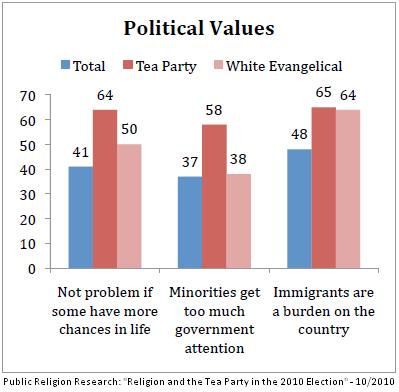
Here’s another cut, showing the Tea Party’s greater comfort with inequality of opportunity and stronger belief that the government devotes too many resources to minorities:
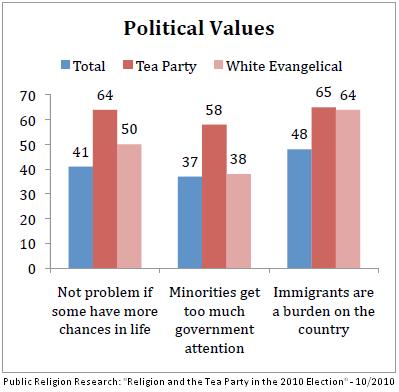
It’s a revolt against the composition of government much more than the level.
Now, it’s true that Republicans aren’t exactly translating this blueprint into action, but they’re not exactly flouting it, either. There is always a generalized antipathy toward spending amongst Republican and swing voters, but it disappears when the subject turns to actual government programs. Usually Republicans decide to just cut taxes for the rich instead. Here’s is the one part of the article proposing a defined policy change:
Even Ralph Reed, the Republican operative most tapped in to evangelicals, reflected the new GOP mindset when he gave this surprising wish list for the next presidential race: “In a perfect world, I’d like to hear the Republican nominee run on a platform that takes the capital gains tax to zero over five years.” Reed, who summoned several of the presidential candidates to Iowa for his Faith & Freedom Coalition this week, made it clear that Christian conservatives will still need to be catered to, but added that his side will understand the nominee’s need to focus on swing voters.
So an article putatively about the GOP redefining itself as an anti-spending party has one actual programmatic detail, and it’s: a zeroing out of the capital gains tax. In the name of appealing to swing voters — who, in fact, oppose tax cuts for the rich. Meet the new boss…
By: Jonathan Chait, The New Republic, March 14, 2011
Share This Blog


 Unknown Feed
- An error has occurred; the feed is probably down. Try again later.
 mykeystrokes.com

You must be logged in to post a comment.