Political “Idjits”: Is the GOP Bound for A ‘Political Jonestown’?
Once upon a time the Republican Party included a few widely-respected leaders who valued reason and flexibility — names like Eisenhower, Javitz, Weicker and a few others come to mind. Hell, Nixon was a paragon of sanity compared to some of the loons running the GOP asylum now. if this sounds overstated, read Richard Cohen’s Sunday WaPo column “A Grand Old Cult,” in which he explains:
To become a Republican, one has to take a pledge. It is not enough to support the party or mouth banalities about Ronald Reagan; one has to promise not to give the government another nickel. This is called the “Taxpayer Protection Pledge,” issued by Americans for Tax Reform, an organization headed by the chirpy Grover Norquist. He once labeled the argument that an estate tax would affect only the very rich “the morality of the Holocaust.” Anyone can see how singling out the filthy rich and the immensely powerful and asking them to ante up is pretty much the same as Auschwitz and that sort of thing….Almost all the GOP’s presidential candidates have taken this oath, swearing before God and Grover Norquist to cease thinking on their own, never to exercise independent judgment and, if necessary, to destroy the credit of the United States, raise the cost of borrowing and put the government deeper into the hole.
Cohen notes the role of revisionist history and denial in the Republicans’ increasingly unhinged worldview:
…The hallmark of a cult is to replace reason with feverish belief. This the GOP has done when it comes to the government’s ability to stimulate the economy. History proves this works — it’s how the Great Depression ended — but Republicans will not acknowledge it.The Depression in fact deepened in 1937 when Franklin D. Roosevelt tried to balance the budget and was ended entirely by World War II, which, besides being a noble cause, was also a huge stimulus program. Here, though, is Sen. Richard Shelby mouthing GOP dogma: Stimulus programs “did not bring us out of the Depression,” he recently told ABC’s Christiane Amanpour, but “the war did.” In other words, a really huge stimulus program hugely worked. Might not a more modest one succeed modestly? Shelby ought to follow his own logic.
‘Logic’ may not be the best word to describe GOP thinking in the second decade of the 21st century. Cohen notes a similar pattern of denial with respect to Republican policies on abortion and global warning, and adds,
…Independent thinkers, stop right here! If you believe in global warming, revenue enhancement, stimulus programs, the occasional need for abortion or even the fabulist theories of the late Charles Darwin, then either stay home — or lie.This intellectual rigidity has produced a GOP presidential field that’s a virtual political Jonestown. The Grand Old Party, so named when it really did evoke America, has so narrowed its base that it has become a political cult. It is a redoubt of certainty over reason and in itself significantly responsible for the government deficit that matters most: leadership. That we can’t borrow from China.
The problem for Democrats is that, when Republicans become irrational proponents of discredited ideas and failed polices, there is not much incentive for Dems to up their game. Dems are not being challenged to respond to good arguments so much as tantrums by intellectually-constipated ideologues. The public gets cheated out of an enlightening debate and everybody loses.
What puzzles is why all of the Republicans have guzzled the Koolaid. Why hasn’t it dawned on the party’s brighter bulbs, perhaps Senator Lugar or, maybe Scott Brown or Huntsman that “Hmm, I could really separate myself from the pack of idjits by taking things to a more rational level”? All indications are that the public would like to see a little more flexibility from Republicans.
There may well come a point when the Republicans’ impressive party discipline starts to look like pointless obstructionism to swing voters. The public can see that, so far only one party is compromising. If sanity prevails, the Republicans’ unspoken meme that “we’re 100 percent right, and they’re 100 percent wrong, so we won’t give an inch” can’t play much longer without diminishing returns.
By: J. P. Green, The Democratic Strategist, July 5, 2011
GOP Jobs Plan: Old Ideas, Fancy New Clip Art
Academic books pack about 600 words to a page. Normal books clock in around
400. Large-print books, you know, the ones for kids or the visually impaired — fit about 250. The House GOP’s jobs plan, however, gets about 200 words to a page. The typeface is fit for giants, and the document’s 10 pages are mostly taken up by pictures. It looks like the staffer in charge forgot the assignment was due on Thursday rather than Friday and cranked up the font to 24 points and began dumping clip art to pad out the plan.
Which is odd, because there’s nothing in this plan that hasn’t been in a thousand other plans. When I asked David Autor, an economist at the Massachusetts Institute of Technology and a specialist on labor markets, to take a look at the substance, he pronounced it a classic case of “what Larry Summers would call ‘now-more-than-everisms.”
“Here’s how it works,” Autor wrote in an e-mail. “1. You have a set of policies that you favor at all times and under all circumstances, e.g., cut taxes, remove regulations, drill-baby-drill, etc. 2. You see a problem that needs fixing (e.g., the economy stinks). 3. You say, ‘We need to enact my favored policies now more than ever.’ I believe that every item in the GOP list that you sent derives from this three-step procedure.
“That’s not to say that there are no reasonable ideas on this list. But there is certainly no original thinking here directed at addressing the employment problem. Or, to put it differently, is there any set of economic circumstances under which the GOP would not actually want to enact every item on this agenda? If the answer is no, then this is clearly now-more-than-everism.”
If you read Autor’s answer and then guessed at what’s included in the plan, you’d probably get it about right. The GOP wants a separate congressional vote on every significant regulation. It wants to cut taxes for corporations and small businesses led by individuals. It wants a tax break on profit that corporations earn overseas. It wants to pass pending trade agreements, increase domestic production of oil and enact spending cuts. The only two proposals you couldn’t have guessed sight unseen are patent reform and visas for the highly skilled.
But even if you think every item on that agenda is a grand idea, this isn’t exactly fast-acting medicine. “At best, an agenda like this is meant to improve long-term growth by a couple of tenths of a percentage point,” says Larry Mishel, president of the Economic Policy Institute. “It takes a really long time to move the dial. It’s not a response to a cyclical downturn.”
That’s okay, because the document doesn’t believe in cyclical downturns. It only believes in deviations from the Republican agenda. The first page sets out the GOP’s narrative of the unemployment crisis. See if you recognize what’s missing here: “For the past four years, Democrats in Washington have enacted policies that undermine these basic concepts which have historically placed America at the forefront of the global marketplace. As a result, most Americans know someone who has recently lost a job, and small businesses and entrepreneurs lack the confidence needed to invest in our economy. Not since the Great Depression has our nation’s unemployment rate been this high this long.”
Four years ago, of course, George W. Bush was president. And he was, as you might remember, a Republican, not a Democrat. As for Wall Street, well, Wall Street who?
But it’s not just that you could read this jobs plan without knowing the financial crisis ever happened. You could read it without knowing the past decade ever happened. As Mishel says, “If lower taxes and less regulation was such good policy, then George W. Bush’s economy would have been a lot better. But under Bush, Republicans cut taxes on business and on investors and high-income people, and they didn’t add many regulations, and that business cycle was the first one in the postwar period where the income for a typical working-class family was lower at the end than at the beginning.”
That, however, is the agenda the House GOP thinks we need. And now more than
ever.
By: Ezra Klein, Columnist, The Washington Post, May 26, 2011
The US Chamber of Commerce: Reliably, Irredeemably Wrong
What if I told you I’d found a political group that for a hundred years had managed to be absolutely right on every crucial political issue? A political lodestone, reliably pointing toward true policy north at every moment.
Sorry. But I have something almost as good: a group that manages to always get it wrong. The ultimate pie-in-the-face brigade, the gang that couldn’t lobby straight.
From the outside, you’d think the US Chamber of Commerce must know what it’s doing. It’s got a huge building right next to the White House. It spends more money on political campaigning than the Republican and Democratic National Committees combined. It spends more money on lobbying that the next five biggest lobbyists combined. And yet it has an unbroken record of error stretching back almost to its founding.
Take the New Deal, which historians have long since credited as saving capitalism in the U.S. FDR was dealing with a nation ruined by Wall Street excess—a quarter of the country unemployed, Americans starving and hopeless. He gave his first fireside chat of 1935 on April 28, and outlined a legislative program that included Social Security. The next morning , a prominent official of the Chamber of Commerce accused Roosevelt of attempting to ‘Sovietize’ America; the chamber adopted a resolution “opposing the president’s entire legislative package.”
Fast forward to the next great challenge for America. FDR, having brought America through the Depression, was trying to deal with Hitler’s rise. In the winter of 1941, with the British hard-pressed to hold off the Germans, FDR proposed what came to be called the Lend-Lease program, a way of supplying the allies with materiel they desperately needed.
Only 22% of Americans opposed the Lend Lease program—they could see who Hitler was—but that sorry number included the Chamber of Commerce. The lead story in the New York Times for February 6, 1941 began with the ringing statement from the Chamber’s president James S . Kemper that “American business men oppose American involvement in any foreign war.”
It’s not just that this was unpatriotic; it was also plain stupid, since our eventual involvement in that “foreign war” triggered the greatest boom in America’s economic history. But it’s precisely the kind of blinkered short-sightedness that has led the US Chamber of Commerce astray over and over and over again. They spent the 1950s helping Joe McCarthy root out communists in the trade unions; in the 1960s they urged the Senate to “reject as unnecessary” the idea of Medicare; in the 1980s they campaigned against a “terrible 20” burdensome rules on business, including new licensing requirements for nuclear plants and “various mine safety rules.”
As Brad Johnson, at the Center for American Progress, has detailed recently, the US Chamber has opposed virtually every attempt to rein in pollution, from stronger smog standards to a ban on the dumping of hazardous waste. (They’re hard at work as well trying to relax restrictions on US corporations bribing foreign governments, not to mention opposing the Lily Leadbetter Fair Pay Act). If there’s a modern equivalent of World War II, of course, it’s the fight against global warming. Again a majority of Americans want firm action, because they understand the planet has never faced a bigger challenge—but that action’s been completely blocked in Washington, and the US Chamber is a major reason why. They’ve lobbied against every effort to cut carbon, going so far as to insist that the EPA should stay out of the fight because, if the planet warmed, “populations can acclimatize via a range of range of behavioral, physiological, and technological adaptations.” That is to say, don’t ask a handful of coal companies to adapt their business plans, ask all species everywhere to adapt their physiologies. Grow gills, I guess.
There’s a reason the US Chamber always gets it wrong: they stand with whoever gives them the most cash (in 2009, 16 companies provided 55% of their budget). That means that they’re always on the side of short-term interest; they’re clinically, and irremediably, short-sighted. They recently published a list of the states they thought were “best for business,” and the results were almost comical—all their top prospects (Mississippi!) ranked at the very bottom of everything fromn education to life expectancy.
But that doesn’t mean that business is a force for evil. Though the US Chamber claims to represent all of American business, their constituency is really that handful of huge dinosaur companies that would rather lobby than adapt. Around America, the local chambers of commerce are filled with millions of small businesses that in fact do what capitalists are supposed to do: adapt to new conditions, thrive on change, show the nimbleness and dexterity that distinguish them from lumbering monopolies. As Chris Mead, in an excellent history of the local chambers, makes clear, there are a thousand instances where clear-sighted businesspeople understood the future. Who lured the first movie producers to southern California? The LA Chamber, which sent out a promotional brochure in 1907. Why was the Lindbergh’s plane called “The Spirit of St. Louis”? Because the St. Louis Chamber of Commerce raised the money—that was a pretty good call.
That’s why thousands and thousands of American businesses concerned about our energy future have already joined a new campaign, declaring that “The US Chamber Doesn’t Speak for Me.” They want to draw a line between themselves and the hard-right ideological ineptitude that is the US Chamber. Some of those businesses are tiny—insurance brokers in southern California, coffee roasters in Georgia, veterinarians in Oklahoma—and some are enormous. Apple Computer, for instance, which has…a pretty good record of seeing into the future.
There’s only one reason anyone pays attention to the US Chamber, and that’s their gusher of cash. But the Chamber turns 100 next year, and it’s just possible that a century of dumb decisions will outweigh even that pile of money. If you’re trying to figure out the future, study the US Chamber—and go as fast as you can in the opposite direction.
By: Bill McKibben, Commondreams.org, March 22, 2011
Punishing the Jobless
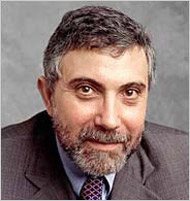
Paul Krugman-Nobel Prize Winner in Economics
There was a time when everyone took it for granted that unemployment insurance, which normally terminates after 26 weeks, would be extended in times of persistent joblessness. It was, most people agreed, the decent thing to do.
But that was then. Today, American workers face the worst job market since the Great Depression, with five job seekers for every job opening, with the average spell of unemployment now at 35 weeks. Yet the Senate went home for the holiday weekend without extending benefits. How was that possible?
The answer is that we’re facing a coalition of the heartless, the clueless and the confused. Nothing can be done about the first group, and probably not much about the second. But maybe it’s possible to clear up some of the confusion.
By the heartless, I mean Republicans who have made the cynical calculation that blocking anything President Obama tries to do — including, or perhaps especially, anything that might alleviate the nation’s economic pain — improves their chances in the midterm elections. Don’t pretend to be shocked: you know they’re out there, and make up a large share of the G.O.P. caucus.
By the clueless I mean people like Sharron Angle, the Republican candidate for senator from Nevada, who has repeatedly insisted that the unemployed are deliberately choosing to stay jobless, so that they can keep collecting benefits. A sample remark: “You can make more money on unemployment than you can going down and getting one of those jobs that is an honest job but it doesn’t pay as much. We’ve put in so much entitlement into our government that we really have spoiled our citizenry.”
Now, I don’t have the impression that unemployed Americans are spoiled; desperate seems more like it. One doubts, however, that any amount of evidence could change Ms. Angle’s view of the world — and there are, unfortunately, a lot of people in our political class just like her.
But there are also, one hopes, at least a few political players who are honestly misinformed about what unemployment benefits do — who believe, for example, that Senator Jon Kyl, Republican of Arizona, was making sense when he declared that extending benefits would make unemployment worse, because “continuing to pay people unemployment compensation is a disincentive for them to seek new work.” So let’s talk about why that belief is dead wrong.
Do unemployment benefits reduce the incentive to seek work? Yes: workers receiving unemployment benefits aren’t quite as desperate as workers without benefits, and are likely to be slightly more choosy about accepting new jobs. The operative word here is “slightly”: recent economic research suggests that the effect of unemployment benefits on worker behavior is much weaker than was previously believed. Still, it’s a real effect when the economy is doing well.
But it’s an effect that is completely irrelevant to our current situation. When the economy is booming, and lack of sufficient willing workers is limiting growth, generous unemployment benefits may keep employment lower than it would have been otherwise. But as you may have noticed, right now the economy isn’t booming — again, there are five unemployed workers for every job opening. Cutting off benefits to the unemployed will make them even more desperate for work — but they can’t take jobs that aren’t there.
Wait: there’s more. One main reason there aren’t enough jobs right now is weak consumer demand. Helping the unemployed, by putting money in the pockets of people who badly need it, helps support consumer spending. That’s why the Congressional Budget Office rates aid to the unemployed as a highly cost-effective form of economic stimulus. And unlike, say, large infrastructure projects, aid to the unemployed creates jobs quickly — while allowing that aid to lapse, which is what is happening right now, is a recipe for even weaker job growth, not in the distant future but over the next few months.
But won’t extending unemployment benefits worsen the budget deficit? Yes, slightly — but as I and others have been arguing at length, penny-pinching in the midst of a severely depressed economy is no way to deal with our long-run budget problems. And penny-pinching at the expense of the unemployed is cruel as well as misguided.
So, is there any chance that these arguments will get through? Not, I fear, to Republicans: “It is difficult to get a man to understand something,” said Upton Sinclair, “when his salary” — or, in this case, his hope of retaking Congress — “depends upon his not understanding it.” But there are also centrist Democrats who have bought into the arguments against helping the unemployed. It’s up to them to step back, realize that they have been misled — and do the right thing by passing extended benefits.
By PAUL KRUGMAN-Published: July 4, 2010 NYT Op-ED
Photo:Fred R. Conrad/The New York Times
Share This Blog


 Unknown Feed
- An error has occurred; the feed is probably down. Try again later.
 mykeystrokes.com
You must be logged in to post a comment.