Committing To A New Birth Of Freedom: It’s Time To Leave 9/11 Behind
After we honor the 10th anniversary of the attacks of Sept. 11, 2001, we need to leave the day behind. As a nation we have looked back for too long. We learned lessons from the attacks, but so many of them were wrong. The last decade was a detour that left our nation weaker, more divided and less certain of itself.
Reflections on the meaning of the horror and the years that followed are inevitably inflected by our own political or philosophical leanings. It’s a critique that no doubt applies to my thoughts as well. We see what we choose to see and use the event as we want to use it.
This does nothing to honor those who died and those who sacrificed to prevent even more suffering. In the future, the anniversary will best be reserved as a simple day of remembrance in which all of us humbly offer our respect for the anguish and the heroism of those individuals and their families.
But if we continue to place 9/11 at the center of our national consciousness, we will keep making the same mistakes. Our nation’s future depended on far more than the outcome of a vaguely defined “war on terrorism,” and it still does. Al-Qaeda is a dangerous enemy.
But our country and the world were never threatened by the caliphate of its mad fantasies.
We asked for great sacrifice over the past decade from the very small portion of our population who wear the country’s uniform, particularly the men and women of the Army and the Marine Corps. We should honor them, too. And, yes, we should pay tribute to those in the intelligence services, the FBI and our police forces who have done such painstaking work to thwart another attack.
It was often said that terrorism could not be dealt with through “police work,” as if the difficult and unheralded labor involved was not grand or bold enough to satisfy our longing for clarity in what was largely a struggle in the shadows.
Forgive me, but I find it hard to forget former president George W. Bush’s 2004 response to Sen. John Kerry’s comment that “the war on terror is less of a military operation and far more of an intelligence-gathering and law-enforcement operation.”
Bush retorted: “I disagree — strongly disagree. . . . After the chaos and carnage of September the 11th, it is not enough to serve our enemies with legal papers. With those attacks, the terrorists and their supporters declared war on the United States of America, and war is what they got.” What The Washington Post called “an era of endless war” is what we got, too.
Bush, of course, understood the importance of “intelligence gathering” and “law enforcement.” His administration presided over a great deal of both, and his supporters spoke, with justice, of his success in staving off further acts of terror. Yet he could not resist the temptation to turn on Kerry’s statement of the obvious. Thus was an event that initially united the nation used, over and over, to aggravate our political disharmony. This is also why we must put it behind us.
In the flood of anniversary commentary, notice how often the term “the lost decade” has been invoked. We know now, as we should have known all along, that American strength always depends first on our strength at home — on a vibrant, innovative and sensibly regulated economy, on levelheaded fiscal policies, on the ability of our citizens to find useful work, on the justice of our social arrangements.
This is not “isolationism.” It is a common sense that was pushed aside by the talk of “glory” and “honor,” by utopian schemes to transform the world by abruptly reordering the Middle East — and by our fears. While we worried that we would be destroyed by terrorists, we ignored the larger danger of weakening ourselves by forgetting what made us great.
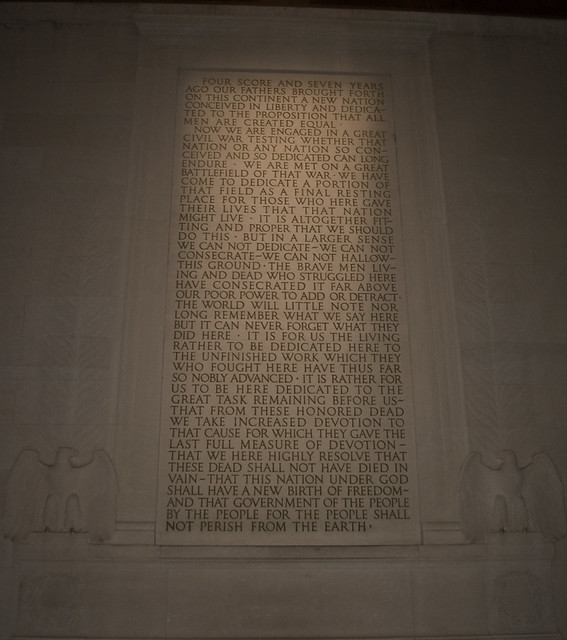
We have no alternative from now on but to look forward and not back. This does not dishonor the fallen heroes, and Lincoln explained why at Gettysburg. “We can not dedicate — we can not consecrate — we can not hallow this ground,” he said. “The brave men, living and dead, who struggled here, have consecrated it, far above our poor power to add or detract.” The best we could do, Lincoln declared, was to commit ourselves to “a new birth of freedom.” This is still our calling.
By: E. J. Dionne, Opinion Writer, The Washington Post, September 7, 2011
When Al Qaeda Endorses The GOP Line On Guns
A few weeks ago, House Republicans killed a proposal to prevent those on the FBI’s terrorist watch list from buying firearms. It’s the same party that’s supported the gun-show loophole for years.
When it comes to organizations that appreciate the Republican approach most, the National Rifle Association certainly comes to mind, but Chris Brown flags a different group that seems pleased.
In a video released [Friday] Al Qaeda spokesman Adam Gadahn encourages terrorists to use American gun shows to arm themselves for potential Mumbai-style attacks. Gadahn’s video laid out a new tactic for Al Qaeda to continue their murderous terrorist agenda:
“America is absolutely awash with easily obtainable firearms. You can go down to a gun show at the local convention center and come away with a fully automatic assault rifle, without a background check, and most likely without having to show an identification card. So what are you waiting for?”
At gun shows buyers can purchase guns from private sellers without passing a background check.
Because the discourse allows no meaningful discussion of restricting gun ownership, this news will probably spark exactly zero debate on Capitol Hill.
But it’s a reminder of just how complete the NRA’s victory really is. Al Qaeda itself is urging radicals to take advantage of loose American laws to arm themselves, presumably to aid in acts of terror … and policymakers who fear the NRA more than they fear terrorists don’t say a word.
By: Steve Benen, Contributing Writer, Washington Monthly-Political Animal, June 6, 2011
Share This Blog


 Unknown Feed
- An error has occurred; the feed is probably down. Try again later.
 mykeystrokes.com