Declaring Loyalties: Sex And Violence On Capitol Hill
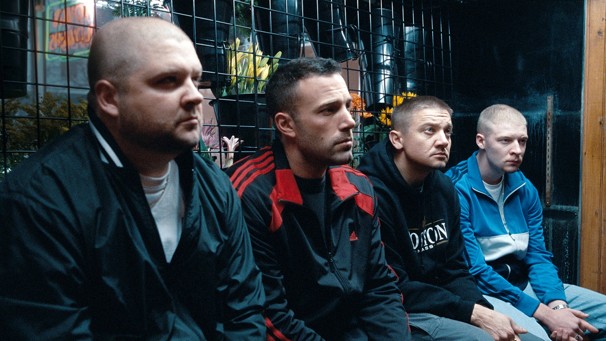
(Warner Bros./via AP) - Searching for a theme in the debt debate, the Republicans settled on honor among thieves.
The time has come in the debt-limit fight for all Americans to declare their loyalties: Are you with the bank robbers, or are you with the dirty old men?
This unpalatable choice is as good a way as any to frame the debate in these last days before the default deadline.
On one side are House Republican leaders who, facing a rebellion of Tea Party conservatives, appealed for party unity by screening for members a clip of the 2010 film “The Town,” in which Ben Affleck’s bank-robber character tells the Jeremy Renner character: “I need your help. I can’t tell you what it is, you can never ask me about it later, and we’re gonna hurt some people.” Renner replies: “Whose car we takin’?” The clip ended before the shooting and beatings that followed.
On the other side are House Democratic leaders, who had to decide how to handle Rep. David Wu (D-Ore.), accused of making unwanted sexual advances toward a teenage girl (he claims it was consensual). Wu, who previously attracted attention by sending staff members photos of himself in a tiger costume, had no choice but to resign. But leaders accepted his plan to stay on the job for the debt standoff, thereby giving them one more vote against Speaker John Boehner’s debt plan.
It’s hard to decide which wins the craven crown: Exhorting colleagues by playing for them a call to criminal violence? Or trying to thwart the opposition by tolerating a 56-year-old colleague accused of forcing himself on a friend’s daughter?
Both are evidence of how desperate the warring parties are for any fleeting advantage in the fight. Someday, Democrats may rue wooing Wu to stay with them for the budget votes, and Republicans may do penance for embracing Hollywood violence. But this is not that day.
In the Democrats’ case, Wu’s grace period was a matter of arithmetic. Without him, Boehner would need 216 votes to pass his budget-cutting plan; with him, Boehner needs 217. And so Wu released a statement that he would “resign effective upon the resolution of the debt-ceiling crisis.”
That’s a delay Democrats are apparently comfortable with, even though this was not the first time this tiger has prowled: He was disciplined in college after a woman accused him of trying to force her to have sex, the Oregonian newspaper reported several years ago.
At a news conference Wednesday, I asked Rep. Debbie Wasserman Schultz, the Democratic National Committee chairman, whether she thought Wu should go sooner — and she demurred. “I think he made the right decision to resign,” she said.
The Republicans’ problem is more complicated. Though he has made few concessions, Boehner is facing a chorus of criticism from Tea Party activists who think he has not been belligerent enough. At a breakfast organized by the Christian Science Monitor on Wednesday, the co-founders of the influential Tea Party Patriots network said a poll of their supporters found 82 percent of them dissatisfied with House leadership and 74 percent inclined to see Boehner replaced.
One of the co-founders, Mark Meckler, called Boehner’s proposed budget cuts “phantom” and “fake.” Later in the day, the leader of a smaller group called Tea Party Nation called for Boehner to be ousted. And staffers for conservative lawmakers rallied interest groups to fight against Boehner’s plan.
To resist such pressure, Majority Whip Kevin McCarthy (R-Calif.) thought the proper tone would be Affleck’s crime thriller, packed with sex, drugs, violence and profanity, and described by USA Today as having “murky morality.”
The selection evidently had the desired effect. After the clip, in which the Renner character asks whose car they’ll drive, Rep. Allen West (Fla.), a Tea Party favorite, announced to his colleagues: “I’m ready to drive the car!”
Over the next 24 hours, conservatives’ resistance to Boehner’s plan ebbed, and Wednesday morning, Rep. Louie Gohmert (Tex.), one of the few remaining holdouts, emerged from a caucus meeting feeling the pain McCarthy promised. “I’m a beat-up ‘no,’ ” he reported.
Democrats pretended to be offended by the film selection. “They could have used ‘Hoosiers,’ ‘Rudy’ or ‘Band of Brothers,’ ” protested Wasserman Schultz (the person would-be getaway car driver West called “vile” and “not a lady”). “Now is not the time to be thinking about putting the political hurt to the other party or the president.”
But Republicans have a defense. That effort to “hurt people” in “The Town” was planned as revenge on men who had hassled a young woman.
David Wu might want to take that as a warning.
American Businesses: Success Is Because Of Government, Not In Spite Of It
While big business whimpers about high statutory tax rates, the effective tax rate paid by most corporations in America is often far lower than most other developed nations (thanks to loopholes and accounting tricks). Meanwhile, corporate tax receipts accounted for 30 percent of US federal revenues in the mid-1950s. In 2009, they made up just 6.6 percent of federal revenue streams.
In other words, not only are big corporations funding a smaller percentage of our shared social safety net, they’re paying a smaller percentage into funding the future infrastructure that they desperately need.
Imagine if big business got its way and corporate taxes were slashed even further. How would businesses suffer?
What would Oprah and Henry Ford have done?
Imagine if, when Henry Ford wanted to start the Ford Motor Company, he had to not only drill for oil himself but also oversee the laying of pipelines and production infrastructure across government-owned land so his cars could have gas to make them go. And when the American auto industry was expanding in the 1940s and 50s creating jobs throughout the nation, imagine if Chrysler and General Motors had to not only build their own factories and assembly lines but actually plan and construct the roads and interstate highways for cars to drive on.
Imagine if Oprah had to regulate the television spectrum for herself and that at random, bandwidth pirates could intrude on broadcasts of the Oprah Winfrey Show because there was no Federal Communications Commission monitoring ownership of and access to the public airwaves.
Imagine if every restaurateur today had to invest in his or her own food safety teams to make sure the meat served isn’t toxic. Imagine if every small business in remote rural communities had to generate its own electricity on site because the government wouldn’t have helped fund the expansion of power lines to those distant places. Imagine if every corporation had to educate its entire workforce from childhood to adulthood because there were no public schools.
Bill Gates would have had to run phone lines.
What if, when Alexander Graham Bell invented the telephone, he couldn’t get a patent from the United States government to protect his idea? Or for that matter, if there had been no laws to protect private property and no law enforcement, Bell might have had to sit up all night with a gun guarding his invention – instead of going out in the world and figuring out how to use it. When Bill Gates wanted to start Microsoft, consider if instead of drawing on the government-created infrastructure of the original Internet (which he accessed early on in high school through the publicly funded University of Washington), Mr. Gates not only had to invent Windows, but also invent the entire World Wide Web and run the wiring for the phone lines that originally connected all his potential consumers.
When Warren Buffet launched his investing career that ultimately earned him billions, imagine if in addition to hiring lawyers to run his business, Mr. Buffett had to hire judges, too, and create entire court systems to oversee and enforce the types of binding contracts on which the stock market relies. For that matter, imagine if Buffet had to print his own currency and negotiate its value against the currencies of all other individual investors.e infrastructure of private sector success
Taxes fund the infrastructure of private sector success
Businesses in the United States don’t succeed in spite of our government, in many ways, they succeed because of our government. Through our taxes, we fund the legal and economic infrastructure of private sector success. By definition, those businesses that get the most out of that infrastructure are those that should give the most back.
At a time when economic conservatives want to slash spending that helps the poor and middle class rather than raise the already-low effective taxes of big business, it’s shameful that corporations like General Electric and Bank of America effectively pay no taxes. In the context of the larger American story, where successful businesses of today support the public infrastructure for the businesses of tomorrow, saying that corporations should pay even less is downright un-American.
By: Sally Kohn, AlterNet, July 22, 2011
Republican Paradox: The Party That Can’t Say Yes
For days, the White House has infuriated its Democratic allies in Congress by offering House Republicans more and more in exchange for a deal to raise the debt ceiling and prevent default. But it was never enough, and, on Friday evening, it became clear that it may never be enough. Speaker John Boehner again walked away from the “grand bargain” he had been negotiating with President Obama, leaving the country teetering on the brink of another economic collapse.
At the White House podium a few minutes later, the president radiated a righteous fury he rarely displays in public, finally placing the blame for this wholly unnecessary crisis squarely where it belongs: on Republicans who will do anything to upend his presidency and dismantle every social program they can find. “Can they say yes to anything?” he asked, noting the paradox of Republicans, who claim that financial responsibility and debt reduction are their biggest priorities, rejecting yet another deal that would have cut that debt by at least $3 trillion.
Mr. Obama, in fact, had already gone much too far in trying to make his deal palatable to House Republicans, offering to cut spending even further than the deficit plan proposed this week by the bipartisan “Gang of Six,” which includes some of the Senate’s most conservative members. The White House was willing to cut $1 trillion in domestic and defense spending and another $650 billion from Medicare, Medicaid and even Social Security.
Much of that savings would have come from raising the eligibility age for Medicare benefits and reducing the cost-of-living increases that elderly people depend on when receiving their health and pension benefits. It could have caused significant damage to some of the nation’s most vulnerable people.
The “bargain” would require that alongside these cuts, tax revenues would go up by $1.2 trillion, largely through a rewrite of the tax code to eliminate many deductions and loopholes. That’s substantially less in revenue than the $2 trillion in the “Gang of Six” plan. The problem is that while much of the cutting would start right away, most of the revenue increases would be put off, in part because a tax-code revision would take months, and in part to allow House Republicans to say they did not agree to any specific tax revenue increases.
Democratic lawmakers were rightly furious when they heard about these details this week, calling the plan wholly unbalanced. But, in the end, it was Mr. Boehner who torpedoed the talks. He said Friday evening that he and the president had come close to agreeing on $800 billion of the revenue increases (the equivalent of letting the upper-income Bush tax cuts expire as scheduled next year — not much of a heavy lift) but could not stomach another $400 billion the White House wanted to raise through ending tax loopholes and deductions.
So, on the eve of economic calamity, the Republicans killed an overly generous deal largely over a paltry $400 billion in deductions. Mr. Obama was willing to take considerable heat from his liberal critics over the deal, and the Republicans were not willing to do a thing to anger their Tea Party base. As the president forcefully said, there is no evidence that House Republicans are capable of making those tough decisions. If last-ditch talks beginning Saturday fail, they will have to take responsibility if the unimaginable — a government default — happens in 10 days and the checks stop going out.
By: The New York Times, Editorial, July 22, 2011
Share This Blog


 Unknown Feed
- An error has occurred; the feed is probably down. Try again later.
 mykeystrokes.com
You must be logged in to post a comment.