Social Security-Raising False Alarms
If there’s a better government program than Social Security, I’d like to know what it is. It has gone a long way toward eliminating poverty among the elderly. Great numbers of them used to live and die in ghastly, Dickensian conditions of extreme want. Without Social Security today, nearly half of all Americans aged 65 or older would be poor. With it, fewer than 10 percent live in poverty.
The Center on Budget and Policy Priorities tells us that close to 90 percent of people 65 and older get at least some of their family income from Social Security. For more than half of the elderly, it provides the majority of their income. For many, it is the only income they have.
When you see surveillance videos of some creep mugging an elderly person in an elevator or apartment lobby, the universal reaction is outrage. But when the fat cats and the ideologues want to hack away at the lifeline of Social Security, they are treated somehow as respectable, even enlightened members of the society.
We need a reality check. Attacking Social Security is both cruel and unnecessary. It needs to stop.
The demagogues would have the public believe that Social Security is unsustainable, that it is some kind of giant contributor to the federal budget deficits. Nothing could be further from the truth. As the Economic Policy Institute has explained, Social Security “is emphatically not the cause of the federal government’s long-term deficits, since it is prohibited from borrowing and must pay all benefits out of dedicated tax revenues and savings in its trust funds.”
Franklin Roosevelt couldn’t have been clearer about the crucial role of the payroll taxes used to finance Social Security. They gave the beneficiaries a “legal, moral and political right” to collect their benefits, he said. “With those taxes in there, no damn politician can ever scrap my Social Security program.”
There has always been feverish opposition on the right to Social Security. What is happening now, in a period of deficit hysteria, is that this crucial retirement program is being dishonestly lumped together with Medicare as an entitlement program that is driving federal deficits. Medicare costs are a serious problem, but that’s because of the nightmarish expansion of health care costs in general.
Beyond Medicare, the major drivers of the deficits are not talked about so much by the fat cats and demagogues because they were either responsible for them, or are reaping gargantuan benefits from them, or both. The country is drowning in a sea of debt because of the obscene Bush tax cuts for the rich, the wars in Afghanistan and Iraq that have never been paid for and the Great Recession.
Mugging the nation’s grandparents by depriving them of some of their modest, hard-earned Social Security retirement benefits is hardly an answer to the nation’s ills. And, believe me, those benefits are modest. The average benefit is just $14,000 a year, which is less than the minimum wage would pay. With employer-provided pensions going the way of the typewriter and pay telephones, the income from Social Security is becoming more precious by the day.
“If we didn’t have Social Security, we’d have to invent it right now,” said Roger Hickey, co-director of the Campaign for America’s Future. “It’s perfectly suited to the terrible times we’re going through. Hardly anyone has pensions anymore. People’s private savings have taken a huge hit, and home prices have been hit hard. So the private savings that so many seniors and soon-to-be seniors have counted on have just been wiped out.
“Social Security is still there, and it’s still paying out retirement benefits indexed to wages. It’s the one part of the retirement stool that is working.”
The deficit hawks and the right-wingers can scream all they want, but there is no Social Security crisis. There is a foreseeable problem with the program’s long-term financing, but it can be fixed with changes that do no harm to its elderly beneficiaries. One obvious step would be to raise the cap on payroll taxes so that wealthy earners shoulder a fairer share of the burden.
The alarmist rhetoric should cease. Americans have enough economic problems to worry about without being petrified that their Social Security benefits will be curtailed. A Gallup poll taken recently found that 90 percent of Americans ages 44 to 75 believed that the country was facing a retirement crisis. Nearly two-thirds were more fearful of depleting their assets than they were of dying. The fears about retirement are well placed — most Americans do not have enough to retire on. But there should be no reason to believe that Social Security is in jeopardy.
The folks who want to raise the retirement age and hack away at benefits for ordinary working Americans are inevitably those who have not the least worry about their own retirement. The haves so often get a perverse kick out of bullying the have-nots.
By: Bob Herbert, Op-Ed Columnist, The New York Times, January 24, 2011
Health Reform at Work Today and Tomorrow: Improvements That Began Last Year Will Continue
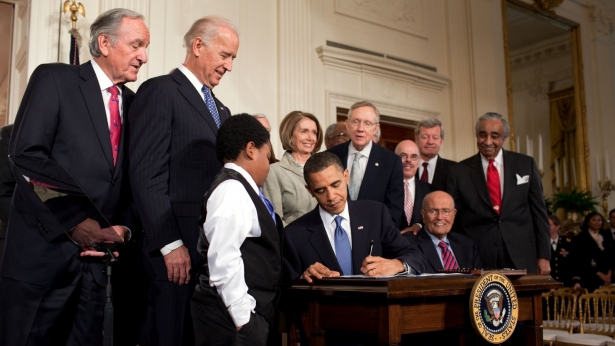
President Barack Obama is applauded as he signs the health care reform bill, on March 23, 2010, in the East Room of the White House in Washington. The bill includes many benefits for Americans who have health insurance today and those who have struggled to find and maintain health coverage.
2010 was a momentous year for the American health care system. In March, Congress passed—and President Barack Obama signed—landmark legislation that reforms the health insurance market, provides all Americans with affordable access to health coverage, and reduces the growth of health care costs.
The Department of Health and Human Services and other parts of the executive branch have begun to implement the new law in the subsequent 10 months. The Affordable Care Act, or ACA, includes many benefits for Americans who have health insurance today and those who have struggled to find and maintain health coverage. Many of these benefits came on-line in 2010.
Signature achievements include:
- Establishing pre-existing condition insurance plans in every state so that individuals with health problems who cannot find coverage in the regular market have a reliable source of coverage
- Requiring employer-sponsored health plans to offer coverage to the young-adult children of policyholders
- Helping employers with unpredictable health care spending for retired workers
- Providing more than 1 million rebate checks to Medicare enrollees who incurred high out-of-pocket prescription drug spending in 2010
- Prohibiting health insurance plans from denying coverage to children with pre-existing conditions
- Protecting individuals with high health care costs from the financial risk of absurdly low annual and lifetime limits on their benefits
- Prohibiting health insurance plans from rescinding coverage when a policyholder gets sick
These changes bring a new degree of stability and security to millions of Americans’ health coverage. And even more improvements are around the corner. Beginning this month, seniors will enjoy meaningful new benefits and significant improvements in their prescription drug coverage, while individuals and businesses will receive premium rebates from their insurance company when the insurers incur excessive administrative costs.
Specific improvements in 2011 include:
- Closing the Medicare prescription drug coverage gap. Seniors and people with disabilities who obtain prescription drug coverage through Medicare Part D will enjoy a new discount on brand-name and generic prescription drugs when they hit the so-called “doughnut hole” in their Part D benefits. Since the beginning of the program, enrollees have hit a gap in coverage when their total drug spending—including out-of-pocket costs and expenses covered by their Medicare Part D plan—exceeds a preset limit (currently $2,830). Patients then pay the total cost of their prescription drugs, without help from their drug plan, until their total drug expenses hit an upper limit and coverage kicks in again. With the new discount, people with drug spending high enough to hit the coverage gap will save almost $500 on average this year, while people with very high drug costs will save more than $1,500.
- Launching new prevention benefits for Medicare enrollees. Good coverage of preventive services helps seniors and other Medicare enrollees better manage their health. New benefits include coverage without cost-sharing for recommended preventive services (those that receive an “A” or “B” rating from the U.S. Preventive Services Task Force) and new coverage for a personal prevention plan.
- Increasing access to primary care. Medicare will pay primary care providers a 10 percent bonus payment, which offers a new incentive for physicians, nurses, and others to provide primary care services.
- Requiring insurers to provide high value for premium dollars. Beginning in 2011, insurers will pay rebates to policyholders—individuals and employers—when plan spending on clinical services falls below 80 percent of premium revenue in the individual and small group market, and 85 percent of premium revenue in the large group market.
Looking ahead, ACA provisions that will touch real people every day will continue coming on-line through 2011. These include providing more consumer information on healthy food choices by requiring chain restaurants and vending machines to provide nutritional data no later than March, and improving long-term care by sending enhanced federal Medicaid payments to support new state investments in community-based long-term care services starting in October. Tangible improvements will continue beyond this year, such as fully closing the coverage gap in Medicare Part D and improving Medicaid coverage for preventive care.
The Affordable Care Act’s most striking impact will come in 2014 when new health insurance exchanges launch, premium subsidies become available, and Medicaid coverage expands to include all low-income individuals regardless of family composition, age, or disability status.
These headline-grabbing changes in our health care system may be a few years down the road. But millions of Americans are already benefiting from the Affordable Care Act—and millions more will receive better care in the near future thanks to the changes in the new law.
By Karen Davenport | January 13, 2011-Center For American Progress. Photo: AP/Charles Dharapak
Share This Blog


 Unknown Feed
- An error has occurred; the feed is probably down. Try again later.
 mykeystrokes.com
You must be logged in to post a comment.