The Government Has Not Failed The People As It Did In 1860
For all its current shortcomings, the United States government remains intact, and the issues it faces are not as resistant to compromise as slavery, which means that 2011 was not as bad as 1860, a year that nearly ended the existence of the United States.
In 1860, “the government” failed on four distinct levels: a major political party, the legislative branch, the executive branch, and the electorate. At the Democratic National Convention in April, delegates from 10 states walked out in response to the nomination of a presidential candidate and the adoption of a platform of which they disapproved, and formed a breakaway party. That break severed one of few remaining national institutions, and opened the way for the victory of Republican candidate Abraham Lincoln. Before Lincoln took office, seven states left the Union.
Neither the legislative nor the executive branches responded well. An incendiary public letter decrying compromise issued by southern congressmen on Dece. 13, 1860, made it obvious that congressional attempts at compromise were exercises in futility. President James Buchanan simply counted days until he could get out of Washington, while members of his Cabinet, most egregiously Secretary of War John Floyd, actively aided secessionists.
Then as now, elected officials in Washington do not have a corner on blame, for if “We the people” in our Constitution’s preamble means anything, then government is not a faraway them; it is us. The electorate shares responsibility. Self-government works if and only if all parties abide by election results whether or not they like them. If a dissatisfied part of the electorate decides it need not be bound by election results, then self-government loses all legitimacy, and the American experiment in self-government fails, which was what Lincoln meant when he explained that secession in response to election results presented “to the whole family of man, the question, whether a constitutional republic, or a democracy–a government of the people, by the same people” could survive.
We may shake our heads in frustration, but we do not face issues as essentially impervious to compromise as slavery, nor do we seriously question the government’s survival, which reminds us that things could be worse. But 1860 should also remind us that if we are to look for the sources of our government’s problems, then “We the People” cannot exempt ourselves from some of the scrutiny.
By: Chandra Manning, U. S. News and World Report, December 30, 2011
The First Thanksgiving: Abraham Lincoln’s Proclamation
The first Thanksgiving was celebrated by the earliest colonists in North America, yet it was not until Abraham Lincoln in 1863 that it first became a national event, its first observance coming just one week after the dedication of the Soldiers National Cemetery at Gettysburg.
Here, according to the website of the National Park Service, is what Lincoln proclaimed:
The year that is drawing toward its close has been filled with the blessings of fruitful fields and healthful skies. To these bounties, which are so constantly enjoyed that we are prone to forget the source from which they come, others have been added, which are of so extraordinary a nature that they cannot fail to penetrate and soften the heart which is habitually insensible to the ever watchful providence of almighty God.
In the midst of a civil war of unequaled magnitude and severity, which has sometimes seemed to foreign states to invite and provoke their aggressions, peace has been preserved with all nations, order has been maintained, the laws have been respected and obeyed, and harmony has prevailed everywhere, except in the theater of military conflict; while that theater has been greatly contracted by the advancing armies and navies of the Union.
Needful diversions of wealth and of strength from the fields of peaceful industry to the national defense have not arrested the plow, the shuttle, or the ship; the ax has enlarged the borders of our settlements, and the mines, as well of iron and coal as of the precious metals, have yielded even more abundantly than heretofore. Population has steadily increased, notwithstanding the waste that has been made in the camp, the siege, and the battlefield, and the country, rejoicing in the consciousness of augmented strength and vigor, is permitted to expect continuance of years with large increase of freedom.
No human counsel hath devised, nor hath any mortal hand worked out these great things. They are the gracious gifts of the most high God, who while dealing with us in anger for our sins, hath nevertheless remembered mercy.
It has seemed to me fit and proper that they should be solemnly, reverently, and gratefully acknowledged as with one heart and one voice by the whole American people. I do, therefore, invite my fellow-citizens in every part of the United States, and also those who are at sea and those who are sojourning in foreign lands, to set apart and observe the last Thursday of November next as a day of thanksgiving and praise to our beneficent Father who dwelleth in the heavens. And I recommend to them that, while offering up the ascriptions justly due to him for such singular deliverances and blessings, they do also, with humble penitence for our national perverseness and disobedience, commend to his tender care all those who have become widows, orphans, mourners, or sufferers in the lamentable civil strife in which we are unavoidably engaged, and fervently implore the interposition of the almighty hand to heal the wounds of the nation, and to restore it, as soon as may be consistent with the Divine purposes, to the full enjoyment of peace, harmony, tranquillity, and union.
In testimony whereof, I have hereunto set my hand and caused the seal of the United Stated States to be affixed.
By: Peter Roff, U. S. News and World Report, November 24, 2011
Committing To A New Birth Of Freedom: It’s Time To Leave 9/11 Behind
After we honor the 10th anniversary of the attacks of Sept. 11, 2001, we need to leave the day behind. As a nation we have looked back for too long. We learned lessons from the attacks, but so many of them were wrong. The last decade was a detour that left our nation weaker, more divided and less certain of itself.
Reflections on the meaning of the horror and the years that followed are inevitably inflected by our own political or philosophical leanings. It’s a critique that no doubt applies to my thoughts as well. We see what we choose to see and use the event as we want to use it.
This does nothing to honor those who died and those who sacrificed to prevent even more suffering. In the future, the anniversary will best be reserved as a simple day of remembrance in which all of us humbly offer our respect for the anguish and the heroism of those individuals and their families.
But if we continue to place 9/11 at the center of our national consciousness, we will keep making the same mistakes. Our nation’s future depended on far more than the outcome of a vaguely defined “war on terrorism,” and it still does. Al-Qaeda is a dangerous enemy.
But our country and the world were never threatened by the caliphate of its mad fantasies.
We asked for great sacrifice over the past decade from the very small portion of our population who wear the country’s uniform, particularly the men and women of the Army and the Marine Corps. We should honor them, too. And, yes, we should pay tribute to those in the intelligence services, the FBI and our police forces who have done such painstaking work to thwart another attack.
It was often said that terrorism could not be dealt with through “police work,” as if the difficult and unheralded labor involved was not grand or bold enough to satisfy our longing for clarity in what was largely a struggle in the shadows.
Forgive me, but I find it hard to forget former president George W. Bush’s 2004 response to Sen. John Kerry’s comment that “the war on terror is less of a military operation and far more of an intelligence-gathering and law-enforcement operation.”
Bush retorted: “I disagree — strongly disagree. . . . After the chaos and carnage of September the 11th, it is not enough to serve our enemies with legal papers. With those attacks, the terrorists and their supporters declared war on the United States of America, and war is what they got.” What The Washington Post called “an era of endless war” is what we got, too.
Bush, of course, understood the importance of “intelligence gathering” and “law enforcement.” His administration presided over a great deal of both, and his supporters spoke, with justice, of his success in staving off further acts of terror. Yet he could not resist the temptation to turn on Kerry’s statement of the obvious. Thus was an event that initially united the nation used, over and over, to aggravate our political disharmony. This is also why we must put it behind us.
In the flood of anniversary commentary, notice how often the term “the lost decade” has been invoked. We know now, as we should have known all along, that American strength always depends first on our strength at home — on a vibrant, innovative and sensibly regulated economy, on levelheaded fiscal policies, on the ability of our citizens to find useful work, on the justice of our social arrangements.
This is not “isolationism.” It is a common sense that was pushed aside by the talk of “glory” and “honor,” by utopian schemes to transform the world by abruptly reordering the Middle East — and by our fears. While we worried that we would be destroyed by terrorists, we ignored the larger danger of weakening ourselves by forgetting what made us great.
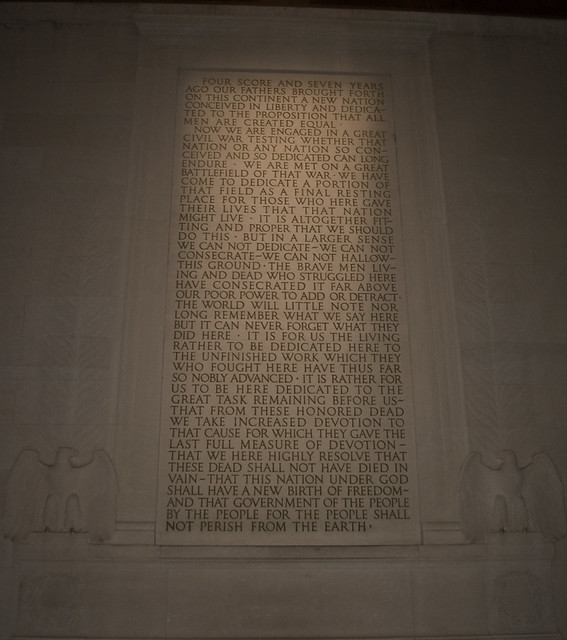
We have no alternative from now on but to look forward and not back. This does not dishonor the fallen heroes, and Lincoln explained why at Gettysburg. “We can not dedicate — we can not consecrate — we can not hallow this ground,” he said. “The brave men, living and dead, who struggled here, have consecrated it, far above our poor power to add or detract.” The best we could do, Lincoln declared, was to commit ourselves to “a new birth of freedom.” This is still our calling.
By: E. J. Dionne, Opinion Writer, The Washington Post, September 7, 2011
“In The Course Of Human Events”: The Declaration Of Interdependence
When, in the course of human events, it becomes necessary for one people to dissolve the political bonds which have connected them with another, and to assume among the powers of the earth, the separate and equal station to which the laws of Nature and of Nature’s God entitle them, a decent respect to the opinions of mankind requires that they should declare the causes which impel them to the separation.
We hold these truths to be self-evident, that all men are created equal, that they are endowed by their Creator with certain unalienable rights, that among these are life, liberty and the pursuit of happiness.
Okay, the Declaration of Interdependence sounds a lot like the Declaration of Independence.
By saying that it is a self-evident truth that all humans are created equal and that our inalienable rights include life, liberty, and the pursuit of happiness, our Founding Fathers were telling us that we are all in this together, that we are interdependent, that we have a moral duty to protect these inalienable rights for all humans. President Lincoln, perhaps above all others, was instrumental in making clear that the second sentence of the Declaration was “a moral standard for which the United States should strive,” as Wikipedia puts it.
The double appeal to “Nature” — including the explicit appeal to “the laws of Nature” in the first sentence — is particularly salient. For masters of rhetoric like the authors of the Declaration, a repeated word, especially in an opening sentence, is repeated for the singular purpose of drawing attention to it (see “Why scientists aren’t more persuasive, Part 1“).
Yes, the phrase “laws of nature” meant something different to Jefferson than it does to us (see here). But as a living document, and as a modern Declaration of Interdependence, the words have grown in meaning.
It is the laws of Nature, studied and enumerated by scientists, that make clear we are poised to render those unalienable rights all but unattainable for billions of humans on our current path of unrestricted greenhouse gas emissions. It is the laws of Nature that make clear Americans can’t achieve sustainable prosperity if the rest of the world doesn’t, and vice versa.
Ironically — or perhaps intentionally — the toughest inalienable right to maintain is “the pursuit of happiness.” Certainly, the catastrophic global warming we know we face (thanks to our understanding of the laws of nature) threatens life and liberty (see “Memorial Day, 2030“).
But if we keep listening to the deniers and delayers, if we fail to sharply reverse our current emissions path nationally and globally, then we are headed toward 5°C (9°F) planetary warming by century’s end and 850+ ppm — with sea level rise of 4 to 6 feet or higher, rising perhaps a foot a decade or more for centuries, the U.S. Southwest and one third of the Earth’s habited land a permanent Dust Bowl, half or more species extinct, and much of the ocean a hot, acidic dead zone (see “Intro to global warming impacts: Hell and High Water“).
Not bloody many people will be pursuing “happiness” under those conditions. They will be desperately trying to avoid misery, when they aren’t cursing our names for betraying our moral values.
If we don’t aggressively embrace the clean energy transition starting immediately with the climate bill in front of Congress — and help lead the entire world to a similar transition — then the Ponzi scheme we call the global economy will probably be in some stage of obvious collapse by our 250th anniversary, July 4, 2026.
That whenever any Form of Government becomes destructive of these ends, it is the Right of the People to alter or to abolish it, and to institute new Government, laying its foundation on such principles and organizing its powers in such form, as to them shall seem most likely to effect their Safety and Happiness.
And so “happiness” is repeated also, underscoring its importance to the Founders. “Life” and “Liberty” are really the very minimum we owe our fellow humans. We have a moral obligation to work toward freedom from want and care for all.
The party of Lincoln has, tragically, abandoned the values embraced and articulated by its greatest thinker and rhetorician — and those embraced and articulated by our Founders in the Declaration see (WashPost: “The GOPs climate-change denial may be its most harmful delusion”).
When is the last time a major conservative politician ever talked about “a decent respect to the opinions of mankind” except to mock the entire notion (see Gingrich sums up GOP ethos: “I am not a citizen of the world! I think the entire concept is intellectual nonsense and stunningly dangerous”).
We live in unique times. We must all hang together or we will surely all hang separately.
Happy Interdependence Day Century!
By: Joe Romm, Think Progress, July 4, 2011
Share This Blog


 Unknown Feed
- An error has occurred; the feed is probably down. Try again later.
 mykeystrokes.com