It’s true that the recall election was never intended to replace our representative form of government, and it’s most certainly not a tool to be used lightly. However, when elected officials subvert the will of those they represent, enacting a radical agenda that seeks to concentrate power in the hands of the very few and jeopardizing the livelihoods of the people they are supposed to protect, the exercise of the constitutionally guaranteed right to force a recall election is a just and proper tool to hold those elected officials accountable for their actions.
And, although the use of the recall election is an appropriate expression of voter outrage, the fact remains that the actual undertaking of a recall election is an incredibly daunting task that requires collecting a great amount of signatures in a relatively short period of time. Here in Wisconsin, the number of valid signatures required to trigger a recall election is equal to 25 percent of the number of persons who voted in the last election for the office of governor within the electoral district of the officer sought to be recalled. Even more of a challenge, these signatures, numbering in the thousands, or possibly even hundreds of thousands, must be collected in a mere 60 days.
These requirements are incredibly stringent, and in being so, protect the integrity of the electoral process by ensuring that the recall election is not used to undermine representative democracy. Prior to the historic recall filings of the past few weeks, Wisconsin has only had four recalls of state officials, dating back to 1926, when, at the very heart of the Progressive movement, the Wisconsin Constitution was amended to provide for the recall of elected officials. Two of those four were successful.
The unprecedented efforts of thousands of engaged citizens only serve to illustrate the significance of the events of recent weeks, where the tremendous momentum against Republican legislators who enabled Gov. Scott Walker’s extreme power grab continues unabated, and where Wisconsinites continue to express their outrage over record cuts to education, healthcare, and support for our seniors and the most vulnerable, while granting tax cuts for the very rich.
It’s clear that the tide is turning in Wisconsin. The people have sent an unmistakable signal to an intransigent governor and his rubber-stamp legislature that their divisive methods and preference for placing narrow and partisan corporate interests over the people they represent have been rejected, and there is no choice now but to know that the voices of thousands of working Wisconsin families will be heard.
The actions of the Republican legislators facing recall are extreme, dangerous, and way out of step with Wisconsin values. Through the power of their ballots in recall elections, Wisconsinites have the opportunity to hold their elected officials accountable and effect immediate change so they are no longer subject to the will of politicians more concerned with promoting the agenda of their party bosses than with keeping their promises to represent the will of their constituents.
Recall elections send a direct message to elected officials—that they will be held responsible for the promises they make to the people they represent, and if they fail to keep those promises, they risk drawing the ire of the electorate.
Recall is undoubtedly a powerful tool, but it does not weaken democracy. If anything, it enhances it.
By: Mike Tate, U. S. News and World Report, May 10, 2011
May 10, 2011
Posted by raemd95 |
Collective Bargaining, Conservatives, Constitution, Corporations, Democracy, GOP, Gov Scott Walker, Government, Lawmakers, Liberty, Politics, Public Employees, Republicans, Right Wing, State Legislatures, States, Union Busting, Unions, Wisconsin, Wisconsin Republicans | Accountability, Citizens, Education, Elected Officials, Elections, Electorate, Electorial Process, Politicians, Recalls, Seniors, Tax cuts, Wisconsin Legislature |
Leave a comment
To the anti-union governors, the Tea Partyers, the whiner down the street who is convinced that everyone in the public sector enjoys a high salary and benefits for doing a cushy job, let us consider the government worker whose effort we have witnessed in the past week.
Let’s start with all the career intelligence staffers—and this includes those who worked under the Bush administration—who have been looking for clues for a decade to chase down and capture or kill Osama bin Laden. These include people who may have had small successes that led to last week’s big success. Or they may have had enormous successes we don’t even know about: Who can say how many major terrorist attacks our teams at the CIA, the Department of Homeland Security, the White House, and the Pentagon have averted through good intelligence work? They can’t say. It would endanger their work. And when people complain about what they do—or don’t do—they just have to suck it up and keep quiet, lest they tip off terrorists.
There are some pretty high-level government workers to thank—President Obama and Secretary of State Hillary Clinton. First, kudos to Obama for offering Clinton the job at State after a bruising and testy primary fight. Kudos to Clinton, as well, for accepting it. Being in government service, at any level, means setting aside personal gripes for the sake of the public. They both did that. And if Clinton had a problem with the United States going into Pakistan to get bin Laden—an idea she questioned during the primary campaign—she surely got over it, and presumably was deeply involved in the diplomatic gymnastics required before and after the raid.
And how about the Navy SEALs, who are, after all, government workers as well? They conducted a brilliant surgical strike on the most wanted man in the world, and we will likely never know their names, never be able to approach them on the street just to say thanks. They’re used to that; they are, I imagine, OK with that. Service isn’t about personal aggrandizement or fame. It’s about doing your job, sometimes anonymously.
And underneath these teams are the support staff who helped the intelligence workers and high-ranking officials and military people do their jobs. They, too, helped make this mission happen.
To the antigovernment forces who repeatedly ask the (hopefully) rhetorical question, “What good is government? Name me one government program that has worked.” Of course, we can start with roads and bridges, public libraries, Social Security, public education, and a raft of other items. But for those who can’t even see the value in those public works, we have the teams that worked for a decade, over two administrations, to get bin Laden. This is what your government does, and it was carried out by government workers. They deserve thanks—not derision.
By: Susan Milligan, U. S. News and Worl Report, May 9, 2011
May 9, 2011
Posted by raemd95 |
Big Government, Conservatives, Democracy, Foreign Policy, GOP, Ground Zero, Homeland Security, Ideologues, Ideology, Middle East, National Security, Neo-Cons, Pentagon, Politics, President Obama, Public Employees, Republicans, Tea Party, Terrorism, Union Busting, Unions | Anti-Government, Anti-Union, CIA, Government Workers, Navy Seals, Osama bin Laden, Pakistan, Sec Hilary Clinton, Terrorists, U S Military |
Leave a comment
Lawmakers in New Hampshire and Missouri are advancing so-called right-to-work bills that would allow private-sector workers to opt out of joining unions, the latest such efforts to curb labor unions in the legislative season that in many states is now entering the home stretch.
The measures, if successful, would mark the first expansion in a decade of right-to-work laws, which are on the books in 22 states.
Lawmakers in New Hampshire, where Republicans took control of both chambers last fall, passed a right-to-work measure last week. Its success will hinge on whether the state House of Representatives has enough votes to override a promised veto by Democratic Gov. John Lynch. If the bill passes, New Hampshire would become the first right-to-work state in the Northeast, historically a union stronghold.
In Missouri, the sponsor of a state Senate right-to-work bill is trying to shape a compromise in the final days of the legislative session.
Right-to-work measures were proposed in 18 states this year, an unusually high number that labor experts attribute to state budget and economic woes, GOP gains in November and influence by tea-party groups that oppose unions’ political clout. Ohio and Wisconsin didn’t pass specific right-to-work legislation but did adopt laws allowing public-sector employees to opt out of paying dues. The laws generally are backed by business groups and Republicans, opposed by Democrats and denounced by labor.
Most of the bills proposed this year likely are not far enough along to pass before legislative sessions end. Others died during negotiations. In Indiana, for instance, where Democrats fled the state in part to protest such a measure, House Republicans abandoned the idea to get them back to the table.
Still, the large number of proposals demonstrate the growing momentum of the idea. Legislators in many states say they will take up similar measures next year.
Right-to-work legislation is typically among the most contentious. A key contributor to the states’ red ink, advocates say, is public-employee benefits and pensions set by generous union contracts. Additionally, advocates say, the slow economy and a desire to create jobs has revived the issue.
“The political equation has changed in a lot of states,” said Michael Eastman, executive director of labor policy for the U.S. Chamber of Commerce. “Measures that may not have been possible two and four and six years ago now may be.”
But unions view such measures as a political attack, aimed at curbing their influence. The laws threaten unions because they permit workers to opt out of joining or paying dues in unionized workplaces. Dues are a key source of funds for political efforts, and higher numbers of workers give unions more clout during contract talks. Without right-to-work laws, workers covered by union contracts can be required to pay union dues.
The goal of right-to-work measures is to “weaken the labor movement in key states around the country,” said Mark MacKenzie, president of the AFL-CIO’s state federation in New Hampshire. “If you look at the map, it has nothing to do with protecting workers rights but taking over key areas of the country” for the 2012 presidential election.
Right-to-work laws were set by the Taft-Hartley Act of 1947. They have largely been enacted by states on the Great Plains and in the South. Those states, including Texas and North Carolina, tend to have the lowest unionization rates.
In March, right-to-work states had both the nation’s lowest U.S. unemployment rate, at 3.6% in North Dakota, and the highest, at 13.2% in Nevada, which still has a relatively large percentage of union members.
In Missouri, 9.9% of all workers belong to a union, and in New Hampshire 10.2% of workers do, according to the U.S. Labor Department. Missouri Sen. Luann Ridgeway, who sponsored that state’s right-to-work measure, said schemes to attract jobs with tax breaks haven’t worked. The bill has stalled in the Senate, but Ms. Ridgeway, a Republican, said she and her colleagues were weighing compromises, such as a voter referendum.
In New Hampshire, unions are lobbying the House, where Republicans have a 294-102 majority. The Senate passed the bill with a two-thirds majority needed to override the veto, but the House vote fell short of that mark.
Unions say they are uncertain about their chances. “I would say that we don’t have the votes right now,” said Dennis Caza, political coordinator for International Brotherhood of Teamsters Local 633, in Manchester, N.H., which represents workers at United Parcel Service Inc. and Anheuser-Busch Cos., among other companies.
By: Kris Majer and Amy Merrick, The Wall Street Journal, May 9, 2011
May 9, 2011
Posted by raemd95 |
Businesses, Collective Bargaining, Democracy, Economy, Elections, GOP, Government, Governors, Jobs, Labor, Lawmakers, Politics, Public Employees, Republicans, State Legislatures, States, Tea Party, Union Busting, Unions | AFL-CIO, Gov John Lynch, Indiana, Missouri, New Hampshire, Ohio, Right To Work Laws, Taft-Hartley Act, Wisconsin, Workers |
Leave a comment
Wisconsin Republican Gov. Scott Walker and GOP leaders have launched a push to ram several years’ worth of conservative agenda items through the Legislature this spring before recall elections threaten to end the party’s control of state government.
Republicans, in a rapid sequence of votes over the next eight weeks, plan to legalize concealed weapons, deregulate the telephone industry, require voters to show photo identification at the polls, expand school vouchers and undo an early release for prisoners.
Lawmakers may also act again on Walker’s controversial plan stripping public employee unions of their collective bargaining rights. An earlier version, which led to massive protest demonstrations at the Capitol, has been left in limbo by legal challenges.
“Everything’s been accelerated,” said Republican Rep. Gary Tauchen, who is working on the photo ID bill. “We’ve got a lot of big bills we’re trying to get done.”
The speed-up is the latest move in a tumultuous legislative session that followed last fall’s midterm elections in which Republicans won the governorship and control of both houses of the Legislature. In other states where conservatives won major victories, such as Ohio, Florida and Michigan, the GOP has moved more deliberatively.
Walker got off to a fast start in January, passing a slew of measures before he unveiled a two-year budget designed to plug a $3.6 billion shortfall. That legislation, involving deep cuts to a wide range of programs, was expected to consume months. Other measures were on tap for next year. But a three-week boycott by Democrats in the winter and recall efforts targeting nine legislators have changed the strategy.
“They know there’s a very strong possibility their days of controlling every level of government are numbered,” Democratic Assembly Leader Peter Barca said. “You’re moving forward huge pieces of legislation that dramatically change the direction and traditions and values of this state. Generally, doing that takes much longer.”
Recall campaigns likely will force six Republican senators to defend their seats this summer. Three Democrats may also be on recall ballots. A net victory of three seats would give the Democrats control of the Senate, which the GOP now controls 19-14. The first elections are scheduled for July 12.
At least publicly, Wisconsin Republicans deny they’re rushing legislation for fear of losing their majority.
“Right now, I don’t foresee (losing the majority),” Assembly Speaker Jeff Fitzgerald said. “Obviously, I’m sure it will be in the back of your mind, but you’ll have to see how that plays out later this summer.”
But Rep. Robin Vos, co-chairman of the Legislature’s budget-writing committee, which will attempt to handle two months of budget legislation in half the usual time, acknowledged, “It’s a factor. For the budget, yeah, I want to get it done by June 30.”
Four of the 12 Republicans on the committee are targets of the recall.
The blitz has created an almost frantic atmosphere in the Capitol.
Major bills, like the one to legalize concealed weapons, were introduced just days before public hearings. A major revision to the photo ID proposal was released late on a Friday afternoon, just four days before a committee passed it, prompting complaints from the nonpartisan board that oversees elections.
“There has been no time for the careful evaluation and vetting needed to ensure the best options for voters and election officials is enacted,” wrote Kevin Kennedy, head of the nonpartisan Government Accountability Board.
Republican leaders scheduled a full Assembly vote on a bill deregulating the telecommunications industry only a week after a hearing, leaving little opportunity for public comment.
Walker said his plan to move his agenda is unchanged. “From our standpoint, it’s really been about being aggressive from the beginning,” he said in an interview.
At the same time lawmakers are pushing through conservative policies, they will be wrestling with Walker’s budget proposal. Walker wants to cut roughly $1 billion from schools and local governments, split the Madison campus from the University of Wisconsin System and slow the growth of Medicaid by $500 million.
The Legislature also may try to quickly pass a redistricting plan, a politically charged process that would reshape congressional and legislative districts with new 2010 census data.
If the Legislature votes again on Walker’s plan stripping public workers of their union negotiating rights, it can sidestep the legal challenges to the first vote, which came after 14 Senate Democrats fled to Illinois to deprive the Senate of a quorum. Unions and Democrats claim the original vote violated the open meetings law and the state constitution’s quorum requirement. The case is pending before the state Supreme Court.
Senate Majority Leader Scott Fitzgerald said he and other leaders are just trying to make up the time lost during the earlier turmoil. “There is an expectation that some of these bills would be completed early on,” he said.
By: Scott Bauer, Huffington Post, May 7, 2011
May 8, 2011
Posted by raemd95 |
Class Warfare, Collective Bargaining, Conservatives, Democracy, Economy, Education, Elections, Gov Scott Walker, Government, Ideologues, Lawmakers, Medicaid, Middle Class, Politics, Public Employees, State Legislatures, States, Wisconsin, Wisconsin Republicans | Concealed Weapons, Deregulation, Government Accountability Board, Open Meetings, Recalls, Rep Gary Tauchen, School Vouchers, Telecommunications, Unions, Voter ID, Wisconsin Legislature |
Leave a comment

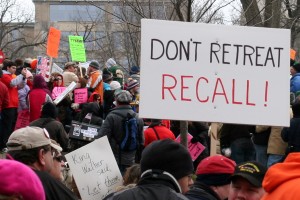
Recent protests at WI capitol
Recall elections loom on the horizon as petitions against nine Wisconsin state senators were recently submitted to the Government Accountability Board (GAB). Each successful petition must include 25 percent of the total number of votes cast in that senate district in the last election.
The recall efforts of Republican senators who supported Gov. Scott Walker’s Budget Repair Bill, and the Democratic senators who left the state to delay voting on the bill, are a result of the political firestorm that quickly flared up over the bill that sought to eliminate almost all collective bargaining rights for public workers.
Currently, the Republican senators who are facing a recall election are Alberta Darling, Robert Cowles, Sheila Harsdorf, Luther Olsen, Randy Hopper and Dan Kapanke. Democrats are facing recall efforts are — Dave Hansen, Jim Holperin and Robert Wirch.
The Milwaukee Journal Sentinel reported that there have also been petitions that didn’t have enough signatures on them to spark a recall. Democratic senators Lena Taylor and Spencer Coggs (both from Milwaukee), Senate Minority Mark Miller (Monona) and Fred Risser (Madison) all have all survived the recall attempts against them. Recall efforts against Republicans Glenn Grothman (West Bend) and Mary Lazich (New Berlin) also failed to garner sufficient support.
Circulators hired by the state Republican Party have submitted “hundreds if not thousands of invalid signatures” in recall drives targeting three Democratic state senators. Volunteers have been working overtime to enter each name into a data base and cross-check it with the phone book and other record. One man who signed a recall petition was Bill Pocan, the deceased father of State Representative Marc Pocan. The Wisconsin Democratic Party (DPW) is formally challenging all three of the recall petitions filed against Democrat senators.
Republicans have filed challenges against “all petitions targeting GOP senators. In addition to their individual signature challenges, they claim the GAB should throw out the petitions because the recall organizers did not properly register with the state.” The elections for recalled legislators with completed petitions will likely be held July 12, 2011.
By: Jennifer Page, Center for Media and Democracy, May 6, 2011
May 6, 2011
Posted by raemd95 |
Collective Bargaining, Democracy, Elections, Gov Scott Walker, Politics, Public Employees, State Legislatures, Union Busting, Unions, Wisconsin | Activism, Government Accountability Board, Milwaukee Journal Sentinel, Recalls, Wisconsin Democratic Party, Wisconsin Legislature, Wisconsin Republicans, Wisconsin Senate |
Leave a comment


 Unknown Feed
 mykeystrokes.com
You must be logged in to post a comment.