Is The Tea Party Just a Big Scam?

E. J. Dionne
Is the tea party one of the most successful scams in American political history?
Before you dismiss the question, note that word “successful.” Judge the tea party purely on the grounds of effectiveness and you have to admire how a very small group has shaken American political life and seized the microphone offered by the media, including the so-called liberal media.
But it’s equally important to recognize that the tea party constitutes a sliver of opinion on the extreme end of politics receiving attention out of all proportion with its numbers.
Yes, there is a lot of discontent in America. But that discontent is better represented by the moderate voters who expressed quiet disillusionment to President Obama at the CNBC town hall meeting on Monday than by tea party ideologues who proclaim the unconstitutionality of the New Deal and everything since.
The tea party drowns out such voices because it has money—some of it from un-populist corporate sources, as Jane Mayer documented last month in The New Yorker—and has used modest numbers strategically in small states to magnify its impact.
Just recently, tea party victories in Alaska and Delaware Senate primaries shook the nation. In Delaware, Christine O’Donnell received 30,563 votes in the Republican primary, 3,542 votes more than moderate Rep. Mike Castle. In Alaska, Joe Miller won 55,878 votes for a margin of 2,006 over incumbent Sen. Lisa Murkowski, who is now running as a write-in candidate.
Do the math. For weeks now, our national political conversation has been driven by 86,441 voters and a margin of 5,548 votes. A bit of perspective: When John McCain lost in 2008, he received 59.9 million votes.
Earlier this year, much was made of the defeat of Sen. Bob Bennett, a Utah conservative insufficiently conservative for the tea party. Bennett lost not in a primary but at a Republican convention attended by all of 3,500 delegates.
Even in larger states, the tea party’s triumphs were built on small shares of the electorate. Rand Paul received 206,986 votes in Kentucky where there are more than 1 million registered Republicans and nearly 2.9 million registered voters. Sharron Angle won with 70,452 votes in Nevada, a state with more than 1 million registered voters.
The media have given substantial coverage to tea party rallies and even small demonstrations. But how many people are actually involved in this movement?
Last April, a New York Times/CBS News poll found that 18 percent of Americans identified themselves as supporters of the tea party movement, but slightly less than a fifth of these sympathizers said they had actually attended a tea party rally or meeting. That means just over 3 percent of Americans can be characterized as tea party activists. A more recent poll by Democracy Corps, just before Labor Day, found that 6 percent of voters said they had attended a tea party rally or meeting.
The tea party is not the only small group in history to wield more power than you’d expect from its numbers. In 2008, Barack Obama did very well in party caucuses, which draw many fewer voters than primaries. And it was Lenin who offered the classic definition of a vanguard party as involving “people who make revolutionary activity their profession” in organizations that “must perforce not be very extensive.”
But something is haywire in our media and our politics. Jill Lepore, a Harvard historian whose new book is “The Whites of Their Eyes: The Tea Party’s Revolution and the Battle Over American History,” observed in an interview that there is a “hall of mirrors” effect created by the rise of “niche” opinion media. They magnify small movements into powerhouses while old-fashioned journalism, which is supposed to put such movements in perspective, reacts to the same niche incentives.
There is also the decline of alternative forces in politics. The Republican establishment, such as it is, has long depended far more on big money than on troops in the field. In search of new battalions, GOP leaders stoked the tea party, stood largely mute in the face of its more outrageous untruths about Obama—and now has to defend candidates like O’Donnell and Angle.
And where are the progressives? Sulking is not an alternative to organizing, and weary resignation is the first step toward capitulation. The tea party may be pulling a fast one on the country and the media. But if it has more audacity than everyone else, it will, I am sorry to say, deserve to get away with it.
E.J. Dionne, Jr. is is a Washington Post columnist, a senior fellow at the Brookings Institution, and a professor at Georgetown University. He is the author of, most recently, Souled Out: Reclaiming Faith and Politics After the Religious Right. Original Post: The New Republic, September 23, 2010.
The Tea Party’s Big Money
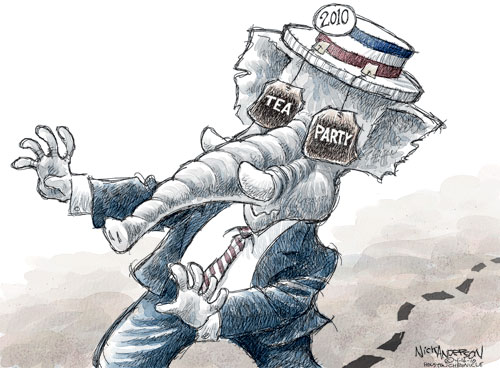
"Establishment Republicans"
Tea Party supporters and their candidates like to imagine themselves as insurgents, crashing the barricades of Washington to establish a new order of clean and frugal government. In earthbound reality, many of the people pulling the Tea Party’s strings are establishment Republican operatives and lobbyists. Some have made money off the party for years.
One example is Sal Russo, a gun-for-hire who has worked for former President Ronald Reagan, former Gov. George Deukmejian of California, former Gov. Christine Todd Whitman of New Jersey, former Gov. George Pataki of New York, and many other Republicans. As The Times reported on Sunday, Mr. Russo saw a sure thing last year, establishing a group called the Tea Party Express to support candidates in the midterm elections and raise cash at the same time.
The group has spent nearly $1 million in an effort to replace Harry Reid of Nevada, the Democratic Senate leader. It spent nearly $350,000 to elect Senator Scott Brown of Massachusetts. It is pouring money into Alaska to support Joe Miller’s Senate bid. And it has spent $250,000 in Delaware on behalf of Christine O’Donnell, now the Republican nominee for the United States Senate. Mr. Russo held a fund-raiser for Ms. O’Donnell and organized a rally.
In all, Mr. Russo and his group have raised $5.2 million and are the biggest independent supporters of Tea Party candidates. Of that, $3 million to buy advertising went to his political consulting firm or one controlled by his wife. Of course, he takes a substantial cut of each buy.
Dick Armey, the former House Republican leader, considers himself a godfather of the Tea Party and is co-author of the book, “Give Us Liberty: a Tea Party Manifesto.” Writing in The Wall Street Journal, he called for a “hostile takeover” of the Republican Party, which sounds so very revolutionary until one remembers that he helped lead that party for many years, guiding its policies and raising its money. When he left office in 2003, he cashed in on his connections to become a very high-paid lobbyist at DLA Piper, one of Washington’s biggest law firms, which has clients that include health-care companies, energy producers and foreign governments.
Then there is Carl Paladino, the Tea Party-backed Republican nominee for governor of New York. His bloodcurdling denunciations of Albany never seem to mention that he is one of the biggest landlords of state agencies, owning properties with $85 million in taxpayer leases in Buffalo alone that provide him with income of more than $5 million a year. He is the biggest property owner in Buffalo, and much of his empire has been constructed with state development incentives and tax breaks. An adviser is Roger Stone, an operator for Republicans since Richard Nixon’s re-election campaign.
There are undoubtedly thousands of Tea Partiers who would love to purge Washington of well-connected lobbyists, high-priced political consultants and others who take millions of taxpayer dollars while condemning the lawmakers who spend it. They should take a long look at the leaders and candidates who are driving their movement and decide whether purging begins at home.
New York Times-Editorial: Published Sept. 23, 2010
Rep. Paul Ryan-The Flimflam Man
Rep. Paul Ryan
One depressing aspect of American politics is the susceptibility of the political and media establishment to charlatans. You might have thought, given past experience, that D.C. insiders would be on their guard against conservatives with grandiose plans. But no: as long as someone on the right claims to have bold new proposals, he’s hailed as an innovative thinker. And nobody checks his arithmetic.
Which brings me to the innovative thinker du jour: Representative Paul Ryan of Wisconsin.
Mr. Ryan has become the Republican Party’s poster child for new ideas thanks to his “Roadmap for America’s Future,” a plan for a major overhaul of federal spending and taxes. News media coverage has been overwhelmingly favorable; on Monday, The Washington Post put a glowing profile of Mr. Ryan on its front page, portraying him as the G.O.P.’s fiscal conscience. He’s often described with phrases like “intellectually audacious.”
But it’s the audacity of dopes. Mr. Ryan isn’t offering fresh food for thought; he’s serving up leftovers from the 1990s, drenched in flimflam sauce.
Mr. Ryan’s plan calls for steep cuts in both spending and taxes. He’d have you believe that the combined effect would be much lower budget deficits, and, according to that Washington Post report, he speaks about deficits “in apocalyptic terms.” And The Post also tells us that his plan would, indeed, sharply reduce the flow of red ink: “The Congressional Budget Office has estimated that Rep. Paul Ryan’s plan would cut the budget deficit in half by 2020.”
But the budget office has done no such thing. At Mr. Ryan’s request, it produced an estimate of the budget effects of his proposed spending cuts — period. It didn’t address the revenue losses from his tax cuts.
The nonpartisan Tax Policy Center has, however, stepped into the breach. Its numbers indicate that the Ryan plan would reduce revenue by almost $4 trillion over the next decade. If you add these revenue losses to the numbers The Post cites, you get a much larger deficit in 2020, roughly $1.3 trillion.
And that’s about the same as the budget office’s estimate of the 2020 deficit under the Obama administration’s plans. That is, Mr. Ryan may speak about the deficit in apocalyptic terms, but even if you believe that his proposed spending cuts are feasible — which you shouldn’t — the Roadmap wouldn’t reduce the deficit. All it would do is cut benefits for the middle class while slashing taxes on the rich.
And I do mean slash. The Tax Policy Center finds that the Ryan plan would cut taxes on the richest 1 percent of the population in half, giving them 117 percent of the plan’s total tax cuts. That’s not a misprint. Even as it slashed taxes at the top, the plan would raise taxes for 95 percent of the population.
Finally, let’s talk about those spending cuts. In its first decade, most of the alleged savings in the Ryan plan come from assuming zero dollar growth in domestic discretionary spending, which includes everything from energy policy to education to the court system. This would amount to a 25 percent cut once you adjust for inflation and population growth. How would such a severe cut be achieved? What specific programs would be slashed? Mr. Ryan doesn’t say.
After 2020, the main alleged saving would come from sharp cuts in Medicare, achieved by dismantling Medicare as we know it, and instead giving seniors vouchers and telling them to buy their own insurance. Does this sound familiar? It should. It’s the same plan Newt Gingrich tried to sell in 1995.
And we already know, from experience with the Medicare Advantage program, that a voucher system would have higher, not lower, costs than our current system. The only way the Ryan plan could save money would be by making those vouchers too small to pay for adequate coverage. Wealthy older Americans would be able to supplement their vouchers, and get the care they need; everyone else would be out in the cold.
In practice, that probably wouldn’t happen: older Americans would be outraged — and they vote. But this means that the supposed budget savings from the Ryan plan are a sham.
So why have so many in Washington, especially in the news media, been taken in by this flimflam? It’s not just inability to do the math, although that’s part of it. There’s also the unwillingness of self-styled centrists to face up to the realities of the modern Republican Party; they want to pretend, in the teeth of overwhelming evidence, that there are still people in the G.O.P. making sense. And last but not least, there’s deference to power — the G.O.P. is a resurgent political force, so one mustn’t point out that its intellectual heroes have no clothes.
But they don’t. The Ryan plan is a fraud that makes no useful contribution to the debate over America’s fiscal future.
By PAUL KRUGMAN-Op-Ed Columist and Nobel Prize Winner-Economics, The New York Times-Aug 5, 2010; Photo- Wikipedia
How To Fight The Tax Cut Wars
The next big fight in Congress revolves around extending the Bush tax cuts. Unlike issues like climate change or stimulus, where the public does not accept the Democrats’ basic analysis of the problem, on the tax cuts the Democrats hold the whip hand. The question is whether they emerge with a political win, a public policy win, or both.
Let’s review a few basic facts about the Bush tax cuts. When Republicans took control of government in 2001, their top priority was reducing tax rates on high income earners. Since tax cuts for the rich were unpopular, they had to pair those cuts with middle-class tax cuts in order to make them politically salable. That’s how they pressured Democrats into supporting them. By packaging the whole thing together, they could accuse Democrats of opposing tax cuts for the middle class if they voted no.
Now, ten years later — and what a decade of bountiful economic growth we’ve enjoyed with the energies of investors and entrepreneurs finally unleashed from restrictive Clinton-era tax rates! — the Bush tax cuts are scheduled to expire. Republicans want to extend the whole thing. Democrats just want to extend the parts that benefit people who earn less than $250,000 a year.
Now, here’s the underlying dynamic. Raising taxes on the middle class is unpopular. But raising taxes on the rich is wildly popular. The truth is that neither party cares very much about the portion of the Bush tax cuts that benefit the middle class. Republicans just threw that in to sell the upper-bracket tax cuts, which is what they care about. Democrats might prefer a more progressive tax code with lower middle-class taxes, but most of them would rather have the revenue instead. But Democrats promised not to raise taxes on people earning less than $250,000 a year — a promise they felt they had to make in order to win. And they can’t break that promise without suffering political consequences.
Republicans, on the other hand, don’t want to pass an extension of the middle-class Bush tax cuts without the upper-bracket tax cuts. That would leave the federal tax code more progressive than it was under Bill Clinton — you’d have a combination of Clinton-era tax rates on the rich and Bush-era tax rates on the middle class. Conservatives have been fretting about such a result for more than a year, warning ominously about a country in which half the population pays no income tax. (They’d still pay other taxes, but the central Republican goal is to minimize the progressivity of the tax code.)
So we’re down to a game of chicken. Here’s why the Democrats hold the whip hand. They can pass an extension of the middle-class Bush tax cuts through the House. If Republicans let the bill pass, then they’ve lost their leverage to extend the unpopular Bush upper-income tax cuts. If they filibuster it, then Democrats can blame them for raising taxes on middle-class Americans. It would let Democrats out of their pledge. (Hey, they tried to keep the middle-class tax cuts.) Then nothing would pass, and we’d instantly revert to Clinton-era rates across the board.
What kind of effect would that have on the deficit? A huge one:
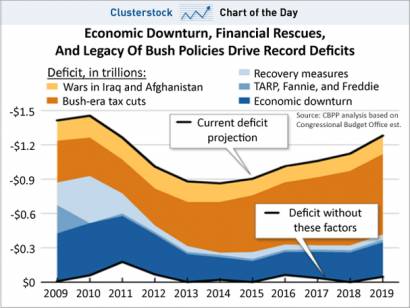
That dark orange stripe is the portion of the deficit attributable to the Bush tax cuts. That would be wiped out. Ending the tax cuts would basically solve the medium-term deficit problem.
The key factor here is that, just as Republicans got to frame the debate in 2001 by combining the tax cuts into an up or down vote, Democrats can frame the debate now by separating the policies Republicans pretend to care about from the ones they actually care about. Republicans want to have a vote on the whole collection of Bush-era tax cuts. Democrats shouldn’t give it to them. You hold a separate vote on the middle class portion and dare them to oppose it.
This seems to be the plan:
“The Senate will move first, and it will be a test to see whether Republicans filibuster” to block the bill in a bid to also win tax cuts for higher earners, said Rep. Chris Van Hollen of Maryland, head of the House Democrats’ re-election effort.
“If you can’t get it out of the Senate, then you take it to the election,” Mr. Van Hollen said in a recent interview. “You say to the American people that Republicans want to continue to hold middle-class tax relief hostage for an extension of tax breaks for [the well-to-do]. That will be the debate.”
Republicans have followed a strategy of opposing nearly everything the Democrats do. It’s worked very well. But the peculiar dynamic of this debate puts the Republicans in a position where they can’t win, and obstructing the Democrats is probably their worst move.
By: Jonathan Chait, Senior Editor, The New Republic-July 26, 2010
Let’s Repeal 2010

Gail Collins-Photo:Tony Cenicola/The New York Times
This has been a bad summer for almost everybody — celebrities, shrimpers, Washington insiders, Tea Party outsiders, people who prefer pleasant weather. So far, my list of who did well only includes the Spanish soccer team and Paul the prophetic octopus. Plus, according to Senator Jim Bunning, George Steinbrenner. The Kentucky Republican praised the Yankee owner in the Senate Finance Committee for being “smart enough to die in 2010,” when the estate tax is temporarily suspended.
This week, Congress passed the huge reform of the financial industry that it had been working on for nearly two years. You’d think there would have been cheering from coast to coast, but the left was disheartened to discover that contrary to all previous precedent, Congress had passed a bill that was imperfect.
“Ending debate on the bill is finishing before the job is done,” said Senator Russ Feingold of Wisconsin, the only Democrat to vote no.
Great idea. I think I speak for us all when I say that there is absolutely nothing I would like better than additional talking in the Senate. It always seems to make things better. Meanwhile, down in the House, John Boehner, the Republican leader, raised the ante, calling for repeal.
Who says that Boehner just hangs out at bars and tanning parlors and doesn’t work hard? The man is tireless! Everybody else was exhausted, but he wanted to start over.
“There are common sense things we should do to plug the holes in the regulatory system … and to bring more transparency to financial transactions. Because transparency is like sunlight and sunlight is the best disinfectant,” he said.
This is an exciting new analogy for Boehner. Just a couple of weeks ago he was leading the opposition to a bill that would require groups that pay for political attack ads to reveal their true identities. Boehner called it a “back-room deal to shred our Constitution.” In this case, transparency was a dangerous concept that would strip away all protective covering and allow vicious ultraviolet rays to stream through the window and burn away our precious freedoms.
Most Republicans are not joining Boehner in his call to repeal the financial reform bill because they are too busy calling for the repeal of health care reform. “The bill should be scrapped and replaced with much better ideas,” said Mario Rubio, the Republican Senate candidate in Florida.
Rubio’s own idea is to eliminate the requirement that healthy people have insurance, but keep the part that says insurance companies have to cover people with pre-existing conditions. This sounds like the ideal solution — no one would have to buy insurance until they got sick, and then they could make the companies sell them a whole bunch of coverage. I don’t know why nobody thought of this before.
With all these great ideas around — debate more, start over, don’t clean the windows — it’s a wonder that Washington hasn’t become the image of Athens in the age of Pericles. But instead, all Barack Obama’s critics have been able to do is make the country feel gloomy about Barack Obama. He’s passed more major legislation than anybody since Franklin Roosevelt and he’s got popularity ratings that look more like Martin Van Buren’s.
This week, there was an enormous outcry at the news that the president was going to take his wife and children to Maine for the weekend. This is the third time he and his family went away for a weekend since the gulf oil crisis. Three weekends in three months!
“Presidents are certainly entitled to vacation, just like everybody else, but there is a fine line as to when presidents should do it, what they should and where they should do it,” a former member of George W. Bush’s staff told CNN. The staff member in question, Brad Blakeman, was in charge of appointments and scheduling. Surely there is nobody better qualified to discuss this important subject than the man who helped the previous president get out of town for a third of his entire time in office.
The Republicans have now set up a site called “Golf or Gulf” that lists all the things Obama has been doing for the last three months when he could have been sitting around worrying about the oil spill. He had Paul McCartney over to the White House. And he played golf 10 times!
Let’s repeal the oil spill and start all over. The right way to handle the disaster, it appears from the many, many critiques, would have been to:
— Call all the oil company executives together to come up with a plan.
— Denounce all the oil companies.
— Apologize to the oil companies.
— Tell Paul McCartney he cannot sing in the White House until all the pelicans are clean.
By GAIL COLLINS-Op-Ed Columnist/NYT
Published: July 16, 2010
Share This Blog


 Unknown Feed
- An error has occurred; the feed is probably down. Try again later.


You must be logged in to post a comment.