First “Obama’s Katrina,” Now “Obama’s Watergate”

On May 8, 1973, the Senate Watergate Committee began its nationally televised hearings. Archibald Cox served as the Justice Department's special prosecutor for the case.
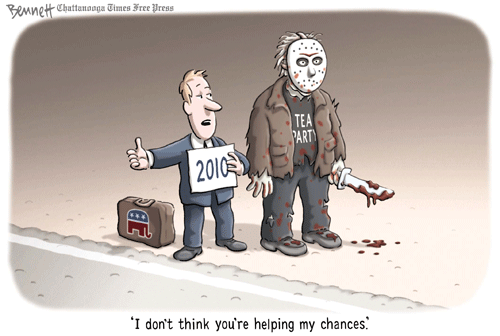
It appears that the Republican Party and the conservative chattering classes are determined to identify Barack Obama with every famous conservative disaster of recent history. BP’s Gulf Oil spill, we are told incessantly, is “Obama’s Katrina,” presumably because of the common geographic location, and now we hear that the silly, contrived “scandal” over alleged job offers to Democratic primary candidates will be “Obama’s Watergate.” What’s next: Obama’s Iraq? Obama’s U.S. Attorney Scandal? Obama’s Plamegate? Obama’s Illegitimate Election? (Oh, sorry, I forgot, Republicans have already used that one!).In any event, the “Watergate” analogy is insane, unless maybe you are too young or too poorly read to remember what Watergate entailed. As Joe Conason explains at Salon:
“Watergate” was the place where the president’s henchmen staged a “third-rate burglary” of the Democratic National Committee headquarters on a June night in 1972, but its historical definition is the vast gangsterism of the Nixon regime. Watergate involved no political job offers, but a series of burglaries, warrantless domestic wiretaps, illegal spying, campaign dirty tricks, and assorted acts of thuggery by a group of goons whose leaders included G. Gordon Liddy and the late E. Howard Hunt. Watergate meant a coverup of those felonies with more felonies, set up by lawyers and bureaucrats who collected cash payoffs from major corporations and then handed out hush money and secret campaign slush funds. Watergate implicated dozens of perps, from Hunt and Liddy all the way up to the president, his palace guard, and his crooked minions at the highest levels of the Justice Department, the FBI and the CIA.
The allegations against the White House today involve alleged discussions of administration jobs for Democrats running in two Democratic primaries, who turned them down without consequences. Does that sound like Watergate in any way, shape or form?
But that even assumes there was anything wrong with the discussions, other than their political clumsiness. Yes, one defense is that the same thing has been done by federal, state and local executives from time immemorial, but even that concedes too much to the critics. The federal statute being invoked by conservatives in this situation makes it a crime to offer a job in exchange for “a political act.” But in this case, “the political act” is simply taking the job. If that’s illegal, then it’s illegal to offer appointments to anyone who is or might be running for office.
It’s not surprising that Republicans are seizing on this silliness, enabled by a bored press corps; not only does it contribute to the constant drumbeat of charges that Obama’s imploding politically and doomed to disaster in 2010 and/or 2012, but it’s also a handy weapon to use against Joe Sestak, who is well-positioned to beat one of the Right’s true heartthrobs, Pat Toomey, in November.
That’s all politics-as-usual, of course. But let’s not get hallucinogenic by comparing this to the wide-ranging use of federal power to raise money illegally and intimidate “enemies” characterized by Watergate.
Posted by Ed Kilgore on June 4, 2010-Photo: Marion Trikosko for USN and WR.
The Cleansing of the GOP

"Ditto" or the Highway: Republican Democracy
The purification process — hard-core and uncompromising partisans driving heretics from their ranks — has been going on for a long time. Saturday’s Republican convention in Utah, the one in which conservative Senator Robert Bennett was defeated for being not conservative enough (despite an 84 percent approval rating from the American Conservative Union), is just one more step in a decades-long effort to drive independent thought from the political decisionmaking process.
This year, of course, attention has been focused primarily on Marco Rubio’s success in driving Florida Governor Charlie Crist out of the Republican Party (he’s now running for the Senate as an Independent) and former Congressman Pat Toomey’s success in converting Republican Senator Arlen Specter into a Democrat. But in both of those cases one can argue that the targeted incumbent was simply too far out of step with his own party. The same ACU ratings index on which Bennett scored an 84 gave Specter a 40. The ratings only measure members of Congress but Crist had more than once angered party members with his support of initiatives that were fiercely opposed by most Republicans. But given Bennett’s long embrace of conservative positions, with relatively few departures from the party-line script over a period of nearly two decades, what happened in Utah was something of a very different and disturbing nature. It was checklist politics, a demand for suspension of judgment and lockstep adherence to an ideological instruction manual that would brook no deviation.
That is important in assessing what is happening in the political wars. When Jeff Bell, a member of the American Conservative Union’s board of directors, took on and defeated incumbent Republican Senator Clifford Case in a party primary in 1978, it was because Bell’s views were, in Republican terms, more mainstream than those of the liberal Case. It was not a matter of the extremes knocking off the middle but of a traditional conservative ousting a Republican who was, for all practical purposes, not a Republican at all. Similarly, two years later, Alfonse D’Amato knocked off incumbent Republican Senator Jacob Javits, another liberal, in a New York primary.
When Ned Lamont defeated incumbent Senator Joseph Lieberman in Connecticut’s Democratic Senate primary — after Lieberman had been his party’s vice presidential nominee — it was because one overriding issue — war — was of sufficient weight to overshadow the rest of Lieberman’s record and his Democratic credentials. War is a trump card; absent Lieberman’s support for the invasion of Iraq, it is unlikely that he would have been challenged by a fellow Democrat, much less be defeated, even though he had long been known for speaking his own mind (as witnessed by his forceful condemnation of Bill Clinton in the wake of the Lewinsky affair).
To be clear, Bennett’s defeat in Utah was not an unprecedented challenge of an incumbent who was just not as conservative as his opponent. Ronald Reagan almost defeated the generally conservative Gerald Ford in 1976 when Ford was seeking the Republican nomination to succeed himself in the White House. But for the most part, parties have been willing to allow some departure from the party line if a legislator’s overall record has been sufficiently on key.
Signs that this is changing were seen recently within the governing ranks of the GOP, with local party leaders attempting to force National Chairman Michael Steele to adopt a “purity” test to determine which Republican candidates would receive the party’s financial support. Steele refused to go along but it is the same sentiment that has now ended Robert Bennett’s Senate career.
When the voters send a man or woman to write the laws, in Washington or a state capitol, that legislator is obligated to weigh seriously the views of his or her constituents, to examine thoroughly the important issues of the day and the proposals to deal with them, and to consult the relevant constitution (federal or state) and then act accordingly. Increasingly, the last two items on that list — intelligent assessment and constitutional constraint — are being driven from the process. One is expected to listen — and to obey — the preferences, indeed the demands, not of “constituents” but of that small band of constituents who dominate party primaries and party conventions.
Ironically, those who demand such mindless conformity cry out a demand for adherence to the Constitution, even as they undermine the most important principles of rational constitutional self-government.
Original post by Mickey Edwards-The Cleansing: The Atlantic-May 10, 2010
GOP Desperate to Sink Finance Reform — Sound Familiar?
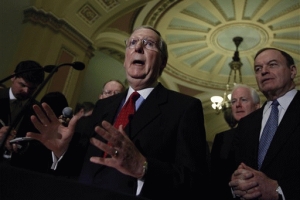
Sen Mitch "Let's scrap this one too" McConnell
Senate Minority Leader Mitch McConnell (R-Ky.) flew to New York two weeks ago for a private, behind-closed-doors meeting with hedge fund managers, bankers, and other Wall Street elites. It was after this meeting — where McConnell reportedly sought campaign contributions — that the Republican Senate leader returned to D.C. determined to kill the legislation that would bring some accountability to the same industry whose recklessness nearly destroyed the global financial system.
McConnell was asked on CNN this morning what, specifically, was said at the gathering about the Wall Street reform bill. The conservative Kentuckian was evasive — imagine that — and instead of answering the questions, he talked about scrapping the legislation altogether.
“We ought to go back to the drawing board and fix it.”
It’s like deja vu all over again — Democrats tackle a pressing national issue, negotiate with Republicans in good faith, craft a reasonable, middle-of-the-road legislative package that deserves bipartisan support, lobbyists tell Republicans to kill it, and McConnell voices his support for killing the legislation and going “back to the drawing board.”
Is it me or does this sound familiar?
McConnell’s principal (but not principled) concern is over the legislation’s liquidation fund, which would impose a fee on large financial institutions, collecting money that would be used to cover the costs of closing firms that fail. McConnell, who doesn’t know what he’s talking about, has characterized this provision as “institutionalizing bailouts.”
Fine, the Obama administration said. If it will help create bipartisan support for the bill, and end talk of a Republican filibuster, the provision on the liquidation fund can be scuttled. So, problem solved? Hardly.
[W]hen asked if he would support the bill if Democrats removed that fund, McConnell told CNN’s “State of the Union” he would still have other issues with the legislation, though he did not say what those qualms were.
Again, we’ve seen these genuinely stupid tactics before.
“Republicans can’t support the reasonable legislation Democrats want because it has a provision we’re pretending not to like.”
“Fine, we’ll get rid of the provision.”
“Republicans still can’t support the legislation, and we don’t want to tell you why.”
I know Republicans want to be taken seriously on public policy, but I can’t figure out why anyone would.
By: Steve Benen-Washington Monthly-April 18, 2010
McCain: I Was a ‘Maverick,’ Now I’m a ‘Partisan’
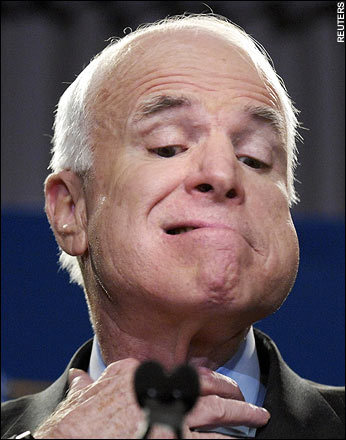
John McCain "the partisan"-even hard for him to swallow!
Arizona Sen. John McCain, trying to fend off a primary challenger trying to outflank him on the right, also found himself trying Sunday to put straight whether he was a “maverick” or not.
McCain’s “maverick” reputation and his past willingness to work with Democrats on issues like the environment, campaign finance reform and immigration before his run for President in 2008 often frustrated or angered fellow Republicans and he has lately made it appear like it’s a moniker he’d like people to forget.
McCain startled many political observers when he told Newsweek magazine “I never considered myself a maverick” — even as Sarah Palin was describing him that way in a campaign appearance late last month in Arizona for her old running mate.
When he appeared on Fox News Sunday, host Chris Wallace pressed McCain on the point, playing a 2008 campaign ad that called him “the original maverick” and showing McCain saying, ” If you want real reform and if you want change, send a team of mavericks. And what maverick really means, what this team of maverick really means, is we understand who we work for.”
Hayworth labels himself the “consistent conservative” on his campaign web site and he has had fun poking McCain over the “maverick” quote. Hayworth told the Politico, “To the extent that he can encourage amnesia in the electorate, that’s what he’s aiming to do.”
A Rasmussen Reports poll conducted April 13 showed that Hayworth had pulled within 5 points of McCain, with McCain leading him 47 percent to 42 percent among likely Republican voters. The margin of error was 4 points. The primary is August 24.
By: Bruce Drake, Contributing Editor-Politics Daily, April 18, 2010
We Gather to Mourn the Loss of John McCain’s Integrity
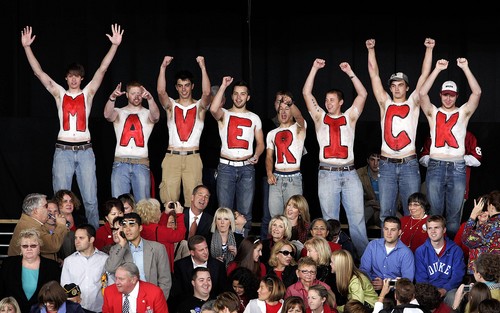
Maverick or Total Fraud?
We are gathered here today to pay our final respects to John McCain’s integrity.
It died recently — turned a triple somersault, stiffened like an exclamation point, fell to the floor with its tongue hanging out — when the senator told Newsweek, “I never considered myself a maverick.” This, after the hard-fought presidential campaign of 2008 in which McCain, his advertising team, his surrogates and his running mate all but tattooed the “M” word on their foreheads.
Indeed, not only did they call McCain a maverick, but so did the subtitle of his 2003 memoir. Heck, his campaign plane when he ran for president back in 1999 was dubbed Maverick One. Yet there he is in the April 12, 2010, edition of Newsweek, page 29, top of the center column: “I never considered myself a maverick.”
And his integrity kicked twice and was still.
The death was not unexpected. McCain’s integrity had been in ill health for a long time. Once, it had been his most attractive political trait, drawing smitten prose from political reporters and intrigued attention from voters sick of the same old, same old from politicians who would bend like Gumby for the electorate’s approval.
McCain’s integrity wouldn’t allow him to be that guy. He was this hard-bitten former Navy flier and heroic POW, impatient with the belittling demands of politics as usual, a fellow who would speak an impolitic truth or cross the aisle to work with the opposition because he had this quaint idea that the needs of the country superseded the needs of his party. Then came the GOP presidential primary of 2000 in which McCain was bested by one George Walker Bush and a load of dirty tricks. McCain took note. And his integrity took sick.
The illness began in that selfsame campaign.
By his own admission, McCain lied to voters about his opinion of the Confederate battle flag, fearing that calling it what it is — a flag of treason, racism and slavery — would cost him votes in flag-worshipping South Carolina.
In later years, he embraced right-wing religious extremists he had once condemned. And reneged on a promise that he’d be open to repealing “Don’t Ask, Don’t Tell” if military leaders advised it. And went from opposition of offshore oil drilling to “Drill, baby, drill!” And et cetera.
Two things here: One, all the nattering about flip-flops aside, there is nothing wrong with changing one’s opinion. It indicates a thinking mind.
Two, McCain is hardly unique. Indeed, they have a name for people who change their opinions in order to win votes: politicians.
But these are not just changes of opinion we’re talking about. Rather, they are betrayals of core principle. And while that might be politics as usual, there is a higher standard for the politician who has positioned himself as a man of uncommon integrity, a purveyor of straight talk in a nation hungry for same. When that man panders, the disappointment is keen.
So it stings to see McCain knuckle under to the ideological rigidity that makes it heresy to cross the aisle, question the orthodoxy or have an independent thought. There’s a sense of loss for those who ask of leaders, leadership. It reinforces the cynical notion that there is no one out there who is authentic.
One is reminded of that poignant scene in “The Truman Show” where Jim Carrey as Truman Burbank has just discovered his entire life was a made-for-TV fiction. “Was nothing real?” he asks. A voter who believed in John McCain, who regarded his iconoclastic singularity as a stirring example, might be forgiven for asking the very same thing.
“I never considered myself a maverick”?! Wow.
With those words, McCain completes his transmutation into an avatar of all that is wrong in American politics.
May his integrity rest in peace.
Miami Herald columnist Leonard Pitts Jr.’s column appears regularly on editorial pages of The Times. His e-mail address is: lpitts@miamiherald.com: AP photo by Michael Conroy
Share This Blog


 Unknown Feed
- An error has occurred; the feed is probably down. Try again later.


You must be logged in to post a comment.