The Ryan Plan For Medicaid: Not Good For Low-Income Americans Or State Budgets
With Washington looking for ways to rein in costly entitlement programs and state governments struggling to balance budgets, conservatives have revived an old nostrum: turning Medicaid into a block grant program.
The desire for fiscal relief is understandable. Medicaid insures low-income people and in these tough economic times, enrollment and costs — for the federal government and state governments — have swelled.
Representative Paul Ryan, and the House Republicans, are now proposing to ease Washington’s strain by capping federal contributions. Like his proposal for Medicare, that would only shift the burden — this time onto both state governments and beneficiaries.
Still, some governors may be tempted. His plan promises them greater flexibility to manage their programs — and achieve greater efficiency and save money. That may sound good, but the truth is, no foreseeable efficiencies will compensate for the big loss of federal contribution.
Mr. Ryan also wants to repeal the health care reform law and its requirement that states expand their Medicaid rolls starting in 2014. Once again Washington would pay the vast bulk of the added cost, so states would be turning down a very good deal to save a lesser amount of money.
Here’s how Medicaid currently works: Washington sets minimum requirements for who can enroll and what services must be covered, and pays half of the bill in the richest states and three-quarters of the bill in the poorest state. If people are poor enough to qualify and a medical service recommended by their doctors is covered, the state and federal governments will pick up the tab, with minimal co-payments by the beneficiaries. That is a big plus for enrollees’ health, and a healthy population is good for everyone. But the costs are undeniably high.
Enter the House Republicans’ budget proposal. Instead of a commitment to insure as many people as meet the criteria, it would substitute a set amount per state. Starting in 2013, the grant would probably equal what the state would have received anyway through federal matching funds, although that is not spelled out. After that, the block grant would rise each year only at the national rate of inflation, with adjustments for population growth.
There are several problems with that, starting with that inflation-pegged rate of growth, which could not possibly keep pace with the rising cost of medical care. The Congressional Budget Office estimates that federal payments would be 35 percent lower in 2022 than currently projected and 49 percent lower in 2030.
To make up the difference, states would probably have to cut payments to doctors, hospitals or nursing homes; curtail eligibility; reduce benefits; or increase their own payments for Medicaid. The problems do not end there. If a bad economy led to a sharp jump in unemployment, a state’s grant would remain the same. Nor would the block grant grow fast enough to accommodate expensive advances in medicine, rising demand for long-term care, or unexpected health care needs in the wake of epidemics or natural disasters. This would put an ever-tightening squeeze on states, forcing them to drop enrollees, cut services or pump up their own contributions.
This is not the way to go. The real problem is not Medicaid. Contrary to most perceptions, it is a relatively efficient program — with low administrative costs, a high reliance on managed care and much lower payments to providers than other public and private insurance.
The real problem is soaring medical costs. The Ryan plan does little to address that. The health care law, which Republicans have vowed to repeal, seeks to reform the entire system to deliver quality care at lower cost.
To encourage that process, President Obama recently proposed a simplified matching rate for Medicaid, which would reward states for efficiencies and automatically increase federal payments if a recession drives up enrollments and state costs. The president’s approach is better for low-income Americans and for state budgets as well.
By: The New York Times, Editorial, April 30, 2011
GOP Medicare Proposal Doesn’t Work Like Members of Congress’ Health Care As Republicans Claim
The Center for American Progress has previously pointed out that the House Republican budget for fiscal year 2012 forces future beneficiaries out of Medicare into more expensive private plans. One of the ways Republicans are trying to sell their Medicare proposal is by claiming that beneficiaries would “be enrolled in the same kind of health-care program that members of Congress enjoy.” That claim is false. In fact, if the rate of growth under this Medicare proposal were applied to federal employees’ most popular health option, the Blue Cross Blue Shield Standard Option, federal workers, including members of Congress, with family coverage would have to pay another $3,330 for the care they enjoy today. Those with individual coverage would have to pay another $1,555.
Most federal workers receive their health coverage through the Federal Employees Health Benefits Plan, or FEHBP. The government contributes a portion of their health premium. That portion is set by law and applied to the weighted average of actual premiums charged in any given year. Beneficiaries make up the rest of the cost.
The Republican budget replaces the traditional fee-for-service Medicare for future beneficiaries with a voucher to private insurance companies that is established on very different terms. Unlike FEHBP, which has a consistent government contribution based on actual premiums charged in any given year, the amount of the voucher is determined independent of actual premiums. Its growth is instead tied to the rate of the consumer price index for all urban consumers, or CPI-U. Because health costs have typically increased faster than inflation, the level of government support from the voucher would become a lower share of actual premium costs over time. In other words, Medicare beneficiaries would be left holding the bag.
What would happen if FEHBP operated like the GOP Medicare proposal?
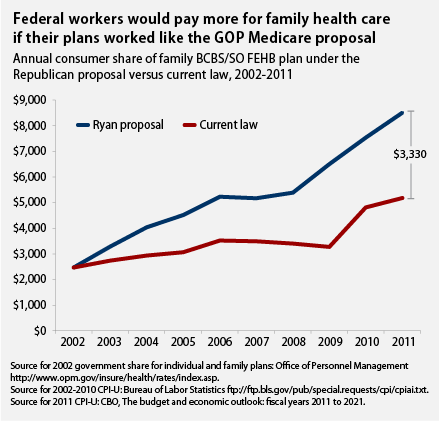
We examined what would happen if FEHBP had operated like the Republican Medicare proposal over the last decade. We used data from the Office of Personnel and Management to look at the annual premiums for federal workers enrolled in the Blue Cross Blue Shield Service Benefit Plan (Standard Family and Standard Individual). We chose this plan because nearly 60 percent of those enrolled in FEHBP have Blue Cross Blue Shield, and the Standard Option is the most popular FEHBP plan. We increased government support for the individual and family plans by the rate of growth in the CPI-U index from 2002 to 2011. We then compared the difference between the government’s share and the actual total premium in each year—which is the amount the beneficiary would pay—under the Republican proposal and the real FEHBP.

The result: A typical federal worker, or member of Congress, enrolled in family coverage in the Blue Cross Blue Shield Standard Option, would have had to pay an additional $3,330.36 for the same level of coverage they have today. Those with individual coverage would have had to pay $1,555 more.
By: Nicole Cafarella, Payment Reform Manager and Policy Analyst and Tony Clark, Policy Analyst, Center for American Progress, April 27, 2011
We Don’t Have A Spending Problem, We Have A Fraud Problem
Conservatives seem to have a knack for changing the subject whenever their backs are up against the wall. Over the last several weeks, there has been an orchestrated chorus by the House Republicans in particular to define the so-called “deficit problem” in terms of a wild spending binge by the federal government and the Obama administration. They seem to have easily forgotten who got us into this mess in the first place. That aside, everyone from Speaker John Boehner to Sen Mitch McConnell have been bellowing throughout the halls of Congress and at every available microphone that “We don’t have a revenue problem, we have a spending problem”.
It’s amazing how we all have bought into this line. The media, in its usual rush to get a headline or sound bite, immediately picked up this line and has been the waterboys for the GOP by enabling this hoax on the American people. The focus in most circles has been on spending cuts. Well, we need to re-characterize what is actually going on here. We don’t have a spending problem..we have a fraud problem.
This fraud has been played on the American people by an ideologically depraved Republican party for at least the last ten years. They have made everybody believe that if we just make the wealthy wealthier, somewhere down the road, we will all benefit. There would be job creation with full employment, small businesses would thrive, home prices would fall, gas would cost less than two dollars a gallon and there would be a chicken in every pot. And we believed it hook, line and sinker. Now we are back to square one. None of these things have happened except the fact that we have indeed made the wealthy wealthier. In 2010, the 400 Americans with the highest adjusted gross revenue incomes averaged $345 million. The average federal income tax was 17%, down from 26% in 1992. The income gap just keeps getting wider. Why does this continue to happen? Because we let it happen.
Just last week, Standard and Poor’s accentuated the Republican clarion that the sky is falling. This call comes from the same S&P who supported every toxic waste subprime security under the sky, the same S&P who sold its ratings to the highest bidder. Regulators have also assisted the GOP in their fraud. The Office of the Currency has gone out of its way to protect its clients, ie the banks. Efforts to reign in the banks and stop their predatory loan practices have been foiled at every turn. Even the banks are too big to fail. Profits for banks, corporations, CEO’s, Wall St and the wealthy just keep soaring. There is a lot of back scratching going on here, by and for a lot of wealthy people.
Now that the cat is out of the bag, all of these wealthy people are trying to figure out a way to take the spot light off themselves. They are beginning to see that they may not be able to stave off demands any longer that they pay their fare share. People who have been adversely affected for so many years are now demanding that this fraud be stopped. Teachers and other low wage earners, the poor, seniors, students and union members have all come to believe that they have sacrificed enough. Even some tea party members are beginning to see the light.
For too many years, the Republicans and their wealthy friends have had their hands in everybody’s pockets. Your pocket was the revenue stream for them. General Electric and the Koch Brothers were probably happier than anyone. The Republicans were also happy because their happy friends provided the cover that allows them to do whatever they want to in terms of policy. Being the ideologues that they are, this protection gives them unimpeded opportunity to push forward with their agenda, from dissolving women’s rights, overturning the Affordable Care Act, union busting, replacing Medicare with vouchers and completely eliminating any sense of environmental protection just to name a few. With happy and contented wealthy backers behind you for so many years, how could you go wrong. My, how things are changing.
The revenue stream that the Republicans have depended on for so long is now drying up…that stream is you. They are finding that when they put their hands in your pockets now, they are feeling the seam of the sewn pocket. There just isn’t any more money there. They become flushed and filled with extreme panic, finally realizing that they are going to have their taxes raised after all these years. Their backs are against the wall. So what do they do now? Change the debate..”Let’s raise taxes on everybody”. Nice try!
It’s well past time that shared sacrifice mean exactly what it says. It is no longer acceptable that the poor, under privileged, seniors and the disenfranchised continue to carry the load for corporations, Wall St and their deadbeat tax-evading friends. No, let’s not raise taxes on everybody. Let’s end the fraud and insist that the wealthy start paying taxes just like everyone else. This being Easter Sunday, this may be a good symbolic time to increase taxes only for the rich. We should leave that rate in place for oh say, the next 40 years. Besides, they have accumulated a fair amount of wealth over the years and should easily be able to live off that profit during that time. Perhaps take a trip or two or just wander around the world enjoying their spoils. We will pledge to re-visit this issue after that time. If, and only if, the middle class has reached a level playing field, then we can talk about lowering the tax rate for the wealthy. I think Moses and the Pharaoh’s would be happy with this compromise. So it is written, so let it be done.
By: raemd95, mykeystrokes.com, April 24, 2011
Insuring The Elderly, Insuring The Poor
Democrats, Republicans and Independents all believe the government is responsible for providing health care to the elderly. Democrats and independents, but not Republicans, believe the government should also provide health care to the poor:

All groups are more likely to favor guaranteed health care for the elderly than for the poor. But the dropoff between the two policies is very different. Democrats by a plus 77% margin favor covering the elderly, but only favor covering the poor by a 52% margin. That’s a 25 percentage point gap between covering the elderly and covering the poor. For independents, the falloff is a very similar 28 percentage points. For Republicans, the falloff is 61 percentage points, from a +15 point margin for covering the elderly to a -46 point margin for covering the poor.
The best way to understand this is by grasping the link between ethnocentrism and support for universal entitlements and both opposition to means-tested entitlements. Ethnocentric attitudes among whites, controlling for all other beliefs, correlate with support for universal programs and with opposition to programs for the poor. White racial conservatives favor programs that benefit people like them — and hey, everybody gets old — and oppose programs for people unlike them — the poor being disproportionately non-white, and even more proportionately so in the white imagination.
GOP: Playing “Dangerous Games” With The Debt Limit
The debt limit is supposed to make Congress think twice before passing tax cuts or spending increases that add to the national debt. Instead, lawmakers routinely support policies without paying for them — like the Bush-era tax cuts and two wars — and then posture and protest when their decisions require raising the debt limit.
So it will be once Congress returns from its spring recess. The debt limit — $14.3 trillion — will be hit as early as mid-May. If it is not raised in time, the government will have to use increasingly unorthodox tactics to meet its obligations, which would disrupt the financial markets and the economic recovery.
Default is theoretically possible, though public outrage over the mess would likely compel Congress to raise the debt limit before then. The best approach, the most sensible and mature, would be to pass a clean and timely increase.
However, nothing sensible or mature is on the horizon. Republicans have vowed to extract more heedless spending cuts in exchange for their votes to raise the debt limit. To that end, they seem likely to demand changes to the budget process, like a balanced budget amendment to the Constitution, or spending caps.
Such reforms have a glib appeal — who can oppose something as prudent-sounding as balanced budgets? In fact, they are a dodge, because they cut spending broadly without lawmakers having to defend specific cuts. They are also often wired to block tax increases, without which deficit reduction efforts are not only unfair, but also will not succeed.
Take, for example, the balanced budget amendment to the Constitution that Senate Republicans recently endorsed. By rigidly requiring a balanced budget each year, it would deepen recessions by forcing tax increases or spending cuts in a weak economy.
Worse, the amendment would hold annual spending to 18 percent of the previous year’s gross domestic product, a formula that works out to about 16.7 percent in the proposal’s early years, according to the Center on Budget and Policy Priorities. That is a level last seen in 1956 — a time before Medicare, before the interstate highways, when many baby boomers were not yet born, never mind aging into retirement.
Sharply lower spending would, in turn, allow for big tax cuts. Those tax cuts would be virtually irreversible, since the amendment calls for a two-thirds vote of both houses to raise taxes.
Another bad idea is the spending cap proposed by two senators, Bob Corker, Republican of Tennessee, and Claire McCaskill, Democrat of Missouri. It would cap spending at around 21 percent of G.D.P., compared with about 24 percent now — which would require deep cuts like those in the House Republican budget plan. With its emphasis on spending cuts, the cap also seems intended to reduce the deficit without tax increases.
In the successful deficit reduction efforts of 1990 and 1993, budget process reforms were helpful. The key, however, was to first enact credible deficit-reduction packages — with spending cuts and tax increases — and then impose rules, like pay-as-you-go, to prevent backsliding. Process reforms alone avoid the hard work. Still, they can exert powerful political pull.
The White House and Congressional Democrats must not allow themselves to be taken hostage again.
By: The New York Times, Editorial, April 22, 2011
Share This Blog


 Unknown Feed
- An error has occurred; the feed is probably down. Try again later.
 mykeystrokes.com
You must be logged in to post a comment.