Committing To A New Birth Of Freedom: It’s Time To Leave 9/11 Behind
After we honor the 10th anniversary of the attacks of Sept. 11, 2001, we need to leave the day behind. As a nation we have looked back for too long. We learned lessons from the attacks, but so many of them were wrong. The last decade was a detour that left our nation weaker, more divided and less certain of itself.
Reflections on the meaning of the horror and the years that followed are inevitably inflected by our own political or philosophical leanings. It’s a critique that no doubt applies to my thoughts as well. We see what we choose to see and use the event as we want to use it.
This does nothing to honor those who died and those who sacrificed to prevent even more suffering. In the future, the anniversary will best be reserved as a simple day of remembrance in which all of us humbly offer our respect for the anguish and the heroism of those individuals and their families.
But if we continue to place 9/11 at the center of our national consciousness, we will keep making the same mistakes. Our nation’s future depended on far more than the outcome of a vaguely defined “war on terrorism,” and it still does. Al-Qaeda is a dangerous enemy.
But our country and the world were never threatened by the caliphate of its mad fantasies.
We asked for great sacrifice over the past decade from the very small portion of our population who wear the country’s uniform, particularly the men and women of the Army and the Marine Corps. We should honor them, too. And, yes, we should pay tribute to those in the intelligence services, the FBI and our police forces who have done such painstaking work to thwart another attack.
It was often said that terrorism could not be dealt with through “police work,” as if the difficult and unheralded labor involved was not grand or bold enough to satisfy our longing for clarity in what was largely a struggle in the shadows.
Forgive me, but I find it hard to forget former president George W. Bush’s 2004 response to Sen. John Kerry’s comment that “the war on terror is less of a military operation and far more of an intelligence-gathering and law-enforcement operation.”
Bush retorted: “I disagree — strongly disagree. . . . After the chaos and carnage of September the 11th, it is not enough to serve our enemies with legal papers. With those attacks, the terrorists and their supporters declared war on the United States of America, and war is what they got.” What The Washington Post called “an era of endless war” is what we got, too.
Bush, of course, understood the importance of “intelligence gathering” and “law enforcement.” His administration presided over a great deal of both, and his supporters spoke, with justice, of his success in staving off further acts of terror. Yet he could not resist the temptation to turn on Kerry’s statement of the obvious. Thus was an event that initially united the nation used, over and over, to aggravate our political disharmony. This is also why we must put it behind us.
In the flood of anniversary commentary, notice how often the term “the lost decade” has been invoked. We know now, as we should have known all along, that American strength always depends first on our strength at home — on a vibrant, innovative and sensibly regulated economy, on levelheaded fiscal policies, on the ability of our citizens to find useful work, on the justice of our social arrangements.
This is not “isolationism.” It is a common sense that was pushed aside by the talk of “glory” and “honor,” by utopian schemes to transform the world by abruptly reordering the Middle East — and by our fears. While we worried that we would be destroyed by terrorists, we ignored the larger danger of weakening ourselves by forgetting what made us great.
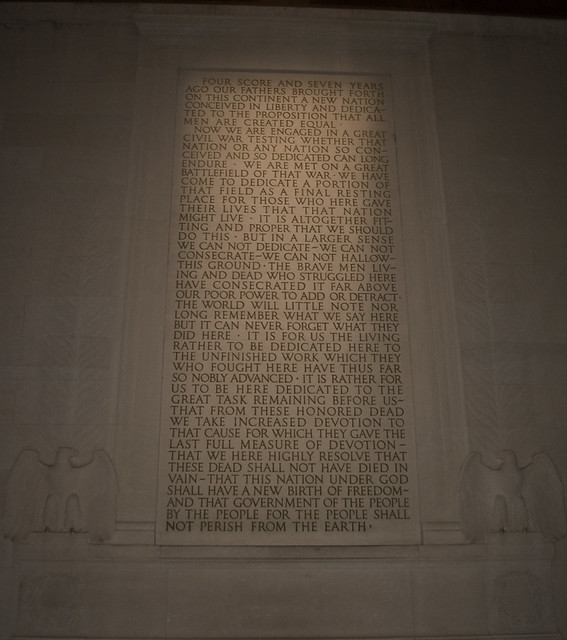
We have no alternative from now on but to look forward and not back. This does not dishonor the fallen heroes, and Lincoln explained why at Gettysburg. “We can not dedicate — we can not consecrate — we can not hallow this ground,” he said. “The brave men, living and dead, who struggled here, have consecrated it, far above our poor power to add or detract.” The best we could do, Lincoln declared, was to commit ourselves to “a new birth of freedom.” This is still our calling.
By: E. J. Dionne, Opinion Writer, The Washington Post, September 7, 2011
Public Perceptions And The Limited Value Of Recent History
CNN’s Candy Crowley made a noteworthy comment on the air last night, and we’ve heard similar remarks from other media figures quite a bit lately. The subject was President Obama’s prospects for a second term.
“He has to buck history, number one, a president with that kind of high unemployment rate has never been re-elected at 9 percent.”
At first blush, the observation is plainly false. Franklin Delano Roosevelt won a second term when unemployment was at 17%.
In fairness, though, Crowley probably just misspoke, and meant to refer to the post-Depression era. But even if we give her the benefit of the doubt here, the observation is largely pointless.
As a factual matter, it’s true that every president since FDR who’s won re-election has seen an unemployment rate below 7.2%. Will the unemployment rate fall below 7.2% by Election Day 2012? No one, anywhere, believes this is even remotely realistic.
But the context matters, and the media routinely pretends it doesn’t exist. No president since FDR has won with a high unemployment rate because no president since FDR has had to govern at a time of a global economic crisis like the Great Depression or the Great Recession. The U.S. has seen plenty of downturns over the last eight decades, but financial collapses are fairly rare, produce far more severe conditions, and take much longer to recover from.
Of course the unemployment rate won’t be below 7.2%. Under the circumstances and given the calamity Obama inherited, that’s impossible.
The more relevant question is what Americans are willing to tolerate and consider in context. In 1934, during FDR’s first midterms, the unemployment rate was about 22%. The public was thrilled — not because a 22% unemployment rate is good news, but because it had come down considerably from 1932. By 1936, when FDR was seeking re-eleciotn, the unemployment rate was about 17%. How can an incumbent president win re-election with a 17% unemployment rate? Because things were getting better, not worse.
That’s obviously the challenge for President Obama. The numerical thresholds are largely irrelevant — comparing the current economic circumstances to what other modern presidents have dealt with is silly. The more relevant metric is directional — are things better or getting worse by the time voters head to the polls, and if worse, who gets the blame.
What’s more, let’s also not lose sight of sample sizes. CNN’s Crowley made it seem as if no American president has ever won a second term with this high an unemployment rate. But even if we limit the analysis to the post-FDR era, as Dana Houle explained a couple of months ago, “Since FDR only Eisenhower, Nixon, Carter, Reagan, Clinton and the two Bush’s have been elected president and then sought reelection. It’s hard to draw big conclusions from a sample of seven.”
If the media is preoccupied with this metric, it will shape the public’s perceptions and help drive the campaign. Here’s hoping news outlets come to realize how incomplete this picture is.
By: Steve Benen, Contributing Writer, Washington Monthly Political Animal, September 4, 2011
Politics Without Purpose: September 11 Should Not Be Another Media Event
It was another one of those weeks in the capital when our leaders debated matters crucial to the survival of American civilization.
Did President Obama try to upstage the Republican presidential debate by asking to address a joint session of Congress that same night? And did House Speaker John Boehner dis the president, and the presidency, by denying him that slot?
Tempted though I was to weigh in on this important matter, I decided instead to head over to the Smithsonian’s National Museum of American History, to preview a small but immensely powerful exhibit marking the 10th anniversary of the Sept. 11 attacks.
There, displayed for the first time, are sacred relics of 9/11: the crumpled piece of the fuselage where the American flag had been painted on the Boeing 757 that crashed in a Pennsylvania field, a flight-attendant call button from the plane, a window shade, a landing gear strut, and a log book with the pages intact. The exhibit is simple and raw, without glass or showcases. Some dried mud caked on an airplane seatbelt was flaking off onto a tablecloth.
Nearby is the door from a fire truck crushed at Ground Zero and the beeper of a man who died in the South Tower. There’s a Pentagon clock frozen at about the time American Airlines Flight 77 struck the complex and the phone on which Ted Olson received the last call from his wife on the doomed plane. Most poignant, perhaps, is the postcard from another passenger, written to her sister the day before the crash to give the address of a new home in which she would never live.
The spare exhibit brought back the horror of that time. But it also reminded me of the pride in what followed, the national unity and sense of purpose.
The warm feelings didn’t last long, of course, destroyed by the war in Iraq and the politicization of homeland security. By now, we have lost all sense of purpose in politics, alternately distracted by Sarah Palin’s bus tours, Anthony Weiner’s private parts, David Wu’s tiger suit, Donald Trump’s birth-certificate campaign, and Dick Cheney’s broadsides.
Obama, whose uncertain trumpet has ceased to rally even his own troops, contemplated his long-delayed jobs agenda while lounging on Martha’s Vineyard last month. His leading Republican rival for the presidency talks of treason and secession. Another challenger arranges to quadruple the size of his California home (his defense: He’s only doubling the living space). Lawmakers play games with the debt ceiling and wound the nation’s credit rating but can’t agree on anything to put Americans back to work.
The political extraneousness of the moment, in other words, is like that of early September 2001. We spent those days amusing ourselves with Gary Condit and shark attacks. President George W. Bush spent August on a record-long ranch vacation. The biggest issue under debate: stem-cell research. Warnings about Osama bin Laden were ignored while the administration obsessed over rewriting a missile treaty with Russia.
What will it require to end the drift this time? A depression? Another attack? Or is there a less painful way to regain national purpose?
“For most people,” curator David Allison told me as I toured the Smithsonian exhibit, “Sept. 11 is only a media event.” The exhibit is a modest attempt at changing that, taking that day’s ruins out of storage and rekindling memory. The lucky few who see the exhibit during its short run will be reminded that there are things more important than whether the president addresses Congress on a Wednesday or a Thursday.
Consider the simple postcard, written by Georgetown economist Leslie Whittington to her sister and brother-in-law, as Whittington, her husband and their 8- and 3-year-old daughters headed off to Australia for a sabbatical. The card, postmarked Sept. 12 at Dulles Airport, must have been mailed just before the family boarded American Flight 77. The note says, in its entirety:
9/10/01
Dear Sara & Jay,
Well, we’re off to Australia. When we return we will have a new address (as of 11/30): 8034 Glendale Rd. Chevy Chase, MD 20815
We don’t know our phone # yet. While we are in “Oz”, email will work best for contacting us: whittinl@georgetown.edu.
Love, Leslie, Chas, Zoe & Dana
I thought about Sara receiving that postcard from her dead sister, and about those little girls who never made it to Glendale Road – because of 19 evil men and a government distracted by less important things.
Then I went out onto Constitution Avenue, where, across from the museum, a bus labeled “Extreme Makeover: Home Edition” had just parked.
By: Dana Milbank, Opinion Writer, The Washington Post, September 2, 2011
Yes, Perry And Bachmann Are Religious Radicals
While few in either the mainstream media or the conservative commentariat have been so bold as to deny that the Republican Party is a lot more ideologically rigid than it was four or twelve or thirty years ago, there has been some regular pushback against attaching such terms as “radical” and “extremist” to the party’s views. Some conservatives like to claim that they just look extreme when compared to a Democratic Party dominated by a radical socialist president. Others admit their party is in an ideological grip unlike anything seen since Barry Goldwater’s 1964 campaign, but argue the whole country’s moved with them. (Just observe Michele Bachmann’s recent statement that the Tea Party represents the views of 90 percent of the U.S. population). But more common is the effort, which extends deep into the media, to push back against charges of Republican extremism on grounds that, well, a party that won over half the ballots of 2010 voters cannot, by definition, be anything other than solidly in the mainstream. And so it becomes habitual to denigrate even the most specific text-proofs that something odd is going on in the GOP as “liberal hysteria” or mere agitprop.
This 45-million-Americans-can’t-be-wrong meme has been deployed most recently to scoff at those progressive writers who have drawn attention to the rather peculiar associations of presidential candidates Michele Bachmann and Rick Perry. The most typical retort came from Washington Post religion columnist Lisa Miller, who deplored those scrutinizing Bachmann’s legal training at Oral Roberts University or the “dominionist” beliefs common among many key organizers of Perry’s recent “day of prayer and fasting” as “raising fears on the left about ‘crazy Christians.’” New York Times columnist Ross Douthat offered a more sophisticated but functionally equivalent rebuke, suggesting that Bachmann and Perry were representing a long Republican tradition of co-opting religious extremists with absolutely no intention of giving them genuine influence.
But the recent resurgence of militant Christian Right activism, alongside its close cousin, “constitutional conservatism,” is genuinely troubling to people who don’t share the belief that the Bible or the Constitution tell you exactly what to do on a vast array of political issues. From both perspectives, conservative policy views are advanced not because they make sense empirically, or are highly relevant to the contemporary challenges facing the country, or because they may from time to time reflect public opinion. They are, instead, rooted in a concept of the eternal order of the universe, or in the unique (and, for many, divinely ordained) character of the United States. As such, they suggest a fundamentally undemocratic strain in American politics and one that can quite justifiably be labeled extreme.
Consider the language of the Mount Vernon Statement, the 2010 manifesto signed by a glittering array of conservative opinion-leaders, from Grover Norquist to Ed Fulner to Tony Perkins:
We recommit ourselves to the ideas of the American Founding. Through the Constitution, the Founders created an enduring framework of limited government based on the rule of law. They sought to secure national independence, provide for economic opportunity, establish true religious liberty and maintain a flourishing society of republican self-government. …
The conservatism of the Declaration asserts self-evident truths based on the laws of nature and nature’s God.
An agenda speaking with the authority of “self-evident truths based on the laws of nature and nature’s God” and advancing the “enduring framework” of the Founders is, by definition, immutable. And in turn, that means that liberals (or, for that matter, their RINO enablers) are not simply misguided, but are objectively seeking to thwart God and/or betray America. Think that might have an impact on the tone of politics, or the willingness of conservatives to negotiate over the key tenets of their agenda?
From this point of view, all the recent carping about liberal alarm over the religious underpinnings of contemporary conservatism seems to miss the big picture rather dramatically. Both Michele Bachmann and Rick Perry have conspicuously offered themselves as leaders to religio-political activists who, whatever their theological differences, largely share a belief that God’s Will on Earth requires the repeal of abortion rights and same-sex relationship rights, radical curtailment of government involvement in education or welfare, assertion of Christian nationhood in both domestic and international relations, and a host of other controversial initiatives. Does it ultimately matter, then, whether these activists consider themselves “dominionists” or “reconstructionists,” or subscribe to Bill Bright’s Seven Mountains theory of Christian influence over civic and cultural life? I don’t think so.
Similarly, the frequent mainstream media and conservative recasting of the Tea Party as just a spontaneous salt-of-the-earth expression of common-sense attitudes towards fiscal profligacy is hard to sustain in light of the almost-constant espousal of “constitutional conservative” ideology by Tea Party leaders and the politicians most closely associated with them. Perhaps Rick Perry, just like his Tea Party fans, really is personally angry about the stimulus legislation of 2009 or the Affordable Care Act of 2010, and that’s fine. But no mainstream conservative leader since Goldwater has published a book challenging the constitutionality and morality of the entire policy legacy of the New Deal and (with the marginal exception of the Civil Rights Act of 1964) the Great Society. Ronald Reagan, to cite just one prominent example, justified his own conservative ideology as the reaction of a pure-bred New Deal Democrat to the later excesses of liberalism. Reagan also largely refrained from promoting his policy ideas as reflecting a mandate from God or the Founders, and he treated Democrats with at least minimal respect.
In that sense, major presidential candidates like Perry and Bachmann really are something new under the sun. They embody a newly ascendant strain of conservatism that is indeed radical or extremist in its claims to represent not just good economics or good governance, but eternal verities that popular majorities can help implement but can never overturn. They deserve all the scrutiny they have attracted, and more.
By: Ed Kilgore, Special Correspondent, The New Republic, August 31, 2011
A “Federal Family” Affair: Coordinated Efforts, Except At Fox News
FEMA chief Craig Fugate and National Weather Service director Jack Hayes recently wrote an op-ed about preparations for hurricane season. They noted the coordinated efforts of “the entire federal family, state, local and tribal governments, the faith-based and non-profit communities, and the private sector.”
This wouldn’t be especially interesting, except as reader J.M. noted via email, Republican media outlets are apparently worked up about the phrase “federal family.”
Here, for example, is a Fox News report that ran on Monday:
[B]efore Irene fizzled, the Obama White House wanted to make sure that Irene was no Katrina and that, in fact, the president and his aides would be seen in compassionate command of the situation.
Hence the introduction of what may be the most condescending euphemism for the national government in its long history of condescending euphemizing: “federal family.”
This new phrase was supposed to, [Fox News’ Power Play] supposes, make anxious East Coasters feel the love of a caring federal government — tender squeeze from the Department of Homeland Security, a gentle embrace from the National Oceanic and Atmospheric Administration. The phrase was a centrally distributed talking point, appearing in op-eds, press releases and statements from across the administration.
No major hurricane had hit the U.S. mainland in the Obama era, and the “federal family” had obviously been saving up a lot of new approaches to differentiate itself from the clan under President George W. Bush.
National Review’s Andrew McCarthy was also troubled by the “federal family” phrase, as was Doug Powers at Michelle Malkin’s site, though both appeared to be working from the assumptions of the Fox News report.
There’s just one problem: Fox News’ report is completely wrong and based on lazy assumptions, which could have been avoided if it had taken 30 seconds to check.
Fox News said the “federal family” phrase was “introduced” by the Obama administration, adding that it’s a “new phrase” intended to draw a distinction between Obama’s team and Bush’s. What Fox News didn’t bother to find out is that the Bush administration also used the “federal family” phrase, many times, as did the Clinton administration, many times. It simply refers to a group of federal agencies that work together on emergency response.
It’s not “new”; it wasn’t “introduced” by the Obama administration; it’s not part of a “condescending” liberal scheme to make Americans love the government; it has nothing to do with embarrassing the Bush administration, since the Bush team used the same rhetoric. Fox News just didn’t bother to get its facts straight before misleading its audience.
There’s a good reason those who rely on Fox News seem so confused, so often — they’re routinely lied to.
By: Steve Benen, Contributing Writer, Washington Monthly Political Animal, August 31, 2011
Share This Blog


 Unknown Feed
- An error has occurred; the feed is probably down. Try again later.
 mykeystrokes.com