Committing To A New Birth Of Freedom: It’s Time To Leave 9/11 Behind
After we honor the 10th anniversary of the attacks of Sept. 11, 2001, we need to leave the day behind. As a nation we have looked back for too long. We learned lessons from the attacks, but so many of them were wrong. The last decade was a detour that left our nation weaker, more divided and less certain of itself.
Reflections on the meaning of the horror and the years that followed are inevitably inflected by our own political or philosophical leanings. It’s a critique that no doubt applies to my thoughts as well. We see what we choose to see and use the event as we want to use it.
This does nothing to honor those who died and those who sacrificed to prevent even more suffering. In the future, the anniversary will best be reserved as a simple day of remembrance in which all of us humbly offer our respect for the anguish and the heroism of those individuals and their families.
But if we continue to place 9/11 at the center of our national consciousness, we will keep making the same mistakes. Our nation’s future depended on far more than the outcome of a vaguely defined “war on terrorism,” and it still does. Al-Qaeda is a dangerous enemy.
But our country and the world were never threatened by the caliphate of its mad fantasies.
We asked for great sacrifice over the past decade from the very small portion of our population who wear the country’s uniform, particularly the men and women of the Army and the Marine Corps. We should honor them, too. And, yes, we should pay tribute to those in the intelligence services, the FBI and our police forces who have done such painstaking work to thwart another attack.
It was often said that terrorism could not be dealt with through “police work,” as if the difficult and unheralded labor involved was not grand or bold enough to satisfy our longing for clarity in what was largely a struggle in the shadows.
Forgive me, but I find it hard to forget former president George W. Bush’s 2004 response to Sen. John Kerry’s comment that “the war on terror is less of a military operation and far more of an intelligence-gathering and law-enforcement operation.”
Bush retorted: “I disagree — strongly disagree. . . . After the chaos and carnage of September the 11th, it is not enough to serve our enemies with legal papers. With those attacks, the terrorists and their supporters declared war on the United States of America, and war is what they got.” What The Washington Post called “an era of endless war” is what we got, too.
Bush, of course, understood the importance of “intelligence gathering” and “law enforcement.” His administration presided over a great deal of both, and his supporters spoke, with justice, of his success in staving off further acts of terror. Yet he could not resist the temptation to turn on Kerry’s statement of the obvious. Thus was an event that initially united the nation used, over and over, to aggravate our political disharmony. This is also why we must put it behind us.
In the flood of anniversary commentary, notice how often the term “the lost decade” has been invoked. We know now, as we should have known all along, that American strength always depends first on our strength at home — on a vibrant, innovative and sensibly regulated economy, on levelheaded fiscal policies, on the ability of our citizens to find useful work, on the justice of our social arrangements.
This is not “isolationism.” It is a common sense that was pushed aside by the talk of “glory” and “honor,” by utopian schemes to transform the world by abruptly reordering the Middle East — and by our fears. While we worried that we would be destroyed by terrorists, we ignored the larger danger of weakening ourselves by forgetting what made us great.
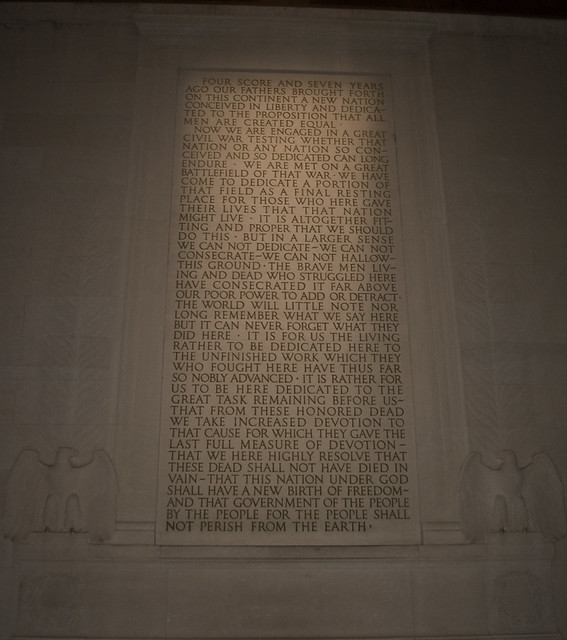
We have no alternative from now on but to look forward and not back. This does not dishonor the fallen heroes, and Lincoln explained why at Gettysburg. “We can not dedicate — we can not consecrate — we can not hallow this ground,” he said. “The brave men, living and dead, who struggled here, have consecrated it, far above our poor power to add or detract.” The best we could do, Lincoln declared, was to commit ourselves to “a new birth of freedom.” This is still our calling.
By: E. J. Dionne, Opinion Writer, The Washington Post, September 7, 2011
Politics Without Purpose: September 11 Should Not Be Another Media Event
It was another one of those weeks in the capital when our leaders debated matters crucial to the survival of American civilization.
Did President Obama try to upstage the Republican presidential debate by asking to address a joint session of Congress that same night? And did House Speaker John Boehner dis the president, and the presidency, by denying him that slot?
Tempted though I was to weigh in on this important matter, I decided instead to head over to the Smithsonian’s National Museum of American History, to preview a small but immensely powerful exhibit marking the 10th anniversary of the Sept. 11 attacks.
There, displayed for the first time, are sacred relics of 9/11: the crumpled piece of the fuselage where the American flag had been painted on the Boeing 757 that crashed in a Pennsylvania field, a flight-attendant call button from the plane, a window shade, a landing gear strut, and a log book with the pages intact. The exhibit is simple and raw, without glass or showcases. Some dried mud caked on an airplane seatbelt was flaking off onto a tablecloth.
Nearby is the door from a fire truck crushed at Ground Zero and the beeper of a man who died in the South Tower. There’s a Pentagon clock frozen at about the time American Airlines Flight 77 struck the complex and the phone on which Ted Olson received the last call from his wife on the doomed plane. Most poignant, perhaps, is the postcard from another passenger, written to her sister the day before the crash to give the address of a new home in which she would never live.
The spare exhibit brought back the horror of that time. But it also reminded me of the pride in what followed, the national unity and sense of purpose.
The warm feelings didn’t last long, of course, destroyed by the war in Iraq and the politicization of homeland security. By now, we have lost all sense of purpose in politics, alternately distracted by Sarah Palin’s bus tours, Anthony Weiner’s private parts, David Wu’s tiger suit, Donald Trump’s birth-certificate campaign, and Dick Cheney’s broadsides.
Obama, whose uncertain trumpet has ceased to rally even his own troops, contemplated his long-delayed jobs agenda while lounging on Martha’s Vineyard last month. His leading Republican rival for the presidency talks of treason and secession. Another challenger arranges to quadruple the size of his California home (his defense: He’s only doubling the living space). Lawmakers play games with the debt ceiling and wound the nation’s credit rating but can’t agree on anything to put Americans back to work.
The political extraneousness of the moment, in other words, is like that of early September 2001. We spent those days amusing ourselves with Gary Condit and shark attacks. President George W. Bush spent August on a record-long ranch vacation. The biggest issue under debate: stem-cell research. Warnings about Osama bin Laden were ignored while the administration obsessed over rewriting a missile treaty with Russia.
What will it require to end the drift this time? A depression? Another attack? Or is there a less painful way to regain national purpose?
“For most people,” curator David Allison told me as I toured the Smithsonian exhibit, “Sept. 11 is only a media event.” The exhibit is a modest attempt at changing that, taking that day’s ruins out of storage and rekindling memory. The lucky few who see the exhibit during its short run will be reminded that there are things more important than whether the president addresses Congress on a Wednesday or a Thursday.
Consider the simple postcard, written by Georgetown economist Leslie Whittington to her sister and brother-in-law, as Whittington, her husband and their 8- and 3-year-old daughters headed off to Australia for a sabbatical. The card, postmarked Sept. 12 at Dulles Airport, must have been mailed just before the family boarded American Flight 77. The note says, in its entirety:
9/10/01
Dear Sara & Jay,
Well, we’re off to Australia. When we return we will have a new address (as of 11/30): 8034 Glendale Rd. Chevy Chase, MD 20815
We don’t know our phone # yet. While we are in “Oz”, email will work best for contacting us: whittinl@georgetown.edu.
Love, Leslie, Chas, Zoe & Dana
I thought about Sara receiving that postcard from her dead sister, and about those little girls who never made it to Glendale Road – because of 19 evil men and a government distracted by less important things.
Then I went out onto Constitution Avenue, where, across from the museum, a bus labeled “Extreme Makeover: Home Edition” had just parked.
By: Dana Milbank, Opinion Writer, The Washington Post, September 2, 2011
“We The People” And America’s Future: Is Rick Perry As American As He Thinks He Is?
A few weeks ago, I wrote a piece asking whether Governor Rick Perry could call himself a Christian given his opposition to government actions to help the hungry, aged, and ill. Not surprisingly, many challenged my view of Christianity. In letter after letter they pointed out that Christ spoke to individuals, not government. My observation that He was speaking to a conquered people, not free individuals who could use their power to make a more just state, was not convincing. My reference to the prophets Micah, Amos, Jeremiah, and Isaiah, each of whom called on governmental leaders to help the poor, was dismissed as being from the “Old Testament.”
I will surely return to the issue of Christianity again, but I devote this piece to Rick Perry’s character and the character he would nurture in American citizens. Teddy Roosevelt said, “Character, in the long run, is the decisive factor in the life of an individual and of nations alike.” So what is the character that Perry embodies? What is his view of the American citizen and the citizen’s responsibility to our country and to one’s fellows?
First, Perry himself.
His persona evokes the rugged individualist. His warning to Ben Bernanke, chairman of the Federal Reserve, not to come to Texas so that he can avoid being subjected to “real ugly” frontier justice evidences a character antithetical to one of the crowning achievements of the United States — a nation under law, not men. In a phrase, he dismisses the Bill of Rights — due process, trial by jury, the right to confront one’s accuser.
The real question is not what character he would make of the United States but whether he believes in America at all. He has threatened to secede. Central to his campaign is his pledge to shrink the federal government — making it impossible for our noble nation to lead the world, to serve as the “city on the Hill.”
Perry may want to pretend that he is taking America back to a better past, but his actions are part of the movement away from nation-states, where countries are largely irrelevant. The notion that we are at the end of the need for nation-states is gaining more adherents globally. The fortunate few, commonly referred to as the Davos groupies, hang out with the other well off and well-heeled all over the world. Summering in Europe, wintering in Colorado, the global elite have more in common with and feel more loyal to their carefully connected crowd than with their fellow citizens. When one’s loyalty lies with one’s own class, where does that leave one’s country?
In declaring his wish to shrink the size of government, Perry believes that government should have as little role in people’s lives as possible. No investment in education, science research, building the railroads, highways, or sewage systems of the future. Why care about America’s future, why set inspirational goals that bring people together, if you don’t believe in “We the people”?
Nationalism, patriotism, commitment to one another are for Perry an anachronism, a thing of the past. He has not said that those with the greatest wealth, talent, and circumstances have any special responsibility to our country or their fellow citizens. He has not said we are all Americans together. Rather, he seems to be able to watch human suffering with equanimity — as though America should be a place of survival of the fittest. No Social Security, no Medicare, no unemployment insurance, no laws to protect clean air, clean water. When hurricanes, tornadoes, earthquakes, and flood destroy home and communities — no FEMA, no help. “We” are on our own.
In his book Fed Up!: Our Fight to Save America From Washington, Perry writes that the 16th Amendment, which gave birth to the federal income tax, was “the great milestone on the road to serfdom,” because it represented “the birth of wealth redistribution in the United States.”
Individualism, self-reliance, self-respect — these are great virtues, useful in many fields of endeavor. But they are not enough to sustain a nation. Virtues don’t spring into being in a moment. They need to be exercised and practiced. Nations at war need courage, quick thinking, and selflessness. Nations at peace require that sense of duty to others. No man goes into a burning building for mere money. Nor does a fierce individualism nurture the patience that a teacher requires, the love given by a hospice nurse caring for a dying man.
Citizens’ moral compasses do not stem only from their faith. Government also defines the moral standard of a nation. If we are told that blacks are worth but three-fifths of whites, many will see this as the acceptable treatment of their fellow man. Likewise, when the government declares it illegal to discriminate on the basis of race, we see that discrimination is also wrong.
When a candidate like Governor Perry boasts that he will shrink government by cutting those programs that grasp the nation’s imagination of what we can do together, he is saying that America does not need the one institution in which we make our most solemn decisions together. We need not nurture a nation of laws, nor educate the young, nor protect the elderly. Teddy Roosevelt took on the trusts, protected the environment, made America more just. The character of the nation improved with his leadership. Can it improve with Perry’s?
By: Kathleen Kennedy Townsend, The Atlantic, August 29, 2011
The GOP Assault On Voting Rights: A Poll Tax By Another Name
AS we celebrate the Martin Luther King Jr. Memorial, we reflect on the life and legacy of this great man. But recent legislation on voting reminds us that there is still work to do. Since January, a majority of state legislatures have passed or considered election-law changes that, taken together, constitute the most concerted effort to restrict the right to vote since before the Voting Rights Act of 1965.
Growing up as the son of an Alabama sharecropper, I experienced Jim Crow firsthand. It was enforced by the slander of “separate but equal,” willful blindness to acts of racially motivated violence and the threat of economic retaliation. The pernicious effect of those strategies was to institutionalize second-class citizenship and restrict political participation to the majority alone.
We have come a long way since the 1960s. When the Voting Rights Act was passed, there were only 300 elected African-American officials in the United States; today there are more than 9,000, including 43 members of Congress. The 1993 National Voter Registration Act — also known as the Motor Voter Act — made it easier to register to vote, while the 2002 Help America Vote Act responded to the irregularities of the 2000 presidential race with improved election standards.
Despite decades of progress, this year’s Republican-backed wave of voting restrictions has demonstrated that the fundamental right to vote is still subject to partisan manipulation. The most common new requirement, that citizens obtain and display unexpired government-issued photo identification before entering the voting booth, was advanced in 35 states and passed by Republican legislatures in Alabama, Minnesota, Missouri and nine other states — despite the fact that as many as 25 percent of African-Americans lack acceptable identification.
Having fought for voting rights as a student, I am especially troubled that these laws disproportionately affect young voters. Students at state universities in Wisconsin cannot vote using their current IDs (because the new law requires the cards to have signatures, which those do not). South Carolina prohibits the use of student IDs altogether. Texas also rejects student IDs, but allows voting by those who have a license to carry a concealed handgun. These schemes are clearly crafted to affect not just how we vote, but who votes.
Conservative proponents have argued for photo ID mandates by claiming that widespread voter impersonation exists in America, despite overwhelming evidence to the contrary. While defending its photo ID law before the Supreme Court, Indiana was unable to cite a single instance of actual voter impersonation at any point in its history. Likewise, in Kansas, there were far more reports of U.F.O. sightings than allegations of voter fraud in the past decade. These theories of systematic fraud are really unfounded fears being exploited to threaten the franchise.
In Georgia, Florida, Ohio and other states, legislatures have significantly reduced opportunities to cast ballots before Election Day — an option that was disproportionately used by African-American voters in 2008. In this case the justification is often fiscal: Republicans in North Carolina attempted to eliminate early voting, claiming it would save money. Fortunately, the effort failed after the State Election Board demonstrated that cuts to early voting would actually be more expensive because new election precincts and additional voting machines would be required to handle the surge of voters on Election Day.
Voters in other states weren’t so lucky. Florida has cut its early voting period by half, from 96 mandated hours over 14 days to a minimum of 48 hours over just eight days, and has severely restricted voter registration drives, prompting the venerable League of Women Voters to cease registering voters in the state altogether. Again, this affects very specific types of voters: according to the nonpartisan Brennan Center for Justice, African-Americans and Latinos were more than twice as likely as white voters to register through a voter registration drive.
These restrictions purportedly apply to all citizens equally. In reality, we know that they will disproportionately burden African Americans and other racial minorities, yet again. They are poll taxes by another name.
The King Memorial reminds us that out of a mountain of despair we may hew a stone of hope. Forty-eight years after the March on Washington, we must continue our work with hope that all citizens will have an unfettered right to vote. Second-class citizenship is not citizenship at all.
We’ve come some distance and have made great progress, but Dr. King’s dream has not been realized in full. New restraints on the right to vote do not merely slow us down. They turn us backward, setting us in the wrong direction on a course where we have already traveled too far and sacrificed too much.
By: Rep John Lewis, Op-Ed Contributor, The New York Times, August 27, 2011
Share This Blog


 Unknown Feed
- An error has occurred; the feed is probably down. Try again later.
 mykeystrokes.com