“The New Peter King”: New House Homeland Security Chair May Not Be A Whole Lot Better.
Good news for people who are uneasy with New York Republican Rep. Peter King’s leadership of the House Homeland Security Committee: He’s stepping down thanks to term limits. But there’s some potential bad news: His replacement may not be a whole lot better.
Texas Republican Rep. Mike McCaul edged out Michigan Rep. Candice Miller — who was the GOP’s best hope of getting a female major committee head — and Mike Rodgers in a close private vote this week. King’s tenure as chairman drew controversy for the series of hearings he held on the radicalization of Muslims in America. Critics didn’t discount the threat of homegrown terror but said King should have expanded the hearings to include all kinds of violent radicalism, including right-wing extremism.
But McCaul has been a big booster of those hearings. “I want to thank you for demonstrating the political courage to hold these hearings,” he said to King during one last year. “I must say, I am mystified by the controversy that has followed from this. It was said by one of the members that we are investigating Muslims. Nothing could be farther from the truth. We are investigating the radicalization of Muslim youth in the United States.”
McCaul is a former federal prosecutor who headed the counterterrorism division of the U.S. attorney’s office in Texas, so his resume lends him credibility on the subject. His rhetoric is generally more mild than King’s, but some advocates in the Muslim-American community are concerned.
“In the past two years, there have been 27 terror plots, and each of them involved extreme radicalization of the Muslim faith,” he said at radicalization hearing this year. What counts as a “terror plot” is obviously subject to semantic debate, but right-wing extremists account for a good portion, if not most, of domestic terrorism under most definitions of the term.
In another hearing, he defended himself when a witness criticized him for connecting Islam and terror. “I would argue that we have to look at the obvious – that there is a religious component to this,” he said. Though he’s always careful to add that terror “doesn’t reflect the vast majority of Muslims.”
McCaul’s district is just south of Fort Hood, and he joined other Republicans in their insistence in labeling as a terrorist Maj. Nidal Hasan, who killed 13 people on the base in 2009. Hasan had corresponded with Anwar Al-Awlaki and shouted “Allahu Akbar” before opening fire, which is enough to convince McCaul that it was a “planned terror attack.” He also introduced a bill to designate victims of the attack as combatants in a combat zone.
McCaul appeared once on the radio show hosted by Frank Gaffney, the controversial activist behind Rep. Michele Bachmann’s Muslim witch hunts. Gaffney said of the congressman: “He is, in a number of capacities, a go-to guy for the sorts of things we’re interested in here at Secure Freedom Radio.” On the show, McCaul discussed one of his hobby horses, the apparent threat of Hezbollah teaming up with Mexican drug cartels to infiltrate the U.S. via the southern border. McCaul has authored two reports on the subject, both titled, “A Line in the Sand: Countering Crime, Violence, and Terror at the Southwest Border.”
He has also sent a number of “dear colleague” letters to other members of Congress asking them to support his bills to crack down on foreign terror networks. One sent in September called attention to a news article alleging the Iran’s elite Quds Force was operating in Syria and asked colleagues to support a bill to designate the unit as a terrorist organization. Others would cut off aid to Egypt and Pakistan.
None of this is particularly unusual for a conservative Republican today, but it doesn’t bode well for those who hoped that King’s departure would turn a new leaf at the Homeland Security Committee.
By: Alex Seitz-Wald, Salon, December 1, 2012
How Dare Cheney Criticize Obama For Taking Out A Terrorist
By near-universal account of those who condemn terrorism, the killing of jihadist Anwar al-Awlaki was a good thing. This was a man believed to be behind the attempted Christmas Day, 2009 bombing of a U.S. aircraft over American soil. It was a man U.S. officials say was trying to blow up American cargo planes by putting explosives into the packages on the planes, a man believed to have been hatching plans to poison fellow Americans.
Al-Awlaki was killed last week in Yemen in a drone strike, not only ridding the world of a dangerous terrorist, but depriving al-Qaeda of a powerful recruiter.
And Dick Cheney wants President Obama to apologize for it.
The irrepressible former vice president sees the killing as justified, to be sure. He’s just mad because he thinks Obama is hypocritical for criticizing what the Bush administration, in almost comically euphemistic terms, described as “enhanced interrogation techniques” used on imprisoned al Qaeda suspects. As Cheney told CNN’s State of the Union:
They’ve agreed they need to be tough and aggressive in defending the nation and using some of the same techniques that the Bush administration did. And they need, as I say, to go back and reconsider some of the criticisms they offered about our policies.
The self-centeredness of the comment is astonishing. A key al-Qaeda subject is killed, and Cheney is thinking about what it means for the reputation of the previous administration? If we’re demanding apologies here, why not demand apologies from the people who are screaming about the budget deficit now after voting for laws and wars that vastly increased the budget deficit? And the al-Awlaki killing doesn’t have anything to do with waterboarding. We don’t know whether al-Awlaki was found because of “enhanced interrogation techniques.” There are surely legitimate questions to be asked about whether and why a U.S. citizen should be targeted, either on U.S. soil or abroad. But hypocrisy isn’t the issue here.
Former President Bush has been gracious and quiet as his successor takes on the problems of the economy and national security. If Bush has disagreed with what Obama has done, he’s kept it to himself—something that is not only just good manners for a former president, but in the specific arena of national security, important to giving a sense of continuity in front of the international audience. How unfortunate that Cheney cannot behave in the same way.
By: Susan Milligan, U. S. News and World Report, October 3, 2011
George W. Bush Says “Most Nervous Moment” Of His Presidency Is When He Threw A Ball
Former U.S. president George W. Bush. (REUTERS) Former President George W. Bush might want to drop the superlatives.
In what is at least his second foot-in-the-mouth moment recalling the toughest moments of his presidency, Bush has said “the most nervous moment” of his presidency was throwing the ceremonial first pitch at the 2001 World Series.
According to an interview Bush gave to the producers of “Beyond 9/11: Portraits of Resilience,” a TIME documentary that aired over the weekend, and a clip provided by Gawker, the former president said:
The adrenaline was coursing through my veins, and the ball felt like a shotput. And Todd Greene, the catcher, looked really small. Sixty feet and six inches seemed like a half-mile. And anyway, I took a deep breath and threw it, and thankfully it went over the plate. The response was overwhelming. It was the most nervous I had ever been. It’s the most nervous moment of my entire presidency, it turns out.
The statement was reminiscent of another by Bush last year, in which he said the worst moment of his presidency is when rapper Kanye West called him a racist. “It was a disgusting moment, pure and simple,” Bush had said. “I didn’t appreciate it then [and] I don’t appreciate it now.”
Bush was referring to a Hurricane Katrina live telethon appearance by West in 2005, in which the performer launched into a an angry diatribe about race and aid efforts, including the accusation: “George Bush doesn’t care about black people.”
The Guardian pointed out at the time that the comment came in spite of Bush having led “the U.S. into war and presiding over the beginnings of one of the greatest financial disasters in history.”
This time, Gawker provides a laundry list of things Bush should have found more nerve-wracking than a baseball pitch, including receiving a warning that Osama bin Laden was going to strike the United States or authorizing the torture of detainees in U.S. custody. “That was some … pitch, though,” Gawker writes sarcastically.
Watch the video of Bush’s statement here or his full “Beyond 9/11” video here.
By: Elizabeth Flock, The Washington Post, September 12, 2011
Committing To A New Birth Of Freedom: It’s Time To Leave 9/11 Behind
After we honor the 10th anniversary of the attacks of Sept. 11, 2001, we need to leave the day behind. As a nation we have looked back for too long. We learned lessons from the attacks, but so many of them were wrong. The last decade was a detour that left our nation weaker, more divided and less certain of itself.
Reflections on the meaning of the horror and the years that followed are inevitably inflected by our own political or philosophical leanings. It’s a critique that no doubt applies to my thoughts as well. We see what we choose to see and use the event as we want to use it.
This does nothing to honor those who died and those who sacrificed to prevent even more suffering. In the future, the anniversary will best be reserved as a simple day of remembrance in which all of us humbly offer our respect for the anguish and the heroism of those individuals and their families.
But if we continue to place 9/11 at the center of our national consciousness, we will keep making the same mistakes. Our nation’s future depended on far more than the outcome of a vaguely defined “war on terrorism,” and it still does. Al-Qaeda is a dangerous enemy.
But our country and the world were never threatened by the caliphate of its mad fantasies.
We asked for great sacrifice over the past decade from the very small portion of our population who wear the country’s uniform, particularly the men and women of the Army and the Marine Corps. We should honor them, too. And, yes, we should pay tribute to those in the intelligence services, the FBI and our police forces who have done such painstaking work to thwart another attack.
It was often said that terrorism could not be dealt with through “police work,” as if the difficult and unheralded labor involved was not grand or bold enough to satisfy our longing for clarity in what was largely a struggle in the shadows.
Forgive me, but I find it hard to forget former president George W. Bush’s 2004 response to Sen. John Kerry’s comment that “the war on terror is less of a military operation and far more of an intelligence-gathering and law-enforcement operation.”
Bush retorted: “I disagree — strongly disagree. . . . After the chaos and carnage of September the 11th, it is not enough to serve our enemies with legal papers. With those attacks, the terrorists and their supporters declared war on the United States of America, and war is what they got.” What The Washington Post called “an era of endless war” is what we got, too.
Bush, of course, understood the importance of “intelligence gathering” and “law enforcement.” His administration presided over a great deal of both, and his supporters spoke, with justice, of his success in staving off further acts of terror. Yet he could not resist the temptation to turn on Kerry’s statement of the obvious. Thus was an event that initially united the nation used, over and over, to aggravate our political disharmony. This is also why we must put it behind us.
In the flood of anniversary commentary, notice how often the term “the lost decade” has been invoked. We know now, as we should have known all along, that American strength always depends first on our strength at home — on a vibrant, innovative and sensibly regulated economy, on levelheaded fiscal policies, on the ability of our citizens to find useful work, on the justice of our social arrangements.
This is not “isolationism.” It is a common sense that was pushed aside by the talk of “glory” and “honor,” by utopian schemes to transform the world by abruptly reordering the Middle East — and by our fears. While we worried that we would be destroyed by terrorists, we ignored the larger danger of weakening ourselves by forgetting what made us great.
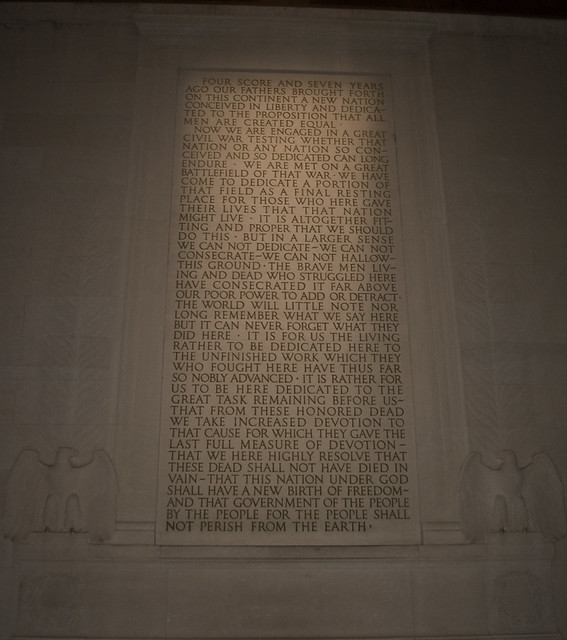
We have no alternative from now on but to look forward and not back. This does not dishonor the fallen heroes, and Lincoln explained why at Gettysburg. “We can not dedicate — we can not consecrate — we can not hallow this ground,” he said. “The brave men, living and dead, who struggled here, have consecrated it, far above our poor power to add or detract.” The best we could do, Lincoln declared, was to commit ourselves to “a new birth of freedom.” This is still our calling.
By: E. J. Dionne, Opinion Writer, The Washington Post, September 7, 2011
Eric Cantor Is A Hypocrite On Disaster Relief Spending
Buried in this Saturday’s Washington Post Metro section was a short piece about the request from conservative Virginia Republican Gov. Robert McDonnell for $39 million in federal disaster relief for his state.
This was an initial request for 22 localities in Virginia hard hit by Hurricane Irene. According to the article, other local governments can request more aid and, in addition, McDonnell also asked for Hazard Mitigation Assistance for all Virginia localities.
This comes from a governor who, along with his Republican congressional counterpart Eric Cantor, rails against Washington and “government spending.”
What makes this quite interesting is the position taken by Cantor last week on Federal Emergency Management funding for disasters. We have had a record 66 natural disasters this year and Hurricane Irene was one of the 10 most costly ever.
Cantor, whose district was hit hard by the earthquake and the hurricane, has said that any spending for FEMA should be tied to cuts elsewhere, dollar for dollar, “Just like any family would operate when it’s struck with disaster,” says Cantor. Funny, that is not how he felt back in 2004 when he appealed for money for his district after another hurricane and voted against the amendment by Republican Rep. Jeb Hensarling of Texas to do require offsets.
Did Eric Cantor ask for dollar for dollar cuts to pay for the wars in Iraq and Afghanistan? Did he ask for dollar for dollar cuts to pay for the Bush tax cuts for the millionaires and billionaires? Did he ask for dollar for dollar cuts to pay for increases to homeland security? How about border agents?
Another very conservative congressman from Virginia, Leonard Lance, totally disagrees with Cantor. Help is needed now. Gov. Chris Christie of New Jersey, no friend of government spending, talks as though Eric Cantor has lost his marbles: “Our people are suffering now, and they need support now. And they [Congress] can all go down there and get back to work and figure out budget cuts later.”
It is time for a host of protesters to go to Cantor’s district office and call him on his absurdity. Does he believe we should help the victims of these disasters? Is that what government has done for over 200 years? Does he just want to play politics and delay help? Does he represent the people of Virginia? Does he care about the others who have been the victims of tornadoes and floods across this country?
It reminds me of a Senate debate where a certain Republican from Idaho was complaining about a bill that included funding for rat control in New York City.
“In Idaho, we take care of our own rats,” to which the New York senator replied, “In New York, we take care of our own forest fires.”
That about sums it up.
By: Peter Fenn, U. S. News and World Report, September 6, 2011
Share This Blog


 Unknown Feed
- An error has occurred; the feed is probably down. Try again later.
 mykeystrokes.com