“Love Thy Neighbor As Thyself”: Where Are The Compassionate Conservatives?
We heard plenty of contradictions, distortions and untruths at the Republican candidates’ Tea Party debate, but we heard shockingly little compassion — and almost no acknowledgement that political and economic policy choices have a moral dimension.
The lowest point of the evening — and perhaps of the political season — came when moderator Wolf Blitzer asked Ron Paul a hypothetical question about a young man who elects not to purchase health insurance. The man has a medical crisis, goes into a coma and needs expensive care. “Who pays?” Blitzer asked.
“That’s what freedom is all about, taking your own risks,” Paul answered. “This whole idea that you have to prepare and take care of everybody. . . .”
Blitzer interrupted: “But Congressman, are you saying that society should just let him die?”
There were enthusiastic shouts of “Yeah!” from the crowd. You’d think one of the other candidates might jump in with a word about Christian kindness. Not a peep.
Paul, a physician, went on to say that, no, the hypothetical comatose man should not be allowed to die. But in Paul’s vision of America, “our neighbors, our friends, our churches” would choose to assume the man’s care — with government bearing no responsibility and playing no role.
Blitzer turned to Michele Bachmann, whose popularity with evangelical Christian voters stems, at least in part, from her own professed born-again faith. Asked what she would do about the man in the coma, Bachmann ignored the question and launched into a canned explanation of why she wants to repeal President Obama’s Affordable Care Act.
According to the Gospel of Matthew, Jesus told the Pharisees that God commands us to “love thy neighbor as thyself.” There is no asterisk making this obligation null and void if circumstances require its fulfillment via government.
Bachmann knows a lot about compassion. She makes much of the fact that she and her husband took in 23 foster children over the years. But what of the orphaned or troubled children who are not lucky enough to find a wealthy family to take them in? What of the boys and girls who have stable homes but do not regularly see a doctor because their parents lack health insurance?
Government can reach them. But according to today’s Republican dogma, it must not.
Rick Perry, Mitt Romney, Bachmann, Paul and the others onstage in Tampa all had the same prescription for the economy: Cut spending, cut taxes and let the wealth that results trickle down to the less fortunate.
They betrayed no empathy for, or even curiosity about, the Americans who depend on the spending that would be cut. They had no kind words — in fact, no words at all — for teachers, firefighters and police officers who will lose their jobs unless cash-strapped state and local government receive federal aid. Public servants, the GOP candidates imply, don’t hold “real” jobs. I wonder: Do Republicans even consider them “real” people?
Government is more than a machine for collecting and spending money, more than an instrument of war, a book of laws or a shield to guarantee and protect individual rights. Government is also an expression of our collective values and aspirations. There’s a reason the Constitution begins “We the people . . .” rather than “We the unconnected individuals who couldn’t care less about one another . . . .”
I believe the Republican candidates’ pinched, crabby view of government’s nature and role is immoral. I believe the fact that poverty has risen sharply over the past decade — as shown by new census data — while the richest Americans have seen their incomes soar is unacceptable. I believe that writing off whole classes of citizens — the long-term unemployed whose skills are becoming out of date, thousands of former offenders who have paid their debt to society, millions of low-income youth ill-served by inadequate schools — is unconscionable.
Perry, who is leading in the polls, wants to make the federal government “inconsequential.” He thinks Social Security is a “Ponzi scheme” and a “monstrous lie.” He doesn’t much like Medicare, either.
But there was a fascinating moment in the debate when Perry defended Texas legislation that allows children of illegal immigrants to pay in-state tuition at state universities. “We were clearly sending a message to young people, regardless of what the sound of their last name is, that we believe in you,” Perry said.
The other candidates bashed him with anti-immigrant rhetoric until the evening’s only glimmer of moral responsibility was snuffed out.
By: Eugene Robinson, Opinion Writer, The Washington Post, September 15, 2011
The Candidates Weren’t The Only Ones On Display In Tampa
The point of presidential candidate debates is to offer the public a chance to scrutinize and evaluate those seeking national office. Occasionally, though, voters get the chance to scrutinize and evaluate those in the audience, which is nearly as interesting.
The candidates seeking the Republican presidential nomination are a pretty scary bunch — remember, one of them stands a reasonably good chance of becoming the leader of the free world in about 17 months — and the two-hour display on CNN last night was a depressing reminder of what’s become of the GOP in the 21st century. That said, maybe it’s just me, but I’m starting to find the audiences for these debates even more disconcerting.
Wolf Blitzer posed a hypothetical scenario to Ron Paul, asking about a young man who makes a good living, but decides to forgo health insurance. Then, tragedy strikes and he needs care. Paul stuck to the libertarian line. “But congressman,” the moderator said, “are you saying that society should just let him die?”
And at that point, some in the audience shouted, “Yeah,” and applauded.
Earlier in the debate, Blitzer asked Rick Perry about his attacks on Federal Reserve Chairman Ben Bernanke. “I said that, if you are allowing the Federal Reserve to be used for political purposes, that it would be almost treasonous,” Perry said. “I think that is a very clear statement of fact.”
The audience loved this, too.
What’s more, note that in last week’s debate, the mere observation that Perry has signed off on the executions of 234 people in Texas, more than any other governor in modern times, was enough to generate applause from a different GOP audience.
Taken together, over the last five days, we’ve learned that the way to impress Republican voters, at least the ones who show up for events like these, is to support letting the uninsured die, accusing the Fed of treason for trying to improve the economy, and executing lots of people.
There’s a deep strain of madness running through Republican politics in 2011, and it appears to be getting worse. Those wondering why the GOP presidential field appears weak, insipid, and shallow need look no further than the voters they choose to pander to.
By: Steve Benen, Contributing Writer, Washington Monthly Political Animal, September 13, 2011
Committing To A New Birth Of Freedom: It’s Time To Leave 9/11 Behind
After we honor the 10th anniversary of the attacks of Sept. 11, 2001, we need to leave the day behind. As a nation we have looked back for too long. We learned lessons from the attacks, but so many of them were wrong. The last decade was a detour that left our nation weaker, more divided and less certain of itself.
Reflections on the meaning of the horror and the years that followed are inevitably inflected by our own political or philosophical leanings. It’s a critique that no doubt applies to my thoughts as well. We see what we choose to see and use the event as we want to use it.
This does nothing to honor those who died and those who sacrificed to prevent even more suffering. In the future, the anniversary will best be reserved as a simple day of remembrance in which all of us humbly offer our respect for the anguish and the heroism of those individuals and their families.
But if we continue to place 9/11 at the center of our national consciousness, we will keep making the same mistakes. Our nation’s future depended on far more than the outcome of a vaguely defined “war on terrorism,” and it still does. Al-Qaeda is a dangerous enemy.
But our country and the world were never threatened by the caliphate of its mad fantasies.
We asked for great sacrifice over the past decade from the very small portion of our population who wear the country’s uniform, particularly the men and women of the Army and the Marine Corps. We should honor them, too. And, yes, we should pay tribute to those in the intelligence services, the FBI and our police forces who have done such painstaking work to thwart another attack.
It was often said that terrorism could not be dealt with through “police work,” as if the difficult and unheralded labor involved was not grand or bold enough to satisfy our longing for clarity in what was largely a struggle in the shadows.
Forgive me, but I find it hard to forget former president George W. Bush’s 2004 response to Sen. John Kerry’s comment that “the war on terror is less of a military operation and far more of an intelligence-gathering and law-enforcement operation.”
Bush retorted: “I disagree — strongly disagree. . . . After the chaos and carnage of September the 11th, it is not enough to serve our enemies with legal papers. With those attacks, the terrorists and their supporters declared war on the United States of America, and war is what they got.” What The Washington Post called “an era of endless war” is what we got, too.
Bush, of course, understood the importance of “intelligence gathering” and “law enforcement.” His administration presided over a great deal of both, and his supporters spoke, with justice, of his success in staving off further acts of terror. Yet he could not resist the temptation to turn on Kerry’s statement of the obvious. Thus was an event that initially united the nation used, over and over, to aggravate our political disharmony. This is also why we must put it behind us.
In the flood of anniversary commentary, notice how often the term “the lost decade” has been invoked. We know now, as we should have known all along, that American strength always depends first on our strength at home — on a vibrant, innovative and sensibly regulated economy, on levelheaded fiscal policies, on the ability of our citizens to find useful work, on the justice of our social arrangements.
This is not “isolationism.” It is a common sense that was pushed aside by the talk of “glory” and “honor,” by utopian schemes to transform the world by abruptly reordering the Middle East — and by our fears. While we worried that we would be destroyed by terrorists, we ignored the larger danger of weakening ourselves by forgetting what made us great.
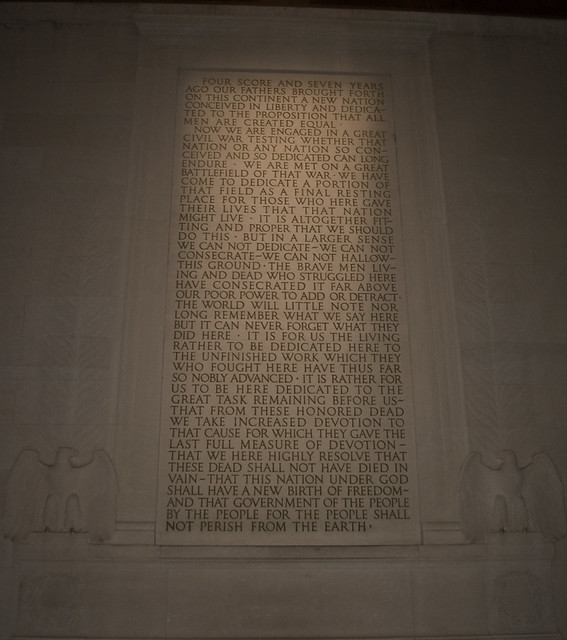
We have no alternative from now on but to look forward and not back. This does not dishonor the fallen heroes, and Lincoln explained why at Gettysburg. “We can not dedicate — we can not consecrate — we can not hallow this ground,” he said. “The brave men, living and dead, who struggled here, have consecrated it, far above our poor power to add or detract.” The best we could do, Lincoln declared, was to commit ourselves to “a new birth of freedom.” This is still our calling.
By: E. J. Dionne, Opinion Writer, The Washington Post, September 7, 2011
Politics Without Purpose: September 11 Should Not Be Another Media Event
It was another one of those weeks in the capital when our leaders debated matters crucial to the survival of American civilization.
Did President Obama try to upstage the Republican presidential debate by asking to address a joint session of Congress that same night? And did House Speaker John Boehner dis the president, and the presidency, by denying him that slot?
Tempted though I was to weigh in on this important matter, I decided instead to head over to the Smithsonian’s National Museum of American History, to preview a small but immensely powerful exhibit marking the 10th anniversary of the Sept. 11 attacks.
There, displayed for the first time, are sacred relics of 9/11: the crumpled piece of the fuselage where the American flag had been painted on the Boeing 757 that crashed in a Pennsylvania field, a flight-attendant call button from the plane, a window shade, a landing gear strut, and a log book with the pages intact. The exhibit is simple and raw, without glass or showcases. Some dried mud caked on an airplane seatbelt was flaking off onto a tablecloth.
Nearby is the door from a fire truck crushed at Ground Zero and the beeper of a man who died in the South Tower. There’s a Pentagon clock frozen at about the time American Airlines Flight 77 struck the complex and the phone on which Ted Olson received the last call from his wife on the doomed plane. Most poignant, perhaps, is the postcard from another passenger, written to her sister the day before the crash to give the address of a new home in which she would never live.
The spare exhibit brought back the horror of that time. But it also reminded me of the pride in what followed, the national unity and sense of purpose.
The warm feelings didn’t last long, of course, destroyed by the war in Iraq and the politicization of homeland security. By now, we have lost all sense of purpose in politics, alternately distracted by Sarah Palin’s bus tours, Anthony Weiner’s private parts, David Wu’s tiger suit, Donald Trump’s birth-certificate campaign, and Dick Cheney’s broadsides.
Obama, whose uncertain trumpet has ceased to rally even his own troops, contemplated his long-delayed jobs agenda while lounging on Martha’s Vineyard last month. His leading Republican rival for the presidency talks of treason and secession. Another challenger arranges to quadruple the size of his California home (his defense: He’s only doubling the living space). Lawmakers play games with the debt ceiling and wound the nation’s credit rating but can’t agree on anything to put Americans back to work.
The political extraneousness of the moment, in other words, is like that of early September 2001. We spent those days amusing ourselves with Gary Condit and shark attacks. President George W. Bush spent August on a record-long ranch vacation. The biggest issue under debate: stem-cell research. Warnings about Osama bin Laden were ignored while the administration obsessed over rewriting a missile treaty with Russia.
What will it require to end the drift this time? A depression? Another attack? Or is there a less painful way to regain national purpose?
“For most people,” curator David Allison told me as I toured the Smithsonian exhibit, “Sept. 11 is only a media event.” The exhibit is a modest attempt at changing that, taking that day’s ruins out of storage and rekindling memory. The lucky few who see the exhibit during its short run will be reminded that there are things more important than whether the president addresses Congress on a Wednesday or a Thursday.
Consider the simple postcard, written by Georgetown economist Leslie Whittington to her sister and brother-in-law, as Whittington, her husband and their 8- and 3-year-old daughters headed off to Australia for a sabbatical. The card, postmarked Sept. 12 at Dulles Airport, must have been mailed just before the family boarded American Flight 77. The note says, in its entirety:
9/10/01
Dear Sara & Jay,
Well, we’re off to Australia. When we return we will have a new address (as of 11/30): 8034 Glendale Rd. Chevy Chase, MD 20815
We don’t know our phone # yet. While we are in “Oz”, email will work best for contacting us: whittinl@georgetown.edu.
Love, Leslie, Chas, Zoe & Dana
I thought about Sara receiving that postcard from her dead sister, and about those little girls who never made it to Glendale Road – because of 19 evil men and a government distracted by less important things.
Then I went out onto Constitution Avenue, where, across from the museum, a bus labeled “Extreme Makeover: Home Edition” had just parked.
By: Dana Milbank, Opinion Writer, The Washington Post, September 2, 2011
Texas-Style Tort Reform: Rick Perry’s Texas Health Care Hoax
In his quest to win the Republican presidential nomination, Texas Gov. Rick Perry is perpetuating a convincing hoax: that implementing Texas-style tort reformwould go a long way toward curing what ails the U.S. health care system.
Like his fellow GOP contenders, Perry consistently denounces “Obamacare” as “a budget-busting, government takeover of healthcare” and “the greatest intrusion on individual freedom in a generation.” He promises to repeal the law if elected.
Unlike those in the “repeal-and-replace” wing of the Republican Party, however, Perry has emerged as leader of the “repeal-and-let-the-states-figure-it-out” wing that believes the federal government has no legitimate role in fixing America’s health care system.
“To hear federal officials tell it, they’ve got all the answers on health care and it’s up to the rest of us to sit, wait and embrace whatever solution — if any — they may eventually provide,” Perry wrote in a newspaper commentary in 2009. “I find this troubling, since states have shown they know a thing or two about solving problems that affect their citizens.”
Even as he points with pride to the alleged benefits of malpractice and other tort reforms that have been enacted during his tenure as governor of Texas, Perry says he is opposed to tort reform at the federal level. He cites the 10th Amendment to the Constitution, which states-rights advocates say limits the role of the federal government.
But if Perry had his way, all the states would do as Texas did in 2003 when lawmakers enacted legislation, which he championed, limiting the amount of money juries can award patients who win malpractice lawsuits against doctors and hospitals. The legislation capped non-economic (pain and suffering) damages at $250,000 in lawsuits against doctors and $750,000 against hospitals. A few months after he signed the bill into law, the state’s voters narrowly passed a constitutional amendment, also endorsed by Perry, which had the same effect. Proponents of the amendment wanted to be sure the new law would be constitutional.
Texas, he wrote in that 2009 commentary “stands as a good example of how smart, responsible policy can help us take major steps toward fixing a damaged medical system, starting with legal reforms.”
As a result of the 2003 tort reform law, malpractice liability insurers reduced their rates in Texas and, according to Perry, the number of doctors applying to practice medicine in the state “skyrocketed.”
He says that in the first five years after tort reform was enacted, 14,498 doctors either returned to practice in Texas or began practicing there for the first time.
Tort Reform Backfires in Texas
That certainly sounds impressive — so long as you look at that number in isolation. But when you look at how Texas stacks up with the rest of the country in terms of physician growth in direct patient care, tort reform appears to have given Texas no leg up in competition with others states for doctors. In fact, according to statistics compiled by the American Medical Association and other physician organizations, Texas has actually lost ground when it comes to the number of doctors practicing in the state since tort reform was enacted. Big time.
In 2008, the number of physicians in patient care per 10,000 civilian population in the United States was 25.7. At just 20.2 doctors per 10,000 people, Texas ranked near the bottom of the 50 states. In fact, only nine states fared worse. In 2000, three years before tort reform, Texas was still bringing up the rear, but not as badly. Back then, 11 states fared worse than the Lone Star state.
Even more revealing, the number of doctors in patient care increased 13.2 percent nationwide from 2000 to 2008. It increased only 12.8 percent in Texas. The rate of growth was actually greater in 41 other states and in Washington, D.C. than it was in the Lone Star state.
It is true that malpractice insurance rates dropped in Texas after tort reform was enacted, but Texans would be hard pressed to claim any direct benefit from that drop — except, that is, Texans who are doctors.
The Dallas Morning News published a chart earlier this year showing that the average malpractice rate charged ob/gyns in Texas by the state’s largest domestic insurer of physicians fell from $53,752 in 2003 to $33,881 in 2011. The paper reported drops of similar percentages for doctors in family practice and general surgery.
Advocates of tort reform have long claimed that one of the reasons for escalating health care costs is the “defensive medicine” doctors practice, such as over-treating and prescribing more medications and diagnostic tests than necessary, out of fear of being sued. Well, if Texans believed their own health insurance rates would go down once tort reform made defensive medicine less prevalent, they have by now been disabused of that notion. The chances of a Texas family saving a few bucks on premiums would actually be greater if they moved to another state.
In 2010, the average premium for family coverage in Texas was $14,526. That’s $655 higher than the U.S. average. Those numbers seem to indicate that doctors have not passed on their own insurance savings to their patients and that they are not practicing medicine any less defensively than before tort reform was enacted.
Not only are Texans paying more for their own insurance while doctors are paying less for theirs, their chances of getting employer-subsidized coverage is less than it would be if they lived in another state. The Dallas Morning News, citing statistics from the Agency for Healthcare Research and Quality and other sources, reported that a smaller percentage of employers in Texas offered coverage to their workers last year than in the U.S. as a whole (51 percent and 53.8 percent, respectively). And the Texans who do have coverage through the workplace are contributing far more out of their own pockets for that coverage than people who live in most other states. In Texas last year, the average employee contribution toward company-sponsored coverage was $4,500. The U.S. average was much lower: $3,721.
Another statistic Perry is not likely to mention when he talks about the benefits of tort reform is the number of Texans who are uninsured. The U.S. Census Bureau reports that Texas continues to be the state with the highest percentage of its residents without coverage, a whopping 25 percent last year, compared to about 16 percent nationwide. It was dead last in 2003 and it is dead last now.
All this should leave us wondering what “thing or two” states have come up with to solve the problems that affect their citizens. Considering the dismal state of health care in Texas, perhaps Perry had Massachusetts in mind.
By: Wendell Potter, Center for Media and Democracy, September 1, 2011
Share This Blog


 Unknown Feed
- An error has occurred; the feed is probably down. Try again later.
 mykeystrokes.com