Gov. Walker Signs Bill Blocking Milwaukee’s Paid Sick Leave Law
In 2008, Milwaukee, Wisconsin became the third city in America to guarantee workers paid sick leave, joining Washington D.C. and San Fransisco. These cities are stepping up to fill a void left by the federal government, which is content to leave America as one of the only countriesin the developed world that does not guarantee workers paid time off if they are sick.
The sick leave law was approved by referendum — with nearly 70 percent of voters in favor — and was upheld a few weeks ago by the state’s court of appeals. However, Republicans in the Wisconsin state legislature passed a bill preempting the city’s law and ensuring that no jurisdiction within the state of Wisconsin is allowed to decide it wants to mandate paid sick days. Gov. Scott Walker (R-WI) — who gained notoriety for proposing a law stripping public sector workers of their collective bargaining rights and sparking mass protests — signed the anti-sick leave bill into law today:
Gov. Scott Walker has signed a bill that prohibits local governments from passing ordinances guaranteeing workers’ paid sick and family leave…Walker, a Republican, says in a statement the bill removes another barrier to creating jobs.
But Walker’s concern about job-loss is overblown. The Drum Major Institute conducted a study examining San Francisco’s paid sick leave law and found “no evidence that businesses in San Francisco have been negatively impacted by the enactment of paid sick leave.” In fact, the U.S. economy as a whole loses $180 billion in productivity annually due to sick employees attending work and infecting other workers.
Despite Walker’s misguided action, as the National Association of Working Women noted, plenty of other cities are forging ahead with paid sick leave legislation:
In Philadelphia, a paid sick days bill was passed out of a City Council committee a few weeks ago, and in Connecticut, the state legislature is moving forward on a bill with bipartisan support. Paid sick days legislation in New York City has 35 City Council sponsors, legislation is about to be introduced in Seattle, and more than a dozen states have coalitions advocating actively for paid sick days and paid family leave policies. San Francisco and Washington, DC have already implemented paid sick days laws.
In the end, repealing Milwaukee’s paid sick leave law is simply one more way in which Walker is undertaking his assault on Wisconsin’s workers.
By: Pat Garofalo, The Wonk Room, Think Progress, May 5, 2011
Share this:
- Share on Facebook (Opens in new window) Facebook
- Share on X (Opens in new window) X
- Share on Newsvine (Opens in new window) Newsvine
- Share on Tumblr (Opens in new window) Tumblr
- Share on Reddit (Opens in new window) Reddit
- Share on Pinterest (Opens in new window) Pinterest
- Share on LinkedIn (Opens in new window) LinkedIn
- Print (Opens in new window) Print
- Email a link to a friend (Opens in new window) Email
May 6, 2011 Posted by raemd95 | Collective Bargaining, Conservatives, Democracy, Economy, GOP, Gov Scott Walker, Governors, Ideology, Jobs, Lawmakers, Middle Class, Politics, Republicans, Right Wing, State Legislatures, States, Unions, Wisconsin, Wisconsin Republicans, Women, Womens Rights | Connecticut Legislature, D. C., Local Governments, National Association of Working Women, NWC City Council, Philadelphia, San Francisco, Sick Leave, Washington, Wisconsin Court of Appeals, Wisconsin Legislature, Workers, Workers Rights | Leave a comment
Wisconsin Recalls Are Heating Up
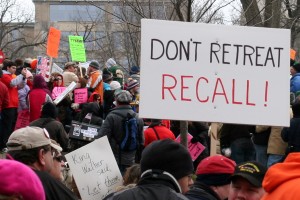
Recent protests at WI capitol
Recall elections loom on the horizon as petitions against nine Wisconsin state senators were recently submitted to the Government Accountability Board (GAB). Each successful petition must include 25 percent of the total number of votes cast in that senate district in the last election.
The recall efforts of Republican senators who supported Gov. Scott Walker’s Budget Repair Bill, and the Democratic senators who left the state to delay voting on the bill, are a result of the political firestorm that quickly flared up over the bill that sought to eliminate almost all collective bargaining rights for public workers.
Currently, the Republican senators who are facing a recall election are Alberta Darling, Robert Cowles, Sheila Harsdorf, Luther Olsen, Randy Hopper and Dan Kapanke. Democrats are facing recall efforts are — Dave Hansen, Jim Holperin and Robert Wirch.
The Milwaukee Journal Sentinel reported that there have also been petitions that didn’t have enough signatures on them to spark a recall. Democratic senators Lena Taylor and Spencer Coggs (both from Milwaukee), Senate Minority Mark Miller (Monona) and Fred Risser (Madison) all have all survived the recall attempts against them. Recall efforts against Republicans Glenn Grothman (West Bend) and Mary Lazich (New Berlin) also failed to garner sufficient support.
Circulators hired by the state Republican Party have submitted “hundreds if not thousands of invalid signatures” in recall drives targeting three Democratic state senators. Volunteers have been working overtime to enter each name into a data base and cross-check it with the phone book and other record. One man who signed a recall petition was Bill Pocan, the deceased father of State Representative Marc Pocan. The Wisconsin Democratic Party (DPW) is formally challenging all three of the recall petitions filed against Democrat senators.
Republicans have filed challenges against “all petitions targeting GOP senators. In addition to their individual signature challenges, they claim the GAB should throw out the petitions because the recall organizers did not properly register with the state.” The elections for recalled legislators with completed petitions will likely be held July 12, 2011.
By: Jennifer Page, Center for Media and Democracy, May 6, 2011
Share this:
- Share on Facebook (Opens in new window) Facebook
- Share on X (Opens in new window) X
- Share on Newsvine (Opens in new window) Newsvine
- Share on Tumblr (Opens in new window) Tumblr
- Share on Reddit (Opens in new window) Reddit
- Share on Pinterest (Opens in new window) Pinterest
- Share on LinkedIn (Opens in new window) LinkedIn
- Print (Opens in new window) Print
- Email a link to a friend (Opens in new window) Email
May 6, 2011 Posted by raemd95 | Collective Bargaining, Democracy, Elections, Gov Scott Walker, Politics, Public Employees, State Legislatures, Union Busting, Unions, Wisconsin | Activism, Government Accountability Board, Milwaukee Journal Sentinel, Recalls, Wisconsin Democratic Party, Wisconsin Legislature, Wisconsin Republicans, Wisconsin Senate | Leave a comment
Continuing The Fight: Wisconsinites Get Revved Up For Worker’s Rights
Hundreds of Wisconsinites lined Madison’s Capitol Square, Saturday, to welcome bikers from all over the Midwest and to protest Scott Walker’s attack on Wisconsin unions.
Just when Governor Scott Walker thought he memorized all the chants and signs, Wisconsinites revved it up a notch. Every kind of bike from Harley-Davidsons to Huffys descended onto the Square from Martin Luther King Jr. Blvd and South Hamilton St.
Eric Hartz, the organizer of the event, complemented the thunderous entrance with songs from the Raging Grannies, a social justice organization made up of older women. Other speakers included Sen. John Erpenbach, Sen. Mark Miller, Rep. Cory Mason, Rep. Peter Barca, Milwaukee Public School Teachers and the City of Middleton Fire Fighters.
Throughout the speeches you could hear the low rumbling from motorcycles surrounding the capitol building. “The sound from the engines and the crowd was overwhelming,” said Miriam Kopelow, a teacher at Wringra Middle School. “I could feel the chants of the people and the rumbling of the bikes.”
According to Rep. Cory Mason, motorcycles and collective bargaining rights have a special place in Wisconsin’s history. “There are two great things that were invented here in the state of Wisconsin,” said Mason. “One is public sector collective bargaining rights and the other one is Harley Davidson and no governor in their right mind would try to get rid of any of those fine institutions.”
Most of the bikers participating were veterans supporting the unions. Dave Boetcher, a member of the State Veterans Board, rode in support of public workers, but also talked about the privatization of the new veteran’s home in Chippewa Falls after private nursing home owners lobbied Gov. Walker.
“We are first and foremost a compassionate state,” said Sen. John Erpenback. However, Gov. Walker’s budget wants to “cut a third from the vocational colleges… a billion dollars from K12…turn back 20 years of
recycling” and ultimately wants “to destroy clean and open government in Wisconsin,” said Rep. Peter Barca.
Another Wisconsin invention Rep. Cory Mason pointed out, that will prove to be important in the coming months, is the right to recall elected officials. “We will continue this fight until we finally prevail, until we bring back our proud Wisconsin tradition that stands up for working people,” said Barca.
By: Summer Abdoh, Center for Media and Democracy, May 1, 2011
Share this:
- Share on Facebook (Opens in new window) Facebook
- Share on X (Opens in new window) X
- Share on Newsvine (Opens in new window) Newsvine
- Share on Tumblr (Opens in new window) Tumblr
- Share on Reddit (Opens in new window) Reddit
- Share on Pinterest (Opens in new window) Pinterest
- Share on LinkedIn (Opens in new window) LinkedIn
- Print (Opens in new window) Print
- Email a link to a friend (Opens in new window) Email
May 1, 2011 Posted by raemd95 | Class Warfare, Collective Bargaining, Democracy, Education, Elections, GOP, Gov Scott Walker, Governors, Lawmakers, Politics, Public Employees, Republicans, State Legislatures, Teachers, Union Busting, Unions, Wisconsin, Wisconsin Republicans | Bikers, Eric Hartz, Harley-Davidson, Madison, Raging Grannies, Recalls, St Rep Cory Mason, St Sen John Erpenback, Veterans, Wisconsin, Workers, Workers Rights | Leave a comment
“Christian Economics” Meets The Anti-Union Movement
Gary North was nearly impossible to track down. He did not return multiple e-mails, and when finally reached by phone, he refused to talk and hung up.
But if you know where to look, he is everywhere.
Mr. North, a onetime aide to Representative Ron Paul of Texas, a possible 2012 Republican presidential candidate, is the leading proponent of “Christian economics,” which applies biblical principles to economic issues and the free market.
Largely unknown to the broader public, Mr. North is an influential figure on the American far right. He has written dozens of books, blogs prolifically and is on the curriculum of Christian home-schoolers across America.
He may even have turned up among the antiunion protesters in Madison, Wis., this year.
Not literally, of course (and who would have recognized him if he had been there?). But Christian conservatism and free-market conservatism meet in Mr. North’s writings. A small but vigorous part of the conservative movement has absorbed his view that the Bible is opposed to organized labor, and especially to organized public employees.
“Not only do Reconstructionists believe that public employees should not have the right to organize, they believe that almost all of them should not be public employees,” writes Julie Ingersoll, of the University of North Florida, in the Web magazine Religion Dispatches. “Most of the tasks performed by those protesting the Wisconsin state budget would, in the biblical economics of North,” be privatized.
These “Reconstructionists” are believers in Christian Reconstructionism, the philosophy of R. J. Rushdoony, who died in 2001. According to Reconstructionism, a Christian theocracy under Old Testament law is the best form of government, and a radically libertarian one. Biblical law, they believe, presupposes total government decentralization, with the family and church providing order. Until that day comes, Reconstructionists believe the rights to home-school and to worship freely at least provide the barest conditions of liberty.
Mr. North, who is Mr. Rushdoony’s son-in-law but was not on speaking terms with him from 1981 until Mr. Rushdoony’s death, focuses on how that biblical libertarianism applies to economics. He concluded that the Bible forbids any welfare programs, is opposed to all inflation, and requires a gold-coin standard for money.
“God has cursed the earth,” Mr. North writes, alluding to the Book of Genesis in his 1973 book “Introduction to Christian Economics.” “This is the starting point for all economic analysis. The earth no longer gives up her fruits automatically. Man must sweat to eat.” Mr. North writes that no form of government assistance “will escape the ethical limits” of the Apostle Paul’s dictum, in II Thessalonians, that “if any would not work, neither should he eat.”
And evidence that God would prefer gold money to paper can be found throughout the Old Testament, according to Mr. North. There are more than 350 references to gold in Strong’s famous Bible concordance, he writes. Gold is used in worship, godly wisdom is compared to gold and the Hebrew prophets used the debasement of metals as a metaphor for immorality.
Home-schoolers can download Mr. North’s economics textbook free from his Web site. And his thinking may have influenced Representative Paul, who briefly employed Mr. North as a speechwriter, working on monetary policy, in 1976.
Michael J. McVicar, who teaches at Ohio State and wrote a doctoral dissertation on Mr. Rushdoony, said Mr. North discovered Mr. Rushdoony’s writing as a young man in Southern California, shortly after he became, along with his parents, an evangelical Christian.
“He corresponded with Rushdoony and made this his livelihood: to generate some synthesis between biblical law and libertarian economics,” Mr. McVicar said. “Eventually Rushdoony took him under his wing and became a sort of surrogate father for North, who married one of Rushdoony’s daughters.”
The two men’s “spectacular break,” as Mr. McVicar calls it, split Reconstructionism into two camps. The break was partly over the kind of theological minutiae that would impress even a rabbinical scholar. In fact, one issue might pique the interest of real rabbinical scholars.
“It was about North’s interpretation of, of all things, Passover and the Israelites’ marking the doorposts with the blood of the lamb,” Mr. McVicar said. “North made this argument, that because of the doorpost’s structure, that this was an indication of hymenal blood from the marriage bed, and tied it into what Rushdoony called this ‘fertility cult’ mentality. And Rushdoony took a much more common-sense approach to the blood.
“The subtext is, it’s a father-son spat,” Mr. McVicar concluded.
The deeper one looks into the obsessions of Mr. North — who was born in 1942 and who as of 2007 lived in Horn Lake, Miss. — the harder it is to spot his influence in Wisconsin. The main themes of the Wisconsin budget battles were union influence, the distribution of wealth and the public fisc; Mr. North, by contrast, is associated with his own brand of far-right Presbyterianism, gun-owners’ rights, home-schooling and the gold standard for money.
Mr. McVicar believes that Professor Ingersoll’s attempted connection between Christian economics and the rallies in Madison is a bit tenuous. “Her insight has to be in my mind so heavily qualified as to make it almost nothing,” he said. But he concedes that it “has the most basic essence of truth,” given how widely Mr. North’s teachings have been disseminated on the Christian right.
Professor Ingersoll concedes it is difficult to prove direct connections between Mr. North’s writings and Wisconsin antiunion conservatism. On the other hand, Mr. North might like to think he has influenced the Wisconsin debate, and he has written in vociferous support of Gov. Scott Walker.
And, as Professor Ingersoll cautions, influence does not always announce itself:
“I like to say, ‘How many Christians know who is Augustine is, and how he influenced them?’ ”
By: Mark Oppenheimer, The New York Times, April 29, 2011
Share this:
- Share on Facebook (Opens in new window) Facebook
- Share on X (Opens in new window) X
- Share on Newsvine (Opens in new window) Newsvine
- Share on Tumblr (Opens in new window) Tumblr
- Share on Reddit (Opens in new window) Reddit
- Share on Pinterest (Opens in new window) Pinterest
- Share on LinkedIn (Opens in new window) LinkedIn
- Print (Opens in new window) Print
- Email a link to a friend (Opens in new window) Email
May 1, 2011 Posted by raemd95 | Collective Bargaining, Conservatives, Democracy, Government, Ideologues, Ideology, Liberatarians, Politics, Religion, Right Wing, Union Busting, Unions, Wisconsin | Anti-Union, Bible, Christian Economics, Christians, Economics, Free Market, Gold Standard, Gov Scott Walker, Home Schooling, Liberty, Organized Labor, Public Employees, R. J. Rushdoony, Reconstructionists, Rep Ron Paul, Safety Nets, Theocracy | Leave a comment
Justice Delayed: Wisconsin Recall Elections To Be Held July 12
A Dane County, WI judge has approved a request by the state Government Accountability Board (GAB), which oversees elections in the state, to delay some state Senate recall elections and consolidate them into one day on July 12. In the course of making that decision, the judge turned back Democratic objections that some of their recalls should proceed as quickly as possible in June.
The Milwaukee Journal Sentinel reports:
Signatures were filed against senators starting April 1, and under tight timelines in the statutes, the first election could have been scheduled in mid-June. But Dane County Judge John W. Markson agreed to give the accountability board more time to evaluate the petitions and schedule the elections.
He agreed the board needed more time because of the unprecedented demands on evaluating tens of thousands of signatures for each recall attempt. He also noted the board is bogged down by a statewide recount in the April 5 election for state Supreme Court.
The GAB had sought the extension primarily on the grounds that the extraordinary number of recalls was straining their capacity to review signatures. On the other hand, as WisPolitics reported on Thursday, Democratic Party attorney Jeremy Levinson had argued in a court filing that delaying any of the recalls would do damage to the Dems, and create political space for the Republicans to do mischief with the extra time:
Levinson argues delaying the matter would give the incumbents an “extra-statutory” fundraising advantage, and leave representation of those districts “an open and pending question.”
In addition, Levinson argues that delaying the recall elections may result in laws being enacted that would not be if the recalls are held in the time frame permitted by statute.
“The rush to put ‘Voter ID’ and the concealed carry of firearms before the legislature — to say nothing of the pending budget — confirm that this is an entirely concrete concern,” Levinson writes.
In addition, as Jessica Arp from the local CBS affiliate reported from Judge Markson’s court hearing, Levinson also argued that the earliest petitions, against state Sen. Dan Kapanke and state Sen. Randy Hopper, were filed so quickly as a deliberate decision on the Dems’ part, in order to have the recalls move forward quickly while the issues are still fresh in the public mind.
Ultimately, though, Markson declared that it had become difficult or impossible for the GAB to meet the statutory deadline, and that the public would be better served by having the recalls held on a single day.
The state Senate currently has a 19-14 Republican majority, with Democrats hoping to pick up three seats in recall elections and win a majority, in a backlash against Gov. Scott Walker’s anti-public employee union legislation. In order to initiate a recall, signatures of at least 25 percent of the number of voters in the previous gubernatorial election, within the targeted district, must be collected in a 60-day window.
Democrats have filed recall signatures against six Republicans: Dan Kapanke, Randy Hopper, Luther Olsen, Sheila Harsdorf, Alberta Darling and Rob Cowles. Republicans have filed recall signatures against three Democrats: Dave Hansen, Jim Holperin and Robert Wirch.
Under Wisconsin’s recall law, elected officials must have served at least one year of their term before being recalled — thus exempting the half of the Senate that was just elected in 2010. In addition, Dems have also declared their intention to recall Walker himself next year, when the one-year exemption runs out.
By: Eric Kleefeld, Talking Points Memo, April 29, 2011
Share this:
- Share on Facebook (Opens in new window) Facebook
- Share on X (Opens in new window) X
- Share on Newsvine (Opens in new window) Newsvine
- Share on Tumblr (Opens in new window) Tumblr
- Share on Reddit (Opens in new window) Reddit
- Share on Pinterest (Opens in new window) Pinterest
- Share on LinkedIn (Opens in new window) LinkedIn
- Print (Opens in new window) Print
- Email a link to a friend (Opens in new window) Email
April 30, 2011 Posted by raemd95 | Collective Bargaining, Elections, Gov Scott Walker, Politics, Public Employees, State Legislatures, Unions, Voters, Wisconsin, Wisconsin Republicans | Dane County, Judge John Markson, Madison WI, Milwaukee Journal Sentinel, Randy Hopper, Recalls, Voter ID, Wisconsin Government Accountability Board, Wisconsin Legislature, Wisconsin Politics | Leave a comment
Pages
-
Join 943 other subscribers
Share This Blog


 Unknown Feed
- An error has occurred; the feed is probably down. Try again later.
Top Posts
- "A Democrat That Can Win Is What We Need": Translating Values Into Governance And Delivering The Goods
- "There Wil Be Consequences": A Senate In The Gun Lobby’s Grip
- "He Was Opposed To Women Having A Say In Anything": The Ugly Views Of America’s Latest Mass Shooter
- "Sotomayor, Kagan Ready For Battles": You May Have The Votes Conservatives, But You’re Going To Have A Fight
- "Investigate Darrell Issa": Or How To Apply The Chairman’s Own Methods And Style To Him
- "Recycling For Fun And Profit": The Imminent Return Of The 'Clinton Scandals'
- Affordable Care Act African Americans Bain Capital Citizens United Congress Conservatives Contraception Corporations Debt Ceiling Democracy Democrats Donald Trump Economic inequality Economy Foreign Policy Fox News George W. Bush GOP GOP Presidential Candidates Government Shutdown Gun Control Gun Violence Health Exchanges Health Insurance Hillary Clinton House Republicans Immigration Immigration Reform Iraq War ISIS Jeb Bush Jobs John Boehner John McCain Koch Brothers Lindsey Graham Marco Rubio media Medicaid Medicare Middle Class Middle East Minorities Mitch McConnell Mitt Romney National Security Newt Gingrich NRA ObamaCare Paul Ryan Politics Poor and Low Income Poverty Progressives Racism Rand Paul Republicans Rick Santorum Right Wing Ronald Reagan Rush Limbaugh Scott Walker SCOTUS Senate Spending Cuts Tax cuts Taxes Tea-party Teaparty Ted Cruz Terrorism uninsured Voter Suppression Wall Street Wealthy
Categories
Archives
March 2026 M T W T F S S 1 2 3 4 5 6 7 8 9 10 11 12 13 14 15 16 17 18 19 20 21 22 23 24 25 26 27 28 29 30 31 Twitter Timeline
Tweets by raemd95Blog Stats
- 335,355 hits
 mykeystrokes.com
You must be logged in to post a comment.