GOP Medicare Proposal Doesn’t Work Like Members of Congress’ Health Care As Republicans Claim
The Center for American Progress has previously pointed out that the House Republican budget for fiscal year 2012 forces future beneficiaries out of Medicare into more expensive private plans. One of the ways Republicans are trying to sell their Medicare proposal is by claiming that beneficiaries would “be enrolled in the same kind of health-care program that members of Congress enjoy.” That claim is false. In fact, if the rate of growth under this Medicare proposal were applied to federal employees’ most popular health option, the Blue Cross Blue Shield Standard Option, federal workers, including members of Congress, with family coverage would have to pay another $3,330 for the care they enjoy today. Those with individual coverage would have to pay another $1,555.
Most federal workers receive their health coverage through the Federal Employees Health Benefits Plan, or FEHBP. The government contributes a portion of their health premium. That portion is set by law and applied to the weighted average of actual premiums charged in any given year. Beneficiaries make up the rest of the cost.
The Republican budget replaces the traditional fee-for-service Medicare for future beneficiaries with a voucher to private insurance companies that is established on very different terms. Unlike FEHBP, which has a consistent government contribution based on actual premiums charged in any given year, the amount of the voucher is determined independent of actual premiums. Its growth is instead tied to the rate of the consumer price index for all urban consumers, or CPI-U. Because health costs have typically increased faster than inflation, the level of government support from the voucher would become a lower share of actual premium costs over time. In other words, Medicare beneficiaries would be left holding the bag.
What would happen if FEHBP operated like the GOP Medicare proposal?
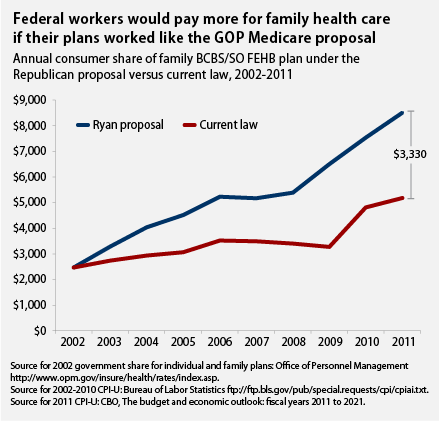
We examined what would happen if FEHBP had operated like the Republican Medicare proposal over the last decade. We used data from the Office of Personnel and Management to look at the annual premiums for federal workers enrolled in the Blue Cross Blue Shield Service Benefit Plan (Standard Family and Standard Individual). We chose this plan because nearly 60 percent of those enrolled in FEHBP have Blue Cross Blue Shield, and the Standard Option is the most popular FEHBP plan. We increased government support for the individual and family plans by the rate of growth in the CPI-U index from 2002 to 2011. We then compared the difference between the government’s share and the actual total premium in each year—which is the amount the beneficiary would pay—under the Republican proposal and the real FEHBP.

The result: A typical federal worker, or member of Congress, enrolled in family coverage in the Blue Cross Blue Shield Standard Option, would have had to pay an additional $3,330.36 for the same level of coverage they have today. Those with individual coverage would have had to pay $1,555 more.
By: Nicole Cafarella, Payment Reform Manager and Policy Analyst and Tony Clark, Policy Analyst, Center for American Progress, April 27, 2011
Governor Walker’s Misleading Claims On Medicaid
Wisconsin Governor Scott Walker painted a misleading picture of Medicaid in his New York Times op-ed on Friday. Medicaid is neither obsolete nor inflexible and changing it to a block grant, as the House Republican budget that Walker supports would do, would significantly harm the millions of seniors, people with disabilities and children who rely on it every day.
Governor Walker says Medicaid is obsolete because it is biased toward covering people in nursing homes rather than their own homes. In fact, Medicaid is moving in precisely the opposite direction. In 1990, just 13 percent of Medicaid spending on long-term care went for care in the community rather than in an institution. By 2009, the figure was 43 percent. That’s a great example of how Medicaid is changing with the times.
Moreover, health reform, (i.e., the Affordable Care Act) provides several new options to speed this trend along and continues funding for the “Money Follows the Person” program, in particular, which moves people from nursing homes back to the community. With health reform’s new options and funding, progress will likely continue. That won’t happen under the House Republican budget plan, which would sharply reduce funding for Medicaid and convert the program to a block grant.
My colleagues, Edwin Park and Matt Broaddus, have shown how risky a block grant is for states. If the House Republican block grant proposal had been in place starting in 2000, their analysis shows, in 2009 Wisconsin would have received 40 percent less in federal funds – nearly $1.6 billion in that year alone. With such a sharp drop in federal funds, the state would have been ill-equipped to deal with a recession or even to meet the ongoing needs of an aging population.
Governor Walker claims the success of the Children’s Health Insurance Program (CHIP) and state Medicaid demonstration projects show that states could do well under a Medicaid block grant, but he’s wrong on both counts:
CHIP, which does operate under a structure similar to a block grant, has a narrower purpose than Medicaid, as noted in a recent brief from the Kaiser Commission on Medicaid and the Uninsured. It covers far fewer children than Medicaid and covers children in families with higher incomes. Moreover, in the past, some state CHIP programs did run short of funds and had to freeze enrollment and set up waiting lists.
As to Medicaid demonstration projects, they allow states to cover people who are ordinarily not eligible for Medicaid (such as low-income, childless adults) or services that aren’t usually covered (such as short-term, or “respite,” care for families with children with complex medical conditions) as long as they don’t spend more federal funds than they otherwise would have received. This is nothing like the Ryan block grant, which would slash the federal funds that states would otherwise get to help them run their programs, not hold federal funds steady.
By: Judy Solomon, Center on Budget and Policy Priorities, April 25, 2011
RyanCare vs. The Public Option
If you want to understand why the budget debate so infuriates people who actually care about deficits — and, in particular, people who actually care about health-care spending — consider this: The central health-care reform in Paul Ryan’s budget, the one that’s got him so many plaudits for courage, would actually increase costs. The health-care reform that progressives have been pursuing for more than two years would cut them. And yet calling for Medicare to be privatized and voucherized is considered serious, while calling for a public option is considered tiresome. But let’s go to the tape.
Back during the health-care reform fight, the Congressional Budget Office looked at the likely effect of adding a public option that paid Medicare rates. “In total, a public plan based on Medicare rates would save $110 billion over 10 years,” the agency concluded. Importantly, the savings would come because premiums would be lower. The basic mechanism here is not complicated: Just as you get better deals by shopping at a mega-retailer like Wal-Mart, you get better deals by working with a mega-insurer like Medicare. Size matters.
As for Ryan’s plan, CBO’s take was just the opposite. “Under the proposal,” they said, “most elderly people would pay more for their health care than they would pay under the current Medicare system.” That is to say, health-care costs go up. Now, federal health-care spending goes down, as seniors are paying 70 percent of their costs out-of-pocket rather than 30 percent. Or, in CBO-ese, Medicare beneficiaries “would bear a much larger share of their health care costs than they would under the current program.” Of course, back in the real world, seniors are going to react poorly to being unable to afford health-care insurance, and those savings won’t manifest.
But even putting that aside, it makes for a very stark contrast. The progressive reform that won’t happen would cut health-care costs. The conservative reform that won’t happen would increase health-care costs. One idea makes insurance cheaper and one makes it more expensive. And yet the idea that makes insurance cheaper is pretty much off the table, while the idea that makes it more expensive — and that almost certainly wouldn’t work — is considered a very serious proposal worthy of brow-furrowing debate.
By: Ezra Klein, The Washington Post, April 25, 2011
We Don’t Have A Spending Problem, We Have A Fraud Problem
Conservatives seem to have a knack for changing the subject whenever their backs are up against the wall. Over the last several weeks, there has been an orchestrated chorus by the House Republicans in particular to define the so-called “deficit problem” in terms of a wild spending binge by the federal government and the Obama administration. They seem to have easily forgotten who got us into this mess in the first place. That aside, everyone from Speaker John Boehner to Sen Mitch McConnell have been bellowing throughout the halls of Congress and at every available microphone that “We don’t have a revenue problem, we have a spending problem”.
It’s amazing how we all have bought into this line. The media, in its usual rush to get a headline or sound bite, immediately picked up this line and has been the waterboys for the GOP by enabling this hoax on the American people. The focus in most circles has been on spending cuts. Well, we need to re-characterize what is actually going on here. We don’t have a spending problem..we have a fraud problem.
This fraud has been played on the American people by an ideologically depraved Republican party for at least the last ten years. They have made everybody believe that if we just make the wealthy wealthier, somewhere down the road, we will all benefit. There would be job creation with full employment, small businesses would thrive, home prices would fall, gas would cost less than two dollars a gallon and there would be a chicken in every pot. And we believed it hook, line and sinker. Now we are back to square one. None of these things have happened except the fact that we have indeed made the wealthy wealthier. In 2010, the 400 Americans with the highest adjusted gross revenue incomes averaged $345 million. The average federal income tax was 17%, down from 26% in 1992. The income gap just keeps getting wider. Why does this continue to happen? Because we let it happen.
Just last week, Standard and Poor’s accentuated the Republican clarion that the sky is falling. This call comes from the same S&P who supported every toxic waste subprime security under the sky, the same S&P who sold its ratings to the highest bidder. Regulators have also assisted the GOP in their fraud. The Office of the Currency has gone out of its way to protect its clients, ie the banks. Efforts to reign in the banks and stop their predatory loan practices have been foiled at every turn. Even the banks are too big to fail. Profits for banks, corporations, CEO’s, Wall St and the wealthy just keep soaring. There is a lot of back scratching going on here, by and for a lot of wealthy people.
Now that the cat is out of the bag, all of these wealthy people are trying to figure out a way to take the spot light off themselves. They are beginning to see that they may not be able to stave off demands any longer that they pay their fare share. People who have been adversely affected for so many years are now demanding that this fraud be stopped. Teachers and other low wage earners, the poor, seniors, students and union members have all come to believe that they have sacrificed enough. Even some tea party members are beginning to see the light.
For too many years, the Republicans and their wealthy friends have had their hands in everybody’s pockets. Your pocket was the revenue stream for them. General Electric and the Koch Brothers were probably happier than anyone. The Republicans were also happy because their happy friends provided the cover that allows them to do whatever they want to in terms of policy. Being the ideologues that they are, this protection gives them unimpeded opportunity to push forward with their agenda, from dissolving women’s rights, overturning the Affordable Care Act, union busting, replacing Medicare with vouchers and completely eliminating any sense of environmental protection just to name a few. With happy and contented wealthy backers behind you for so many years, how could you go wrong. My, how things are changing.
The revenue stream that the Republicans have depended on for so long is now drying up…that stream is you. They are finding that when they put their hands in your pockets now, they are feeling the seam of the sewn pocket. There just isn’t any more money there. They become flushed and filled with extreme panic, finally realizing that they are going to have their taxes raised after all these years. Their backs are against the wall. So what do they do now? Change the debate..”Let’s raise taxes on everybody”. Nice try!
It’s well past time that shared sacrifice mean exactly what it says. It is no longer acceptable that the poor, under privileged, seniors and the disenfranchised continue to carry the load for corporations, Wall St and their deadbeat tax-evading friends. No, let’s not raise taxes on everybody. Let’s end the fraud and insist that the wealthy start paying taxes just like everyone else. This being Easter Sunday, this may be a good symbolic time to increase taxes only for the rich. We should leave that rate in place for oh say, the next 40 years. Besides, they have accumulated a fair amount of wealth over the years and should easily be able to live off that profit during that time. Perhaps take a trip or two or just wander around the world enjoying their spoils. We will pledge to re-visit this issue after that time. If, and only if, the middle class has reached a level playing field, then we can talk about lowering the tax rate for the wealthy. I think Moses and the Pharaoh’s would be happy with this compromise. So it is written, so let it be done.
By: raemd95, mykeystrokes.com, April 24, 2011
Yes, Paul Ryan Does Cut Taxes For The Rich
A number of conservatives have asserted that, contrary to what I’ve written, the House Republican budget written by Paul Ryan does not cut taxes for high earners. (See John McCormack, Ramesh Ponnuru, Charles Krauthammer, and McCormack again quoting Ryan.) Here’s the argument. Ryan keeps overall tax levels the same as they are right now by making the tax cuts permanent. He would then reduce the corporate tax rate and the top income tax rate by ten percentage points, from 35% to 25%. But he would make up for that additional revenue loss by closing “loopholes and deductions,” many of which benefit the rich. Therefore, his plan doesn’t really cut taxes on the rich.
There are four problems with this claim, each of them fatal.
First, the argument simply reflects a legitimate difference in baselines. Under current law, the Bush tax cuts are in full effect, but expire at the end of 2012. Keep Bush-era tax levels in place is not a tax cut compared with the tax code now, but it is a tax cut compared with the tax code in 2013. Which is the true baseline? I think both sides have a point, and Congressional scorekeepers have taken to using both baselines.
When President Obama accuses Ryan of cutting taxes for the rich, he’s using the post-2012 baseline. I consider that the best point of reference because the most important force in our political system is inertia. Given our multiple veto points, it takes great effort to enact a policy change that the parties disagree upon. Ryan proposes to make that change. Therefore, I think it’s fair to describe him as “cutting taxes,” even if revenues did remain at present levels (which I dispute, but more on that later.) I do think there’s merit in both baselines. The argument that Obama is lying about Ryan — that calling him a tax-cutter is, in Krauthammer’s characteristically understated phrasing, “scurrilous” — rests upon the assumption that the current-policy baseline is not only more preferable but the only remotely honest point of reference. That seems like a huge stretch.
Second, even if we accept Ryan’s preferred baseline, his description of his plan is hard to accept at face value. Tax reform is a trade where you take away deductions (that’s hard) and use the money to reduce rates (that’s easy.) The rate reductions are specified. The reduced deductions aren’t. Another way to put this is that Ryan has proposed a specific tax cut that would benefit the affluent, accompanied by utterly vague promises to find offsets. At the very least, the rate-lowering portion ought to carry more weight than the deduction-closing portion.
Third, even if we accept both Ryan’s baseline and assume he will match every dollar in lost revenue from the rate cuts with another dollar in reduced deductions, he will almost certainly wind up cutting taxes for the rich relative even to the post-Bush tax code. Ryan implies that his plan would leave the rich paying the same effective tax rates as they do now because he’s “getting rid of loopholes and deductions, which by the way are enjoyed by the top [tax] rate filers, the people in the top two brackets.” But he hasn’t put out any details. In 1995, House Republicans loudly promised to promote shared sacrifice by rooting out corporate welfare in the tax code. The actual savings they produced turned out to consist of proposals that hurt the poor (by cutting the Earned Income Tax Credit), benefited business (by letting them swipe funds from employee pensions, keeping the money as profit and thus increasing corporate tax revenue), or other reverse-Robin Hood measures.
Now, Ryan was not around then. But we can get a measure of his intentions from the more specific tax plan laid out in his “Roadmap” from 2010. That plan constituted a massive tax cut for the rich, combined with a tax hike on the middle class.
The Tax Policy Center examined various proposals to reduce tax deductions while using the revenue to lower rates across the board. All the plans decreased the tax burden for the top-earning 1%. The problem is that tax deductions are just not worth as much to very rich people as low tax rates.
It’s true that the Bowles-Simpson deficit reduction plan includes proposals that would lower rates to around 25% while increasing the effective tax rate paid by the very rich. To do that, you have to do things like raise the estate tax rate and completely eliminate the preferential treatment of capital gains. But Ryan’s budget promises instead — and this is the only specific policy commitment in its tax section, other than lowering rates — to expand the preferential treatment of income from wealth:
Raising taxes on capital is another idea that purports to affect the wealthy but actually hurts all participants in the economy. Mainstream economics, not to mention common sense, teaches that raising taxes on any activity generally results in less of it. Economics and common sense also teach that the size of a nation’s capital stock – the pool of saved money available for investment and job creation – has an effect on employment, productivity, and wages. Tax reform should promote savings and investment because more savings and more investment mean a larger stock of capital available for job creation. That means more jobs, more productivity, and higher wages for all American workers.
Fourth — almost there! — even if you reject everything I’ve written to this point, Ryan’s plan includes the repeal of all the taxes in the Affordable Care Act, including the taxes on the affluent. Here’s the Path to Prosperity’s description of health care taxes he proposes to undo:
The new law imposes a 0.9 percent surtax on wages and a 3.8 percent surtax on interest, dividends, and capital gains. Both taxes only apply to filers in the top two income brackets, but as discussed elsewhere in this section, those filers include small businesses employing millions of Americans, and the new taxes on capital will reduce the pool of capital available for investment and job creation.
There. Per Paul Ryan, these are upper-bracket taxes he proposes to lower. He could keep those taxes in effect, and cover a few of the uninsured people he throws off their coverage, or make the progressively-more-inadequate health care vouchers he uses to replace Medicare slightly less inadequate. But he chooses not to do that, because he believes it’s more important to tax capital at lower rates. It’s fine for him to believe that. But he and his defenders have to stop insisting that he doesn’t propose tax cuts for the rich. He indisputably does so.
By: Jonathan Chait, The New Republic, April 20, 2011
Share This Blog


 Unknown Feed
- An error has occurred; the feed is probably down. Try again later.
 mykeystrokes.com
You must be logged in to post a comment.