Conservative Newspeak?: Grover Norquist Compares GOPers Who Support Lifesaving Health Care Programs To Cancer cells
In the annals of Orwellian Newspeak, Grover Norquist, president of the libertarian group Americans for Tax Reform, may have established a new precedent for what kind of logic-defying propaganda is accepted in our political discourse — and for what journalists will uncritically reprint sans context or question.
In Monday’s Washington Post story on how deep the anti-tax fervor runs inside the Republican Party, Norquist is quoted criticizing three Republicans, including Sen. Tom Coburn (Okla.), for considering anything other than cutting government programs like Medicare and Medicaid as a solution to the national debt. As the Post reports it (emphasis mine):
The work of reducing the national debt must be done entirely by shrinking government, he said. Any compromise that includes taxes would hinder that goal and taint the Republican brand.
Norquist compared Coburn, the most outspoken of the Senate trio, to a “malignant” cell in the body politic. “So,” Norquist said, “we use chemo and radiation to protect all the healthy cells around it, so it doesn’t grow and metastasize.”
That’s right, Norquist is unequivocally saying that efforts to preserve health care programs like Medicare and Medicaid that often use chemo and radiation to cure cancer — these efforts are, in fact, the real malignant cancer that require chemo and radiation to kill.
Orwell long ago warned of a political system that would insist with a straight face that “war is peace, freedom is slavery and ignorance is strength.” But my guess is that he never envisioned one of the leaders of a major political party claiming that curing cancer is actually cancer — and my guess is that he certainly never envisioned one of the world’s leading newspapers printing that allegation without at least questioning it’s logic.
By: David Sirota, Contributing Writer, Salon, June 6, 2011
Bin Laden Was Not A “Muslim Leader”
The Washington Post this morning ponders a portion of President Obama’s Sunday night speech that likely made many Americans take pause — the portion in which the president explicitly said “bin Laden was not a Muslim leader.” This key phrase directly counters an integral tenet of the “war on terror” narrative: the vision of the current era as an epic conflict between the United States and a global Muslim population supposedly guided by the al-Qaida mastermind.
However, despite the ubiquity of this kind of Islamophobic “us-versus-them” framing, and despite the Post’s perseverating, Obama was exactly right, and not just because, as the president correctly noted, bin Laden was “a mass murderer of Muslims” — but because bin Laden doesn’t meet a basic definition of “Muslim leader” in terms of mass support and following in the Muslim world.
That’s right, as the Pew Research Center’s Global Attitudes Project reports, “In the months leading up to Osama bin Laden’s death, a survey of Muslim publics around the world found little support for the al-Qaida leader [and] al-Qaida also received largely negative ratings among Muslim publics.”
In fact, a comparison of these results with Pew’s larger study from 2010 shows that in terms of favorability ratings, Obama outpolled bin Laden and the United States outpolled al-Qaida in almost every Muslim nation surveyed.
Of course, just because bin Laden and al-Qaida are wildly unpopular in the Muslim world doesn’t mean the United States is winning over those populations in the long haul.
As America occupies Iraq and Afghanistan, bombs Libya and Yemen, conducts drone strikes in Pakistan and props up repressive dictators in Saudi Arabia and Bahrain, Pew’s data shows the Muslim world still conflicted as to whether the United States is an ally or an aggressor. So, a recent Zogby poll finding that “a majority of the public across the [Middle East] — including a sizable minority in Saudi Arabia — believes a nuclear-armed Iran would be a positive development in the Middle East.” That’s not because Muslims necessarily support the Iranian regime at large, but because, as one of the pollsters noted, many Muslims see nuclear arms as the only deterrent to U.S. aggression in the region.
The bottom line, then, is clear: While insinuations that the Muslim world monolithically loved bin Laden and continues to love al-Qaida are absurd, it’s perfectly reasonable to suggest that our current occupations and bombing raids aren’t winning the “war on terror” — that is, as long as you consider the “war on terror” as much a long-term battle for hearts and minds as a short-term exercise of military maneuvers.
By: David Sirota, Salon, May4, 2011
In Politics Of Temper Tantrums, Washington Post As Spineless As GOP In Debt Ceiling Debate
Yesterday, The Washington Post editorial page turned into Springfield, circa 1991. Not Springfield, Illinois or Springfield, Massachusetts. That more famous Springfield. The one that’s home to the Simpsons.
You see, 20 years ago Lisa Simpson wished for a world in which every nation laid down its arms and there was peace. And it was done. But then two crafty aliens landed in Springfield and took over the earth, armed only with a slingshot and a club.
What does that have to do with The Washington Post? Well, we’re just days into the debate about raising the debt ceiling and they’ve already given up.
Here’s what I mean:
Every politician knows that voting to raise the debt ceiling, particularly in an electoral environment like this one, is dangerous. Large swaths of the electorate are opposed. And the most angry and energized conservatives have made it an article of faith to punish legislators who facilitate more government spending. Voting to raise the debt ceiling is a tough vote–politically.
But on the merits, it’s got to be one of the easiest votes ever. Everyone from the U.S. Chamber of Commerce to former U.S. Labor Secretary Robert Reich agrees that we must raise the debt ceiling. That’s true of just about every economist of every political stripe, too. They say that if we don’t it will lead America, and perhaps the global economy, to literal economic ruin. The stakes couldn’t be higher.
Democrats are on board. They’re pushing for a “clean” vote on the debt ceiling—an up or down vote on that issue alone. In essence they’re saying: let’s do what needs to be done and get it over with. Then we can move on to the myriad other pressing matters confronting the nation.
Republicans are in a different place. They’re making increasingly belligerent demands to tie various kinds of “reforms” to the debt ceiling vote. Deep spending cuts. A balanced budget amendment. Caps on future spending. All sorts of things that may or may not have merit, but which are also deeply partisan and political. And they say they won’t vote to raise the debt ceiling unless their demands are met—if they vote for it at all.
Their position in a nutshell: I’m a Republican and I’m not going to prevent economic ruin unless I get these other things that I really, really, really want. It’s the politics of temper tantrum. Only this time the baby’s got his finger on the nuclear launch codes.
Cue the media. There’s a reason “freedom of the press” is enshrined in the First Amendment. It’s because the Founding Fathers envisioned a Fourth Estate that held government accountable at times just like these.
Instead, we get this: buried in the sixth paragraph of yesterday’s editorial about Standard and Poor’s, the Post dismisses the idea of a “clean vote” saying it’s “unrealistic as a political matter” because “you couldn’t get enough Republican votes in the House to increase the debt limit without some spending cuts attached.”
Well, I guess that’s that. The Republicans have rattled their slingshot and the Post editorial page has fled for the hills.
What’s even more galling is that you needed look no further than the front page of yesterday’s Post to see just how political the issue has become for Republicans. There, Philip Rucker told the sad story of Arizona freshman Republican Rep. David Schweikert. Schweikert concedes that failing to raise the debt ceiling will cause economic chaos, but then he surveys the angry faces of his Tea Party constituents in town hall after town hall and wrings his hands. Destroying the economy on one hand and lessening my chances for reelection on the other…oh what is a Republican to do!
Here’s an idea: suck it up and do the right thing. Vote for the bill and, if you lose your re-election, well, at least you have the comfort of knowing that you didn’t help ruin the world’s economy. Isn’t that what we say we want from our leaders? To take tough votes and put aside personal, ideological, or political goals when the nation’s interest calls for it?
Of course, as much as I would like to think otherwise, my saying so probably won’t encourage Republicans to do much of anything. If only there were an influential, well-respected, credible voice with a broad reach whose job it was to offer opinions like that… Sigh.
Perhaps not all is lost. In the aforementioned Simpsons episode the aliens are eventually vanquished when Moe the bartender hammers a nail through a board and chases them with it. There are a couple months to go in this debate. There’s still time for the Post to find its spine. Someone get them a nail and a board.
By: Anson Kaye, U.S. News and World Report, April 21, 2011
PolitiFact’s Lie of the Year: ‘A government takeover of health care’
In the spring of 2009, a Republican strategist settled on a brilliant and powerful attack line for President Barack Obama’s ambitious plan to overhaul America’s health insurance system. Frank Luntz, a consultant famous for his phraseology, urged GOP leaders to call it a “government takeover.”
“Takeovers are like coups,” Luntz wrote in a 28-page memo. “They both lead to dictators and a loss of freedom.”
The line stuck. By the time the health care bill was headed toward passage in early 2010, Obama and congressional Democrats had sanded down their program, dropping the “public option” concept that was derided as too much government intrusion. The law passed in March, with new regulations, but no government-run plan.
But as Republicans smelled serious opportunity in the midterm elections, they didn’t let facts get in the way of a great punchline. And few in the press challenged their frequent assertion that under Obama, the government was going to take over the health care industry.
PolitiFact editors and reporters have chosen “government takeover of health care” as the 2010 Lie of the Year. Uttered by dozens of politicians and pundits, it played an important role in shaping public opinion about the health care plan and was a significant factor in the Democrats’ shellacking in the November elections.
Readers of PolitiFact, the St. Petersburg Times‘ independent fact-checking website, also chose it as the year’s most significant falsehood by an overwhelming margin. (Their second-place choice was Rep. Michele Bachmann’s claim that Obama was going to spend $200 million a day on a trip to India, a falsity that still sprouts.)
By selecting “government takeover’ as Lie of the Year, PolitiFact is not making a judgment on whether the health care law is good policy.
The phrase is simply not true.
Said Jonathan Oberlander, a professor of health policy at the University of North Carolina-Chapel Hill: “The label ‘government takeover” has no basis in reality, but instead reflects a political dynamic where conservatives label any increase in government authority in health care as a ‘takeover.’ ”
An inaccurate claim
“Government takeover” conjures a European approach where the government owns the hospitals and the doctors are public employees. But the law Congress passed, parts of which have already gone into effect, relies largely on the free market:
• Employers will continue to provide health insurance to the majority of Americans through private insurance companies.
• Contrary to the claim, more people will get private health coverage. The law sets up “exchanges” where private insurers will compete to provide coverage to people who don’t have it.
• The government will not seize control of hospitals or nationalize doctors.
• The law does not include the public option, a government-run insurance plan that would have competed with private insurers.
• The law gives tax credits to people who have difficulty affording insurance, so they can buy their coverage from private providers on the exchange. But here too, the approach relies on a free market with regulations, not socialized medicine.
PolitiFact reporters have studied the 906-page bill and interviewed independent health care experts. We have concluded it is inaccurate to call the plan a government takeover because it relies largely on the existing system of health coverage provided by employers.
It’s true that the law does significantly increase government regulation of health insurers. But it is, at its heart, a system that relies on private companies and the free market.
Republicans who maintain the Democratic plan is a government takeover say that characterization is justified because the plan increases federal regulation and will require Americans to buy health insurance.
But while those provisions are real, the majority of Americans will continue to get coverage from private insurers. And it will bring new business for the insurance industry: People who don”t currently have coverage will get it, for the most part, from private insurance companies.
Consider some analogies about strict government regulation. The Federal Aviation Administration imposes detailed rules on airlines. State laws require drivers to have car insurance. Regulators tell electric utilities what they can charge. Yet that heavy regulation is not described as a government takeover.
This year, PolitiFact analyzed five claims of a “government takeover of health care.” Three were rated Pants on Fire, two were rated False.
‘Can’t do it in four words’
Other news organizations have also said the claim is false.
Slate said “the proposed health care reform does not take over the system in any sense.’ In a New York Times economics blog, Princeton University professor Uwe Reinhardt, an expert in health care economics, said, “Yes, there would be a substantial government-mandated reorganization of this relatively small corner of the private health insurance market (that serves people who have been buying individual policies). But that hardly constitutes a government takeover of American health care.”
FactCheck.org, an independent fact-checking group run by the University of Pennsylvania, has debunked it several times, calling it one of the “whoppers” about health care and saying the reform plan is neither “government-run” nor a “government takeover.”
We asked incoming House Speaker John Boehner’s office why Republican leaders repeat the phrase when it has repeatedly been shown to be incorrect. Michael Steel, Boehner’s spokesman, replied, “We believe that the job-killing ObamaCare law will result in a government takeover of health care. That’s why we have pledged to repeal it, and replace it with common-sense reforms that actually lower costs.”
Analysts say health care reform is such a complicated topic that it often cannot be summarized in snappy talking points.
“If you’re going to tell the truth about something as complicated as health care and health care reform, you probably need at least four sentences,” said Maggie Mahar, author of Money-Driven Medicine: The Real Reason Health Care Costs So Much. “You can”t do it in four words.”
Mahar said the GOP simplification distorted the truth about the plan. “Doctors will not be working for the government. Hospitals will not be owned by the government,” she said. “That’s what a government takeover of health care would mean, and that’s not at all what we”re doing.”
How the line was used
If you followed the health care debate or the midterm election – even casually – it’s likely you heard “government takeover” many times.
PolitiFact sought to count how often the phrase was used in 2010 but found an accurate tally was unfeasible because it had been repeated so frequently in so many places. It was used hundreds of times during the debate over the bill and then revived during the fall campaign. A few numbers:
• The phrase appears more than 90 times on Boehner’s website, GOPLeader.gov.
• It was mentioned eight times in the 48-page Republican campaign platform “A Pledge to America” as part of their plan to “repeal and replace the government takeover of health care.”
• The Republican National Committee’s website mentions a government takeover of health care more than 200 times.
Conservative groups and tea party organizations joined the chorus. It was used by FreedomWorks, the Heritage Foundation and the Cato Institute.
The phrase proliferated in the media even after Democrats dropped the public option. In 2010 alone, “government takeover” was mentioned 28 times in the Washington Post, 77 times in Politico and 79 times on CNN. A review of TV transcripts showed “government takeover” was primarily used as a catchy sound bite, not for discussions of policy details.
In most transcripts we examined, Republican leaders used the phrase without being challenged by interviewers. For example, during Boehner’s Jan. 31 appearance on Meet the Press, Boehner said it five times. But not once was he challenged about it.
In rare cases when the point was questioned, the GOP leader would recite various regulations found in the bill and insist that they constituted a takeover. But such followups were rare.
An effective phrase
Politicians and officials in the health care industry have been warning about a “government takeover” for decades.
The phrase became widely used in the early 1990s when President Bill Clinton was trying to pass health care legislation. Then, as today, Democrats tried to debunk the popular Republican refrain.
When Obama proposed his health plan in the spring of 2009, Luntz, a Republican strategist famous for his research on effective phrases, met with focus groups to determine which messages would work best for the Republicans. He did not respond to calls and e-mails from PolitiFact asking him to discuss the phrase.
The 28-page memo he wrote after those sessions, “The Language of Healthcare 2009,” provides a rare glimpse into the art of finding words and phrases that strike a responsive chord with voters.
The memo begins with “The 10 Rules for Stopping the ‘Washington Takeover’ of Healthcare.” Rule No. 4 says people “are deathly afraid that a government takeover will lower their quality of care – so they are extremely receptive to the anti-Washington approach. It’s not an economic issue. It’s a bureaucratic issue.”
The memo is about salesmanship, not substance. It doesn’t address whether the lines are accurate. It just says they are effective and that Republicans should use them. Indeed, facing a Democratic plan that actually relied on the free market to try to bring down costs, Luntz recommended sidestepping that inconvenient fact:
“The arguments against the Democrats’ healthcare plan must center around politicians, bureaucrats and Washington … not the free market, tax incentives or competition.”
Democrats tried to combat the barrage of charges about a government takeover. The White House and House Speaker Nancy Pelosi repeatedly put out statements, but they were drowned out by a disciplined GOP that used the phrase over and over.
Democrats could never agree on their own phrases and were all over the map in their responses, said Howard Dean, former head of the Democratic National Committee.
“It was uncoordinated. Everyone had their own idea,” Dean said in an interview with PolitiFact.
“The Democrats are atrocious at messaging,” he said. “They’ve gotten worse since I left, not better. It’s just appalling. First of all, you don”t play defense when you”re doing messaging, you play offense. The Republicans have learned this well.”
Dean grudgingly admires the Republican wordsmith. “Frank Luntz has it right, he just works for the wrong side. You give very simple catch phrases that encapsulate the philosophy of the bill.”
A responsive chord
By March of this year, when Obama signed the bill into law, 53 percent of respondents in a Bloomberg poll said they agreed that “the current proposal to overhaul health care amounts to a government takeover.”
Exit polls showed the economy was the top issue for voters in the November election, but analysts said the drumbeat about the “government takeover” during the campaign helped cement the advantage for the Republicans.
Rep. Earl Blumenauer, an Oregon Democrat whose provision for Medicare end-of-life care was distorted into the charge of “death panels” (last year’s Lie of the Year), said the Republicans’ success with the phrase was a matter of repetition.
“There was a uniformity of Republican messaging that was disconnected from facts,” Blumenauer said. “The sheer discipline . . . was breathtaking.”
By: Bill Adair, Angie Drobnic Holan, PolitiFact-December 16th, 2010
Rep. Paul Ryan-The Flimflam Man
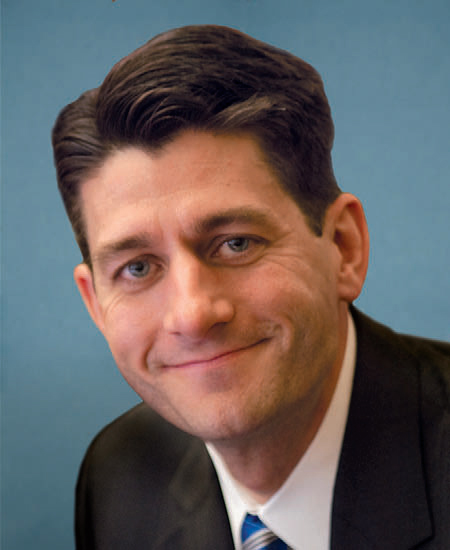
Rep. Paul Ryan
One depressing aspect of American politics is the susceptibility of the political and media establishment to charlatans. You might have thought, given past experience, that D.C. insiders would be on their guard against conservatives with grandiose plans. But no: as long as someone on the right claims to have bold new proposals, he’s hailed as an innovative thinker. And nobody checks his arithmetic.
Which brings me to the innovative thinker du jour: Representative Paul Ryan of Wisconsin.
Mr. Ryan has become the Republican Party’s poster child for new ideas thanks to his “Roadmap for America’s Future,” a plan for a major overhaul of federal spending and taxes. News media coverage has been overwhelmingly favorable; on Monday, The Washington Post put a glowing profile of Mr. Ryan on its front page, portraying him as the G.O.P.’s fiscal conscience. He’s often described with phrases like “intellectually audacious.”
But it’s the audacity of dopes. Mr. Ryan isn’t offering fresh food for thought; he’s serving up leftovers from the 1990s, drenched in flimflam sauce.
Mr. Ryan’s plan calls for steep cuts in both spending and taxes. He’d have you believe that the combined effect would be much lower budget deficits, and, according to that Washington Post report, he speaks about deficits “in apocalyptic terms.” And The Post also tells us that his plan would, indeed, sharply reduce the flow of red ink: “The Congressional Budget Office has estimated that Rep. Paul Ryan’s plan would cut the budget deficit in half by 2020.”
But the budget office has done no such thing. At Mr. Ryan’s request, it produced an estimate of the budget effects of his proposed spending cuts — period. It didn’t address the revenue losses from his tax cuts.
The nonpartisan Tax Policy Center has, however, stepped into the breach. Its numbers indicate that the Ryan plan would reduce revenue by almost $4 trillion over the next decade. If you add these revenue losses to the numbers The Post cites, you get a much larger deficit in 2020, roughly $1.3 trillion.
And that’s about the same as the budget office’s estimate of the 2020 deficit under the Obama administration’s plans. That is, Mr. Ryan may speak about the deficit in apocalyptic terms, but even if you believe that his proposed spending cuts are feasible — which you shouldn’t — the Roadmap wouldn’t reduce the deficit. All it would do is cut benefits for the middle class while slashing taxes on the rich.
And I do mean slash. The Tax Policy Center finds that the Ryan plan would cut taxes on the richest 1 percent of the population in half, giving them 117 percent of the plan’s total tax cuts. That’s not a misprint. Even as it slashed taxes at the top, the plan would raise taxes for 95 percent of the population.
Finally, let’s talk about those spending cuts. In its first decade, most of the alleged savings in the Ryan plan come from assuming zero dollar growth in domestic discretionary spending, which includes everything from energy policy to education to the court system. This would amount to a 25 percent cut once you adjust for inflation and population growth. How would such a severe cut be achieved? What specific programs would be slashed? Mr. Ryan doesn’t say.
After 2020, the main alleged saving would come from sharp cuts in Medicare, achieved by dismantling Medicare as we know it, and instead giving seniors vouchers and telling them to buy their own insurance. Does this sound familiar? It should. It’s the same plan Newt Gingrich tried to sell in 1995.
And we already know, from experience with the Medicare Advantage program, that a voucher system would have higher, not lower, costs than our current system. The only way the Ryan plan could save money would be by making those vouchers too small to pay for adequate coverage. Wealthy older Americans would be able to supplement their vouchers, and get the care they need; everyone else would be out in the cold.
In practice, that probably wouldn’t happen: older Americans would be outraged — and they vote. But this means that the supposed budget savings from the Ryan plan are a sham.
So why have so many in Washington, especially in the news media, been taken in by this flimflam? It’s not just inability to do the math, although that’s part of it. There’s also the unwillingness of self-styled centrists to face up to the realities of the modern Republican Party; they want to pretend, in the teeth of overwhelming evidence, that there are still people in the G.O.P. making sense. And last but not least, there’s deference to power — the G.O.P. is a resurgent political force, so one mustn’t point out that its intellectual heroes have no clothes.
But they don’t. The Ryan plan is a fraud that makes no useful contribution to the debate over America’s fiscal future.
By PAUL KRUGMAN-Op-Ed Columist and Nobel Prize Winner-Economics, The New York Times-Aug 5, 2010; Photo- Wikipedia
Share This Blog


 Unknown Feed
- An error has occurred; the feed is probably down. Try again later.
 mykeystrokes.com
You must be logged in to post a comment.