Tea Party Budgeting: Everyone Doesn’t Deserve A Fair Shot
Three lessons I’ve learned from Tea Party budgeting:
1. Charles Lightroller was a chump.
Lightroller was the second mate on the Titanic. Legend holds that no one enforced the command to allow women and children to board the lifeboats first more rigorously than he did. Some call him a hero. But not me. That’s because I, like Rush Limbaugh, think Paul Ryan’s budget is “wonderful.”
And how could you not? Ryan surveys the budget battlefield and here’s what he sees: on one side, an onrushing horde of seniors, working people, and the disabled. On the other, defenseless corporations and their affluent compatriots prancing like happy kittens amongst the flowers. In the face of such forbidding odds some might duck, but Ryan strides onto the field of play and bravely interposes himself between the conflicting parties, prepared to defend the defenseless come what may.
Here’s what that looks like: Medicare, the health program relied on by millions of seniors, is replaced with a benefit guaranteed to fall further and further behind the actual cost of healthcare. Medicaid (healthcare for people with low-incomes) sustains deep cuts. But tax rates on corporations and the highest earners are lowered, while subsidies for oil companies remain untouched. Truly a profile in courage.
2. Pell Grants are destroying America.
I feel badly for not recognizing it, but it seems so obvious now. Freeloaders figured out how to get free food, free housing, and free electricity years ago, but they’ve never been able to reach the Holy Grail: free Biology of the East African Mud Turtle 101. Until now. “You can go to school,” warns Rep. Denny Rehberg of Montana, “collect your Pell Grants, get food stamps, low-income energy assistance, Section 8 housing, and all of a sudden we find ourselves subsidizing people that don’t have to graduate from college.”
Welfare cheats scheming to take the college courses of their dreams? (And then not graduate!) It’s an outrage. How many of them are sitting in a college cafeteria right now snickering over a steaming plate of American Chop Suey? (Purchased with food stamps, natch.) “It’s turning out to be the welfare of the 21st century,” Rehberg says. Talk about getting schooled: that’s got to be one of the smartest theories I’ve ever heard.
Of course, it’s not just Pell Grants that are so nefarious. It’s Head Start too, and Medicare, and Medicaid, and …(hence, Lesson 1 above).
3. Better than Government? Fairies.
A signal question in American political life today is: when things go wrong, what role, if any, should government play in trying to make things right?
We seem to have settled on some answers. When we’re to blame for the bad things that happen, we’re on our own. The same is true when we do our best but lose fair and square. But what about when people encounter difficulties through no fault of their own and in a way that offends our sense of fairness? A kid who’s born into a family without the means to send him to a good school, or a mother who works hard every day but loses her employment because global economic forces are moving manufacturing jobs to other countries? Should government lend a hand in those kinds of cases?
The Ryans and the Rehbergs conceive of a government that does so less and less. They say the benefit of helping the disadvantaged is outweighed by its expense. What they don’t say is what happens to people who no longer can rely on needed government assistance. Perhaps magical fairies come along, wave their magic wands, and everyone who used to get a Pell Grant can still go to college, only this one is taught by chocolate bunnies! And all those people who can’t afford healthcare anymore? It’s OK. They’re now living in a cottage made entirely of gingerbread!
Let me be clear: there’s every reason to be serious about reducing the budget deficit. Political leaders on both sides of the aisle should be open to good faith ideas that emanate from anywhere on the political spectrum. But it’s reasonable to ask whether using concern over the deficit as an excuse to accomplish purely ideological goals can be considered serious.
Democrats agree that the private sector should be the engine that drives our economy and that we need the discipline to cut government programs that aren’t working. But there’s something else we believe that sets us apart from the Tea Partyers: there’s a promise inherent to the American free market system that says everyone deserves a fair shot, and that promise goes unfulfilled when people are disadvantaged by forces beyond their control and we all stand by and do nothing about it.
In other words, bring back Charles Lightroller. Boy, do we need him.
By: Anson Kaye, U.S. News and World Report, April 7, 2011
What Does The Tea Party Want?….The New Litmus Test
Jim VandeHei and Mike Allen argue that the Tea Party redefined the purpose of the GOP as opposition to spending:
The Republican Party is undergoing a messy but unmistakable 20-month transformation from fanatically anti-Obama to fanatically anti-spending, providing top party officials a new and intriguing playbook for recapturing the White House in 2012.
To understand the current evolution, flash back to late spring of 2009. The GOP was disoriented and adrift, its leadership void filled by the bombastic voices of Palin, Beck and Rush Limbaugh. There was no common conservative cause, beyond fear and loathing of Obama. No wonder swing voters were so down on them.
But the tea party, treated at first by the media as exotics, forced Republicans to focus almost exclusively on the size of government. By the time the 2010 elections rolled around, tea party activists and most independent voters were completely aligned on the need to cut, cut, cut.
Midterm election results showed that this approach offers the GOP its best – and maybe only – hope of keeping the interests of independents and tea party activists aligned enough to beat Obama.
The new litmus tests for GOP presidential hopefuls are support for repealing “Obamacare” and taking a cleaver to government spending. If a presidential candidate could harness the smaller-government conservatism, temper it enough to avoid a blatant overreach and articulate a vision for a prosperous future for the country, it’s not hard to imagine swing voters finding such a person appealing.
There’s a superficial appeal to this story. But the evidence that Tea Party activists want to cut spending — at least actual spending programs — is sparse. Polls show that Tea Party supports overwhelmingly oppose cuts to Social Security and Medicare. The main thrust of Tea Party opinion is not the belief that Obama has spent too much money, but the belief that Obama has spent too much money on people unlike them:
More than half say the policies of the administration favor the poor, and 25 percent think that the administration favors blacks over whites — compared with 11 percent of the general public.
They are more likely than the general public, and Republicans, to say that too much has been made of the problems facing black people.
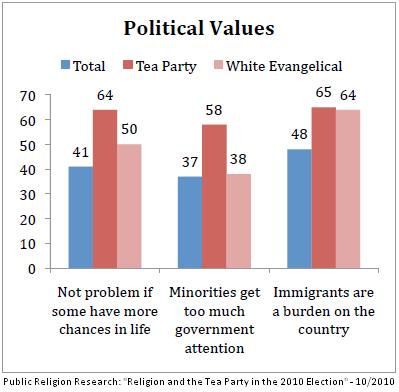
Here’s another cut, showing the Tea Party’s greater comfort with inequality of opportunity and stronger belief that the government devotes too many resources to minorities:
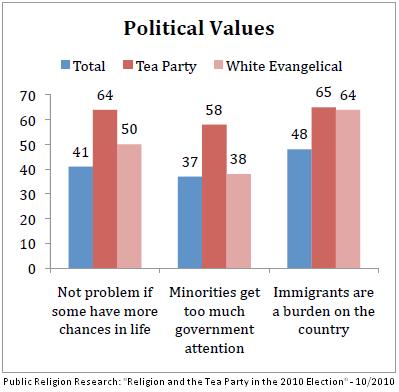
It’s a revolt against the composition of government much more than the level.
Now, it’s true that Republicans aren’t exactly translating this blueprint into action, but they’re not exactly flouting it, either. There is always a generalized antipathy toward spending amongst Republican and swing voters, but it disappears when the subject turns to actual government programs. Usually Republicans decide to just cut taxes for the rich instead. Here’s is the one part of the article proposing a defined policy change:
Even Ralph Reed, the Republican operative most tapped in to evangelicals, reflected the new GOP mindset when he gave this surprising wish list for the next presidential race: “In a perfect world, I’d like to hear the Republican nominee run on a platform that takes the capital gains tax to zero over five years.” Reed, who summoned several of the presidential candidates to Iowa for his Faith & Freedom Coalition this week, made it clear that Christian conservatives will still need to be catered to, but added that his side will understand the nominee’s need to focus on swing voters.
So an article putatively about the GOP redefining itself as an anti-spending party has one actual programmatic detail, and it’s: a zeroing out of the capital gains tax. In the name of appealing to swing voters — who, in fact, oppose tax cuts for the rich. Meet the new boss…
By: Jonathan Chait, The New Republic, March 14, 2011
Public Alert: What If We’re Not Broke?
“We’re broke.”
You can practically break a search engine if you start looking around the Internet for those words. They’re used repeatedly with reference to our local, state and federal governments, almost always to make a case for slashing programs – and, lately, to go after public-employee unions. The phrase is designed to create a sense of crisis that justifies rapid and radical actions before citizens have a chance to debate the consequences.
Just one problem: We’re not broke. Yes, nearly all levels of government face fiscal problems because of the economic downturn. But there is no crisis. There are many different paths open to fixing public budgets. And we will come up with wiser and more sustainable solutions if we approach fiscal problems calmly, realizing that we’re still a very rich country and that the wealthiest among us are doing exceptionally well.
Consider two of the most prominent we’re-brokers, House Speaker John Boehner and Wisconsin Gov. Scott Walker.
“We’re broke, broke going on bankrupt,” Boehner said in a Feb. 28 Nashville speech. For Boehner, this “fact” justifies the $61 billion in domestic spending cuts House Republicans passed (cuts that would have a negligible impact on the long-term deficit). Boehner’s GOP colleagues want reductions in Head Start, student loans and scores of other programs voters like, and the only way to sell them is to cry catastrophe.
Walker, of course, used the “we’re broke” rationale to justify his attack on public-worker collective bargaining rights. Yet the state’s supposedly “broke” status did not stop him from approving tax cuts before he began his war on unions and proposed all manner of budget cuts, including deep reductions in aid to public schools.
In both cases, the fiscal issues are just an excuse for ideologically driven policies to lower taxes on well-off people and business while reducing government programs. Yet only occasionally do journalists step back to ask: Are these guys telling the truth?
The admirable Web site PolitiFact.com examined Walker’s claim in detail and concluded flatly it was “false.”
“Experts agree the state faces financial challenges in the form of deficits,” PolitiFact wrote. “But they also agree the state isn’t broke. Employees and bills are being paid. Services are continuing to be performed. Revenue continues to roll in. A variety of tools – taxes, layoffs, spending cuts, debt shifting – is available to make ends meet. Walker has promised not to increase taxes. That takes one tool off the table.”
And that’s the whole point.
Bloomberg News looked at Boehner’s statement and declared simply: “It’s wrong.” As Bloomberg’s David J. Lynch wrote: “The U.S. today is able to borrow at historically low interest rates, paying 0.68 percent on a two-year note that it had to offer at 5.1 percent before the financial crisis began in 2007. Financial products that pay off if Uncle Sam defaults aren’t attracting unusual investor demand. And tax revenue as a percentage of the economy is at a 60-year low, meaning if the government needs to raise cash and can summon the political will, it could do so.”
Precisely. A phony metaphor is being used to hijack the nation’s political conversation and skew public policies to benefit better-off Americans and hurt most others.
We have an 8.9 percent unemployment rate, yet further measures to spur job creation are off the table. We’re broke, you see. We have a $15 trillion economy, yet we pretend to be an impoverished nation with no room for public investments in our future or efforts to ease the pain of a deep recession on those Americans who didn’t profit from it or cause it in the first place.
As Sen. Al Franken (D-Minn.) pointed out in a little-noticed but powerful speech on the economy in December, “during the past 20 years, 56 percent of all income growth went to the top 1 percent of households. Even more unbelievably, a third of all income growth went to just the top one-tenth of 1 percent.” Some people are definitely not broke, yet we can’t even think about raising their taxes.
By contrast, Franken noted that “when you adjust for inflation, the median household income actually declined over the last decade.” Many of those folks are going broke, yet because “we’re broke,” we’re told we can’t possibly help them.
Give Boehner, Walker and their allies full credit for diverting our attention with an arresting metaphor. The rest of us are dupes if we fall for it.
By: E. J. Dionne, Op-Ed Columnist, The Washington Post, March 14, 2011
The “Have-Nots” Sink While The “Haves” Smirk
The “race to the bottom” used to refer to the competition with low-cost foreign labor that threatened to undermine the wages of U.S. workers struggling in the same industries.
Now it refers to the competition between private- and public-sector workers to see who can become poorer faster.
In essence, that’s what the fight in Wisconsin is about. It’s also what last weekend’s Niagara Square rally with 250 union supporters was about.
But who’s going to foot the bill for the standard of living they want to protect? Middle-class taxpayers are tapped out. Wisconsin Gov. Scott Walker made that point, as did Gov. Andrew Cuomo when calling New York “functionally bankrupt.”
In other words, the money is gone.
But as private-sector workers turn on public employees, and non-union workers castigate their unionized brethren, the internecine warfare distracts from a more fundamental question: Where did the money go?
In a nutshell, it went up. Not in smoke, though it could have, as far as the middle class is concerned. Rather, it went to the top of the economic pyramid.
A Center on Budget and Policy Priorities review last year found that the gap between the top 1 percent and those in the middle and at the bottom “more than tripled between 1979 and 2007.” (If the wealthy lost any relative ground during the Great Recession, they’ve more than made up for it during the recovery.)
Similarly, the Economic Policy Institute — in its State of Working America report last month — found that average annual income growth from 2000 to 2007 went entirely to those in the top 10 percent, while “income for the bottom 90 percent actually declined.”
And what of those government workers lavishly compensated with our tax dollars?
A review by the center last week found that, when controlling for education, job tenure and other variables, “public workers are paid 4 to 11 percent less than private-sector workers.” A separate study by the institute found that state and local government workers make $2,001 less on average, even when benefits are included.
Yet the fight rages on among those in the middle of the pyramid.
Meanwhile, in its annual Executive Excess report, the Institute for Policy Studies calculated that CEOs of major firms made 263 times the average compensation of American workers in 2009.
SEIU Local 1199 Vice President Todd Hobler, who was at the Niagara Square rally, says such inequity gets accepted because the media suggest “that the goal of all people is to become rich, and that those who have fortunes deserve it and have earned it.”
But are corporate bosses 263 times smarter than you are? Do they work 263 times harder?
Yet despite the reams of data, the issue of inequity gets little traction in this country. Republicans philosophically don’t believe in greater income equality unless it occurs by accident, while Democrats have no beliefs at all that they’re willing to fight for.
The result is that anyone who mentions the income gap is accused of “class warfare,” which brings to mind a quote by billionaire Warren Buffett, whose Berkshire Hathaway owns The Buffalo News, that “my class is winning.”
But apparently working-class Americans are OK with that. We’ll dump teachers, close libraries and let parks go to seed because we can’t afford to pay more. Yet we’ll never ask, “Who can?” That’s not what we do.
Washington extended the Bush tax cuts for the top 2 percent; New York will let its surtax on millionaires expire. Both capitals are responding to working-class voters who apparently don’t want to “redistribute” wealth and are satisfied fighting one another for the scraps.
After all, we’re not Tunisians. We’re not Egyptians.
We’re Americans.
By: Rod Watson, News Columnist-BuffaloNews.com, March 3, 2011
Beyond Reason on the Budget: House Republicans Have Finally Revealed There Real Vision
After two years of raging at President Obama’s spending plans, House Republican leaders have finally revealed their real vision of small government: tens of billions in ideologically driven cuts to job training, environmental protection, disease control, crime protection and dozens of other critical functions that only the government can perform.
In all, they want more than $32 billion in cuts below current spending packed into the next seven months. They would be terribly damaging to a frail recovery and, while spending reductions must be part of long-term deficit control, these are the wrong cuts, to the wrong programs, at the wrong time.
But they are not deep enough for many Tea Party members, freshmen and other extremists in the House Republican caucus. In a closed-door meeting on Wednesday, they forced the leadership to abandon its cuts and prepare to double them. The new list is expected on Friday and promises to be one of the most irresponsible budget documents ever issued by a House majority.
The Senate should make it clear that it is not worthy of consideration, and President Obama should back them up with a veto threat.
If House Republicans don’t come to their senses, they could shut down the government on March 4 when the stopgap measure that is now financing it runs out. If that does take place, it will at least be clear to voters that their essential government services were turned off in the service of two single-minded and destructive goals: giving the appearance of cutting a deficit that was deliberately inflated by years of tax cuts for the rich, and going after programs that the Republicans never liked in good times or bad.
Many of the Republican freshmen want to stick to the “Pledge to America” that they would cut $100 billion from the president’s 2011 budget, a nice round number apparently plucked from thin air. More experienced Republican leaders knew it would be impossible to cut that much in the remaining few months of the fiscal year and said they would trim the equivalent percentage. Harold Rogers, the Republican chairman of the House Appropriations Committee, warned that the full cut would require laying off F.B.I. agents and air traffic controllers.
If he was trying to make his $32 billion in cutbacks seem modest by comparison, he failed. The list would cut $2 billion from job training programs — precisely what is needed to help employ workers mismatched with the job market. It would cut $1.6 billion from the Environmental Protection Agency, which is struggling to keep up with the growth of greenhouse gases. There would be significant cuts to legal assistance for the poor and renewable energy programs and an end to all spending for AmeriCorps, public broadcasting and high-speed rail.
The battle over the rest of the 2011 budget is only a prelude, of course, to the bigger fight about to begin over the 2012 budget. President Obama is scheduled to unveil his budget on Monday, and already he seems willing to feed the bottomless Republican hunger for cuts rather than fight them. An ominous early sign is his proposal to cut the low-income heating assistance program nearly in half to $2.57 billion. Administration officials say that energy prices have fallen, but, as Democratic lawmakers from the frostbitten Northeast have pointed out to him, there are many more unemployed people now.
Some cuts will have to be made, but strategically it seems to make little sense to start giving away important ones before reaching the negotiating table. Republican lawmakers in the House have already made it clear that they are indifferent to the suffering and increased joblessness their cuts will cause. As the extreme reductions are heaped up in the next few days, Democrats in Congress and in the White House need to make a clear case to the public that quality of the nation’s civic life is at stake.
By: Editorial-Opinion Pages, The New York Times, February 10, 2011
Share This Blog


 Unknown Feed
- An error has occurred; the feed is probably down. Try again later.
 mykeystrokes.com

You must be logged in to post a comment.