Wisconsin Gov. Scott Walker Shows Why Ideologues Can’t Govern
Ideologues make lousy politicians, even worse office holders. The ideological straight jacket does just what you would expect–it constricts movement. Everything is nice and neat and tight but not conducive to serious efforts to move forward. Politicians such as Scott Walker, who put themselves in ideological straight jackets, either live to regret it or are thrown out on their ear, or both.
Intellectuals sometimes make good ideologues, cultural commentators make very thought provoking arguments, philosophers have the luxury of being way out on the edge at times, but those who go into office find that they are rejected very quickly by the public when all they have is their ideology.
Scott Walker is the latest example of an ideologue–combined with a self righteous, bullying approach, not backed up by intellectual rigor.
My guess is that the events of the last month will not only harm him politically in the short run but will result in a serious problem for those who follow in his footsteps.
First and foremost, his approach to governing won’t work. Cutting taxes for ideological reasons, rather than pragmatic ones, prohibiting local governments from paying for education with their own decisions on local taxes, cutting services to the bone, breaking collective bargaining with unions, making them a scapegoat, just won’t wash.
Look at the governors who are putting forth a balanced, reasonable approach to focusing on the dual realities of too much spending and too little revenue. They are not engaging in a hard and fast ideological battle. They are pragmatic. They do not focus only on slash and burn cuts but, rather, are flexible enough to include tax and fee increases.
What was Walker thinking, cutting taxes by $117.2 million as his first act when his state faced a deficit of $137 million? I guess I get the million dollars he included to encourage businesses to move to Wisconsin but I sure as heck don’t understand a $49 million tax cut for health savings accounts. The rich will take advantage of that boondoggle and it won’t create jobs.
That was ideology, not pragmatism.
Look at Gov. Jerry Brown in California, or Mark Dayton in Minnesota, or John Kitzhaber of Oregon, John Lynch of New Hampshire, Pat Quinn in Illinois, or Andrew Cuomo in New York. These are governors, many of whom have a lot tougher problem than Wisconsin, who are struggling and succeeding, not resorting to hard ideology, not refusing to look at the revenue side of the equation.
If members of Congress take lessons from the states, they should learn a whopper from Wisconsin. Don’t follow in Walker’s footsteps, look to the governors listed above.
In fact, they can even look to Ronald Reagan who as governor way back in 1967 raised taxes by $1 billion in California as well as cut the budget. As president, he raised taxes in every year but one, when it was necessary. He learned very quickly about “never saying never.” He didn’t put himself in the ideological straight jacket that many now fantasize about. I am not a Reagan fan, but I do recognize he was pragmatic.
Walker is in way over his head. Sadly, he has been a train wreck for his state. Let’s not let his style and approach be a train wreck for the nation.
By: Peter Fenn, U.S. News and World Report, March 11, 2011
How To Kill A Recovery-Republican Style
The economic news has been better lately. New claims for unemployment insurance are down; business and consumer surveys suggest solid growth. We’re still near the bottom of a very deep hole, but at least we’re climbing.
It’s too bad that so many people, mainly on the political right, want to send us sliding right back down again.
Before we get to that, let’s talk about why economic recovery has been so long in coming.
Some economists expected a rapid bounce-back once we were past the acute phase of the financial crisis — what I think of as the oh-God-we’re-all-gonna-die period — which lasted roughly from September 2008 to March 2009. But that was never in the cards. The bubble economy of the Bush years left many Americans with too much debt; once the bubble burst, consumers were forced to cut back, and it was inevitably going to take them time to repair their finances. And business investment was bound to be depressed, too. Why add to capacity when consumer demand is weak and you aren’t using the factories and office buildings you have?
The only way we could have avoided a prolonged slump would have been for government spending to take up the slack. But that didn’t happen: growth in total government spending actually slowed after the recession hit, as an underpowered federal stimulus was swamped by cuts at the state and local level.
So we’ve gone through years of high unemployment and inadequate growth. Despite the pain, however, American families have gradually improved their financial position. And in the past few months there have been signs of an emerging virtuous circle. As families have repaired their finances, they have increased their spending; as consumer demand has started to revive, businesses have become more willing to invest; and all this has led to an expanding economy, which further improves families’ financial situation.
But it’s still a fragile process, especially given the effects of rising oil and food prices. These price rises have little to do with U.S. policy; they’re mainly because of growing demand from China and other emerging markets, on one side, and disruption of supply from political turmoil and terrible weather on the other. But they’re a hit to purchasing power at an especially awkward time. And things will be much worse if the Federal Reserve and other central banks mistakenly respond to higher headline inflation by raising interest rates.
The clear and present danger to recovery, however, comes from politics — specifically, the demand from House Republicans that the government immediately slash spending on infant nutrition, disease control, clean water and more. Quite aside from their negative long-run consequences, these cuts would lead, directly and indirectly, to the elimination of hundreds of thousands of jobs — and this could short-circuit the virtuous circle of rising incomes and improving finances.
Of course, Republicans believe, or at least pretend to believe, that the direct job-destroying effects of their proposals would be more than offset by a rise in business confidence. As I like to put it, they believe that the Confidence Fairy will make everything all right.
But there’s no reason for the rest of us to share that belief. For one thing, it’s hard to see how such an obviously irresponsible plan — since when does starving the I.R.S. for funds help reduce the deficit? — can improve confidence.
Beyond that, we have a lot of evidence from other countries about the prospects for “expansionary austerity” — and that evidence is all negative. Last October, a comprehensive study by the International Monetary Fund concluded that “the idea that fiscal austerity stimulates economic activity in the short term finds little support in the data.”
And do you remember the lavish praise heaped on Britain’s conservative government, which announced harsh austerity measures after it took office last May? How’s that going? Well, business confidence did not, in fact, rise when the plan was announced; it plunged, and has yet to recover. And recent surveys suggest that confidence has fallen even further among both businesses and consumers, indicating, as one report put it, that the private sector is “unprepared to fill the hole left by public sector cuts.”
Which brings us back to the U.S. budget debate.
Over the next few weeks, House Republicans will try to blackmail the Obama administration into accepting their proposed spending cuts, using the threat of a government shutdown. They’ll claim that those cuts would be good for America in both the short term and the long term.
But the truth is exactly the reverse: Republicans have managed to come up with spending cuts that would do double duty, both undermining America’s future and threatening to abort a nascent economic recovery.
By: Paul Krugman, Op-Ed Columnist, The New York Times, March 3, 2011
Rep. Paul Ryan-The Flimflam Man
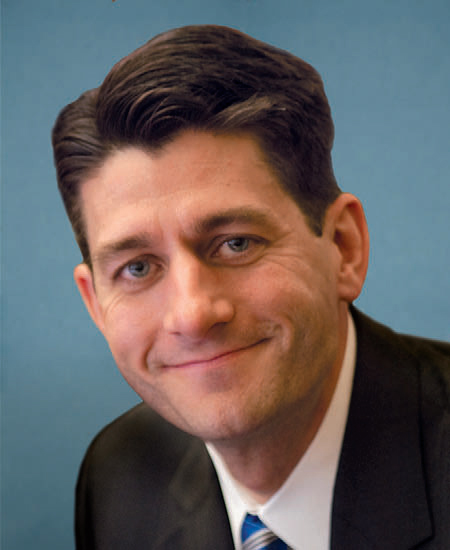
Rep. Paul Ryan
One depressing aspect of American politics is the susceptibility of the political and media establishment to charlatans. You might have thought, given past experience, that D.C. insiders would be on their guard against conservatives with grandiose plans. But no: as long as someone on the right claims to have bold new proposals, he’s hailed as an innovative thinker. And nobody checks his arithmetic.
Which brings me to the innovative thinker du jour: Representative Paul Ryan of Wisconsin.
Mr. Ryan has become the Republican Party’s poster child for new ideas thanks to his “Roadmap for America’s Future,” a plan for a major overhaul of federal spending and taxes. News media coverage has been overwhelmingly favorable; on Monday, The Washington Post put a glowing profile of Mr. Ryan on its front page, portraying him as the G.O.P.’s fiscal conscience. He’s often described with phrases like “intellectually audacious.”
But it’s the audacity of dopes. Mr. Ryan isn’t offering fresh food for thought; he’s serving up leftovers from the 1990s, drenched in flimflam sauce.
Mr. Ryan’s plan calls for steep cuts in both spending and taxes. He’d have you believe that the combined effect would be much lower budget deficits, and, according to that Washington Post report, he speaks about deficits “in apocalyptic terms.” And The Post also tells us that his plan would, indeed, sharply reduce the flow of red ink: “The Congressional Budget Office has estimated that Rep. Paul Ryan’s plan would cut the budget deficit in half by 2020.”
But the budget office has done no such thing. At Mr. Ryan’s request, it produced an estimate of the budget effects of his proposed spending cuts — period. It didn’t address the revenue losses from his tax cuts.
The nonpartisan Tax Policy Center has, however, stepped into the breach. Its numbers indicate that the Ryan plan would reduce revenue by almost $4 trillion over the next decade. If you add these revenue losses to the numbers The Post cites, you get a much larger deficit in 2020, roughly $1.3 trillion.
And that’s about the same as the budget office’s estimate of the 2020 deficit under the Obama administration’s plans. That is, Mr. Ryan may speak about the deficit in apocalyptic terms, but even if you believe that his proposed spending cuts are feasible — which you shouldn’t — the Roadmap wouldn’t reduce the deficit. All it would do is cut benefits for the middle class while slashing taxes on the rich.
And I do mean slash. The Tax Policy Center finds that the Ryan plan would cut taxes on the richest 1 percent of the population in half, giving them 117 percent of the plan’s total tax cuts. That’s not a misprint. Even as it slashed taxes at the top, the plan would raise taxes for 95 percent of the population.
Finally, let’s talk about those spending cuts. In its first decade, most of the alleged savings in the Ryan plan come from assuming zero dollar growth in domestic discretionary spending, which includes everything from energy policy to education to the court system. This would amount to a 25 percent cut once you adjust for inflation and population growth. How would such a severe cut be achieved? What specific programs would be slashed? Mr. Ryan doesn’t say.
After 2020, the main alleged saving would come from sharp cuts in Medicare, achieved by dismantling Medicare as we know it, and instead giving seniors vouchers and telling them to buy their own insurance. Does this sound familiar? It should. It’s the same plan Newt Gingrich tried to sell in 1995.
And we already know, from experience with the Medicare Advantage program, that a voucher system would have higher, not lower, costs than our current system. The only way the Ryan plan could save money would be by making those vouchers too small to pay for adequate coverage. Wealthy older Americans would be able to supplement their vouchers, and get the care they need; everyone else would be out in the cold.
In practice, that probably wouldn’t happen: older Americans would be outraged — and they vote. But this means that the supposed budget savings from the Ryan plan are a sham.
So why have so many in Washington, especially in the news media, been taken in by this flimflam? It’s not just inability to do the math, although that’s part of it. There’s also the unwillingness of self-styled centrists to face up to the realities of the modern Republican Party; they want to pretend, in the teeth of overwhelming evidence, that there are still people in the G.O.P. making sense. And last but not least, there’s deference to power — the G.O.P. is a resurgent political force, so one mustn’t point out that its intellectual heroes have no clothes.
But they don’t. The Ryan plan is a fraud that makes no useful contribution to the debate over America’s fiscal future.
By PAUL KRUGMAN-Op-Ed Columist and Nobel Prize Winner-Economics, The New York Times-Aug 5, 2010; Photo- Wikipedia
Share This Blog


 Unknown Feed
- An error has occurred; the feed is probably down. Try again later.
 mykeystrokes.com
You must be logged in to post a comment.