GOP Medicare Proposal Doesn’t Work Like Members of Congress’ Health Care As Republicans Claim
The Center for American Progress has previously pointed out that the House Republican budget for fiscal year 2012 forces future beneficiaries out of Medicare into more expensive private plans. One of the ways Republicans are trying to sell their Medicare proposal is by claiming that beneficiaries would “be enrolled in the same kind of health-care program that members of Congress enjoy.” That claim is false. In fact, if the rate of growth under this Medicare proposal were applied to federal employees’ most popular health option, the Blue Cross Blue Shield Standard Option, federal workers, including members of Congress, with family coverage would have to pay another $3,330 for the care they enjoy today. Those with individual coverage would have to pay another $1,555.
Most federal workers receive their health coverage through the Federal Employees Health Benefits Plan, or FEHBP. The government contributes a portion of their health premium. That portion is set by law and applied to the weighted average of actual premiums charged in any given year. Beneficiaries make up the rest of the cost.
The Republican budget replaces the traditional fee-for-service Medicare for future beneficiaries with a voucher to private insurance companies that is established on very different terms. Unlike FEHBP, which has a consistent government contribution based on actual premiums charged in any given year, the amount of the voucher is determined independent of actual premiums. Its growth is instead tied to the rate of the consumer price index for all urban consumers, or CPI-U. Because health costs have typically increased faster than inflation, the level of government support from the voucher would become a lower share of actual premium costs over time. In other words, Medicare beneficiaries would be left holding the bag.
What would happen if FEHBP operated like the GOP Medicare proposal?
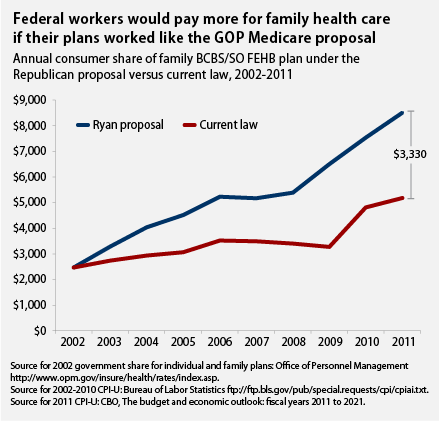
We examined what would happen if FEHBP had operated like the Republican Medicare proposal over the last decade. We used data from the Office of Personnel and Management to look at the annual premiums for federal workers enrolled in the Blue Cross Blue Shield Service Benefit Plan (Standard Family and Standard Individual). We chose this plan because nearly 60 percent of those enrolled in FEHBP have Blue Cross Blue Shield, and the Standard Option is the most popular FEHBP plan. We increased government support for the individual and family plans by the rate of growth in the CPI-U index from 2002 to 2011. We then compared the difference between the government’s share and the actual total premium in each year—which is the amount the beneficiary would pay—under the Republican proposal and the real FEHBP.

The result: A typical federal worker, or member of Congress, enrolled in family coverage in the Blue Cross Blue Shield Standard Option, would have had to pay an additional $3,330.36 for the same level of coverage they have today. Those with individual coverage would have had to pay $1,555 more.
By: Nicole Cafarella, Payment Reform Manager and Policy Analyst and Tony Clark, Policy Analyst, Center for American Progress, April 27, 2011
RyanCare vs. The Public Option
If you want to understand why the budget debate so infuriates people who actually care about deficits — and, in particular, people who actually care about health-care spending — consider this: The central health-care reform in Paul Ryan’s budget, the one that’s got him so many plaudits for courage, would actually increase costs. The health-care reform that progressives have been pursuing for more than two years would cut them. And yet calling for Medicare to be privatized and voucherized is considered serious, while calling for a public option is considered tiresome. But let’s go to the tape.
Back during the health-care reform fight, the Congressional Budget Office looked at the likely effect of adding a public option that paid Medicare rates. “In total, a public plan based on Medicare rates would save $110 billion over 10 years,” the agency concluded. Importantly, the savings would come because premiums would be lower. The basic mechanism here is not complicated: Just as you get better deals by shopping at a mega-retailer like Wal-Mart, you get better deals by working with a mega-insurer like Medicare. Size matters.
As for Ryan’s plan, CBO’s take was just the opposite. “Under the proposal,” they said, “most elderly people would pay more for their health care than they would pay under the current Medicare system.” That is to say, health-care costs go up. Now, federal health-care spending goes down, as seniors are paying 70 percent of their costs out-of-pocket rather than 30 percent. Or, in CBO-ese, Medicare beneficiaries “would bear a much larger share of their health care costs than they would under the current program.” Of course, back in the real world, seniors are going to react poorly to being unable to afford health-care insurance, and those savings won’t manifest.
But even putting that aside, it makes for a very stark contrast. The progressive reform that won’t happen would cut health-care costs. The conservative reform that won’t happen would increase health-care costs. One idea makes insurance cheaper and one makes it more expensive. And yet the idea that makes insurance cheaper is pretty much off the table, while the idea that makes it more expensive — and that almost certainly wouldn’t work — is considered a very serious proposal worthy of brow-furrowing debate.
By: Ezra Klein, The Washington Post, April 25, 2011
Remember When The GOP Hated Medicare Cuts?
You’ve seen hypocrisy in politics before. But rarely have you seen the brazen kind Republicans just showed on the House floor, when they voted for Budget Chairman Paul Ryan’s “Path to Prosperity.”
Ryan’s budget calls for repealing most of the Affordable Care Act, including both the insurance coverage expansions and creation of an independent board to help restrain Medicare costs. But it would leave in place the rest of the planned reductions in Medicare spending, at least for the next ten years. Among those cuts are $136 billion in reductions to Medicare Advantage plans.
As you may know, Medicare Advantage plans are the private insurance alternative, already in existence, for seniors who prefer to opt out of the traditional, government-run insurance plan. About a quarter of all seniors now use them. The government pays insurers a fee for every senior who enrolls, but studies have shown the government is paying too much. That’s how supporters of the Affordable Care Act have justified the $136 billion reduction.
Throughout the health care debate, Republicans not only rejected these and other arguments for Medicare cuts. They made the cuts a centerpiece of their attacks on Democrats, as the Associated Press noted recently:
“The new law’s massive Medicare cuts will fall squarely on the backs of seniors, millions of whom will be forced off their current Medicare coverage,” the GOP wrote in their Pledge to America, an election-season manifesto. …
In addition to the Pledge to America, House Speaker John Boehner, House Majority Leader Eric Cantor and individual Republican candidates all criticized the cuts.
The National Republican Congressional Committee featured them in ads attacking Democrats in numerous campaign commercials, and some individual candidates made use of the cuts as well.
Ryan and his supporters claim the Medicare reductions in the new Republican budget are different, because Democrats used their cuts to finance more government spending. And that’s partially true. Although Democrats bolstered Medicare drug coverage and arguably put in place policies that will lead to higher quality care, they used the bulk of the saved Medicare money to offset the cost of subsidizing insurance for working-age Americans.
But, by the same logic, Republicans are also diverting most of the Medicare Advantage money away from Medicare. They’re using that money to underwrite the cost of tax cuts for the wealthy.
So Democrats are cutting Medicare to make sure everybody has health insurance, while Republicans are cutting Medicare to make sure millionaires have tax cuts. This is really an argument the Republicans want to make?
By: Jonathan Cohn, The New Republic, April 15, 2011
Pragmatic Policy vs Ideological Philosophy
For some time now, Democrats and Republicans alike have been yearning for a great philosophical clash between the two parties. No more of this five percent of 12 percent of the federal budget stuff. We wanted entitlements, the role of government, the obligations that the old have to the young, that the rich have to the poor, that the powerful have to the powerless.
Paul Ryan’s budget offer exactly that sort of reconstruction of the social compact. America is a very different place before his budget than it would be after his budget. But though Obama’s speech was closer to that sort of clash of visions than anything he’s offered before — he used the word “vision” 15 times, for instance — what he offered was not philosophy. It was policy. But you have to read it closely — and know where it came from — to see that.
This is difficult advice when it comes to deficit reduction, but don’t look at the number. This plan cuts $4 trillion, that plan cuts $2 trillion, that one cuts $10 trillion. Those numbers reflect little but the internal hopes and dreams of the plan. If I say that my plan means Medicare will never spend another penny and economic growth will shoot to 8 percent — and that’s only a shade less optimistic than the assumptions and models included in the Ryan budget (pdf) — I can save an almost unlimited amount of money. My number can be anything I want it to be. The problem is I actually can’t save that much money because my math is based on fantasy. So my number is meaningless.
President Obama says his plan cuts $4 trillion over 12 years. Rep. Paul Ryan says his plan cuts $4 trillion over 10 years. If you look at the numbers, the two plans appear quite similar. But if you look at how they’d get to the number, they couldn’t be more different. And it’s how you get to the number that matters, because that’s what decides whether you’ll get to the number. It’s also, incidentally, what decides the shape of our government going forward.
Ryan’s number is the product of holding the growth of Medicare and Medicaid to the rate of inflation, which is far lower than has ever been shown to be possible. How he gets there is, on Medicaid, he tells the states to figure it out, and on Medicare, he tells seniors to figure it out. Both strategies have been tried: Various states have gotten waivers to radically remake their Medicaid program, and the consumer-driven model that Ryan is proposing for Medicare has been attempted in the Federal Employee Health Benefits Program and Medicare Advantage. None of these programs have worked, which is why we’re in our current predicament.
Obama’s number is the product of holding Medicare growth to GDP+0.5 percent — which is, in practice, a few percentage points beyond inflation, and a few percentage points behind the health-care system’s normal rate of growth. He mostly gets there through the cost controls passed as part of the Affordable Care Act, which hope to hold Medicare to GDP+1 percent. He then proposes to shave a further half-percentage point off the growth rate by introducing value-based insurance — where we pay more for treatments that are proven to work than for treatments that are not proven to work — into Medicare and giving generic drugs quicker entry into the marketplace. These programs have worked at smaller scales and in more limited pilots. We don’t know if they’ll work across the entire Medicare system, but we have reason to think they will.
Then there are taxes. Ryan’s plan pledges to make the Bush tax cuts permanent, at a cost of at least $4 trillion over 10 years, and more after that. He’d then clean out the tax code, but he’d pump the money he made from closing expenditures back into tax cuts. Obama proposes to return to the Clinton-era tax rates on income over $250,000 and then raise a further trillion through closing tax expenditures. Altogether, that’s about $2 trillion less than letting all the Bush tax cuts expire, but at least $2 trillion more than Ryan’s plan. Notably, Obama hasn’t said which expenditures he’d close to get to $1 trillion. The difference between the two tax plans — particularly when added to Obama’s decision to cut $400 billion from security-related spending, while Ryan largely exempts that category — explains why Obama doesn’t have to make such deep cuts in programs for seniors and low-income Americans.
So are we finally getting the grand philosophical debate we wanted? Not quite. Obama spoke extensively of vision — the GOP’s, which “claims to reduce the deficit by spending a trillion dollars on tax cuts for millionaires and billionaires … {while} asking for sacrifice from those who can least afford it and don’t have any clout on Capitol Hill,” and his, “where we live within our means while still investing in our future; where everyone makes sacrifices but no one bears all the burden; where we provide a basic measure of security for our citizens and rising opportunity for our children,” but he’s overselling it.
Obama’s budget is not philosophy. It is very similar to the Simpson-Bowles report, which attracted the votes of Republicans as far to the right as Tom Coburn. Few Democrats would say their vision of balancing the budget is one in which there was only one dollar of new taxes for every three dollars of spending cuts, but that’s what Obama’s proposal envisions. Obama’s budget, somewhat curiously, is what you’d expect at the end of a negotiation process, not the beginning. In fact, as it’s modeled off of Simpson-Bowles, it is the product of a negotiation process, as opposed to an opening bid. It is, in other words, policy. You could argue that this is a philosophy, and that philosophy is pragmatism, but I think that’s getting too cute. This is the sort of policy that might pass and might work.
Ryan’s budget is purer, but it is also more fantastical. It posits the government it wishes were possible, and the policies it wishes would work. It is an opening bid so ideological that it leaves little room for a process of negotiation. Every dollar it purports to raise comes from cutting spending. Not one comes from taxes. It privatizes Medicare and unwinds the federal government’s role in Medicaid. For all the philosophy in his budget — and his budget does have a very different philosophy about the proper role of government than we see in federal pllicy today — there’s neither policy that could pass nor policy that could work. And, curiously for a conservative who distrusts both government and congress, it has no answer to the question of “what if this fails?”
The policy that clarifies this difference is the “trigger.” Obama’s budget, aware that it might not pass and, if it does pass, it might not work, proposes to make automatic cuts to discretionary spending and tax expenditures if the promised savings don’t materialize. If Ryan’s budget falls shorts, there’s no comparable failsafe. That is to say, Obama’s budget has two plausible ways to get to its number, while Ryan’s budget has none. You don’t need a PhD in philosophy to understand why that’s a problem.
By: Ezra Klein, The Washington Post, April 13, 2011
Share This Blog


 Unknown Feed
- An error has occurred; the feed is probably down. Try again later.
 mykeystrokes.com
You must be logged in to post a comment.