
Recent protests at WI capitol
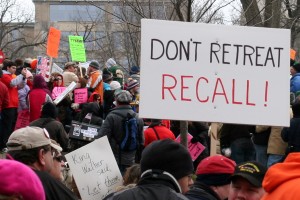
Recall elections loom on the horizon as petitions against nine Wisconsin state senators were recently submitted to the Government Accountability Board (GAB). Each successful petition must include 25 percent of the total number of votes cast in that senate district in the last election.
The recall efforts of Republican senators who supported Gov. Scott Walker’s Budget Repair Bill, and the Democratic senators who left the state to delay voting on the bill, are a result of the political firestorm that quickly flared up over the bill that sought to eliminate almost all collective bargaining rights for public workers.
Currently, the Republican senators who are facing a recall election are Alberta Darling, Robert Cowles, Sheila Harsdorf, Luther Olsen, Randy Hopper and Dan Kapanke. Democrats are facing recall efforts are — Dave Hansen, Jim Holperin and Robert Wirch.
The Milwaukee Journal Sentinel reported that there have also been petitions that didn’t have enough signatures on them to spark a recall. Democratic senators Lena Taylor and Spencer Coggs (both from Milwaukee), Senate Minority Mark Miller (Monona) and Fred Risser (Madison) all have all survived the recall attempts against them. Recall efforts against Republicans Glenn Grothman (West Bend) and Mary Lazich (New Berlin) also failed to garner sufficient support.
Circulators hired by the state Republican Party have submitted “hundreds if not thousands of invalid signatures” in recall drives targeting three Democratic state senators. Volunteers have been working overtime to enter each name into a data base and cross-check it with the phone book and other record. One man who signed a recall petition was Bill Pocan, the deceased father of State Representative Marc Pocan. The Wisconsin Democratic Party (DPW) is formally challenging all three of the recall petitions filed against Democrat senators.
Republicans have filed challenges against “all petitions targeting GOP senators. In addition to their individual signature challenges, they claim the GAB should throw out the petitions because the recall organizers did not properly register with the state.” The elections for recalled legislators with completed petitions will likely be held July 12, 2011.
By: Jennifer Page, Center for Media and Democracy, May 6, 2011
May 6, 2011
Posted by raemd95 |
Collective Bargaining, Democracy, Elections, Gov Scott Walker, Politics, Public Employees, State Legislatures, Union Busting, Unions, Wisconsin | Activism, Government Accountability Board, Milwaukee Journal Sentinel, Recalls, Wisconsin Democratic Party, Wisconsin Legislature, Wisconsin Republicans, Wisconsin Senate |
Leave a comment
Hundreds of Wisconsinites lined Madison’s Capitol Square, Saturday, to welcome bikers from all over the Midwest and to protest Scott Walker’s attack on Wisconsin unions.
Just when Governor Scott Walker thought he memorized all the chants and signs, Wisconsinites revved it up a notch. Every kind of bike from Harley-Davidsons to Huffys descended onto the Square from Martin Luther King Jr. Blvd and South Hamilton St.
Eric Hartz, the organizer of the event, complemented the thunderous entrance with songs from the Raging Grannies, a social justice organization made up of older women. Other speakers included Sen. John Erpenbach, Sen. Mark Miller, Rep. Cory Mason, Rep. Peter Barca, Milwaukee Public School Teachers and the City of Middleton Fire Fighters.
Throughout the speeches you could hear the low rumbling from motorcycles surrounding the capitol building. “The sound from the engines and the crowd was overwhelming,” said Miriam Kopelow, a teacher at Wringra Middle School. “I could feel the chants of the people and the rumbling of the bikes.”
According to Rep. Cory Mason, motorcycles and collective bargaining rights have a special place in Wisconsin’s history. “There are two great things that were invented here in the state of Wisconsin,” said Mason. “One is public sector collective bargaining rights and the other one is Harley Davidson and no governor in their right mind would try to get rid of any of those fine institutions.”
Most of the bikers participating were veterans supporting the unions. Dave Boetcher, a member of the State Veterans Board, rode in support of public workers, but also talked about the privatization of the new veteran’s home in Chippewa Falls after private nursing home owners lobbied Gov. Walker.
“We are first and foremost a compassionate state,” said Sen. John Erpenback. However, Gov. Walker’s budget wants to “cut a third from the vocational colleges… a billion dollars from K12…turn back 20 years of
recycling” and ultimately wants “to destroy clean and open government in Wisconsin,” said Rep. Peter Barca.
Another Wisconsin invention Rep. Cory Mason pointed out, that will prove to be important in the coming months, is the right to recall elected officials. “We will continue this fight until we finally prevail, until we bring back our proud Wisconsin tradition that stands up for working people,” said Barca.
By: Summer Abdoh, Center for Media and Democracy, May 1, 2011
May 1, 2011
Posted by raemd95 |
Class Warfare, Collective Bargaining, Democracy, Education, Elections, GOP, Gov Scott Walker, Governors, Lawmakers, Politics, Public Employees, Republicans, State Legislatures, Teachers, Union Busting, Unions, Wisconsin, Wisconsin Republicans | Bikers, Eric Hartz, Harley-Davidson, Madison, Raging Grannies, Recalls, St Rep Cory Mason, St Sen John Erpenback, Veterans, Wisconsin, Workers, Workers Rights |
Leave a comment
A Dane County, WI judge has approved a request by the state Government Accountability Board (GAB), which oversees elections in the state, to delay some state Senate recall elections and consolidate them into one day on July 12. In the course of making that decision, the judge turned back Democratic objections that some of their recalls should proceed as quickly as possible in June.
The Milwaukee Journal Sentinel reports:
Signatures were filed against senators starting April 1, and under tight timelines in the statutes, the first election could have been scheduled in mid-June. But Dane County Judge John W. Markson agreed to give the accountability board more time to evaluate the petitions and schedule the elections.
He agreed the board needed more time because of the unprecedented demands on evaluating tens of thousands of signatures for each recall attempt. He also noted the board is bogged down by a statewide recount in the April 5 election for state Supreme Court.
The GAB had sought the extension primarily on the grounds that the extraordinary number of recalls was straining their capacity to review signatures. On the other hand, as WisPolitics reported on Thursday, Democratic Party attorney Jeremy Levinson had argued in a court filing that delaying any of the recalls would do damage to the Dems, and create political space for the Republicans to do mischief with the extra time:
Levinson argues delaying the matter would give the incumbents an “extra-statutory” fundraising advantage, and leave representation of those districts “an open and pending question.”
In addition, Levinson argues that delaying the recall elections may result in laws being enacted that would not be if the recalls are held in the time frame permitted by statute.
“The rush to put ‘Voter ID’ and the concealed carry of firearms before the legislature — to say nothing of the pending budget — confirm that this is an entirely concrete concern,” Levinson writes.
In addition, as Jessica Arp from the local CBS affiliate reported from Judge Markson’s court hearing, Levinson also argued that the earliest petitions, against state Sen. Dan Kapanke and state Sen. Randy Hopper, were filed so quickly as a deliberate decision on the Dems’ part, in order to have the recalls move forward quickly while the issues are still fresh in the public mind.
Ultimately, though, Markson declared that it had become difficult or impossible for the GAB to meet the statutory deadline, and that the public would be better served by having the recalls held on a single day.
The state Senate currently has a 19-14 Republican majority, with Democrats hoping to pick up three seats in recall elections and win a majority, in a backlash against Gov. Scott Walker’s anti-public employee union legislation. In order to initiate a recall, signatures of at least 25 percent of the number of voters in the previous gubernatorial election, within the targeted district, must be collected in a 60-day window.
Democrats have filed recall signatures against six Republicans: Dan Kapanke, Randy Hopper, Luther Olsen, Sheila Harsdorf, Alberta Darling and Rob Cowles. Republicans have filed recall signatures against three Democrats: Dave Hansen, Jim Holperin and Robert Wirch.
Under Wisconsin’s recall law, elected officials must have served at least one year of their term before being recalled — thus exempting the half of the Senate that was just elected in 2010. In addition, Dems have also declared their intention to recall Walker himself next year, when the one-year exemption runs out.
By: Eric Kleefeld, Talking Points Memo, April 29, 2011
April 30, 2011
Posted by raemd95 |
Collective Bargaining, Elections, Gov Scott Walker, Politics, Public Employees, State Legislatures, Unions, Voters, Wisconsin, Wisconsin Republicans | Dane County, Judge John Markson, Madison WI, Milwaukee Journal Sentinel, Randy Hopper, Recalls, Voter ID, Wisconsin Government Accountability Board, Wisconsin Legislature, Wisconsin Politics |
Leave a comment
Ohio Democrats this week introduced into a divided state legislature a new bill that would allow Ohio citizens to recall Governor John Kasich and other legislatures. The state has been in an ideological upheaval for months after Kasich’s budget bill was introduced, similar to the Wisconsin bill that has received incredible national attention for stripping unions of their collective bargaining rights, and eventually signed April 2nd after some concessions were made by the Republican-held Assembly and Senate.
There are now 17 other states where similar bills have been passed. Democrats in Ohio are now trying to join the ranks of some of those states like Wisconsin, where voters also have the option to recall their elected legislatures.
Reuters reported that State Representatives Mike Foley and Robert Hagan’s bill would allow “Ohio voters to undertake a recall effort if they gather petition signatures of voters equal to 15 percent of the total votes for governor or in a particular legislative district in the last election.”
Recall efforts are already well underway in Wisconsin, where 16 senators have petitions started against them. Governor Scott Walker, in his inaugural term, cannot be recalled until he has served in office for one full year, according to Wisconsin state law.
Kasich’s bill to limit collective bargaining rights of unions and slash funding for many state-funded programs has received passionate opposition by supporters of workers’ rights. Protests in Columbus drew thousands in February, riding the wave of protests started in Madison and that then spread throughout the country.
The hotly-contested Senate Bill 5, or SB5 as it has been dubbed by the media, severely limits the actions of unions, and in conjunction with Kasich’s budget, introduces major cuts to public programs: like a $852 million cut to schools.
The Toledo Blade explains SB5: “It prohibits all public employees from striking, prohibits local governments from picking up any portion of an employee’s contributions to his pension, eliminates automatic step and longevity raises in favor of a yet undefined performance-pay system, and prohibits unions from automatically collecting ‘fair share’ fees from members of a workforce who opt not to join the union.”
Besides the Democrats’ efforts to pass the recall bill, Ohio law also allows for a public referendum of any passed bill. Opponents of the bill need to gather 231,147 signatures 90 days from the official signing of the bill for the statewide referendum to be voted on Nov. 8th.
By: Jennifer Page, Center for Media and Democracy, April 11, 2011
April 13, 2011
Posted by raemd95 |
Collective Bargaining, Conservatives, Democracy, Democrats, Economy, Elections, GOP, Gov John Kasich, Gov Scott Walker, Government, Governors, Ideologues, Labor, Lawmakers, Middle Class, Politics, Public Employees, Republicans, State Legislatures, States, Union Busting, Unions, Voters | Ohio, Ohio Senate Bill 5, Public Employees, Public Referendums, Recalls, State Budgets, Toledo Blade, Wisconsin, Workers Rights |
Leave a comment
Ever since Wisconsin Dems and labor activists announced late Friday that they had already amassed enough signatures to trigger a recall election against GOP state Senator Dan Kapanke — and filed their petition to make it happen — political observers have been wondering precisely how many signatures activists had gathered. The number could contain clues as to whether the election will actually happen and how much grassroots energy there remains on the ground in the state.
I’ve now been given the precise number by Wisconsin Democratic Party spokesman Graeme Zielinski, and it’s eye-opening: In that district, 15,588 signatures are needed to trigger a recall — and activists collected and filed a whopping total of 22,561.
That’s 145 percent of the total required — and Wisconsin election experts tell me it virtually ensures that a recall election will take place despite any challenges to the veracity of signatures.
Because the news of the petition broke late on a Friday, the signficance of it has gone entirely unnoticed. Dems and labor activists in the state collected nearly 23,000 signatures in Kapanke’s districts in 29 days — less than half the 60 alloted — which has tied the record for the fastest collection of signatures for a recall election in recent Wisconsin state history. And unlike in that previous case, recall drives are now simultaneously proceeding against other Republicans.
There have been only two successful recalls of state legislators in Wisconsin history, against former state senators George Petak in 1996 and against Gary George for corruption in 2003. George was subsequently convicted on felony charges. In the first case, the requisite signatures were filed on the last day of the 60-day period, according to Nexis, and in the second it took 29 days. In other words, Dems and labor racked up the signatures required against Kapanke as fast as organizers did against a legislator later convicted of a felony.
Wisconsin experts tell me that the number of signatures is a reliable indicator that grassroots energy on the ground remains strong. “Given how long you have to get the signatures and how quickly they got these, it’s a strong signal that the activation of the pro-recall forces is very high,” Charles Franklin, a professor of political science at the University of Wisconsin in Madison, tells me. “Kapanke is in the most Democratic leaning district, but completing a third more than rquired in 20-something days is quite a feat for any petition drive.”
Adds his fellow professor Barry Burden: “I would say it’s a near certainty that they have enough signatures to make the recall go forward.”
The question remains whether the drive on display in Kapanke’s district will manifest itself with similarly strong recall signature showings in other districts. But that said, even though the national press has moved on from this story, the energy and staying power of what has been unleashed in Wisconsin continue to surprise.
By: Greg Sargent, The Washington Post, April 4, 2011
April 4, 2011
Posted by raemd95 |
Democracy, Elections, Media, Politics, Unions, Wisconsin | Grassroots, Labor Activists, Petition Drives, Recalls, Wisconsin Democratic Party, Wisconsin Republicans |
Leave a comment


 Unknown Feed
 mykeystrokes.com
You must be logged in to post a comment.