By: Dana Milbank, Opinion Writer, The Washington Post, February 10. 2012
CPAC: “Nattering Nabobs Of Negativism”
“How many of you,” Scott Rasmussen asked the crowd at this week’s Conservative Political Action Conference, “have ever mocked or made fun of the president’s call for hope and change? Raise your hands.”
Most people in the Marriott Wardman Park hotel ballroom raised their hands. There were cheers and whoops.
“With all due respect,” the conservative pollster and commentator told them, “I’d like to say that’s really stupid.”
This time, there was uncomfortable laughter. “Voters are looking for hope and change as much today as they were in 2008,” Rasmussen explained, and “you ought to be encouraging Republican candidates, people you support, to offer that positive step forward.”
Rasmussen had put his finger on a major problem for Republicans in 2012, and conservatives in particular: At a time when the national mood has begun to improve, they remain nattering nabobs of negativism. At CPAC, any hint of a “positive step” was buried in vitriol.
This worked well for Republicans in 2010, because it matched the sour mood of the electorate. But now, with optimism and confidence finally on the rise, Republicans are left with an anger management problem. They risk leaving the impression that they are rooting against an economic recovery.
Take, for example, the speech to CPAC by Mitch McConnell, the Senate Republican leader. Among his criticisms of the Obama administration: It “made an art form out of the orchestrated attack”; it will “go after anybody or any organization they think is standing in their way”; it releases “the liberal thugs” on opponents; it “used the resources of the government itself to intimidate or silence those who question or oppose it”; it engages in “attacking private citizens or groups for the supposed crime of turning a profit”; it takes it on itself to “dig through other people’s tax returns”; and it has no higher priority “than picking on Fox News.”
“The president seems to have forgotten . . . that he was elected to be president of the United States, not the Occupy Wall Street fan club,” McConnell lectured, spitting out the words.
The unrelenting anger in the ballroom was an extension of what’s been happening on the campaign trail. In the week preceding the Florida Republican primary, 92 percent of the political ads were negative, according to the Campaign Media Analysis Group. There was only one positive ad for Mitt Romney — and it was in Spanish.
The Republican candidates for president visited CPAC on Friday to deliver more of the same: “We’re going to win by making Barack Obama and his failed policies the issue in this race” (Rick Santorum); “History will record the Obama presidency as the last gasp of liberalism’s great failure” (Romney); and “My goal, with your help, is that by the time President Obama lands in Chicago, we will have repudiated at least 40 percent of his government on the opening day” (Newt Gingrich).
The dour message has contributed to low voter turnout and an enthusiasm gap among GOP voters — a worrisome development that the Washington Times’ Ralph Hallow tried to warn the CPAC participants about. “None of these things I see are particularly good,” he said during one of the conference panels. “Intensity and enthusiasm about voting is now with the Democrats.”
On the same CPAC panel, conservative activist Ralph Reed argued that “it isn’t going to be enough to be anti-Obama. . . . We have to have a forward-leaning, positive conservative reform agenda.”
But at the moment, the message remains backward-looking and negative. At CPAC, Rep. Steve King (R-Iowa) used his speech to decry a “totalitarian state that’s descending upon us” and to assert the existence of the administration’s “Stasi troops” — a reference to the East German secret police.
Sen. Jim DeMint (R-S.C.) claimed, “Our country has never been in as much trouble as we’re in today, and I’m not exaggerating.” Speaker John Boehner recalled his defiant stand against Obamacare on the House floor: “Hell no, you can’t!” And former presidential candidate Herman Cain argued that “stupid people are ruining America.”
Rep. Michele Bachmann (R-Minn.) even dismissed the significance of the death of Osama bin Laden, the fall of Moammar Gaddafi and the birth of the Arab Spring. They are “tactical successes” that pale against the “mess that Barack Obama has created,” she said.
On another CPAC panel, conservative commentators were asked to respond to conservative columnist David Brooks’s argument that Romney needs “to actually have some big policies” rather than “cruising on a bad economy.”
Radio host Roger Hedgecock disagreed. “We know that this economy is not recovering,” he said.
McConnell was similarly grim. “Last week’s jobs report happened in spite of the president’s policies, not because of them,” he told the gathering. “It’s the Obama economy now. And we’re not going to let people forget it.”
Such nattering is exactly what Obama needs.
Mitt Romney The Weathervane: What Our Most Changeable Politician Can Tell Us About The Modern GOP
As Mitt Romney enters the Republican presidential race this week, there will be plenty of attention on his shifting political views. But Romney’s changing positions are not just the tragicomic tale of a man so desperate for the presidency he’ll say anything to get there: they’re also a valuable measure of what it takes to make it in the modern GOP.
Romney’s many breathtaking U-turns — on universal health care, on gay rights, on abortion rights — have been extensively documented and parsed, and have become a reliable punchline. The former governor’s willingness to adopt the position that he thinks will get him the most votes in whatever election he happens to be running in does speak to his own character. But Romney’s ease at shifting also makes him a perfect weathervane for measuring the audiences he is trying to appeal to. And the speed with which Romney has been spinning to the right is an alarming sign of the political winds within the Republican Party.
This weekend, Romney will be making an important appearance among a group that has historically mistrusted him: the Religious Right. Speaking at the annual conference of Ralph Reed’s Faith and Freedom Coalition, Romney can be expected to once again disavow his previously convenient reasonable positions on abortion rights and gay equality. But he is also likely to go a step farther.
At a similar event in 2007, as he tried to shake off his image as a socially moderate Massachusetts Republican in preparation for his first presidential run, Romney spoke at the Values Voter Summit hosted by a coalition of right-wing social issues groups. In his speech, he rattled off Religious Right catchphrases, speaking of the United States’ “Judeo-Christian heritage,” the “breakdown of the family,” and making “out-of-wedlock birth out of fashion again” and passing an anti-gay marriage amendment to “protect marriage from liberal, unelected judges.” He promised a federal “marriage amendment,” funding for vouchers for religious schools and across-the-board anti-choice policies. By earlier that year, he had impressed Ann Coulter enough that she endorsed him in a speech made famous by her use of an anti-gay slur.
At last year’s Values Voter Summit, having done full penance to the Religious Right for his previous statements in favor of gay rights and choice, Romney focused his speech on right-wing economic policies, including an odd tribute comparing Wal-Mart founder Sam Walton to the Founding Fathers. But the company he kept revealed the friends he was hoping to make. The event was sponsored in part by the Family Research Council and the American Family Association, two groups who were soon to be named “hate groups” by the SPLC for their long histories of false anti-gay rhetoric. Romney’s fellow speakers included Religious Right stalwarts Phyllis Schlafly, Tony Perkins, Planned Parenthood scam artist Lila Rose, and the AFA’s Bryan Fischer, who has gained infamy with his vicious rhetoric about gays and lesbians, Muslims, African Americans and progressives. I wrote a letter to Romney warning him about associating himself with Fischer — he didn’t respond.
The Religious Right leaders that Romney is eager to curry favor with aren’t just hostile to gays, Muslims and the social safety net — many have expressed concern or even outright hostility to Romney’s own Mormon faith. Fischer recently confronted Romney’s faith, declaring that there is “a direct contradiction between Mormon theology and the teaching of Jesus Christ.” A writer for a leading Religious Right publication declared, “If Mitt Romney believes what the Mormon Church teaches about the world and how it operates, then he is unfit to serve.” As Romney angles himself into an increasingly extreme GOP, he will have to make nice to those who insult not only his past politics but his core religious beliefs.
At the Faith and Freedom Conference this weekend, Romney will have a similar opportunity to reinforce his social conservative bona fides while tying in his newly adamant anti-gay and anti-choice positions with the Tea Party’s love of pro-corporate anti-tax talk. Ralph Reed, the resurgent mastermind behind the Christian Coalition, will perhaps be the perfect ally in his effort to paint himself as a true Tea Party candidate who wants small government for corporations and big government for individuals. Reed was, after all, partly responsible for bringing the passion of American evangelicals to the Republican anti-regulation agenda and schmoozes equally comfortably with Pat Robertson and Jack Abramoff. He is the perfect power-broker for an age when GOP politicians are supposed to oppose universal health care while supporting IRS involvement in abortions – the niche that Romney is trying to carefully fit himself into.
Romney will try to take advantage of the GOP base’s newfound love of tax breaks for the rich, while continuing to pretend that he never supported choice and gay rights and reasonable environmental and health policies. If he can get away with it, he’ll be the perfect candidate for today’s ultraconservative GOP. But either way, he’s bound to become a powerful symbol of just how far to the Right you have to go to make it in today’s Republican Party.
By: Michael B. Keegan, President, People For The American Way: Posted June 3, 2011 in The Huffington Post.
What Does The Tea Party Want?….The New Litmus Test
Jim VandeHei and Mike Allen argue that the Tea Party redefined the purpose of the GOP as opposition to spending:
The Republican Party is undergoing a messy but unmistakable 20-month transformation from fanatically anti-Obama to fanatically anti-spending, providing top party officials a new and intriguing playbook for recapturing the White House in 2012.
To understand the current evolution, flash back to late spring of 2009. The GOP was disoriented and adrift, its leadership void filled by the bombastic voices of Palin, Beck and Rush Limbaugh. There was no common conservative cause, beyond fear and loathing of Obama. No wonder swing voters were so down on them.
But the tea party, treated at first by the media as exotics, forced Republicans to focus almost exclusively on the size of government. By the time the 2010 elections rolled around, tea party activists and most independent voters were completely aligned on the need to cut, cut, cut.
Midterm election results showed that this approach offers the GOP its best – and maybe only – hope of keeping the interests of independents and tea party activists aligned enough to beat Obama.
The new litmus tests for GOP presidential hopefuls are support for repealing “Obamacare” and taking a cleaver to government spending. If a presidential candidate could harness the smaller-government conservatism, temper it enough to avoid a blatant overreach and articulate a vision for a prosperous future for the country, it’s not hard to imagine swing voters finding such a person appealing.
There’s a superficial appeal to this story. But the evidence that Tea Party activists want to cut spending — at least actual spending programs — is sparse. Polls show that Tea Party supports overwhelmingly oppose cuts to Social Security and Medicare. The main thrust of Tea Party opinion is not the belief that Obama has spent too much money, but the belief that Obama has spent too much money on people unlike them:
More than half say the policies of the administration favor the poor, and 25 percent think that the administration favors blacks over whites — compared with 11 percent of the general public.
They are more likely than the general public, and Republicans, to say that too much has been made of the problems facing black people.
Here’s another cut, showing the Tea Party’s greater comfort with inequality of opportunity and stronger belief that the government devotes too many resources to minorities:
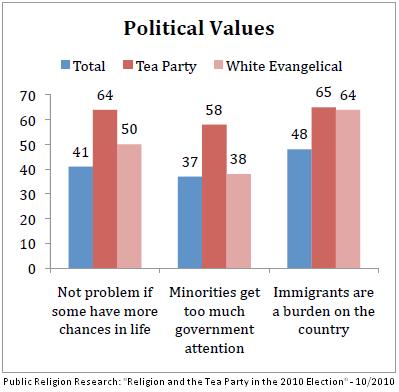
It’s a revolt against the composition of government much more than the level.
Now, it’s true that Republicans aren’t exactly translating this blueprint into action, but they’re not exactly flouting it, either. There is always a generalized antipathy toward spending amongst Republican and swing voters, but it disappears when the subject turns to actual government programs. Usually Republicans decide to just cut taxes for the rich instead. Here’s is the one part of the article proposing a defined policy change:
Even Ralph Reed, the Republican operative most tapped in to evangelicals, reflected the new GOP mindset when he gave this surprising wish list for the next presidential race: “In a perfect world, I’d like to hear the Republican nominee run on a platform that takes the capital gains tax to zero over five years.” Reed, who summoned several of the presidential candidates to Iowa for his Faith & Freedom Coalition this week, made it clear that Christian conservatives will still need to be catered to, but added that his side will understand the nominee’s need to focus on swing voters.
So an article putatively about the GOP redefining itself as an anti-spending party has one actual programmatic detail, and it’s: a zeroing out of the capital gains tax. In the name of appealing to swing voters — who, in fact, oppose tax cuts for the rich. Meet the new boss…
By: Jonathan Chait, The New Republic, March 14, 2011
Share This Blog


 Unknown Feed
- An error has occurred; the feed is probably down. Try again later.
 mykeystrokes.com

You must be logged in to post a comment.