“Discrediting The Social Safety Net”: GOP Race-Baiting Masks Class Warfare
By demonizing some, the Republicans seek to discredit the safety net for the 99 percent.
It’s commonplace to note that Newt Gingrich’s dog-whistle appellation that Barack Obama is the “food stamp president” is both racist and politically cynical. But the stereotyping of black government dependency also serves the strategic end of discrediting the entire social safety net, which most Americans of all races depend on. Black people are subtly demonized, but whites and blacks alike will suffer.
Gingrich persists because it’s a dependable applause line, and because his political fortunes keep rising. Compare that to September, when Mitt Romney attacked then-candidate Rick Perry for calling Social Security a “Ponzi scheme.” Perry backtracked, insisting that he only wanted to bolster the program and ensure its solvency. But in his 2010 book “Fed Up,” Perry made his opposition to Social Security clear, calling it “a crumbling monument to the failure of the New Deal.” Scrapping entitlements is a core tenet of contemporary fiscal conservatism, but most of the time politicians only get away with attacking the most vulnerable ones: Medicaid, food stamps and welfare cash assistance, which are means-tested and thus associated with the black (read: undeserving) poor, although whites make up a far greater share of food stamp recipients. Government welfare programs with Teflon political defenses — Medicare and Social Security — are nearly universal entitlements and thus associated with “regular” (read: white) Americans.
“Ending welfare as we know it,” as Bill Clinton and congressional Republicans did in 1996, is one thing. “Ending Medicare,” Republicans were last year reminded, is something else altogether. “Keep your government hands off my Medicare,” declared a 2009 Tea Party town hall attendee who today might very well be an ardent supporter of Gingrich’s assault on food stamps. It is a political lesson that free-market fundamentalists have to relearn with some frequency. It was only 2005, after all, when President George W. Bush launched his ill-fated proposal to privatize Social Security — a setback he later called his greatest failure.
Yet as more government programs of any sort are framed as pernicious, laissez-faire ideologues are again emboldened to get rid of everything.
As recently as November 2009, the New York Times reported that stigma around food stamps had faded; the program received strong bipartisan support as millions of newly impoverished Americans reached out for food assistance. But temporarily cautious politicians had only stashed the old playbook on the top shelf, and the revival of welfare queen demagoguery made for quick political results. Nationwide, state legislatures are moving to impose drug testing of welfare, and even unemployment insurance, recipients.
“If you go apply for a job today, you are generally going to be drug-tested,” Florida Gov. Rick Scott said in October 2010. “The people that are working are paying the taxes for people on welfare. Shouldn’t the welfare people be held to the same standard?”
And and then came the push for cuts. Few noticed in April 2011 when House Budget Committee Chairman Paul Ryan, R-Wis., proposed cutting $127 billion from the food stamp program. The same went for the proposed dismantling of Medicaid, the healthcare entitlement for the nation’s poorest, which would be transformed into a block grant to the states with no coverage requirements. Everyone was focused on Ryan’s audacious proposal to privatize Medicare, and conservative pundits were eager to sink the popular entitlement under the banner of pragmatic fiscal seriousness. “The Ryan budget,” David Brooks wrote at the time, “will put all future arguments in the proper context: The current welfare state is simply unsustainable and anybody who is serious, on left or right, has to have a new vision of the social contract.”
Republicans quickly backtracked. But the effort to dismantle the “poor black people” entitlements continues unabated. In Pennsylvania, Gov. Tom Corbett this month announced that people under 60 with more than $2,000 in savings or other assets — cars and homes generally excluded, savings very much included — will be barred from receiving food stamps. The move elicited widespread criticism from anti-hunger advocates but little concerted political resistance. Corbett’s administration also cut 88,000 Pennsylvania children from Medicaid.
But politicians have more trouble getting away with criticism of less stigmatized benefits. Corbett suggested on the campaign trail that “The jobs are there. But if we keep extending unemployment, people are just going to sit there.” Democrats pounced and he rushed to issue a clarification, though a conservative think tank eagerly backed up his original position.
Unemployment benefits, however, are on the political cusp: Once somewhat invincible like Social Security and Medicare, some states have made cuts amid the campaign of stigmatization. In South Carolina, state-funded jobless benefits were reduced from 26 to 20 weeks. Republican state Sen. Kevin Bryant blogged, “I’m disappointed that we have a significant segment of our society leeching [off] the system.” Arkansas, Missouri, Michigan and Florida have also reduced benefits. Yet it was just two months ago that Republicans suffered their greatest embarrassment of 2011 after nearly blocking the extension of unemployment benefits.
Welfare was “reformed” in 1996 because politicians, and many white Americans, were convinced the program’s beneficiaries weren’t meritorious. Indeed, the entire history of the American safety net is one of programs losing popularity as they are associated with poor black people. Initially blacks were largely excluded from New Deal welfare. It was when the War on Poverty broke down racial barriers that white public opinion turned against it. “Increasingly associated with Black mothers already stereotyped as lazy, irresponsible, and overly fertile,” writes Northwestern School of Law’s Dorothy Roberts, “it became increasingly burdened with behavior modification, work requirements, and reduced effective benefit levels.”
The same was true for public housing, which once received broad-based support. But in the 1950s, whites moved to segregated suburbs and blacks were left behind, and the projects became unpopular and underfunded. Housing benefits for upper-income Americans, like the mortgage interest rate deduction, are not, to be sure, subject to such negative stereotypes, and neither are the billions in federal and state dollars that have been spent on highways and federally subsidized mortgages for disproportionately white homeowners.
Or take public schools. If all of our children, black and white, rich and poor, were in one big system, that system would get ample support. But since many poorer students of color are segregated into separate, unequal and low-performing districts, policy solutions like charters and an obsession over standardized testing that would never pass muster in a wealthy district are advocated as pragmatic solutions.
Count yourself lucky that rich people still (for the meantime) breathe the same air as everyone else.
Rick Santorum has declared, “I don’t want to make black people’s lives better by giving them somebody else’s money.” (He now says that he said “blah” people.) On Social Security, Santorum is making what appears to be a safe argument for reform: cutting rich people out of the program. Right now, Social Security belongs to everyone. Cutting rich people out is the first step to making it a program for the poor. Making something a program for the poor — see food stamps, Medicaid and welfare — is the first step toward eliminating it. While crazy Newt Gingrich talks about black people and food stamps, Mitt Romney (whom Brooks, of course, calls “serious”) resurrects a big idea: privatize Medicare. That, of course, is why conservatives so fear single-payer universal healthcare: They know that once we got it, we would never let them take it away.
If some whites reap some cold comfort from Gingrich’s performance, the racial hostility on display comes at a much higher cost to the American people as a whole. We have long since traded the possibility of a decent society for fear and resentment. So watch out for the next attack on “the food stamp president.” The entitlement they end might be your own.
By: Daniel Denvir, Salon, January 27, 2012
How Newt Gingrich Gets Away With “Class Warfare” and “Race Baiting”
When Rick Perry was still in the presidential race, he angered some conservatives by asserting that if you oppose in-state tuition for illegal immigrants brought here as kids then “you don’t have a heart.” For normal politicians, it is folly to tell the base a position they hold is heartless.
But Newt Gingrich isn’t a normal politician. He is so expert at signaling tribal identification with conservatives that he can seemingly say or do anything without losing the ability to be competitive. In a past entry, I explained how the conservative movement made such a rise possible. Here I want to cite just one example of the ruinous (for them) dynamic that is beginning to result.
[Here] is a clip from Newt Gingrich’s appearance on Univision on Wednesday. Here’s the transcript:
INTERVIEWER: What do you think of Romney’s idea of self-deportation?
NEWT GINGRICH: I think you have to live in a world of Swiss bank accounts and Cayman Island accounts — and automatic, you know, $20 million per year income with no work — to have some fantasy this far from reality.
Remember that I talk, very specifically, about people who have been here for a long time. Who are grandmothers and grandfathers who have been paying their bills, they’ve been working, they’re part of the community. Now for Romney to believe that somebody’s grandmother is going to be so cut off that she’s going to self-deport? This is an Obama-level fantasy.
INTERVIEWER: You call him anti-immigrant.
NEWT GINGRICH: Well he certainly shows no concern for the humanity of people who are already here. I mean, I just think the idea that we’re going to deport grandmothers and grandfathers is a sufficient level of inhumanity — first of all it’s never going to happen.
Observations:
1. Isn’t it amazing to see Newt Gingrich soar in a Republican primary even as he asserts that (a) rich guys are so clueless it’s like they live in a fantasy world and (b) investing money and earning a return on it is tantamount to “no work”? Isn’t it stranger still that while saying all this he accuses President Obama of class warfare?
2. Isn’t it amazing that Gingrich can surge in a GOP primary even as he suggests that wanting to deport illegal immigrants is inhumane, even anti-immigrant? His base has a hair-trigger sensitivity to being accused of xenophobia, and supports deporting all illegal immigrants; yet somehow Gingrich gets away with saying this on Univision. Had Jon Huntsman done the same he’d have been excoriated.
3. The idea of self-deportation spurred by better workplace enforcement — the Mitt Romney position — is in fact the mainstream position of illegal-immigration restrictionists, who mostly insist that the specter of mass deportations are a straw man conjured up by the left to scare people. And it is in fact the case that if you make it more difficult for folks without documents to get jobs, many of them will leave, having come here with the express hope of earning American wages.
4. Under Romney’s plan, which is clearly targeted at working-age adults, illegal immigrant grandparents who’ve been here for many years are in fact the least likely people to be bothered, yet Gingrich talks as if they’re the focus of Romney’s plan.
5. Even Gingrich’s demagoguery is inconsistent, for he isn’t willing to affirm that illegal-immigrant grandparents who’ve been here for some time should be given amnesty. He’d instead create a series of citizen panels modeled after the draft boards of the World War II era that would sit in judgment of whether these longtime residents got to stay or go, presumably sending some of them home. I wonder how Gingrich would respond if a debate moderator pointed out that his plan would deport some longtime residents and called him anti-immigrant and inhumane?
This is but one example of what the right can expect so long as Newt Gingrich is around. Because his appeal is grounded in tribal solidarity — because what people like about him is his ability to lash out at the mainstream media, the cultural elite, and President Obama — he can stray from conservative orthodoxy and policy far more than any other candidate and still retain his support. It’s a more extreme version of what happened during the Bush era. Republicans elected the guy with whom they wanted to have a beer, and since they felt in their gut he was one of them, he spent years advancing an agenda that would’ve drawn cries of tyranny had a Democrat tried it.
Gingrich backed that Bush-era agenda. And if he’s elected president expect him to do all sorts of things that conservatives complain about after the fact, when they realize that they’ve been had again.
By: Conor Friedersdorf, The Atlantic, January 25, 2012
“Food Stamps” Bigotry Feeds GOP Anti-Government Agenda
Newt Gingrich has rightly earned the derision he’s been getting for his performance last Monday night when he threw red meat wrapped in black skin to South Carolina Republicans who gave Gingrich a standing ovation for calling Barack Obama “the greatest food-stamp president in American history.”
When the master propagandist said President Obama “put” more people on food stamps than any president in American history he was deliberately confusing cause with effect.
Obama “put” no one on food stamps, as the New York Times rightly notes. People did that to themselves when they signed up for food assistance because they were poor, jobless or hungry. And the reason they were hungry was because America is suffering the worst recession since the Great Depression.
Indeed, as former George W. Bush speechwriter David Frum helpfully reminds us, in South Carolina where Newt Gingrich is now slyly insinuating his poison, residents may be hungrier than most since portions of the state suffer the highest poverty and unemployment rates in the nation and where 100,000 households now depend on food stamps for their daily diet.
By waving foods stamps around like the Confederate Battle Flag which flies aloft the South Carolina statehouse, Gingrich is clearly trying to “feed the prejudice of people who already believe that blacks and other poor people don’t really like to work,” argues the Times.
But the facts belie the bigotry since whites far outnumber blacks who receive foods stamps, notes the Times, and where 30% of those depend on food stamps to supplement the income they earn from working.
So, if you’re looking for the logic behind Gingrich’s raising of the food stamp non-issue forget about it, says the Times, because it just isn’t there.
Gingrich’s comments have been singled out for the scurrilous dog-whistle politics they are, and rightly so. But more important than the racially-charged implications of his coded messaging against minorities is the fact that Gingrich’s impugning of food stamps as a collective response to collective suffering is another manifestation of the larger Republican strategy to blame the current crisis entirely on government itself.
Newt Gingrich’ argument that the President of the United States would deliberately “put” millions of Americans on food stamps, like some drug pusher trying to get the public hooked on government the same way addicts get hooked on crack cocaine, is not all that different in its underlying assumptions and premises from the charges global warming deniers level against climatologists who deniers say exploit fears of the earth’s impending doom to grab power for themselves – or to make life miserable for oil magnets Charles and David Koch, whichever comes first.
It turns out the big banks weren’t the only ones whose failures the government bailed out in 2006 and 2008. Conservatives and Republicans, too, discovered that government can be a life-saver.
For, just as banks dubbed “Too Big To Fail” were able to press the government to cover their losing bets with taxpayer money, so too were true-believing conservatives able to target the government as a ready-made scapegoat for their own grievous blunders and so keep intact their blind faith in economic orthodoxies thought to be Too Veritable to Fail.
Be that as it may, never before had a worldview been more thoroughly repudiated than was the infallibility of unregulated markets by the economic calamity of 2008.
That left Republicans with an important choice to make. They could either man up and defend their record and supply-side principles against mounting evidence they had failed. Or, they could oppose everything the in-coming president did or stood for, and thereby take the emergency steps Barack Obama was forced to make to rescue the country from the disasters bequeathed to him by his retreating Republican predecessors and recast them as steps down some nightmarish path as America’s ancient liberties succumbed to a hostile government takeover.
The GOP left no doubt about which fork in the road it intended to take when right out of the gates House Republicans on a unanimous party line vote rejected Obama’s first $780 million stimulus bill at the height of the economic crisis in early 2009. This set the tone for all that has transpired in the preceding three years as Republicans execute their strategy of “blame the government first.”
While Republicans in Congress dig in with their rear-guard action to prevent President Obama from governing except on Republican terms, conservatives outside government are engaged in the task of feverishly rewriting history.
It’s what author Thomas Frank in his new book, Pity the Billionaire, calls “the classic switcheroo.” Republicans have been successful, says Frank, because they’ve been able to lay down a “thick smokescreen of deliberate bewilderment” that replaces real economic fears among middle class families facing job loss and foreclosure with false ones about the impending government takeover of society. It’s a bait and switch tactic being used so that a new villain (the government) can be pushed on stage as target for all those rotten eggs and tomatoes meant for the real villain (Wall Street).
A falsity this vast requires an all-consuming effort to round up and smash any incriminating evidence that might expose the nonsense behind the resurgent Right’s fairy tale for what it is, much like a criminal syndicate does when it ties up loose ends.
And so, says Frank, when the Right refused to accept that the infallibility of “free markets” was a myth, the only other road available to it in 2008 and 2009 was to “declare their true faith in the myth” and then to preserve the delusion by casting out as heretics all those unwelcome reminders conservatism and capitalism had failed — which meant in real life purging from Republican ranks most of the previous generation of people who also called themselves “conservative.”
That is why George W. Bush is a forgotten man and likely to remain a silent one all throughout the 2012 campaign. It is also why so many veteran Republican incumbents were consumed in the purifying fires of the Tea Party or beaten by Tea Party challengers whose single claim on political virtue was that they had virtually no political experience at all.
“Many Americans who had never been politically active, never walked a precinct, never interrupted their golf games, family gatherings or vacations to discuss politics, government or the Constitution were suddenly gripped with the sense that their government, nation and way of life were being stolen from them.”
Listening to that you might think the source of the writer’s worries was the growing concentration of wealth at the top, the theft of our government by Wall Street, the attacks on unions and the right to vote or a Supreme Court that had unleashed an unchecked flood of corporate cash with which to swallow our democracy.
But you’d be wrong. The words above are by right wing Red State blogger Erick Erickson, who gives voice to Tea Party paranoia that providing a lifeline to states to keep teachers in the classroom or cops on the beat or to extend unemployment insurance another few weeks to those who have lost jobs in the worst economic downturn in a century, wasn’t part of the rescue mission we’d expect from any decent government in a crisis like this but was instead a milestone that marked the way as President Obama and lead us down the perilous road to “European-style socialism.”
When Roger Ailes hired Glenn Beck shortly after conservatives were booted from all three branches of government in 2008, he told his new host: “I see this as the Alamo. If I just had somebody who was willing to sit on the other side of the camera until the last shot is fired, we’d be fine.”
Beck’s assignment was to take Barack Obama’s recovery challenge — that by logical implication exposed the Republican Party’s manifest failures with every problem President Obama managed to solve — and to turn that rescue effort into some vast left wing conspiracy to usher in a new “era of socialism.”
We were soon to learn what that assignment meant. Typical was a show aired in March 2010 when Beck said: “Most people will dread economic recessions and depressions. But some people don’t dread them. Some people are a little more opportunistic. They view this as their big chance, a window of opportunity to seize power to fundamentally transform things. They don’t see this as, ‘Oh my gosh, we’re struggling.’ They see this is as, ‘Now is our time.'”
You’ve got to hand it to Republicans. After their worldview collapsed in a pile of rubble around them they did not retreat or take time to rethink the fundamentals of their major premises. Instead, they responded like French Marshal Ferdinand Foch at the First Battle of the Marne when he declared: “Hard pressed on my right. My center is yielding. Impossible to maneuver. Situation excellent. I attack.”
Watching the way the Republican Party pursues power, I’m reminded of another quote, this one from the character Matt Hooper in the Spielberg classic, Jaws, when the marine biologist calls the Great White Shark a “machine” – a machine that does nothing all day but swim and eat and make little sharks. And that’s all.
Republicans today are just that single-minded — and also that ruthless and unsentimental — just like those Manifest Destiny expansionists that historian Robert W. Merry describes as rallying behind President James K. Polk and his war of conquest against Mexico to divest that often tragic country of its American possessions.
Unlike those Northern Whigs like Abraham Lincoln who opposed the Mexican war on moral grounds, or Southern Democrats like John C. Calhoun who opposed it for disturbing the delicate balance of power between slave state and free, Polk’s land-grabbing supporters understood that ethical considerations miss the fundamental truth about history, which Merry says is this: History does not turn on “normal suasion or concepts of political virtue” but instead moves forward “with a crushing force,” based on “differentials of power, will, organization and population.”
And so from the point of view of history, says Merry, the dismemberment of a “weak and dysfunctional” country like Mexico by a “vibrant, expanding and exuberant” democracy like America was not so much justified as inevitable.
These are the narratives and propensities that Newt Gingrich embodies with a vengeance with his dog-whistle references to food stamps that feed not only racist appetites but also the right wing/Fox News survival-of-the-fittest storyline that doing anything to repair the damage Republicans and free market capitalism have wrought — short of applying an even purer and more robust version of unregulated, untaxed capitalism – is nothing more than socialism and so contrary to the American Way of Life.
By: Ted Frier, Salon, Open Salon Blog, January 20, 2012
Greater Of Two Evils: Gingrich Vs Santorum
Why did South Carolina’s evangelical voters go for Newt Gingrich rather than Rick Santorum?
What have we learned from the fact that it was Newt Gingrich, not Rick Santorum, who surged past Mitt Romney in Saturday’s South Carolina Republican primary? The voters who turned out, after all, sure fit the profile of Santorum supporters. Fully 65 percent described themselves as born-again or evangelical Christians, and Santorum was the candidate who most stressed the cultural and religious values in which these voters believe, even as Newt’s private life made a mockery of them. Fifty-three percent of the GOP voters had no college degree, and, again, it was Santorum who explicitly defended both the economic interests and cultural importance of blue-collar workers.
But Gingrich won the votes of 44 percent of the born-agains and evangelicals, while Santorum won just 21 percent. And Gingrich got 43 percent of the non-college grads, while Santorum ended up with just 18 percent.
The appeals that Gingrich made mattered far more to these voters than the religious and economic appeals that Santorum offered. What Newt appealed to was these voters’ racism, which he also deliberately wrapped in the belief that the nation’s media elites favor liberal racial policies and look down on people like them. The two incidents that propelled Newt to his victory (other than Romney’s inability to deal with the issue of his taxes) were his assaults on Juan Williams and John King in last week’s debates. When Williams dared to suggest that Gingrich’s labeling of Barack Obama as a “food-stamp president” had racist overtones, Gingrich slapped Williams down almost as though he were a surrogate for Obama—an uppity black in a privileged position complaining of injustices to his own minority group. The impact of this moment on many South Carolina Republicans was little less than cathartic; it was a triumphal outburst of pent-up resentments clearly screaming for release. A few nights later, Gingrich augmented his image as the man who whacks the liberal media with his assault on King.
It’s all straight out of the playbook of George Wallace, who not only slandered and threatened African Americans in his speeches but also took out after the national news media (“Huntley and Chinkley and Walter Contrite,” as he termed them in a burst of almost surreal folk poetry).
The Republican voters of South Carolina may think of themselves as religiously devout and economically embattled, but what they were really looking for in a candidate was a champion who’d slap down pretentious blacks and promise a restoration of white normality. Abnormal as Gingrich may actually be, this was what he offered up in South Carolina, and it went down mighty smooth.
By: Harold Meyerson, The American Prospect, January 23, 2012
Remembering Dr. King
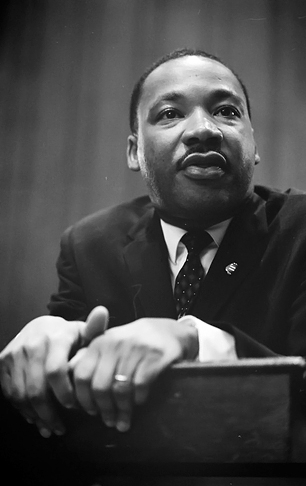
Dr. Martin Luther King, Jr (BuyenLarge/Getty Images)
I was surprised by his assassination. I didn’t see the Poor People’s Campaign as the threat to Washington and the Establishment that I now see it was. We feared for Dr. King’s life more in the early Sixties, through 1963, than we did by 1968. Up through 1965, there was a civil-rights-related death every couple of months, though most of them didn’t make headlines. By the end of ’65, there was a lull in the killings, and I thought perhaps we were finally beyond all that.
In his last year, we worried about Dr. King’s health. He was working eighteen to twenty hours a day. He would stay up all night reading, talking, clowning – whatever he felt like doing – and then wake up at five-thirty raring to go. His wife used to say that he had a war on sleep.
We would tell him that it looked like he was going to be around for a long time, and he couldn’t possibly keep this pace up, because he was close to forty. But if you said anything, he’d brush you off. I could never argue with him anyway. He was a preacher. And whenever we argued, he’d get to preaching. You never won an argument because he would take off on flights of oratory, and you’d forget your point trying to listen to him.
The year he died was the year he felt he had to establish the agenda for America’s future. For fifteen years he’d been struggling with the issues of racism, poverty and war. He refused to be just a civil rights leader. He was a sensitive lover of people who saw his primary responsibility in the black community. By 1968, though, it was clear to him that the black community could not concern itself with civil rights issues alone. The country was spending billions of dollars in Vietnam, and he saw racism and war becoming ever more tied up into one big problem for this country.
It was a time of increasing desperation for him. The SCLC had a fraction of the budget it should have had, about $700,000, and a small staff of fifty people, trying to take on the problems of the urban North, as well as the South, which still had large pockets of resistance. Not only weren’t we getting any aid from the federal government, but we had legions of FBI agents tracking us down, harassing us, trying to disrupt the work we were doing – work which I thought was the only thing that was giving America a fighting chance to survive.
The dangerous times when we were together were always the times he was most humorous. For years we couldn’t go anywhere without FBI men following us around. Dr. King was philosophical about it and very friendly toward them. Every now and then, we would leave a meeting through another entrance – not to escape the car that trailed us, but to sneak up on them. Dr. King would say hello, introduce us and (we always gave them the benefit of the doubt) thank them for the “protection” they were giving us.
I think he would have been quite content to be pastor of the Riverside Church, maybe teach at a university or a seminary. He wanted to teach the philosophy of religion, which was the subject of his Ph.D. He turned down a chance for the presidency of the NAACP when he first came to Montgomery in 1954, because he wasn’t sure he wanted to become that involved in the growing civil rights movement.
But when the bus boycott came in ’55, he was pressed into action. He had to respond. He was just twenty-six, and he never had the time to be the fun-loving man that he really was. He made the cover of Time magazine only a couple of years after he finished his degree, and then he was a celebrity.
From that time on he felt the burden of the country, his people and the world on his shoulders. He accepted it, but he always said he would have liked to do something else. He felt responsible for America’s future and its survival because he said that nobody understands nonviolence except black Americans, and if America was going to learn to live with the rest of the world, we’d have to help her find a nonmilitary course. In his Nobel Peace Prize speech, in fact, Dr. King said that the choice was nonviolence or nonexistence. I think back sometimes to what this country would have been like without Dr. King. The South was an armed camp in the Forties and Fifties. The GI bill and better job opportunities had created the beginnings of a black middle class, and they were not going to tolerate oppression any further. The white forces of reaction were trying to resist the advance of this new black middle class.
Every black family in the South had a gun. My father was probably the least violent man I know, and yet there were at least four guns in our household. Had there been no Martin Luther King Jr., the southern part of the United States would have looked like Northern Ireland or Lebanon.
And yet Martin saw that blacks and whites did not hate each other. They were being forced down through history on a collision course. Martin Luther King straightened out that course. He made it possible for blacks and whites to move in a parallel course of development and work together by using the tactic and methodology of nonviolence. He did not blame the white man for the problems that blacks were having. He saw blacks and whites caught up in a situation that they didn’t create, that they inherited. He saw nonviolence as a means for bringing people to realize that they could work their way together out of the situation.
Dr. King never understood why J. Edgar Hoover couldn’t comprehend what he was doing. If you read Hoover’s FBI reports on the March on Washington speech, you realize that he never saw Dr. King’s vision of a New America. He saw a powerful, radical political voice trying to destroy the nation.
I didn’t know then, but I now think that there lies the indirect responsibility for his assassination. I don’t know if it can ever be pinned down, but there are so many client groups that did dirty jobs around and for official people. I think now that Dr. King’s assassination was directly related to the fear that officialdom had of his bringing large numbers of poor people to the nation’s capital, setting up tents, demanding some response from them.
By: Andrew Young, Rolling Stone, January 13, 2012. (This story is from the December 1, 1977 issue of Rolling Stone). Writing in 1977, the famed civil rights activist Andrew Young reflects on the life and legacy of Martin Luther King.
Share This Blog


 Unknown Feed
- An error has occurred; the feed is probably down. Try again later.


You must be logged in to post a comment.