Pragmatic Policy vs Ideological Philosophy
For some time now, Democrats and Republicans alike have been yearning for a great philosophical clash between the two parties. No more of this five percent of 12 percent of the federal budget stuff. We wanted entitlements, the role of government, the obligations that the old have to the young, that the rich have to the poor, that the powerful have to the powerless.
Paul Ryan’s budget offer exactly that sort of reconstruction of the social compact. America is a very different place before his budget than it would be after his budget. But though Obama’s speech was closer to that sort of clash of visions than anything he’s offered before — he used the word “vision” 15 times, for instance — what he offered was not philosophy. It was policy. But you have to read it closely — and know where it came from — to see that.
This is difficult advice when it comes to deficit reduction, but don’t look at the number. This plan cuts $4 trillion, that plan cuts $2 trillion, that one cuts $10 trillion. Those numbers reflect little but the internal hopes and dreams of the plan. If I say that my plan means Medicare will never spend another penny and economic growth will shoot to 8 percent — and that’s only a shade less optimistic than the assumptions and models included in the Ryan budget (pdf) — I can save an almost unlimited amount of money. My number can be anything I want it to be. The problem is I actually can’t save that much money because my math is based on fantasy. So my number is meaningless.
President Obama says his plan cuts $4 trillion over 12 years. Rep. Paul Ryan says his plan cuts $4 trillion over 10 years. If you look at the numbers, the two plans appear quite similar. But if you look at how they’d get to the number, they couldn’t be more different. And it’s how you get to the number that matters, because that’s what decides whether you’ll get to the number. It’s also, incidentally, what decides the shape of our government going forward.
Ryan’s number is the product of holding the growth of Medicare and Medicaid to the rate of inflation, which is far lower than has ever been shown to be possible. How he gets there is, on Medicaid, he tells the states to figure it out, and on Medicare, he tells seniors to figure it out. Both strategies have been tried: Various states have gotten waivers to radically remake their Medicaid program, and the consumer-driven model that Ryan is proposing for Medicare has been attempted in the Federal Employee Health Benefits Program and Medicare Advantage. None of these programs have worked, which is why we’re in our current predicament.
Obama’s number is the product of holding Medicare growth to GDP+0.5 percent — which is, in practice, a few percentage points beyond inflation, and a few percentage points behind the health-care system’s normal rate of growth. He mostly gets there through the cost controls passed as part of the Affordable Care Act, which hope to hold Medicare to GDP+1 percent. He then proposes to shave a further half-percentage point off the growth rate by introducing value-based insurance — where we pay more for treatments that are proven to work than for treatments that are not proven to work — into Medicare and giving generic drugs quicker entry into the marketplace. These programs have worked at smaller scales and in more limited pilots. We don’t know if they’ll work across the entire Medicare system, but we have reason to think they will.
Then there are taxes. Ryan’s plan pledges to make the Bush tax cuts permanent, at a cost of at least $4 trillion over 10 years, and more after that. He’d then clean out the tax code, but he’d pump the money he made from closing expenditures back into tax cuts. Obama proposes to return to the Clinton-era tax rates on income over $250,000 and then raise a further trillion through closing tax expenditures. Altogether, that’s about $2 trillion less than letting all the Bush tax cuts expire, but at least $2 trillion more than Ryan’s plan. Notably, Obama hasn’t said which expenditures he’d close to get to $1 trillion. The difference between the two tax plans — particularly when added to Obama’s decision to cut $400 billion from security-related spending, while Ryan largely exempts that category — explains why Obama doesn’t have to make such deep cuts in programs for seniors and low-income Americans.
So are we finally getting the grand philosophical debate we wanted? Not quite. Obama spoke extensively of vision — the GOP’s, which “claims to reduce the deficit by spending a trillion dollars on tax cuts for millionaires and billionaires … {while} asking for sacrifice from those who can least afford it and don’t have any clout on Capitol Hill,” and his, “where we live within our means while still investing in our future; where everyone makes sacrifices but no one bears all the burden; where we provide a basic measure of security for our citizens and rising opportunity for our children,” but he’s overselling it.
Obama’s budget is not philosophy. It is very similar to the Simpson-Bowles report, which attracted the votes of Republicans as far to the right as Tom Coburn. Few Democrats would say their vision of balancing the budget is one in which there was only one dollar of new taxes for every three dollars of spending cuts, but that’s what Obama’s proposal envisions. Obama’s budget, somewhat curiously, is what you’d expect at the end of a negotiation process, not the beginning. In fact, as it’s modeled off of Simpson-Bowles, it is the product of a negotiation process, as opposed to an opening bid. It is, in other words, policy. You could argue that this is a philosophy, and that philosophy is pragmatism, but I think that’s getting too cute. This is the sort of policy that might pass and might work.
Ryan’s budget is purer, but it is also more fantastical. It posits the government it wishes were possible, and the policies it wishes would work. It is an opening bid so ideological that it leaves little room for a process of negotiation. Every dollar it purports to raise comes from cutting spending. Not one comes from taxes. It privatizes Medicare and unwinds the federal government’s role in Medicaid. For all the philosophy in his budget — and his budget does have a very different philosophy about the proper role of government than we see in federal pllicy today — there’s neither policy that could pass nor policy that could work. And, curiously for a conservative who distrusts both government and congress, it has no answer to the question of “what if this fails?”
The policy that clarifies this difference is the “trigger.” Obama’s budget, aware that it might not pass and, if it does pass, it might not work, proposes to make automatic cuts to discretionary spending and tax expenditures if the promised savings don’t materialize. If Ryan’s budget falls shorts, there’s no comparable failsafe. That is to say, Obama’s budget has two plausible ways to get to its number, while Ryan’s budget has none. You don’t need a PhD in philosophy to understand why that’s a problem.
By: Ezra Klein, The Washington Post, April 13, 2011
America Is Suffering The Effects Of Short-Sighted GOP Policies
I spent much of last week in a hospital in Cincinnati with my dad. He has Parkinson’s disease, which sucks. He’s home now, with my mom, brother, and sister doing all they can to care for him. And it hit home for me that we are living not only with the consequences of a horrible disease, but also with the consequences of decisions made in Washington over the last 10 years.
Where would we be with Parkinson’s treatment if George Bush hadn’t banned federal funding of embryonic stem cell research for eight precious years? A hell of a lot further along than we are.
Would my parents, a retired educator and a small businesswoman, be struggling to pay tens of thousands of dollars in out-of-pocket prescription drug costs if back in the ’90s Republicans had allowed Medicare to negotiate drug prices? Nope.
Would their retirement savings and those of millions of others have been hit so hard by the economic collapse if there had been meaningful regulation of Wall Street? No.
You really don’t need a crystal ball to see the future. Usually a rear view mirror will do just fine. We know what shortsighted Republican policies have done to this country. The Bush years are America’s own lost decade. For my parents, these losses are profound and personal, as they are for millions of others.
Now Republicans seem determined to make this yet another decade when America treads water or risks sinking further.
Right now, Republicans are blocking any meaningful effort to reduce our dependence on foreign oil and stop climate change in order to protect big oil and some big business.
Right now, while middle class families struggle mightily, Republicans are all about the mighty–going to the mat to preserve tax breaks for the wealthy and loopholes that let corporations pay literally zero taxes.
Right now, budget cuts are being demanded that will provide fewer children with Head Start, cut college loans, and gut Social Security and Medicare.
And right now, somewhere in America, a husband, a father, a mother, a wife is being told they have Parkinson’s. President Obama lifted the Bush ban soon after taking office, but we’ll never get those eight years back. For many of those suffering with Parkinson’s and other diseases that stem cell research could help, the stroke of George Bush’s pen signed away a measure of hope.
Past is precedent. We know our dependence on oil is killing us, so let’s start doing what we must now to end it. We know what happens in the future when kids get shut out of Head Start now, so let’s not do it. We know tax breaks for large corporations and the wealthy won’t strengthen the economy (we’ve tried that), so let’s repeal them. We know Social Security and Medicare will continue to be lifelines for millions, so let’s not cut them.
The hard-won historic change of the last two years has only just begun to undo the damage of the preceding eight. There is no turning back. We haven’t got a decade to lose. Because we know the wrong policies have real casualties.
My dad is one of them.
By: Greg Pinelo, U.S. News and World Report, March 31, 2011
The Real Threat to Health Care Reform….It’s Not The Supreme Court
Will the Supreme Court overturn the part of the health-care law that penalizes people who don’t buy insurance for themselves? A few months ago, the answer that experienced Court-watchers gave was “not a chance.” Orin Kerr, a law professor at George Washington University who once clerked for Justice Anthony Kennedy, said “there is a less than 1 percent chance that the courts will invalidate the individual mandate.” Now, the best we can say is, who knows?
As Slate’s legal columnist Dahlia Lithwick has said, the conventional wisdom has turned sharply. “Today,” she writes, “it is an equally powerful article of faith that everything rests in the hands of Justice Anthony Kennedy in what will surely be a 5-4 decision.”
That could mean we were wrong a few months ago, or it could mean we’re wrong now. But it doesn’t matter. Replacing the individual mandate wouldn’t be particularly hard. All we need is another policy that does the same thing – specifically, discourage free-riders who don’t want to buy insurance until after they get sick and thus leave the rest of us paying for them.
In fact, I can give you four credible alternatives in four sentences:
We could limit enrollment changes to once every two years, so people who decide to go without insurance can’t buy coverage the moment they get a bad report from their doctor.
We could penalize those who wait to buy coverage with higher premiums, which is what we do in the Medicare Prescription Drug Benefit.
We could have a five-year lockout, in which people who decide to go without coverage wouldn’t be able to access the subsidies or insurance protections for five years, even if they decided they wanted to buy insurance.
We could raise taxes by the same amount as the individual mandate penalty and give everyone who showed proof of insurance on their tax forms a “personal responsibility tax credit” of the same amount.
But all these ideas suffer the same problem: They’d need to pass through Congress. And Republicans in Congress don’t want to make the Affordable Care Act better. They want to repeal it.
This – and not the Supreme Court, or even any flaws in the design of the bill – is the real problem for the Affordable Care Act. Like any major piece of legislation, parts of it will work much better than we expect, and parts of it will disappoint us. Perhaps the experiment with paying hospitals a flat fee to treat a patient’s diabetes will prove a smashing success, leading to lower costs and higher-quality care. And perhaps the provision allowing individuals to publicly rate their insurers will prove a disaster, with companies paying the computer-savvy to rig the ratings.
In that world, the answer would be obvious: Expand the good and repeal the bad. Indeed, we should expect to do this over and over again. We’ll constantly need to double down on what works, remove what doesn’t, and add new ideas and refinements into the mix. Policymakers are never omniscient, but they are, at their best, persistent. And that’s how we’ll move from the inefficient and expensive health-care system we have to the efficient and affordable system we want: one tweak at a time.
That assumes, however, that both parties’ top priority is to get from the system we have to the system that the Affordable Care Act suggests we want: a system with lower costs and near-universal care. But is it?
Increasingly, it seems not. The Democrats have a deep and longtime commitment to health-care reform, one they’ve proven by moving continually right on the issue in a fruitless search for bipartisan support. They’ve given up on single-payer, on an employer mandate, on a public option. And they adopted the same structure that Mitt Romney signed in Massachusetts and that Republicans called for in 1994.
Republicans, meanwhile, have proven deeply and continually committed to opposing health-care reform bills pushed by Democrats. They abandoned Richard Nixon’s idea when Bill Clinton adopted it and Romney’s idea when President Obama endorsed it. In the most recent election, they ran on “repeal and replace,” but when they got to Congress, they voted on a bill that included the “repeal” but was silent on the “replace.” Even now, they’ve done nothing more than vaguely direct some committees to come up with some unspecified ideas at some unnamed date in the future.
Their inattention to “replace” is evidence that their top priority is “repeal.” But they don’t have the votes to repeal the bill. They might not have the votes to repeal it after 2012, either. But so long as they’re telling their base that they will repeal it, if not today then soon, they can’t participate in any significant reforms of the bill, as improving the legislation tacitly accepts its existence. “I think it’s clear that this is an area upon which we are not likely to reach any agreements with the president,” Senate Minority Leader Mitch McConnell told conservative radio host Laura Ingraham.
Democrats, meanwhile, aren’t becoming any friendlier to the GOP’s repeal efforts. Of the 13 House Democrats who voted against the law and survived the election, only three voted with the House Republicans to repeal the bill. In the Senate, not a single Democrat voted for repeal.
This raises the possibility that Congress will neither repeal the legislation nor commit itself to its success. Rather, Republicans will work to hobble it where they can, starving the law of the funds needed for its implementation, harassing the regulators charged with setting it up and stopping Democrats from improving on the law’s successes or responding to its inevitable failures. Democrats will work to ensure that the law survives, but they won’t have the votes to do much more than that.
Wounded, the law will limp along, protected from dying and prevented from thriving.
By: Ezra Klein-The Washington Post, February 8, 2011
Health Reform at Work Today and Tomorrow: Improvements That Began Last Year Will Continue
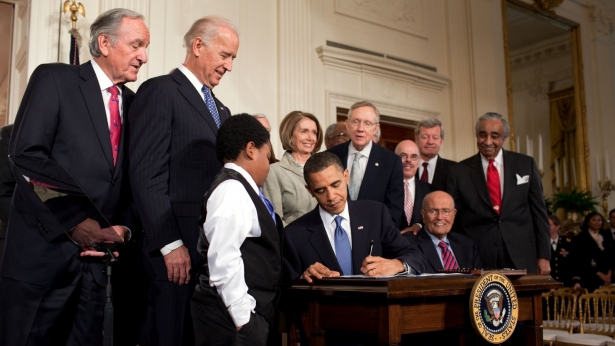
President Barack Obama is applauded as he signs the health care reform bill, on March 23, 2010, in the East Room of the White House in Washington. The bill includes many benefits for Americans who have health insurance today and those who have struggled to find and maintain health coverage.
2010 was a momentous year for the American health care system. In March, Congress passed—and President Barack Obama signed—landmark legislation that reforms the health insurance market, provides all Americans with affordable access to health coverage, and reduces the growth of health care costs.
The Department of Health and Human Services and other parts of the executive branch have begun to implement the new law in the subsequent 10 months. The Affordable Care Act, or ACA, includes many benefits for Americans who have health insurance today and those who have struggled to find and maintain health coverage. Many of these benefits came on-line in 2010.
Signature achievements include:
- Establishing pre-existing condition insurance plans in every state so that individuals with health problems who cannot find coverage in the regular market have a reliable source of coverage
- Requiring employer-sponsored health plans to offer coverage to the young-adult children of policyholders
- Helping employers with unpredictable health care spending for retired workers
- Providing more than 1 million rebate checks to Medicare enrollees who incurred high out-of-pocket prescription drug spending in 2010
- Prohibiting health insurance plans from denying coverage to children with pre-existing conditions
- Protecting individuals with high health care costs from the financial risk of absurdly low annual and lifetime limits on their benefits
- Prohibiting health insurance plans from rescinding coverage when a policyholder gets sick
These changes bring a new degree of stability and security to millions of Americans’ health coverage. And even more improvements are around the corner. Beginning this month, seniors will enjoy meaningful new benefits and significant improvements in their prescription drug coverage, while individuals and businesses will receive premium rebates from their insurance company when the insurers incur excessive administrative costs.
Specific improvements in 2011 include:
- Closing the Medicare prescription drug coverage gap. Seniors and people with disabilities who obtain prescription drug coverage through Medicare Part D will enjoy a new discount on brand-name and generic prescription drugs when they hit the so-called “doughnut hole” in their Part D benefits. Since the beginning of the program, enrollees have hit a gap in coverage when their total drug spending—including out-of-pocket costs and expenses covered by their Medicare Part D plan—exceeds a preset limit (currently $2,830). Patients then pay the total cost of their prescription drugs, without help from their drug plan, until their total drug expenses hit an upper limit and coverage kicks in again. With the new discount, people with drug spending high enough to hit the coverage gap will save almost $500 on average this year, while people with very high drug costs will save more than $1,500.
- Launching new prevention benefits for Medicare enrollees. Good coverage of preventive services helps seniors and other Medicare enrollees better manage their health. New benefits include coverage without cost-sharing for recommended preventive services (those that receive an “A” or “B” rating from the U.S. Preventive Services Task Force) and new coverage for a personal prevention plan.
- Increasing access to primary care. Medicare will pay primary care providers a 10 percent bonus payment, which offers a new incentive for physicians, nurses, and others to provide primary care services.
- Requiring insurers to provide high value for premium dollars. Beginning in 2011, insurers will pay rebates to policyholders—individuals and employers—when plan spending on clinical services falls below 80 percent of premium revenue in the individual and small group market, and 85 percent of premium revenue in the large group market.
Looking ahead, ACA provisions that will touch real people every day will continue coming on-line through 2011. These include providing more consumer information on healthy food choices by requiring chain restaurants and vending machines to provide nutritional data no later than March, and improving long-term care by sending enhanced federal Medicaid payments to support new state investments in community-based long-term care services starting in October. Tangible improvements will continue beyond this year, such as fully closing the coverage gap in Medicare Part D and improving Medicaid coverage for preventive care.
The Affordable Care Act’s most striking impact will come in 2014 when new health insurance exchanges launch, premium subsidies become available, and Medicaid coverage expands to include all low-income individuals regardless of family composition, age, or disability status.
These headline-grabbing changes in our health care system may be a few years down the road. But millions of Americans are already benefiting from the Affordable Care Act—and millions more will receive better care in the near future thanks to the changes in the new law.
By Karen Davenport | January 13, 2011-Center For American Progress. Photo: AP/Charles Dharapak
Share This Blog


 Unknown Feed
- An error has occurred; the feed is probably down. Try again later.
 mykeystrokes.com
You must be logged in to post a comment.