Donald Trump’s Not So Great Relationship With “The Blacks”
In an episode early in Donald Trump’s career, his New York real estate company was sued by the federal government for discriminating against potential black renters. After a lengthy legal battle, it ultimately agreed to wide-ranging steps to offer rentals to nonwhites.
The little-remembered case provides crucial context for the current discussion centering on Trump and race. The celebrity businessman made news last month when he declared, “I have a great relationship with the blacks. I’ve always had a great relationship with the blacks.”
He has recently come under fire for attacks on President Obama that critics have described as racially tinged. CBS anchor Bob Schieffer, for example, said Wednesday there is “an ugly strain of racism” in Trump’s recent (baseless) accusations that President Obama should not have been admitted to Columbia. Also yesterday, Trump told a black reporter, unprompted, “Look I know you are a big Obama fan.”
The discrimination case began in the earliest days of Trump’s career, when he was still in his 20s.
Fred Trump, Donald’s father, was, unlike his son, a self-made man. He made his fortune by building thousands of units of middle-class housing in Brooklyn and Queens. But in the early 1970s, Donald was made president of the family company.
One of Donald’s first challenges came in October 1973, when the Justice Department hit the Trump Organization with a major discrimination suit for violating the Fair Housing Act. The Times reported:
… the Government contended that Trump Management had refused to rent or negotiate rentals “because of race and color.” It also charged that the company had required different rental terms and conditions because of race and that it had misrepresented to blacks that apartments were not available.
The journalist Gwenda Blair reported in her 2005 Trump biography that while Fred Trump had sought to combat previous discrimination allegations through “quiet diplomacy,” Donald decided to go on the offensive. He hired his friend Roy Cohn, the celebrity lawyer and former Joseph McCarthy aide, to countersue the government for making baseless charges against the company. They sought a staggering $100 million in damages.
A few months after the government filed the suit, Trump gave a combative press conference at the New York Hilton in which he went after the Justice Department for being too friendly to welfare recipients. He “accused the Justice Department of singling out his corporation because it was a large one and because the Government was trying to force it to rent to welfare recipients,” the Times reported. Trump added that if welfare recipients were allowed into his apartments in certain middle-class outer-borough neighborhoods, there would be a “massive fleeing from the city of not only our tenants, but communities as a whole.”
A federal judge threw out Trump’s countersuit a month later, calling it a waste of “time and paper.”
Writes Blair in her book:
Donald testified repeatedly that he had nothing to do with renting apartments, although in an application for a broker’s license filed at the same time he said that he was in charge of all rentals.
In 1975, Trump ultimately came to a far-reaching agreement with the DOJ in which he and the company did not admit guilt but agreed not to discriminate and to take steps to open its housing stock to more nonwhites. The company agreed to submit a weekly list of vacancies to the Urban League, which would produce qualified applicants for a portion of all vacancies.
But it didn’t end there. In 1978, the government filed a motion for supplemental relief, charging that the Trump company had not complied with the 1975 agreement. The government alleged that the Trump company “discriminated against blacks in the terms and conditions of rental, made statements indicating discrimination based on race and told blacks that apartments were not available for inspection and rental when, in fact, they are,” the Times reported. Trump again denied the charges.
It’s not clear what happened with the government’s request for further action (and compensation for victims), but in 1983, a fair-housing activist cited statistics that two Trump Village developments had white majorities of at least 95 percent.
At the very least, the case is something for reporters to ask about next time Trump touts his “great relationship with the blacks.”
By: Justin Elliott, Salon War Room, April 28, 2011
Changing Demographics: The GOP’s Census Problem
When the Census released its reapportionment totals in December, much of the focus was on the new seats in red states, and how it was a good thing for Republicans.
The data released by Census on Thursday, though, shows how those same population shifts are creating new challenges for the GOP.
While much of the shifting population is moving to red states, there is increasing evidence that it’s making those red states bluer, and most of the demographic trends are heading in Democrats’ direction.
Census Bureau director Robert Groves summed it up best Thursday: “We are increasingly metropolitan today, our country is becoming racially and ethnically more diverse over time … and geographically, there are a lot of areas of the country growing in number that have large minority populations.”
All three of those things suggest growing Demcoratic constituencies. Let’s look at each individually:
* The country is getting less rural: While 82.8 percent of the population in 2000 lived in metropolitan areas, that number is now 83.7 percent. A look at population changes county-by-county shows that many rural counties, especially in the solidly Republican middle of the country, actually experienced population loss over the last decade, while most of the big population growth was near big cities, where Democrats dominate.
* The country is getting more diverse: The minority population has increased dramatically to 36.3 percent and will only keep going down that path, as only a slight majority of U.S. children are white. And Republicans have major problems with minority populations. The black vote generally goes almost completely for Democrats, and even in the GOP wave in 2010, six in 10 Hispanics voted Democratic.
* The areas that are getting bigger are Democratic: A look at the states with the biggest growth over the past decade shows many of them have moved toward Democrats, including Nevada, North Carolina and Virginia (Obama was a surprise winner in all three, which had gone for President Bush in 2004). A look at the county-by-county growth in these states shows that the growth is focused in urban and Democratic areas — Las Vegas-based Clark County, Charlotte-based Mecklenburg County and the Research Triangle in North Carolina, and Northern Virginia all grew the fastest. That suggests that the growth is occuring in Democratic areas.
Now, just because Democratic-leaning demographics grow doesn’t necessarily mean Democratic voters will be created. For all we know, rural Republicans are moving into the city and making them redder.
But if Republicans want to compete in the decades to come, they need to be able to compete in metropolitan areas — likely by reasserting their dominance in the suburbs — and also be able to woo Hispanics, who now account for one in six people in the United States.
If they can’t, the demographics are just going to make it harder and harder.
By: Aaron Blake and Chris Cillizza, The Washington Post, March 25, 2011
What Does The Tea Party Want?….The New Litmus Test
Jim VandeHei and Mike Allen argue that the Tea Party redefined the purpose of the GOP as opposition to spending:
The Republican Party is undergoing a messy but unmistakable 20-month transformation from fanatically anti-Obama to fanatically anti-spending, providing top party officials a new and intriguing playbook for recapturing the White House in 2012.
To understand the current evolution, flash back to late spring of 2009. The GOP was disoriented and adrift, its leadership void filled by the bombastic voices of Palin, Beck and Rush Limbaugh. There was no common conservative cause, beyond fear and loathing of Obama. No wonder swing voters were so down on them.
But the tea party, treated at first by the media as exotics, forced Republicans to focus almost exclusively on the size of government. By the time the 2010 elections rolled around, tea party activists and most independent voters were completely aligned on the need to cut, cut, cut.
Midterm election results showed that this approach offers the GOP its best – and maybe only – hope of keeping the interests of independents and tea party activists aligned enough to beat Obama.
The new litmus tests for GOP presidential hopefuls are support for repealing “Obamacare” and taking a cleaver to government spending. If a presidential candidate could harness the smaller-government conservatism, temper it enough to avoid a blatant overreach and articulate a vision for a prosperous future for the country, it’s not hard to imagine swing voters finding such a person appealing.
There’s a superficial appeal to this story. But the evidence that Tea Party activists want to cut spending — at least actual spending programs — is sparse. Polls show that Tea Party supports overwhelmingly oppose cuts to Social Security and Medicare. The main thrust of Tea Party opinion is not the belief that Obama has spent too much money, but the belief that Obama has spent too much money on people unlike them:
More than half say the policies of the administration favor the poor, and 25 percent think that the administration favors blacks over whites — compared with 11 percent of the general public.
They are more likely than the general public, and Republicans, to say that too much has been made of the problems facing black people.
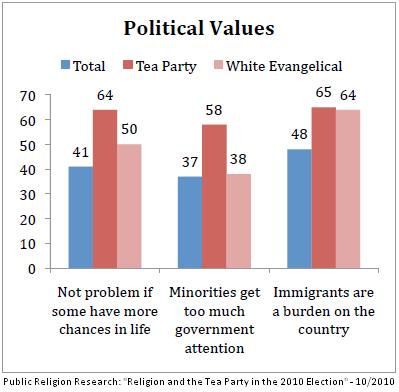
Here’s another cut, showing the Tea Party’s greater comfort with inequality of opportunity and stronger belief that the government devotes too many resources to minorities:
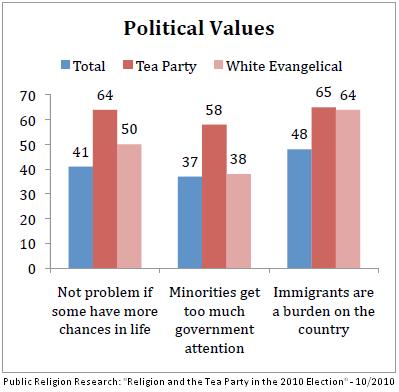
It’s a revolt against the composition of government much more than the level.
Now, it’s true that Republicans aren’t exactly translating this blueprint into action, but they’re not exactly flouting it, either. There is always a generalized antipathy toward spending amongst Republican and swing voters, but it disappears when the subject turns to actual government programs. Usually Republicans decide to just cut taxes for the rich instead. Here’s is the one part of the article proposing a defined policy change:
Even Ralph Reed, the Republican operative most tapped in to evangelicals, reflected the new GOP mindset when he gave this surprising wish list for the next presidential race: “In a perfect world, I’d like to hear the Republican nominee run on a platform that takes the capital gains tax to zero over five years.” Reed, who summoned several of the presidential candidates to Iowa for his Faith & Freedom Coalition this week, made it clear that Christian conservatives will still need to be catered to, but added that his side will understand the nominee’s need to focus on swing voters.
So an article putatively about the GOP redefining itself as an anti-spending party has one actual programmatic detail, and it’s: a zeroing out of the capital gains tax. In the name of appealing to swing voters — who, in fact, oppose tax cuts for the rich. Meet the new boss…
By: Jonathan Chait, The New Republic, March 14, 2011
Repeal, Restrict and Repress: GOP Running Amok
Republican state lawmakers, emboldened by their swollen ranks, have a message for minorities, women, immigrants and the poor: It’s on!
In the first month of the new legislative season, they have introduced a dizzying number of measures on hot-button issues in statehouses around the country as part of what amounts to a full-throttle mission to repeal, restrict and repress.
It wasn’t supposed to happen like this.
As Reuters pointed out this week, in the midterms, “Republicans gained nearly 700 state legislative seats and now have their largest numbers since the Great Depression, according to the National Conference of State Legislatures.”
Judging by the lead-up to those elections, one could have easily concluded that the first order of business on Republicans’ agendas would be a laserlike focus on job creation and deficit reductions to the exclusion of all else. Not the case.
As MSNBC and Telemundo reported recently, at least 15 state legislatures are considering Arizona-style immigration legislation. If passed, four of the five states with the largest Hispanic populations — California, Texas, Florida and Arizona — would also be the most inhospitable to them.
As Fox News Latino recently reported, state legislatures are poised to break the record on the number of immigration measures and resolutions introduced this year, having already introduced 600 by the end of last month. For comparison, 1,400 were introduced in total last year, according to a report issued last month by the state legislatures’ group. A record number of those laws were enacted.
And, according to the State Legislators for Legal Immigration, which was founded by State Representative Daryl Metcalfe, a Republican of Pennsylvania, lawmakers from 40 state legislatures have joined the group that last month unveiled “model legislation to correct the monumental misapplication of the 14th Amendment of the U.S. Constitution.”
On another note, Republicans in Kentucky, Missouri, Nebraska and Oregon are pushing legislation that would require drug testing of welfare recipients.
This despite the fact that, as the American Civil Liberties Union rightly pointed out, the policy is “scientifically, fiscally, and constitutionally unsound.” Other states have considered it but deemed it not feasible or impractical. In Michigan, the only state to implement it, only a tenth of those tested had positive results for drugs and only 3 percent had positive results for hard drugs, which the A.C.L.U. points out is “in line with the drug use rates of the general population.”
Most importantly, the Michigan law was struck down as unconstitutional, with the judge ruling that the rationale for testing people on welfare “could be used for testing the parents of all children who received Medicaid, State Emergency Relief, educational grants or loans, public education or any other benefit from that state.”
Despite all this, these states are pushing ahead because the made-for-the-movies image of a crack-addicted welfare queen squandering government money on her habit is the beef carpaccio of red meat for spending-weary, hungry conservatives.
On the gay rights front, Republicans in Iowa, Indiana, West Virginia and Wyoming (where Matthew Shepard was tortured to death) are pushing constitutional amendments to ban same-sex marriage.
Republican Rick Snuffer, a freshman delegate from Raleigh, W.Va., turned logic on its head when arguing for that state’s amendment. He chided Democrats’ pro-choice position, and reasoned that, “They don’t want you to choose your definition of marriage, so they’re not really pro-choice. If they’re pro-choice, let the people choose their definition of marriage.” So let me get this straight. To be pro-choice, one has to submit to the tyranny of the majority, which may seek to restrict the rights and choices of others?
This is exactly the kind of thinking that the shapers of the Constitution worried about. A quick read of the Federalist Papers would help Mr. Snuffer understand just how concerned they were about the danger posed by majority rule to personal freedom.
Republicans in New Hampshire have filed bills to overturn that state’s same-sex marriage law, even though, according to a recent WMUR Granite State Poll, the state’s residents want to leave the law in place by a majority of more than 2 to 1, and when asked which were the most important issues the State Legislature should address, “almost no one mentioned dealing with hot-button social issues such as gay marriage or abortion.” I guess that “let the people choose” argument only works when the people agree with the Republican position.
A Republican state representative in Utah has even gone so far as to introduce a bill that would bar same-sex couples from drafting wills.
According to The News and Observer in North Carolina, Republicans are considering severely narrowing or repealing the state’s recently enacted Racial Justice Act, which allows death-row inmates to use statistics to appeal their cases on the basis of racial discrimination.
Two studies of the death penalty in the state have found that someone who kills a white person is about three times as likely to be sentenced to death as someone who kills a minority.
And in Wisconsin, Republicans are pushing a bill that would repeal a 2009 law that requires police to record the race of people they pull over at traffic stops so the data could be used to study racial-profiling.
Furthermore, abortion rights advocates are now bracing for the worst. NARAL Pro Choice America is now tracking 133 proposed bills thus far this legislative season, and that’s just the beginning. Donna Crane, the policy director of the group, said earlier this month that thanks to the gains by conservatives in the Nov. 2 election, “2011 will be a banner year for anti-choice legislation in the states.”
Richard Gephardt once said, “Elections have consequences.” He was right, and the consequences of the last election could well be a loss of liberty, choice, access and avenues of recourse for many. Brace yourselves. It’s on!
By: Charles M. Blow, Op-Ed Columnist, The New York Times-February 11, 2011
How Conservative Attacks on Health Care Reform Will Affect You
Attempts to Repeal Affordable Care Act Have Serious Consequences
The Affordable Care Act provides Americans economic and health security with protections against exorbitant premium hikes, better health benefits, and slower growth in health care costs. Conservatives in the Congress are intent on taking these benefits away.
Conservatives are starting to implement their onslaught to repeal the Affordable Care Act this week as Republicans take control of the House of Representatives. They have scheduled a vote on January 12. If conservatives have their way and repeal the Affordable Care Act, we will go back to a health care system that failed millions of Americans: one with skyrocketing costs bankrupting families and our budget, fewer people with access to quality care, and more people at the mercy of the health insurance industry.
Increasing premiums for millions of Americans. Prior to passage of the Affordable Care Act, individuals and families were faced with skyrocketing premiums. Premiums for individuals increased 120 percent and family premiums increased 130 percent from 1999 to 2009. The Affordable Care Act controls these costs. In fact, the nonpartisan Congressional Budget Office or CBO looked at the law’s effect on premiums in 2016 and estimated that the health reform law would cut premiums for millions of Americans. These premiums cuts would be more substantial for those in the individual market, most of whom will receive subsidies to help cover the cost. According to the CBO, those receiving help in the individual market would see their premiums reduced by 56 percent to 59 percent less than they would pay without the law, while also enjoy better coverage than what they currently receive. Repealing the law means going back to a status quo of skyrocketing premiums that made health insurance out of reach and unaffordable for American families.
Costing 400,000 jobs annually. The Affordable Care Act helps create as many as 400,000 jobs annually over the next decade by lowering costs and helping promote a healthier workforce. It includes cost-containment measures to slow the rate of growth of health care spending. Small businesses in particular are helped through exchanges that allow them to pool resources to lower costs as well as tax credits to make it more affordable to offer their employees health coverage. These cost-reduction provisions free up money that otherwise would be spent on health care and allow companies to spend it hiring more workers. In addition, a healthier workforce is a more productive workforce. Those benefits disappear, as well as the jobs created along with it, if the law is repealed.
Increasing costs for seniors by as much as $1,500 in 2011. The Affordable Care Act eliminates the “donut hole” in the Medicare prescription drug program by 2020. Seniors with high prescription drug expenses before health reform had to pay full price for their prescription drugs—without any help from their drug plan—once their prescription drug spending reached a pre-defined limit. People who hit this limit in 2011 will get a 50 percent discount on their name-brand prescription drugs, saving some Medicare enrollees as much as $1,500 in out-of-pocket drug costs. Those savings will not be realized if the Affordable Care Act is repealed.
Hurting communities of color. Communities of color are more likely to be uninsured, and they suffer from higher rates of chronic illness than the rest of the population. The Affordable Care Act addresses these inequities by expanding health insurance coverage and improving access to primary care, including preventive services. These provisions will be eliminated if conservatives have their way and repeal the health reform law.
Increasing costs and deficits. The Affordable Care Act creates tools to control the growth in health costs while improving quality of care. Effective implementation can reduce administrative costs for small businesses and individuals, promote greater use of preventive care, and prevent unnecessary hospitalizations, saving as much as $2 trillion in total health spending over the next decade. In addition, the CBO estimated the law will reduce the federal budget deficit by $143 billion over the first 10 years and more than $1.2 trillion over the next two decades. Repealing the new law stymies these much-needed efforts and reverts to the unsustainable status quo of skyrocketing costs that were bankrupting our country. Make no mistake: The Affordable Care Act provides Americans economic and health security with protections against exorbitant premium hikes, better health benefits, and slower growth in health care costs. Conservatives in Congress are intent on taking these benefits away and going back to a health system that was failing America. And, to top it off, they’d keep their benefits, while taking away ours.
Americans deserve better. We need the Affordable Care Act.
By: Tony Carrk, Center For American Progress. Note: Originally Published January 5, 2011 prior to US House Vote on Repeal.
Share This Blog


 Unknown Feed
- An error has occurred; the feed is probably down. Try again later.
 mykeystrokes.com

You must be logged in to post a comment.