Is Obama “American” Enough For The Far Right Now?
Now that President Obama and his national security team have proven their mettle in pursuing and finally eliminating the supreme Islamic terrorist, a question arises: Will the not-insignificant chunk of voters who have rejected the president’s basic legitimacy — expressing skepticism about the circumstances of his birth in the face of conclusive proof that he was born here — be more likely to view Obama as “American” now?
On CNN’s “Reliable Sources” over the weekend, Washington Post reporter Nia-Malika Henderson suggested that the birther movement may not be about race. She compared the buzz around the issue to those conspiracy-minded individuals who tied Bill Clinton to the “murder” of Vince Foster in 1993 — an observation that other have made as well. It just seems too easy to describe the ruling passion of those who label President Obama a secret Muslim (or, to recall Mike Huckabee’s infamous slur, a Kenyan revolutionary), as strictly racist. History, though, yields enough clues to suggest that journalists who look for alternative explanations are wrong.
Birtherism has a distinctive history. If you go to the birther.org website, you will find a history lesson along with their creed: “The Birthers: Dedicated to the Rebirth of the Constitutional Republic.” Much like the Tea Partiers, birthers have linked themselves to America’s founding fathers. Their fealty to the Constitution is centered on a single phrase in Article II that requires the president to be a “natural born citizen.”
What does the all-important phrase mean? Birthers interpreting Article II say that “the president must above all else be loyal to this nation.” It is a “self-evident” truth that such loyalty is drawn from nature–and they are quite explicit about what that means: “kinship, our most primitive and natural form of citizenship, from blood”; a nativity which comes “from the soil,” or “place of birth.” It is an ideal of kinship that energizes the birther movement—the transmission of civic identity by descent, through bloodlines, from parents to children.
The website also makes it clear that, for birthers, a natural-born president must have natural-born parents, and that civic identity only exists in a homogeneous population. “If the parents were split in their loyalties,” the website declares, “the child would be split in loyalty to America.” Mixed heritage is thus a liability, for it undermines proper patriotic breeding. Indeed, for the birthers, the breeding question is inextricably linked to a person’s genetic vulnerability.
President Obama was raised by his white, midwestern mother, and her parents. But his actual upbringing matters not a bit to birthers. For most of them, Obama is his father’s son, because kinship is measured though the traditional order of the father’s line. To make their claims stick, birthers have had to erase President Obama’s mother from the fanciful narrative of his African birth. Just as Glenn Beck indelicately declared that Obama had an instinctive hatred of white people, birthers divorced him from his mother’s family. The father he hardly knew remains the dominant force in his life; the president cannot be an American because he is loyal to his patriarchal line, that is, to his father’s race.
Not surprisingly, the birthers have the Constitution all wrong. The delegates who attended the convention in Philadelphia in 1787 were not much concerned with the president’s nativity. In establishing the chief executive’s qualifications, the initial proposal focused on age and duration of residency, and said nothing about his being a “natural born citizen.” The founders made no mention of any requirement that the parents of the president be natural born citizens either. Nor, for that matter, did they require the president to be a Christian. Abigail Adams, the wife of the second president, referred to her daughter-in-law, Louisa Catherine, who married John Quincy Adams, as a “half blood”; by this cultural (though not legalistic) designation she meant that one parent was American, the other English. In sum, the founders could easily have specified that the president have “natural born” parents. But they did not. The reason is obvious. Any talk about kinship and bloodlines bore the taint of aristocracy and royalty, a caste system the founders had rejected during the Revolution.
The convention delegates did, however, vigorously debate the requirements for senators and representatives. Some delegates expressed fears of “foreign attachments”; future vice president Elbridge Gerry of Massachusetts indulged in some wild conspiracy mongering when he proposed longer residency requirements for House members to prevent the possibility that foreign governments (he meant the British) might send spies to infiltrate the federal government. He hoped that, in the future, only the native-born would be eligible to serve in the House.
Yet even Gerry could never have imagined the 21st-century birther conspiracy, the most extreme versions of which evoked the “Manchurian Candidate,” a plot so cleverly devised that the institution of the presidency could be subverted by placing a secret Muslim in the White House. In fact, the deepest fear the founders expressed had nothing to do with the president’s qualifications. Instead, it was the military powers with which the Constitution endows him. They worried that as commander-in-chief, he might be bought off by a foreign government and drawn into unnecessary wars at the behest of an ally to whom he felt personally indebted. To counteract their fear, the framers insisted that Congress alone be authorized to declare war.
Despite all their efforts, the birther movement cannot look to the founders for its inspiration. Their ideas grow out of a traditional obsession with the legal status of free blacks and mulattos in the decades before the Civil War. When a firestorm of debate flared over Missouri’s admission to the Union in 1819-1820, northern and southern congressmen tangled and principles yielded to racial prejudices. Missouri’s proposed constitution barred blacks from entering the state who were not the legal property of white men. While northerners argued that free blacks were not “aliens or slaves,” but “free citizens,” opposing politicians and jurists twisted the law to justify the argument that native born free black Americans could be denied the same constitutional protections that native-born white Americans claimed. In the years before the South finally seceded, judges issued decisions in which free blacks were described as “our wards” or “strangers to our Constitutions.” Mississippi’s highest court categorized free U.S. residents of African descent as “alien strangers.”
The question of how to define a natural-born citizen reached the Supreme Court in the notorious Dred Scott case of 1857. Chief Justice Roger B. Taney (appointed by unapologetic slave-owner Andrew Jackson) argued that free blacks were never contemplated by the founders as part of the national community. Insisting that African Americans were not recognized as citizens in any state, before or after the Revolution, he dismissed all contrary evidence. To Taney, as with the birthers, facts were irrelevant.
Taney’s goal was to restrict citizenship to one of two processes: naturalization or biological inheritance. Blacks had been explicitly excluded from citizenship in the federal Naturalization Act of 1790, he noted. Even more telling, according to constitutional historian James Kettner, Taney wished to ignore “volumes of judicial precedents emphasizing place of birth without regard to ancestry.” Taney thus transformed “natural born citizen” into a racial category.
The birthers have the same idea in mind. Ultimately, they don’t really care what it says on President Obama’s birth certificate, short or long form. For these modern-day Taneyites, Obama’s citizenship is questionable because his civic identity is tainted by descent — he is, unmistakably, the son of an African man. The birthers, like Taney, believe that a natural-born citizen must be possess the right pedigree: he must descend from the same race as the founders, or be born on U.S. soil in the image of the founders. For Taney, the national community was a closed community. Even if they haven’t gone so far as to say so explicitly, for today’s birthers the presidency is an exclusive club.
Their obsession with placing Obama in Africa at the moment of his birth was a means to diminish the influence of his mother, Stanley Ann Dunham. Republican hopefuls Newt Gingrich and Mike Huckabee deliberately circulated the strange story that Obama’s politics can be traced, genetically, to the anti-colonial revolutionary rhetoric that once existed in his father’s homeland.
But what about the equally ridiculous claim that Obama’s paternal grandmother testified to her grandson’s birth in Kenya? Why did that idea capture birthers’ imaginations? Here, historical precedent may again shed light. In 1907, a law was passed in the United States stating that any natural-born female who married an alien automatically lost her citizenship. She was expatriated without her consent. Compare that to the law that prevailed from 1855 to 1922, by which any alien woman who married an American citizen immediately became a citizen, bypassing the normal naturalization process.
It was a longstanding tradition in American history that a wife’s civil and political rights came through her husband. Under the law, marriage made husband and wife “one person.” The argument that citizens cannot have two allegiances was applied to wives: her first allegiance was to her husband. She could not vote or exercise political rights, because she had no independent civic identity. Her husband acted as her political proxy, voting in her stead. Recall that women did to receive the right to vote until 1920.
The birthers, too, in recurring to antiquated racist assumptions, assume that President Obama cannot have dual allegiances. Either he is all-American or else his true loyalty resides elsewhere. Birthers have made Obama’s mother a cipher all over again. Her political identity was subsumed into her African husband’s. In effect, he “voted” for her. Because she is deceased, it has been easy for birthers (not to mention the hubristic Donald Trump) to erase the president’s mother from the picture. She was never able to testify. And her World War II hero father presumably had no need to; his service to his country should have spoken volumes.
At the time of the 1907 law, women who married aliens were considered unpatriotic. Until 1967, interracial marriages could still be considered illegal in most southern states. What matters to birthers, subconsciously or otherwise, is the taint of foreign blood, the taint of African blood, Obama, Sr.’s alien status. Stanley Ann Dunham had made an unnatural and unpatriotic choice of a husband.
The racism of the birther movement, then, is not just a wacko conspiracy. Adherents of this new old cause have a large following because of our country’s troubled history. Of course, Americans are by no means the only culture to rationalize discrimination on racial and gender grounds. It happens on every continent, constantly. In the modern age, anxiety over what makes a “real” American is most often tied to wartime, or “Cold War time”; but in this case, it was the “national emergency” of a person becoming president whose physiognomy tapped into vestigial fears.
Finally, there is the newly hatched probe (thank you, once again, Donald) into the president’s educational pedigree. For hardcore birthers, President Obama cannot possibly deserve his office. There must be a catch somewhere. How, akin to “uppity” free blacks past, did he move into elite circles from which black aspirants were traditionally barred? The world has been turned upside down for birthers.
The term “birther” has always sounded idiotic. If they want a more legitimate-sounding name, they should call themselves “descenters.” For what they really seem to be defending is that every child inherits his nationality from his father, just as he inherits his surname: Barack Hussein Obama II instead of Barry Dunham.
In their campaign to unearth the secret life of President Obama, birthers make descent more important than consent — the republican principle that Americans choose their officeholders by popular election. For them, nature trumps consent. According to their logic, natural-born presidents have natural-born American parents. And by nature, they mean the traits passed down from one’s ancestors to his rightful heirs. We’ve seen this logical construction before: it worked for something known as the “divine right of kings.” Loyalty to the sovereign? Didn’t we, at some point, declare national independence in order to move beyond that sort of thinking?
So maybe those who suggest that it’s not just racism that motivates the birthers really are on to something. Maybe it’s something that really is un-American..
By: Andrew Burstein and Nancy Isenberg, Salon War Room, May 4, 2011
GOP Presidential Contenders Compete To Win Over “The Political Army Of The Lord”
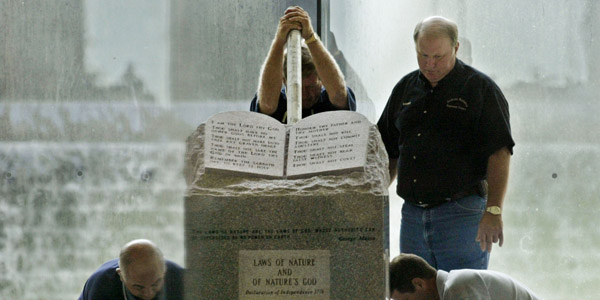
Workers remove a monument of the Ten Commandments from the rotunda of the Alabama Judicial Building after Superior Court Justice Roy Moore refused to take it down in 2003
So you can add another car to the crazy train that is the 2012 Republican presidential nominating contest. No, I’m not talking about last week’s sensation, Donald Trump. He’s a pretty conventional figure compared to the latest would-be president, former Alabama Supreme Court Chief Justice Roy Moore, who is currently barnstorming through Iowa after announcing an exploratory committee.
You may remember Judge Moore as the man who was forced from his judicial post after refusing to remove a gigantic monument to the Ten Commandments from his courthouse. He was also known for abrasive comments from the bench about homosexuality as contrary to God’s will, which in Moore’s opinion was dispositive. A martyr for theocrats everywhere, Moore spent some time hauling his monument around Alabama before launching two notably unsuccessful gubernatorial races — coming in a bad second in 2006’s Republican primary and a bad fourth in 2010 — and becoming a minor fixture at tea party events.
Moore was undoubtedly drawn to Iowa by that state’s furor over same-sex marriage, decreed legal by a 2009 state Supreme Court ruling. Iowa’s powerful Christian Right movement has made overturning that decision Job One, beginning with a successful effort in 2010 to remove three of the seven jurists responsible for it. It’s one of the few places left where Republicans don’t try to ignore the whole issue of gay rights as a divisive loser of an issue (which is why presidential wannabees like Tim Pawlenty have anachronistically come out against the repeal of “don’t ask, don’t tell). For Moore, it must have felt more like “home” than home.
Before writing off Moore as a kook trying to horn in on the spotlight of a presidential race, consider the company he’s keeping on his tour of the first-in-the-nation-caucuses state: former state legislator Danny Carroll. Carroll was co-chairman (with three-time gubernatorial candidate Bob Vander Plaats) of Mike Huckabee’s successful 2008 Caucus campaign, and more recently, signed on as a lobbyist for Vander Plaats’ new Christian Right umbrella group, The Family Leader. He’s a reasonably big deal in Iowa GOP circles, and by no means someone who howls at the moon.
For all I know, Carroll sees something in the crusty Alabama judge that others haven’t seen. Or maybe Judge Moore is a convenient stalking horse for Huckabee, designed to keep The Faithful loose and out of anyone else’s camp, in case Huck ultimately decides to run.
Regardless of Carroll’s (or Moore’s) personal motives, it’s likely the national Republican chattering class will dismiss the Judge’s campaign as a joke even worse than Trump’s. Or, it may be said, there is now such a crowd on the far right that opportunities are opening up for more moderate possibilities like Romney, T-Paw or an establishment-backed candidate-yet-to-be-named.
But I’d like to suggest another theory: the Christian/tea party right in Iowa is big enough, powerful enough, and politically sophisticated enough to hold its own caucus-within-a-caucus (well, caucuses, to be technical about it), an intramural contest to determine which candidate will actually represent the cause when Iowa Republicans make their final commitments before Caucus Night. Proven zealots like Michele Bachmann, Herman Cain, and now Moore, will joust with more suspect supplicants like T-Paw, Newt Gingrich — and maybe even Donald Trump! — over the next few months, with someone emerging as the designated favorite of the political army of the Lord. That is arguably what happened in Iowa in 2008, when Huckabee and Sen. Sam Brownback fought to become the Christian Right alternative to Mitt Romney, with Huckabee becoming The Man only after he out-organized Brownback at the State Party Straw Poll in Ames during the summer.
Moore’s candidacy may not ultimately have any direct influence on what happens next winter in Iowa, when conservative evangelicals and conservative Catholics get together to shape the 2012 Republican nominating process.
But he could indeed intensify the competition for Christian Right voters. And just as importantly, he could definitely serve as a symbol of the ideological and psychological gap between rigorous conservative activists and the mainstream political commentariat. Most of the latter think Moore is a crazy person. But most of the Iowa audiences before which Moore speaks will consider him an authentic if polarizing voice expressing the Word of God. That’s a pretty big gulf in perception, but also a pretty good reflection of the real differences Americans experience in how they view their leaders.
By: Ed Kilgore, Managing Editor of The Democratic Strategist and Senior Editor, Progressive Policy Institute. Article published in The Atlantic, April 20, 2011: Photo by Tami Chappell (Reuters)
Flirting With The Fringe: Stop Pretending Michele Bachmann Can Win The Iowa Caucuses
Ever since Michele Bachmann announced her intention to form a presidential exploratory committee, pundits, including Ed Kilgore at TNR, have been making the case that she has a good chance at winning Iowa—or if not winning, then doing well enough to hurt one or more of the stronger candidates. Republican caucus-goers in the state, they argue, are at least half-nuts, and therefore may well support Bachmann or some other candidate who doesn’t pass conventional standards of seriousness.
Certainly, Iowa Republicans are very socially conservative, more so than in some other states. But a closer look at Iowa caucus history shows that their history of supporting fringe candidates is not quite what it’s made out to be.
The case that “wacky Iowans will do anything” essentially comes down to interpreting a handful of episodes from recent decades. The first occurred in 1988 when Pat Robertson stunned everyone by finishing second with 25 percent of the vote, besting George H.W. Bush and Jack Kemp. But Pat Robertson was a social conservative—and no ordinary one at that—in a year in which the frontrunner (George H.W. Bush) was not. Moreover, that example is now over two decades old, and since then Iowa Republicans have had no trouble voting for mainstream candidates with conventional credentials, as long as those candidates—Lamar Alexander, George W. Bush—had solid records on social conservative issues.
That leaves us with three other supposed episodes of Iowan craziness: Pat Buchanan’s second place finish in 1996; the surprising showings of fringe candidates Alan Keyes and Gary Bauer in 2000; and Huckabee’s victory in 2008. Closer inspection of each of these episodes, however, reveals that none were quite as crazy as they appear.
Take Pat Buchannan in 1996. As odd as it might seem now, he was almost a serious candidate at the time: He had already run for president in 1992, and while he was never quite a plausible nominee, he did have some serious claim as a repeat candidate that Bachmann doesn’t have now. Nor was Buchannan’s success in Iowa especially unique. In fact, he proceeded to win the primary in New Hampshire, and wound up beating his Iowa percentage in sixteen states (several of those, to be sure, were after other candidates had dropped out, so the higher percentage was less impressive).
As for Alan Keyes and Gary Bauer in 2000, they certainly were fringe candidates—even more so than Bachmann—and their combined 25 percent was both impressive and anomalous; they combined for only 7 percent in New Hampshire, although Keyes did have some stronger showings in late states after the nomination was decided. However, it’s also the case that they didn’t have a whole lot of competition. John McCain campaigned in Iowa in 2000, but he did not fully commit to the state, and the only other candidate they beat was Orrin Hatch, who hardly ran any campaign at all. And even with their totals combined, Keyes and Bauer finished well back of Steve Forbes for second, and even further behind winner George W. Bush.
Finally, there’s Huckabee’s surprise victory in 2008; but the extent to which his candidacy was in any way similar to Bachmann’s has been vastly overstated. Yes, he won with the support of social issues voters. But Huckabee wasn’t some backbench member of the House; he was a recent former governor, and, in that sense, just as legitimate a candidate as Jimmy Carter or Bill Clinton.
Compared to Huckabee, Michele Bachmann is an altogether different sort of candidate. Since 1972, no candidate in any way similar has run a competitive campaign. The only three members of the House who had plausible shots at winning—Mo Udall in 1976, Jack Kemp in 1988, and Dick Gephardt in 1988 and 2004—were all senior members with leadership positions, legislative accomplishments, or both. No, Bachmann belongs in a different category, with other sideshow acts who may attract attention but have no real chance to win the nomination. And even in allegedly crazy Iowa, those candidates rarely impress on caucus day.
By: Jonathan Bernstein, The New Republic, April 16, 2011
How A Birther Thinks: A Demonstration
Mike Huckabee’s defenders have made much of the fact that he’s never endorsed the idea that President Obama wasn’t born in the United States. Therefore, he’s not a “birther” and his comments on a conservative radio show earlier this week are those of a man who either “didn’t mean it” and “clearly misspoke” or who is guilty of an “odd” but relatively benign ignorance about Obama’s biography.
As I’ve noted, these defenses fall flat on several levels. Even if you put the birther issue aside, It should be obvious that Huckabee didn’t just misspeak when he claimed that Obama grew up in Kenya; after all, he went into detail about the effect that a Kenyan upbringing filled with stories from relatives about the horrors of British colonial rule and the glory of the Mau Mau uprising would have had on Obama’s worldview and his actions as president today. Nor is this benign ignorance akin to (as Dave Weigel suggested) Obama being fuzzy on the details of Huckabee’s life story. Obama, to my knowledge, is not promoting an inflammatory indictment of Huckabee’s basic worldview and policy instincts that is based on an entirely and laughably false understanding of the circumstances of his upbringing.
Then there’s the matter of birtherism. Yes, it’s true, Huckabee is not claiming that Obama was born in Kenya — or in Indonesia or in any country other than the United States. But, as Jonathan Bernstein pointed out earlier this week:
This is where birtherism gets tricky. In its wildest forms, birtherism is about a massive conspiracy to install a conscious, deliberate enemy of the United States in the White House. It’s nice that Mike Huckabee doesn’t subscribe to that. But in its more plausible, and presumably more popular forms, it’s really just a way of saying that Barack Obama isn’t a “real” American.
Which brings me to the e-mails we’ve been receiving in response to our coverage of Huckabee, which (as you might have noticed) has been on the critical side. Plenty of readers are upset with Huckabee’s comments, to be sure, but I’ve also noticed an unusually large number of virulently anti-Obama e-mails written in Huckabee’s defense. I’ll readily admit that I don’t know any of the people who are sending these individually; for all I know, some or all of them are fake. But I’ve gotten so many expressing the same basic sentiments that I think it’s worth running one in its entirety:
Steve,
Where were you when Obama had to think so hard that it hurt-his-brain when he stated he went to 57 states in his campaign?
You continued supporting Obama and covering up his mistakes because of his skin color.
Because you are white, You are So Racist and bigoted and can’t help it.
So why should you worry when someone thinks Obama was born in Kenya—especially when the Kenyan official government states he was born there.
Instead, Obama claims to be born in the last state to enter the Union, so how could Obama claim 57 states?
Is it because he is stupid?
Since you never brought it up, you must agree with someone that ignorant and stupid.
And why does Indonesia have a school enrollment certificate that categorically states Obama is a Muslim? And why can Obama recite the muslim evening call to prayer from memory if he is a Christian, but he is a member of the “God Damn America” church of the most reverend Wright.
You can deny facts all you want, just like the hide the decline global warmest conspirators but that does not make you right.
Smug maybe, because you like attacking selected people because you are bigoted and racist.
Again, I don’t know the person who sent this to me. Who knows — it could be a mischievous liberal having some fun by assuming the voice of a right-winger. But the points this e-mailer makes are representative of the points that many, many others have expressed to me this week. In that sense, I think this e-mail demonstrates how Huckabee’s comments — even though they didn’t endorse birtherism in any literal sense — encourage the exact kind of attitude that has led a majority of Republicans likely to participate in next year’s primaries to express doubt over whether their president was even born in this country.
Note that the e-mailer didn’t get the part where Huckabee resisted endorsing full-on birtherism. “[W]hy should you worry when someone thinks Obama was born in Kenya?” he/she asks. And note how quick the e-mailer is to latch onto the false equivalency that Huckabee has been promoting since the interview blew up — that he committed a “slip of the tongue” no different from the slip of the tongue Obama committed as a candidate in 2008 when he said he’d visited 57 states. The difference between these episodes, as I noted yesterday, ought to be blindingly obvious.
Not all of the anti-Obama e-mails I received this week were as specific and detailed as this one. But almost all of them seemed to be written with the conviction that the president of the United States is a fundamentally un-/anti-American figure. Yes, the slice of the Republican Party base that actually bothers to send e-mails to Salon writers is very, very small. But the basic feelings expressed to me this week are more widespread. What Huckabee has done is to reinforce those feelings.
By: Steve Kornacki-News Editor, Salon, March 3, 2011
The Tea Party’s Religious Inspiration
If American politics were a TV show, it would by now have jumped the shark. Then again, American politics is a sort of TV show, considering its surreal plot lines, its cast of kooky narcissists, and an epistemology that blithely combines absolutist religious convictions with post-modern relativism: belief that the Bible is literally true comfortably co-exists with disbelief in simple, verifiable matters of fact, like the President’s place of birth or the absence of an HCR death panel mandate. It’s not surprising that, under the influence of the Tea Party, freedom is just another word for no abortion rights (and no contraception or cancer screenings for poor women).
Not long ago, the Tea (taxed enough already) Party was often presumed to stand for what its name implies — low taxes and limited government services (or at least limits on programs and services not enjoyed by its members.) But a new Pew Forum survey offers some quantitative evidence that Tea Party members tend to be religiously inspired, social conservatives; the movement “draws disproportionate support from the ranks of white evangelical Protestants … most people who agree with the religious right also support the Tea Party.”
Pew’s findings are unsurprising. You might have inferred the Tea Party’s religious motivations from the statements and policies of its established or aspiring political leaders, at state and federal levels. I’ll refrain from offering an extended litany of their wacky assertions and legislative ideas. Just keep in mind a few examples.
One of the subtler but also most hysterical expressions of legislative sectarianism is the wave of state proposals aimed at banning the non-existent threat of Sharia law. At first glance, you might mistake this trend for an effort to keep religion out of government, but a law intended to impose special disadvantages on one religion is no less sectarian (and violative of the First Amendment) than a law intended to extend special advantages to another.
So it’s not surprising to find proposed bans on Sharia law in conservative states, like South Dakota and Texas, alongside extreme anti-abortion proposals. (You can find atheists and agnostics who oppose abortion rights, but generally the anti-abortion movement is overwhelmingly religious and tends to divide along sectarian lines: according to Pew, “most religious traditions in the U.S. come down firmly on one side or the other.”) The notorious South Dakota bill that would arguably legalize the killing of abortion providers has been tabled; but a bill pending in Texas requires doctors to conduct pre-abortion sonograms for women and to impose on them a description of the fetus’s arms, legs and internal organs. Supporters of this bill insist that it is “pro-woman;” its purpose is empower them and “ensure there are no barriers preventing women from receiving the information to which they are entitled for such a life-changing decision” — barriers like a woman’s right to decline a sonogram or description of the fetus.
But the right wing’s aggressive sectarianism extends far beyond the usual battles over abortion and other culture-war casualties. Just listen to Mike Huckabee gush over Israel (biblical Zionists have been carrying on about Israel for years, but these days they have Tea Party stars on their side.) Michelle Bachmann claims that “if we reject Israel, then there is a curse that comes into play.” Note former Senator Rick Santorum’s defense of the Crusades, which, he laments, have been maligned by “the American left who hates Christendom.” Remember the Bible-based environmental policy of Illinois Congressman John Shimkus, now chair of the House Environment and Economy Sub-Committee. “The Earth will end when God declares it’s time to be over,” Shimkus famously declared in a 2009 hearing. Reading from the Bible and citing God’s promise to Noah not to destroy the earth (again), Shimkus said, “I believe that’s the infallible word of God and that’s the way it’s gonna be for his creation.”
Pay particular attention to Indiana congressman Mike Pence’s revealing declaration that the Employment Non-Discrimination Act, a federal bill prohibiting workplace discrimination against gay people “wages war on freedom of religion in the workplace.” If religious beliefs legitimized workplace discrimination, as Pence advises, then Title Vll of the 1964 Civil Rights Act would be unconstitutional at least as applied to people with religious compunctions against hiring women or members of particular racial or religious groups: If you believe that God did not intend women to hold traditionally male jobs, for example, or if you simply don’t like Mormons, then, in Pence’s view of religious freedom, you have a constitutional defense to employment discrimination claims by female or Mormon job applicants. But I bet that Pence would hesitate to defend a constitutional right to discriminate categorically against women or Mormons in the workplace; and if I’m right, it means he recognizes religious biases as defenses to discrimination claims as long as they’re biases he shares. Pence’s position on ENDA demonstrates the confident, theocratic approach to governing enabled by the Tea Party’s electoral successes.
Of course, Pence and Shimkus, among others, are hardly the first theocrats to land in office. There’s nothing new about the religious right’s drive for political power, which helped sweep Ronald Reagan into the White House in 1980, when liberal stalwarts were swept out of the Senate. What does seem new is the increased dominance of the Republican Party by sectarian religious extremists and their acquisition of power during a prolonged economic crisis and even longer war — a period marked by national pessimism, fear of terror, and a bipartisan assault on civil liberty unprecedented in its scope (thanks to technology) if not its intentions. In other words, what’s worrisome is our vulnerability, susceptibility to demagoguery, and diminishing margin of error. We don’t have time for the unexamined certitudes of religious zealotry.
If only Tea Partiers and their legislative surrogates would take seriously the Constitution and the founding fathers they so frequently invoke. Then they’d respect the First Amendment’s prohibition on government-established religion, which codified the Founder’s belief in a secular, civil government that accommodates diverse religious practices and beliefs. They’d understand that the Establishment clause doesn’t merely bar the federal government from requiring us to attend a federal church; it bars Congress from turning sectarian religious beliefs into law (unless they coincide with practically universal moral codes, like prohibitions on murder.) “People place their hand on the Bible and swear to uphold the Constitution, they don’t put their hand on the Constitution and swear to uphold the Bible,” Maryland State Senator Jamie Raskin once said (to appropriate acclaim.) It’s an accurate statement of law and constitutional ideals, but, sad to say, an increasingly aspirational description of political practice.
By: Wendy Kaminer, The Atlantic, February 25, 2011
Share This Blog


 Unknown Feed
- An error has occurred; the feed is probably down. Try again later.
 mykeystrokes.com
You must be logged in to post a comment.