Republican Budget Cuts Promote ‘Trickle Up’ Poverty
How appropriate that Washington’s most challenging budget crisis in decade coincides with the Republican Party’s centenary birthday celebration of Ronald Reagan, whose attacks on “welfare queens” and the social safety net in the name of deficit reduction caused indisputable collateral damage to middle class Americans. The Ronnie-like budget cuts that Republican leaders are proposing today—against unemployment insurance, food stamps, Medicaid and subsidized housing—all boast the potential to carry on the Reagan tradition of hurting the very middle class they aspire to help.
Why? Because the cuts to the programs the Republican leadership in the House of Representatives are targeting would increase poverty, and more poverty lowers property values, diminishes the quality of life, and drives up family taxes and expenses of middle class Americans.
Cuts to federal housing programs will increase homelessness. Combine increased homelessness with vacant public housing and you have a cancer that will spread, reducing property values in communities across our nation. Or consider cuts to unemployment and food stamps. These are likely to cause grocery stores in urban, suburban, and rural areas—many of which serve the middle class—to either close or lower the quality and selection of their wares, just to preserve profit margin.
A persistently high unemployment rate may well also translate into desperation and increased property and personal crimes. Not only will more crime lower our quality of life, it will drive up the cost of local policing. That could mean higher local taxes meet crime-fighting demands.
Public schools were once the first choice of middle class families; these schools are the first to fail as poverty rises. Where school was once free, poverty forces many middle class families today to shell out thousands of dollars to educate their children. These new costs are a fact of life for more and more middle class Americans as poverty spreads across the country. Sadly it’s at just the time they can least afford it.
Let’s be clear. No one rejoices at the prospect of spending billions of dollars for subsidized housing or food stamps or Medicaid. And Glenn Beck acolytes and progressives alike can agree that good paying jobs are better for families than a plethora of government subsidies. But the problem is that our economy and the policies that drive it are not creating enough decent paying jobs for all able-bodied Americans to cover their basic household expenses. Federal subsidies for basic needs make up for the shortcomings in our economy. And they help a surprising number of people.
To be sure, we can find ways to run these programs more effectively and more efficiently. And that’s where the hard work of budget cutting should concentrate. The ubiquity of technology, even in low-income communities, presents a huge opportunity to shed administrative costs. We should also find ways to better align these programs so that they enable workers and their families to more successfully move out of poverty. If we are serious about protecting and expanding the middle class, then the tough discussions on how to overhaul the delivery of these income-support programs need to commence.
But it’s simply not in the interest of most Americans to swing an ax at these programs amid a nascent economic recovery. Today, over 10 million Americans are collecting unemployment, and nearly that many citizens are in apartments with rents subsidized by the federal government. More than 40 million Americans put food on the table with the aid of food stamps. Fifty million Americans are able to go to the doctor or the hospital because of the Medicaid program. And fully one in six Americans is dependent on federal and state support for their basic necessities of life.
The consequences of reducing federal income supports will be devastating on the poorest among us. But the impact will not be contained to them. Remember: Ronald Reagan tried to convince us that wealth trickles down. His enduring legacy, however, is that poverty trickles up.
By: Donna Cooper, Senior Fellow-Center for American Progres, February 14, 2011
“When Democracy Weakens”: We’re In Serious Danger Of Becoming A Democracy In Name Only.
As the throngs celebrated in Cairo, I couldn’t help wondering about what is happening to democracy here in the United States. I think it’s on the ropes. We’re in serious danger of becoming a democracy in name only.
While millions of ordinary Americans are struggling with unemployment and declining standards of living, the levers of real power have been all but completely commandeered by the financial and corporate elite. It doesn’t really matter what ordinary people want. The wealthy call the tune, and the politicians dance.
So what we get in this democracy of ours are astounding and increasingly obscene tax breaks and other windfall benefits for the wealthiest, while the bought-and-paid-for politicians hack away at essential public services and the social safety net, saying we can’t afford them. One state after another is reporting that it cannot pay its bills. Public employees across the country are walking the plank by the tens of thousands. Camden, N.J., a stricken city with a serious crime problem, laid off nearly half of its police force. Medicaid, the program that provides health benefits to the poor, is under savage assault from nearly all quarters.
The poor, who are suffering from an all-out depression, are never heard from. In terms of their clout, they might as well not exist. The Obama forces reportedly want to raise a billion dollars or more for the president’s re-election bid. Politicians in search of that kind of cash won’t be talking much about the wants and needs of the poor. They’ll be genuflecting before the very rich.
In an Op-Ed article in The Times at the end of January, Senator John Kerry said that the Egyptian people “have made clear they will settle for nothing less than greater democracy and more economic opportunities.” Americans are being asked to swallow exactly the opposite. In the mad rush to privatization over the past few decades, democracy itself was put up for sale, and the rich were the only ones who could afford it.
The corporate and financial elites threw astounding sums of money into campaign contributions and high-priced lobbyists and think tanks and media buys and anything else they could think of. They wined and dined powerful leaders of both parties. They flew them on private jets and wooed them with golf outings and lavish vacations and gave them high-paying jobs as lobbyists the moment they left the government. All that money was well spent. The investments paid off big time.
As Jacob Hacker and Paul Pierson wrote in their book, “Winner-Take-All Politics”: “Step by step and debate by debate, America’s public officials have rewritten the rules of American politics and the American economy in ways that have benefited the few at the expense of the many.”
As if the corporate stranglehold on American democracy were not tight enough, the Supreme Court strengthened it immeasurably with its Citizens United decision, which greatly enhanced the already overwhelming power of corporate money in politics. Ordinary Americans have no real access to the corridors of power, but you can bet your last Lotto ticket that your elected officials are listening when the corporate money speaks.
When the game is rigged in your favor, you win. So despite the worst economic downturn since the Depression, the big corporations are sitting on mountains of cash, the stock markets are up and all is well among the plutocrats. The endlessly egregious Koch brothers, David and Charles, are worth an estimated $35 billion. Yet they seem to feel as though society has treated them unfairly.
As Jane Mayer pointed out in her celebrated New Yorker article, “The Kochs are longtime libertarians who believe in drastically lower personal and corporate taxes, minimal social services for the needy, and much less oversight of industry — especially environmental regulation.” (A good hard look at their air-pollution record would make you sick.)
It’s a perversion of democracy, indeed, when individuals like the Kochs have so much clout while the many millions of ordinary Americans have so little. What the Kochs want is coming to pass. Extend the tax cuts for the rich? No problem. Cut services to the poor, the sick, the young and the disabled? Check. Can we get you anything else, gentlemen?
The Egyptians want to establish a viable democracy, and that’s a long, hard road. Americans are in the mind-bogglingly self-destructive process of letting a real democracy slip away.
I had lunch with the historian Howard Zinn just a few weeks before he died in January 2010. He was chagrined about the state of affairs in the U.S. but not at all daunted. “If there is going to be change,” he said, “real change, it will have to work its way from the bottom up, from the people themselves.”
I thought of that as I watched the coverage of the ecstatic celebrations in the streets of Cairo.
By: Bob Herbert, Op-Ed Columnist-The New York Times, February 11, 2011
What Happens If Conservatives Succeed in Undermining The Affordable Care Act?
The legal theory currently in vogue in conservative circles holds that the Constitution’s vision of “a central government with limited power” — to use Judge Vinson’s phrase — permits the government to establish a single-payer health-care system that every American pays into through payroll taxes and that wipes out the private insurance industry but forbids the government from administering a regulated market in which individuals purchase private insurance plans and pay a penalty if they can afford coverage but choose to delay buying it until they’re sick.
There’s a chance conservatives will come to seriously regret this stratagem. I think it’s vanishingly unlikely that the Supreme Court will side with Judge Vinson and strike down the whole of the law. But in the event that it did somehow undermine the whole of the law and restore the status quo ex ante, Democrats would start organizing around a solution based off of Medicare, Medicaid, and the budget reconciliation process — as that would sidestep both legal attacks and the supermajority requirement.
The resulting policy isn’t too hard to imagine. Think something like opening Medicare to all Americans over age 45, raising Medicaid up to 300 percent of the poverty line, opening S-CHIP to all children, and paying for the necessary subsidies and spending with a surtax on the wealthy (which is how the House originally wanted to fund health-care reform). That won’t get us quite to universal health care, but it’ll get us pretty close. And it’ll be a big step towards squeezing out private insurers, particularly if Medicaid and Medicare are given more power to control their costs.
By: Ezra Klein-The Washington Post, January 31, 2011
Mr. Speaker: What Comes After No?
The Republicans have vowed to “repeal and replace” President Obama’s historic health care reform law. Now that House Republicans have muscled through a symbolic repeal bill, they will have to deliver their own alternative plan. Don’t expect much.
By: New York Times- Editorial, The Opinion Pages, January 24, 2011
There are many more slogans than details. But it is already clear that their approach would do almost nothing to control skyrocketing health care costs and would provide little help to the 50 million uninsured Americans.
When Republican leaders talk of reducing medical costs they really mean reducing insurance premiums for some people, primarily by letting the young and healthy buy insurance in states that allow the sale of skimpy policies. That won’t help older and less healthy people and would probably drive up their premiums as they flock to states whose regulations guarantee them coverage.
The Republicans have offered no coherent plan for slowing the rapid rise in medical costs that is driving up insurance premiums, Medicare and Medicaid costs, and the federal deficit. The reform law, by contrast, has multiple provisions for changing the delivery of health care in ways that should reduce costs.
As for the Republicans’ calls to reduce waste and fraud in Medicare, reform the medical malpractice system, and expand high-risk pools to cover people with pre-existing conditions, most of these ideas are already in the reform law. They could surely be strengthened if both parties worked together.
Even as it denounces reform at every turn, the Republican leadership has figured out that many Americans want the many consumer protections that come with the new law. So, once reform is repealed, the leaders are vowing to reinstate such provisions as letting young people stay on their parents’ plans until age 26, preventing insurers from canceling policies after people become sick, and barring insurers from placing caps on what they will pay.
The problem is that such requirements will drive up the cost of insurance unless they are paired with a mandate (or comparable prod) requiring that everyone buy insurance so that healthy people offset the costs of less healthy beneficiaries. Yes, that’s the same mandate the Republicans have vowed to overturn.
Many Republicans have also vowed to restore more than $130 billion worth of unjustified subsidies to private Medicare Advantage plans that is needed to help pay for the expansion of coverage under health care reform.
In coming weeks, expect to see a lot more posturing on issues that might energize the party’s conservative base or poll well with people made skittish by months of Republican exaggerations about the new reform law. They have already introduced bills making it even harder for insurance policies in new insurance exchanges to cover abortions, never mind that the law already has incredibly strict provisions.
The Party of No will also try to use its new control of the House to block implementation of reform by withholding money needed to hire people to write necessary regulations. The House Republican Study Committee has proposed legislation that would prohibit using money in the annual budget to carry out any provision of the law or to defend it in court.
The Republicans need to explain how they plan to address the problems of covering the uninsured, wrestling down medical costs and controlling the deficit. Just saying no isn’t enough.
Health Reform at Work Today and Tomorrow: Improvements That Began Last Year Will Continue
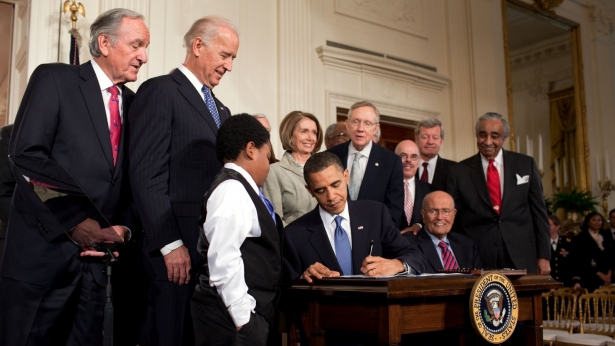
President Barack Obama is applauded as he signs the health care reform bill, on March 23, 2010, in the East Room of the White House in Washington. The bill includes many benefits for Americans who have health insurance today and those who have struggled to find and maintain health coverage.
2010 was a momentous year for the American health care system. In March, Congress passed—and President Barack Obama signed—landmark legislation that reforms the health insurance market, provides all Americans with affordable access to health coverage, and reduces the growth of health care costs.
The Department of Health and Human Services and other parts of the executive branch have begun to implement the new law in the subsequent 10 months. The Affordable Care Act, or ACA, includes many benefits for Americans who have health insurance today and those who have struggled to find and maintain health coverage. Many of these benefits came on-line in 2010.
Signature achievements include:
- Establishing pre-existing condition insurance plans in every state so that individuals with health problems who cannot find coverage in the regular market have a reliable source of coverage
- Requiring employer-sponsored health plans to offer coverage to the young-adult children of policyholders
- Helping employers with unpredictable health care spending for retired workers
- Providing more than 1 million rebate checks to Medicare enrollees who incurred high out-of-pocket prescription drug spending in 2010
- Prohibiting health insurance plans from denying coverage to children with pre-existing conditions
- Protecting individuals with high health care costs from the financial risk of absurdly low annual and lifetime limits on their benefits
- Prohibiting health insurance plans from rescinding coverage when a policyholder gets sick
These changes bring a new degree of stability and security to millions of Americans’ health coverage. And even more improvements are around the corner. Beginning this month, seniors will enjoy meaningful new benefits and significant improvements in their prescription drug coverage, while individuals and businesses will receive premium rebates from their insurance company when the insurers incur excessive administrative costs.
Specific improvements in 2011 include:
- Closing the Medicare prescription drug coverage gap. Seniors and people with disabilities who obtain prescription drug coverage through Medicare Part D will enjoy a new discount on brand-name and generic prescription drugs when they hit the so-called “doughnut hole” in their Part D benefits. Since the beginning of the program, enrollees have hit a gap in coverage when their total drug spending—including out-of-pocket costs and expenses covered by their Medicare Part D plan—exceeds a preset limit (currently $2,830). Patients then pay the total cost of their prescription drugs, without help from their drug plan, until their total drug expenses hit an upper limit and coverage kicks in again. With the new discount, people with drug spending high enough to hit the coverage gap will save almost $500 on average this year, while people with very high drug costs will save more than $1,500.
- Launching new prevention benefits for Medicare enrollees. Good coverage of preventive services helps seniors and other Medicare enrollees better manage their health. New benefits include coverage without cost-sharing for recommended preventive services (those that receive an “A” or “B” rating from the U.S. Preventive Services Task Force) and new coverage for a personal prevention plan.
- Increasing access to primary care. Medicare will pay primary care providers a 10 percent bonus payment, which offers a new incentive for physicians, nurses, and others to provide primary care services.
- Requiring insurers to provide high value for premium dollars. Beginning in 2011, insurers will pay rebates to policyholders—individuals and employers—when plan spending on clinical services falls below 80 percent of premium revenue in the individual and small group market, and 85 percent of premium revenue in the large group market.
Looking ahead, ACA provisions that will touch real people every day will continue coming on-line through 2011. These include providing more consumer information on healthy food choices by requiring chain restaurants and vending machines to provide nutritional data no later than March, and improving long-term care by sending enhanced federal Medicaid payments to support new state investments in community-based long-term care services starting in October. Tangible improvements will continue beyond this year, such as fully closing the coverage gap in Medicare Part D and improving Medicaid coverage for preventive care.
The Affordable Care Act’s most striking impact will come in 2014 when new health insurance exchanges launch, premium subsidies become available, and Medicaid coverage expands to include all low-income individuals regardless of family composition, age, or disability status.
These headline-grabbing changes in our health care system may be a few years down the road. But millions of Americans are already benefiting from the Affordable Care Act—and millions more will receive better care in the near future thanks to the changes in the new law.
By Karen Davenport | January 13, 2011-Center For American Progress. Photo: AP/Charles Dharapak
Share This Blog


 Unknown Feed
- An error has occurred; the feed is probably down. Try again later.
 mykeystrokes.com
You must be logged in to post a comment.