Our Irresponsible American Ruling Class Is Failing
The American ruling class is failing us — and itself.
At other moments in our history, the informal networks of the wealthy and powerful who often wield at least as much influence as our elected politicians accepted that their good fortune imposed an obligation: to reform and thus preserve the system that allowed them to do so well. They advocated social decency out of self-interest (reasonably fair societies are more stable) but also from an old-fashioned sense of civic duty. “Noblesse oblige” sounds bad until it doesn’t exist anymore.
An enlightened ruling class understands that it can get richer and its riches will be more secure if prosperity is broadly shared, if government is investing in productive projects that lift the whole society and if social mobility allows some circulation of the elites. A ruling class closed to new talent doesn’t remain a ruling class for long.
But a funny thing happened to the American ruling class: It stopped being concerned with the health of society as a whole and became almost entirely obsessed with money.
Oh yes, there are bighearted rich people when it comes to private charity. Heck, David Koch, the now famous libertarian-conservative donor, has been extremely generous to the arts, notably to New York’s Lincoln Center.
Yet when it comes to governing, the ruling class now devotes itself in large part to utterly self-involved lobbying. Its main passion has been to slash taxation on the wealthy, particularly on the financial class that has gained the most over the past 20 years. By winning much lower tax rates on capital gains and dividends, it’s done a heck of a job.
Listen to David Cay Johnston, the author of “Free Lunch” and a columnist for Tax Notes. “The effective rate for the top 400 taxpayers has gone from 30 cents on the dollar in 1993 to 22 cents at the end of the Clinton years to 16.6 cents under Bush,” he said in a telephone interview. “So their effective rate has gone down more than 40 percent.”
He added: “The overarching drive right now is to push the burden of government, of taxes, down the income ladder.”
And you wonder where the deficit came from.
If the ruling class were as worried about the deficit as it claims to be, it would accept that the wealthiest people in society have a duty to pony up more for the very government whose police power and military protect them, their property and their wealth.
The influence of the ruling class comes from its position in the economy and its ability to pay for the politicians’ campaigns. There are not a lot of working-class people at those fundraisers President Obama has been attending lately. And I’d underscore that I am not using the term to argue for a Marxist economy. We need the market. We need incentives. We don’t need our current levels of inequality.
Those at the top of the heap are falling far short of the standards set by American ruling classes of the past. As John Judis, a senior editor at the New Republic, put it in his indispensable 2000 book, “The Paradox of American Democracy,” the American establishment has at crucial moments had “an understanding that individual happiness is inextricably linked to social well-being.” What’s most striking now, by contrast, is “the irresponsibility of the nation’s elites.”
Those elites will have no moral standing to argue for higher taxes on middle-income people or cuts in government programs until they acknowledge how much wealthier they have become than the rest of us and how much pressure they have brought over the years to cut their own taxes. Resolving the deficit problem requires the very rich to recognize their obligation to contribute more to a government that, measured against other wealthy nations, is neither investing enough in the future nor doing a very good job of improving the lives and opportunities of the less affluent.
“A blind and ignorant resistance to every effort for the reform of abuses and for the readjustment of society to modern industrial conditions represents not true conservatism, but an incitement to the wildest radicalism.” With those words in 1908, President Theodore Roosevelt showed he understood what a responsible ruling class needed to do. Where are those who would now take up his banner?
By: E. J. Dionne, Opinion Writer, The Washington Post, April 17, 2011
Our Narrow And Wrong Headed Economic Debate
There’s a janitor who lives in a studio apartment just outside of Stevens Point, Wis. He cleans the math and science buildings at a state university, a job he’s been doing for about 18 months, after a year of unemployment. He’s 43 and last year made $24,622. He doesn’t have kids, so he doesn’t qualify for a child-care tax credit. He doesn’t own a home or a hybrid car — those credits don’t apply to him, either. He hasn’t been enrolled in school since the 10th grade, so he definitely doesn’t qualify for any education credits or deductions. He just learned that Gov. Scott Walker’s new budget has slashed his benefits and that next year he’ll be bringing in about 16 percent less per month. And when he sits down to do his taxes next week, he’ll find that he paid the federal government around $1,400 in 2010.
“People can think what they think,” said Jeff Immelt, GE’s chief executive, in response to a growing anger to this story, first reported last week by the New York Times. What else is there to think, one wonders, but that with the muscle and money of lobbyists and lawyers, with the access and influence built over generations, GE has done not just the audacious but the outrageous. And it is not alone.
Exxon Mobil, for example, made $19 billion in profits in 2009 but paid no federal income taxes. In fact, it received a $156 million rebate from the IRS. Bank of America received a $1.9 billion tax refund from the IRS last year, even though it made $4.4 billion in profits and was handed a nearly $1 trillion bailout by taxpayers. The list, inconceivably, goes on.
And yet the conversation in Washington hasn’t turned to aggressively closing the loopholes that GE’s lobbyists created for its accountants to exploit. It hasn’t turned toward ending the ridiculous tax breaks on corporate dividends and capital gains that allow hedge fund managers and the very wealthy to pay the government a lower percentage than their middle-class employees. Instead, Congress is debating whether $33 billion in cuts to the social safety net is enough to make the Tea Party happy.
While Republicans in the House have stopped talking nearly altogether about jobs (and have embraced a budget that could cost the economy 700,000 of them, according to Moody’s chief economist Mark Zandi), the head of the President’s Council on Jobs and Competitiveness, someone charged with finding a way to sustained job growth, is none other than Jeff Immelt himself, tax evader in chief. This is a systemic problem that neither belongs to nor can be solved by a single man. But for Immelt to keep his post with the administration now would be bad politics, bad policy and bad messaging. Yet as I write this, it doesn’t look as if he will be asked to step down.
Still, I am hopeful.
I am hopeful because an incredible spirit and energy has been unleashed. It was first shown during the Wisconsin labor battle, and it is being sustained and nurtured, and broadened to communities across the country. People are showing that they will not abide a system that finances corporate greed on the backs of the poor and middle class.
On Monday, the nation commemorated the assassination of Martin Luther King Jr., who was killed in Memphis, where he had gone to fight for the rights of sanitation workers. Thousands gathered across America for a national day of action supporting public employees, other working people and trade unions in a common quest for jobs, justice and decency for all citizens. They participated in teach-ins, protests, demonstrations and vigils, all with a simple and deeply American message: It is time for the richest, most privileged among us to pay their fair share.
They spoke of the widening gulf in American politics, between the powerful and the powerless, between those who most need the government’s assistance and those most likely, instead, to receive it. They are not alone. For all the disappointment that progressives feel about this Congress, there are members who have been leaders and allies on Capitol Hill.
Consider Sen. Bernie Sanders (I-Vt.). Always the people’s champion, Sanders has called for closing corporate tax loopholes, which, if done, would raise more than $400 billion over a 10-year period. He’s also introduced legislation imposing a 5.4 percent surtax on millionaires that would yield up to $50 billion more a year — more than enough to protect Pell Grants and Head Start and other programs facing the chopping block.
He is joined by Rep. Jan Schakowsky (D-Ill.), who has introduced legislation to create a separate tax bracket for millionaires and billionaires — an option that garners the support of 81 percent of the American people, according to an NBC/Wall Street Journal poll.
The common sense, humane response at this moment is to fight to reset the terms of a suffocatingly narrow and wrongheaded debate. This is the heritage of the progressive movement and, indeed, our obligation. The best principles of our country have been trampled by corporate immorality and right-wing extremism. But they can be restored. Martin Luther King Jr. knew as much when he fought for the sanitation workers of Tennessee 43 years ago. Now, we must know it too.
By: Katrina Vanden Heuvel, Opinion Writer, The Washington Post, April 5, 2011
The Tea Party’s Big Money
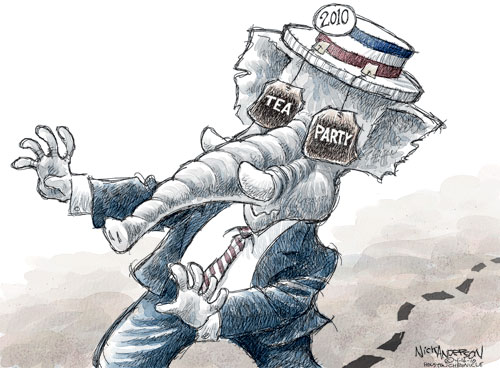
"Establishment Republicans"
Tea Party supporters and their candidates like to imagine themselves as insurgents, crashing the barricades of Washington to establish a new order of clean and frugal government. In earthbound reality, many of the people pulling the Tea Party’s strings are establishment Republican operatives and lobbyists. Some have made money off the party for years.
One example is Sal Russo, a gun-for-hire who has worked for former President Ronald Reagan, former Gov. George Deukmejian of California, former Gov. Christine Todd Whitman of New Jersey, former Gov. George Pataki of New York, and many other Republicans. As The Times reported on Sunday, Mr. Russo saw a sure thing last year, establishing a group called the Tea Party Express to support candidates in the midterm elections and raise cash at the same time.
The group has spent nearly $1 million in an effort to replace Harry Reid of Nevada, the Democratic Senate leader. It spent nearly $350,000 to elect Senator Scott Brown of Massachusetts. It is pouring money into Alaska to support Joe Miller’s Senate bid. And it has spent $250,000 in Delaware on behalf of Christine O’Donnell, now the Republican nominee for the United States Senate. Mr. Russo held a fund-raiser for Ms. O’Donnell and organized a rally.
In all, Mr. Russo and his group have raised $5.2 million and are the biggest independent supporters of Tea Party candidates. Of that, $3 million to buy advertising went to his political consulting firm or one controlled by his wife. Of course, he takes a substantial cut of each buy.
Dick Armey, the former House Republican leader, considers himself a godfather of the Tea Party and is co-author of the book, “Give Us Liberty: a Tea Party Manifesto.” Writing in The Wall Street Journal, he called for a “hostile takeover” of the Republican Party, which sounds so very revolutionary until one remembers that he helped lead that party for many years, guiding its policies and raising its money. When he left office in 2003, he cashed in on his connections to become a very high-paid lobbyist at DLA Piper, one of Washington’s biggest law firms, which has clients that include health-care companies, energy producers and foreign governments.
Then there is Carl Paladino, the Tea Party-backed Republican nominee for governor of New York. His bloodcurdling denunciations of Albany never seem to mention that he is one of the biggest landlords of state agencies, owning properties with $85 million in taxpayer leases in Buffalo alone that provide him with income of more than $5 million a year. He is the biggest property owner in Buffalo, and much of his empire has been constructed with state development incentives and tax breaks. An adviser is Roger Stone, an operator for Republicans since Richard Nixon’s re-election campaign.
There are undoubtedly thousands of Tea Partiers who would love to purge Washington of well-connected lobbyists, high-priced political consultants and others who take millions of taxpayer dollars while condemning the lawmakers who spend it. They should take a long look at the leaders and candidates who are driving their movement and decide whether purging begins at home.
New York Times-Editorial: Published Sept. 23, 2010
Share This Blog


 Unknown Feed
- An error has occurred; the feed is probably down. Try again later.
 mykeystrokes.com
About a thousand miles to the east, in Fairfield, Conn., General Electric, one of the world’s largest multinational corporations, posted a $14.2 billion profit for 2010. When its accountants were finished working their magic, the company didn’t owe a single dollar in federal taxes.