GOP Presidential Contenders Compete To Win Over “The Political Army Of The Lord”
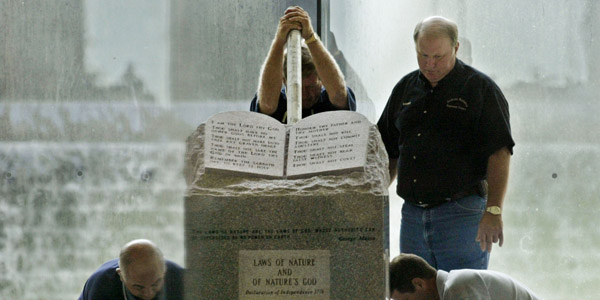
Workers remove a monument of the Ten Commandments from the rotunda of the Alabama Judicial Building after Superior Court Justice Roy Moore refused to take it down in 2003
So you can add another car to the crazy train that is the 2012 Republican presidential nominating contest. No, I’m not talking about last week’s sensation, Donald Trump. He’s a pretty conventional figure compared to the latest would-be president, former Alabama Supreme Court Chief Justice Roy Moore, who is currently barnstorming through Iowa after announcing an exploratory committee.
You may remember Judge Moore as the man who was forced from his judicial post after refusing to remove a gigantic monument to the Ten Commandments from his courthouse. He was also known for abrasive comments from the bench about homosexuality as contrary to God’s will, which in Moore’s opinion was dispositive. A martyr for theocrats everywhere, Moore spent some time hauling his monument around Alabama before launching two notably unsuccessful gubernatorial races — coming in a bad second in 2006’s Republican primary and a bad fourth in 2010 — and becoming a minor fixture at tea party events.
Moore was undoubtedly drawn to Iowa by that state’s furor over same-sex marriage, decreed legal by a 2009 state Supreme Court ruling. Iowa’s powerful Christian Right movement has made overturning that decision Job One, beginning with a successful effort in 2010 to remove three of the seven jurists responsible for it. It’s one of the few places left where Republicans don’t try to ignore the whole issue of gay rights as a divisive loser of an issue (which is why presidential wannabees like Tim Pawlenty have anachronistically come out against the repeal of “don’t ask, don’t tell). For Moore, it must have felt more like “home” than home.
Before writing off Moore as a kook trying to horn in on the spotlight of a presidential race, consider the company he’s keeping on his tour of the first-in-the-nation-caucuses state: former state legislator Danny Carroll. Carroll was co-chairman (with three-time gubernatorial candidate Bob Vander Plaats) of Mike Huckabee’s successful 2008 Caucus campaign, and more recently, signed on as a lobbyist for Vander Plaats’ new Christian Right umbrella group, The Family Leader. He’s a reasonably big deal in Iowa GOP circles, and by no means someone who howls at the moon.
For all I know, Carroll sees something in the crusty Alabama judge that others haven’t seen. Or maybe Judge Moore is a convenient stalking horse for Huckabee, designed to keep The Faithful loose and out of anyone else’s camp, in case Huck ultimately decides to run.
Regardless of Carroll’s (or Moore’s) personal motives, it’s likely the national Republican chattering class will dismiss the Judge’s campaign as a joke even worse than Trump’s. Or, it may be said, there is now such a crowd on the far right that opportunities are opening up for more moderate possibilities like Romney, T-Paw or an establishment-backed candidate-yet-to-be-named.
But I’d like to suggest another theory: the Christian/tea party right in Iowa is big enough, powerful enough, and politically sophisticated enough to hold its own caucus-within-a-caucus (well, caucuses, to be technical about it), an intramural contest to determine which candidate will actually represent the cause when Iowa Republicans make their final commitments before Caucus Night. Proven zealots like Michele Bachmann, Herman Cain, and now Moore, will joust with more suspect supplicants like T-Paw, Newt Gingrich — and maybe even Donald Trump! — over the next few months, with someone emerging as the designated favorite of the political army of the Lord. That is arguably what happened in Iowa in 2008, when Huckabee and Sen. Sam Brownback fought to become the Christian Right alternative to Mitt Romney, with Huckabee becoming The Man only after he out-organized Brownback at the State Party Straw Poll in Ames during the summer.
Moore’s candidacy may not ultimately have any direct influence on what happens next winter in Iowa, when conservative evangelicals and conservative Catholics get together to shape the 2012 Republican nominating process.
But he could indeed intensify the competition for Christian Right voters. And just as importantly, he could definitely serve as a symbol of the ideological and psychological gap between rigorous conservative activists and the mainstream political commentariat. Most of the latter think Moore is a crazy person. But most of the Iowa audiences before which Moore speaks will consider him an authentic if polarizing voice expressing the Word of God. That’s a pretty big gulf in perception, but also a pretty good reflection of the real differences Americans experience in how they view their leaders.
By: Ed Kilgore, Managing Editor of The Democratic Strategist and Senior Editor, Progressive Policy Institute. Article published in The Atlantic, April 20, 2011: Photo by Tami Chappell (Reuters)
Judicial Elections: You Get The Judges You Pay For
Legal elites must come to terms with a reality driven by the grass-roots electorate: judicial elections are here to stay. Given this reality, we should focus on balancing important First Amendment rights to financially support campaigns with due process concerns about fair trials.
An ugly, expensive campaign for a seat on the Wisconsin Supreme Court is but the latest example of what is now common in judicial elections: millions of dollars in misleading television ads, subsidized by lobbies that have cases before the bench.
In 39 states, at least some judges are elected. Voters rarely know much, if anything, about the candidates, making illusory the democratic benefits of such elections. Ideally, judges should decide cases based on the law, not to please the voters. But, as Justice Otto Kaus of the California Supreme Court once remarked about the effect of politics on judges’ decisions: “You cannot forget the fact that you have a crocodile in your bathtub. You keep wondering whether you’re letting yourself be influenced, and you do not know.”
The need to run multimillion-dollar campaigns to win election to the court in much of the country renders the crocodile ever more menacing.
For more than a quarter of a century, voters have rejected efforts to move from an elective to an appointive bench. Last year, despite a campaign led by Sandra Day O’Connor, Nevada voters became the latest to reject such a change.
Scholars, judges and advocates who find intellectual comfort in seeking to eliminate judicial elections are indulging a luxury that America’s courts can no longer afford. Instead they should focus on incremental changes to what Justice O’Connor bluntly calls the “wrong” of “cash in the courtroom.”
More than 7 in 10 Americans believe campaign cash influences judicial decisions. Nearly half of state court judges agree. Never before has there been so much cash in the courts. Measured only by direct contributions to candidates for state high courts, campaign fund-raising more than doubled in a decade.
But this is only part of the financial story. Nationally, in 2008, for the first time, noncandidate groups outspent the candidates on the ballot.
Perhaps most tellingly, a study of 29 campaigns in the 10 costliest judicial election states over the last decade revealed the extraordinary comparative power of “super spenders” in court races. The top five spenders in each of the elections laid out an average of $473,000.
In 2009, the United States Supreme Court dealt with this issue, holding that due process is violated when a judge participates in a case involving a party that spent a great deal of money on the judge’s election effort. The case before the court involved a West Virginia Supreme Court decision overturning a jury verdict that awarded a $50 million judgment against Massey Coal Company.
One of the justices in the majority of that 3 to 2 decision, Brent D. Benjamin, had been elected after Massey Coal’s chief executive spent $3 million on his campaign. The United States Supreme Court held, 5 to 4, that due process was violated because of the lack of an impartial decision-maker. The court made clear, however, that campaign spending requires the disqualification of a judge only rarely.
A year later, the high court held, in the Citizens United case, that corporations and unions have the First Amendment right to spend unlimited amounts of money in election campaigns. In light of these two decisions, corporate and union officials must engage in a perverse guessing game: they want to spend enough to get their candidate for the bench elected, but not so much as to require the judge’s disqualification if the campaign is successful.
Rigorous recusal rules are an important step, but merely disqualifying a judge on occasion is insufficient. The most obvious solution is to limit spending in judicial races. States with elected judges should restrict how much can be contributed to a candidate for judicial office or even spent to get someone elected.
That solution has long been assumed to be off the table, though, because the Supreme Court ruled in 1976 that while the government can limit the amount that a person gives directly to a candidate, it cannot restrict how much a person spends on his or her own to get the candidate elected. Nevertheless, large expenditures to get a candidate elected to the bench undermine both the appearance and reality of impartial justice.
The Supreme Court’s 2009 decision properly focused on the $3 million in campaign expenditures, not the $1,000 that was directly contributed. In the legislative and executive offices, it is accepted that special-interest lobbying and campaign spending can influence votes; but that is anathema to our most basic notions of fair judging.
Thus, the Supreme Court should hold that the compelling interest in ensuring impartial judges is sufficient to permit restrictions on campaign spending that would be unconstitutional for nonjudicial elections.
States should restrict contributions and expenditures in judicial races to preserve impartiality. Such restrictions are the only way to balance the right to spend to get candidates elected, and the due process right to fair trials.
By: Erwin Chemerinsky and James J. Sample, The New York Times, April 17, 2011
Narrowly Dodged Bullets: John Roberts’s Dissenting Opinions

Activism at it's best...and you're worried about Elena Kagan?
Yet Roberts’s 5-4 giveaways to corporate America only tell half the story. Indeed, Roberts has authored or joined numerous radical dissents that would give powerful corporate interests sweeping immunity from the law. This stands in stark contrast to his confirmation hearing promise to display “humility” and accept his own “modest role” as a justice.
- Immunity for drug companies: A dangerous drug was injected into the arm of a woman named Diana Levine in 2000, eventually costing her half her right arm and her career as a professional musician. A Vermont jury ordered the drug’s manufacturer to compensate Levine, but Roberts joined a dissent in Wyeth v. Levine that would have held drug companies largely immune from state law. Had this dissent prevailed, states would be powerless to protect women like Levine from drug defects or defective drug labels discovered after the Food and Drug Administration approves a drug for use.
- Protecting rogue banks: Roberts joined a dissent in a similar case, Cuomo v. Clearinghouse, arguing that federal regulators properly gave the banking industry broad immunity from state law—despite no legal basis for doing so. Had Roberts’s views carried just one more vote, state fair-lending laws and many other consumer banking protections would have effectively ceased to exist.
- Justice for sale: After A.T. Massey Coal Company—the same company whose negligent safety record led to the death of 29 miners in a recent explosion—lost a $50 million verdict, its CEO paid $3 million to elect a sympathetic justice to a state supreme court. This justice then cast the deciding vote overturning the verdict against Massey—a 1,667 percent return on the CEO’s investment. Roberts’s dissent in Caperton v. Massey said this bought-and-paid-for judge was under no obligation to recuse himself from Massey’s case.
- Deceptive marketing: Finally, Roberts voted to cut off deceptive advertising claims in Altria v. Good. In his eyes the tobacco industry should have extensive immunity from state laws preventing fraudulent marketing.
Roberts rarely finds himself in dissent since he leads a bloc of conservatives committed to protecting corporate interests. Nevertheless, his few dissenting opinions in corporate immunity cases reveal a willingness to aggrandize corporate power even more so than he already has in cases like Citizens United or Rent-a-Center.
Such zealous advocacy would be entirely appropriate were Roberts still an attorney for corporate interests. He gave up that role, however, when he became a judge. It’s time for him to live up to his promise to be modest and humble in his decision making.
By Ian Millhiser | June 28, 2010-Center For American Progress; Photo-SOURCE: AP/Nick Ut
Share This Blog


 Unknown Feed
- An error has occurred; the feed is probably down. Try again later.
 mykeystrokes.com
You must be logged in to post a comment.