GOP Presidential Contenders Compete To Win Over “The Political Army Of The Lord”
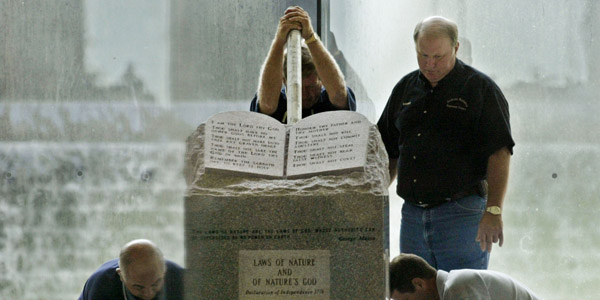
Workers remove a monument of the Ten Commandments from the rotunda of the Alabama Judicial Building after Superior Court Justice Roy Moore refused to take it down in 2003
So you can add another car to the crazy train that is the 2012 Republican presidential nominating contest. No, I’m not talking about last week’s sensation, Donald Trump. He’s a pretty conventional figure compared to the latest would-be president, former Alabama Supreme Court Chief Justice Roy Moore, who is currently barnstorming through Iowa after announcing an exploratory committee.
You may remember Judge Moore as the man who was forced from his judicial post after refusing to remove a gigantic monument to the Ten Commandments from his courthouse. He was also known for abrasive comments from the bench about homosexuality as contrary to God’s will, which in Moore’s opinion was dispositive. A martyr for theocrats everywhere, Moore spent some time hauling his monument around Alabama before launching two notably unsuccessful gubernatorial races — coming in a bad second in 2006’s Republican primary and a bad fourth in 2010 — and becoming a minor fixture at tea party events.
Moore was undoubtedly drawn to Iowa by that state’s furor over same-sex marriage, decreed legal by a 2009 state Supreme Court ruling. Iowa’s powerful Christian Right movement has made overturning that decision Job One, beginning with a successful effort in 2010 to remove three of the seven jurists responsible for it. It’s one of the few places left where Republicans don’t try to ignore the whole issue of gay rights as a divisive loser of an issue (which is why presidential wannabees like Tim Pawlenty have anachronistically come out against the repeal of “don’t ask, don’t tell). For Moore, it must have felt more like “home” than home.
Before writing off Moore as a kook trying to horn in on the spotlight of a presidential race, consider the company he’s keeping on his tour of the first-in-the-nation-caucuses state: former state legislator Danny Carroll. Carroll was co-chairman (with three-time gubernatorial candidate Bob Vander Plaats) of Mike Huckabee’s successful 2008 Caucus campaign, and more recently, signed on as a lobbyist for Vander Plaats’ new Christian Right umbrella group, The Family Leader. He’s a reasonably big deal in Iowa GOP circles, and by no means someone who howls at the moon.
For all I know, Carroll sees something in the crusty Alabama judge that others haven’t seen. Or maybe Judge Moore is a convenient stalking horse for Huckabee, designed to keep The Faithful loose and out of anyone else’s camp, in case Huck ultimately decides to run.
Regardless of Carroll’s (or Moore’s) personal motives, it’s likely the national Republican chattering class will dismiss the Judge’s campaign as a joke even worse than Trump’s. Or, it may be said, there is now such a crowd on the far right that opportunities are opening up for more moderate possibilities like Romney, T-Paw or an establishment-backed candidate-yet-to-be-named.
But I’d like to suggest another theory: the Christian/tea party right in Iowa is big enough, powerful enough, and politically sophisticated enough to hold its own caucus-within-a-caucus (well, caucuses, to be technical about it), an intramural contest to determine which candidate will actually represent the cause when Iowa Republicans make their final commitments before Caucus Night. Proven zealots like Michele Bachmann, Herman Cain, and now Moore, will joust with more suspect supplicants like T-Paw, Newt Gingrich — and maybe even Donald Trump! — over the next few months, with someone emerging as the designated favorite of the political army of the Lord. That is arguably what happened in Iowa in 2008, when Huckabee and Sen. Sam Brownback fought to become the Christian Right alternative to Mitt Romney, with Huckabee becoming The Man only after he out-organized Brownback at the State Party Straw Poll in Ames during the summer.
Moore’s candidacy may not ultimately have any direct influence on what happens next winter in Iowa, when conservative evangelicals and conservative Catholics get together to shape the 2012 Republican nominating process.
But he could indeed intensify the competition for Christian Right voters. And just as importantly, he could definitely serve as a symbol of the ideological and psychological gap between rigorous conservative activists and the mainstream political commentariat. Most of the latter think Moore is a crazy person. But most of the Iowa audiences before which Moore speaks will consider him an authentic if polarizing voice expressing the Word of God. That’s a pretty big gulf in perception, but also a pretty good reflection of the real differences Americans experience in how they view their leaders.
By: Ed Kilgore, Managing Editor of The Democratic Strategist and Senior Editor, Progressive Policy Institute. Article published in The Atlantic, April 20, 2011: Photo by Tami Chappell (Reuters)
Flirting With The Fringe: Stop Pretending Michele Bachmann Can Win The Iowa Caucuses
Ever since Michele Bachmann announced her intention to form a presidential exploratory committee, pundits, including Ed Kilgore at TNR, have been making the case that she has a good chance at winning Iowa—or if not winning, then doing well enough to hurt one or more of the stronger candidates. Republican caucus-goers in the state, they argue, are at least half-nuts, and therefore may well support Bachmann or some other candidate who doesn’t pass conventional standards of seriousness.
Certainly, Iowa Republicans are very socially conservative, more so than in some other states. But a closer look at Iowa caucus history shows that their history of supporting fringe candidates is not quite what it’s made out to be.
The case that “wacky Iowans will do anything” essentially comes down to interpreting a handful of episodes from recent decades. The first occurred in 1988 when Pat Robertson stunned everyone by finishing second with 25 percent of the vote, besting George H.W. Bush and Jack Kemp. But Pat Robertson was a social conservative—and no ordinary one at that—in a year in which the frontrunner (George H.W. Bush) was not. Moreover, that example is now over two decades old, and since then Iowa Republicans have had no trouble voting for mainstream candidates with conventional credentials, as long as those candidates—Lamar Alexander, George W. Bush—had solid records on social conservative issues.
That leaves us with three other supposed episodes of Iowan craziness: Pat Buchanan’s second place finish in 1996; the surprising showings of fringe candidates Alan Keyes and Gary Bauer in 2000; and Huckabee’s victory in 2008. Closer inspection of each of these episodes, however, reveals that none were quite as crazy as they appear.
Take Pat Buchannan in 1996. As odd as it might seem now, he was almost a serious candidate at the time: He had already run for president in 1992, and while he was never quite a plausible nominee, he did have some serious claim as a repeat candidate that Bachmann doesn’t have now. Nor was Buchannan’s success in Iowa especially unique. In fact, he proceeded to win the primary in New Hampshire, and wound up beating his Iowa percentage in sixteen states (several of those, to be sure, were after other candidates had dropped out, so the higher percentage was less impressive).
As for Alan Keyes and Gary Bauer in 2000, they certainly were fringe candidates—even more so than Bachmann—and their combined 25 percent was both impressive and anomalous; they combined for only 7 percent in New Hampshire, although Keyes did have some stronger showings in late states after the nomination was decided. However, it’s also the case that they didn’t have a whole lot of competition. John McCain campaigned in Iowa in 2000, but he did not fully commit to the state, and the only other candidate they beat was Orrin Hatch, who hardly ran any campaign at all. And even with their totals combined, Keyes and Bauer finished well back of Steve Forbes for second, and even further behind winner George W. Bush.
Finally, there’s Huckabee’s surprise victory in 2008; but the extent to which his candidacy was in any way similar to Bachmann’s has been vastly overstated. Yes, he won with the support of social issues voters. But Huckabee wasn’t some backbench member of the House; he was a recent former governor, and, in that sense, just as legitimate a candidate as Jimmy Carter or Bill Clinton.
Compared to Huckabee, Michele Bachmann is an altogether different sort of candidate. Since 1972, no candidate in any way similar has run a competitive campaign. The only three members of the House who had plausible shots at winning—Mo Udall in 1976, Jack Kemp in 1988, and Dick Gephardt in 1988 and 2004—were all senior members with leadership positions, legislative accomplishments, or both. No, Bachmann belongs in a different category, with other sideshow acts who may attract attention but have no real chance to win the nomination. And even in allegedly crazy Iowa, those candidates rarely impress on caucus day.
By: Jonathan Bernstein, The New Republic, April 16, 2011
Share This Blog


 Unknown Feed
- An error has occurred; the feed is probably down. Try again later.
 mykeystrokes.com
You must be logged in to post a comment.