“The GOP’s ‘Jobs’ Hypocrisy”: Their Own Party Is The Biggest Obstacle
I bring good news this new year! Conservatives have a jobs agenda, one that isn’t built around merely cutting taxes and regulations and getting the government out of the way so the free market can strut its stuff.
No—this includes… are you ready?… infrastructure investment, and a monetary policy less obsessed with keeping inflation under 2 percent. It’s new, it’s exhilarating, it’s brilliant! And it’s the same stuff that Barack Obama and most liberal Democrats have favored for years.
When David Frum, whom I respect a great deal, tweets that a new article should be thought of as “a ‘95 theses’ moment for the reformist right,” he gets my attention. So I clicked immediately and read through “A Jobs Agenda for the Right,” by Michael Strain of the American Enterprise Institute, from the new issue of National Affairs. I liked the essay and even agreed with a respectable percentage of what Strain had to say. But reading it was far more infuriating than reading something by a conservative and disagreeing with every syllable, because articles like Strain’s refuse to acknowledge, let alone try to grapple with, the central and indisputable fact that the contemporary Republican Party—his presumed vehicle for all this pro-jobs reform—has opposed many of these initiatives tooth and nail.
The first big measure Strain touts in his essay is infrastructure. “Anyone who has driven on a highway in Missouri or has taken an escalator in a Washington, D.C., Metro station knows that the United States could use some infrastructure investment,” he writes. He doesn’t lay out a specific program, but clearly he favors fairly broad public investment.
Um, OK. There are people who’ve been trying to do just that. And not only Barack Obama. John Kerry led this effort in the Senate, and he was joined by Republican Kay Bailey Hutchison (who’s since retired). Their attempts to fund a modest infrastructure bank were supported by the U.S. Chamber of Commerce. But it could never get anywhere because of rock-solid GOP opposition. Does Strain not even know this? Or is he pretending it never existed so he doesn’t have to deal with the political reality of Republican obduracy?
I think, of course, it’s the latter, and there’s further evidence for my guess in the way Strain talks about recent history. The 2009 stimulus was not a failure in infrastructure terms at all (has he read Michael Grunwald?). But even if you believe it was an infrastructure failure, or have to say so for political reasons, should you not acknowledge in fairness that it was Democrats and liberals who wanted it to have more infrastructure spending, and that nearly 40 percent of the bill took the form of tax cuts because that’s what Republicans demanded (before they decided en masse to vote against it anyway)?
From there, Strain turns to monetary policy, and this is even more comic. The Federal Reserve, he writes, should relax the 2 percent inflation target to get the unemployment numbers down. Uh, yes. It should. But it’s not as if Strain just originally thought of this. Liberals have been saying this ever since 2009, or 2008 even. And in response, conservatives have been saying that doing so will produce galloping inflation and destroy our economy. You’ve seen Ben Bernanke get badgered about inflation by Republicans from Paul Ryan on down for years. Inflation could have been 1.2 percent, or lower, but if Bernanke was up on the Hill, Republicans tore into him as if he were unleashing the mid-’70s on us again.
As I said, I agree with Strain. I agree when he writes: “In short, conservatives should see that there is a role for macroeconomic stimulus in getting the labor market back on its feet” and that “monetary policy with its eye on enabling growth can make a big difference.” Yes, they should. Well… how are they going to see that? Does Strain have some special pixie dust?
It’s astonishing that he can write this way, but it’s what they all do on the right. They maintain the fiction that their party is a party of rational people who will listen to rational argument and isn’t simply dug into a state of psychotic opposition to anything Barack Obama wants to do. Everyone watching our politics for the last five years knows that if Obama is for it, the Republicans will oppose it. Strain might say counting noses in the Senate isn’t his job. Well, OK. But at least he could acknowledge that his party has been preventing some of his own ideas from having any hope of becoming reality (he goes on to discuss other proposals, some of them more traditionally conservative, others that acknowledge a fairly strong governmental role in getting people back to work).
Usually, with regard to jobs and wage stagnation and poverty and so on, the problem is that conservatives deny empirical reality. This gives us people like Paul Ryan, for example, who genuinely seems to believe, in the face of the mountains of evidence about how the social safety net and federal entitlements have saved millions from lives of far worse destitution, that all government can do is make slaves of people. That’s bad enough.
But now, we have conservatives who accept enough empirical reality to agree that public investment is not a crime against nature, but who deny the political reality that the Republican Party stands in the way of progress. This may actually be worse. The only hope of changing Washington for the better is getting a Republican Party in which there are enough legislators who act like legislators again and who are willing to cross party lines occasionally for the sake of governance and the country. If conservative intellectuals keep pretending this isn’t a problem, there is no hope that it will change.
By: Michael Tomasky, The Daily Beast, January 3, 2014
“Give Jobs A Chance”: To Err Is Human, But To Err On The Side Of Growth Is Wise
This week the Federal Reserve’s Open Market Committee — the group of men and women who set U.S. monetary policy — will be holding its sixth meeting of 2013. At the meeting’s end, the committee is widely expected to announce the so-called “taper” — a slowing of the pace at which it buys long-term assets.
Memo to the Fed: Please don’t do it. True, the arguments for a taper are neither crazy nor stupid, which makes them unusual for current U.S. policy debate. But if you think about the balance of risks, this is a bad time to be doing anything that looks like a tightening of monetary policy.
O.K., what are we talking about here? In normal times, the Fed tries to guide the economy by buying and selling short-term U.S. debt, which effectively lets it control short-term interest rates. Since 2008, however, short-term rates have been near zero, which means that they can’t go lower (since people would just hoard cash instead). Yet the economy has remained weak, so the Fed has tried to gain traction through unconventional measures — mainly by buying longer-term bonds, both U.S. government debt and bonds issued by federally sponsored home-lending agencies.
Now the Fed is talking about slowing the pace of these purchases, bringing them to a complete halt by sometime next year. Why?
One answer is the belief that these purchases — especially purchases of government debt — are, in the end, not very effective. There’s a fair bit of evidence in support of that belief, and for the view that the most effective thing the Fed can do is signal that it plans to keep short-term rates, which it really does control, low for a very long time.
Unfortunately, financial markets have clearly decided that the taper signals a general turn away from boosting the economy: expectations of future short-term rates have risen sharply since taper talk began, and so have crucial long-term rates, notably mortgage rates. In effect, by talking about tapering, the Fed has already tightened monetary policy quite a lot.
But is that such a bad thing? That’s where the second argument comes in: the suggestions that there really isn’t that much slack in the U.S. economy, that we aren’t that far from full employment. After all, the unemployment rate, which peaked at 10 percent in late 2009, is now down to 7.3 percent, and there are economists who believe that the U.S. economy might begin to “overheat,” to show signs of accelerating inflation, at an unemployment rate as high as 6.5 percent. Time for the Fed to take its foot off the gas pedal?
I’d say no, for a couple of reasons.
First, there’s less to that decline in unemployment than meets the eye. Unemployment hasn’t come down because a higher percentage of adults is employed; it’s come down almost entirely because a declining percentage of adults is participating in the labor force, either by working or by actively seeking work. And at least some of the Americans who dropped out of the labor force after 2007 will come back in as the economy improves, which means that we have more ground to make up than that unemployment number suggests.
How misleading is the unemployment number? That’s a hard one, on which reasonable people disagree. The question the Fed should be asking is, what is the balance of risks?
Suppose, on one side, that the Fed were to hold off on tightening, then learn that the economy was closer to full employment than it thought. What would happen? Well, inflation would rise, although probably only modestly. Would that be such a bad thing? Right now inflation is running below the Fed’s target of 2 percent, and many serious economists — including, for example, the chief economist of the International Monetary Fund — have argued for a higher target, say 4 percent. So the cost of tightening too late doesn’t look very high.
Suppose, on the other side, that the Fed were to tighten early, then learn that it had moved too soon. This could damage an already weak recovery, causing hundreds of billions if not trillions of dollars in economic damage, leaving hundreds of thousands if not millions of additional workers without jobs and inflicting long-term damage as more and more of the unemployed are perceived as unemployable.
The point is that while there is legitimate uncertainty about what the Fed should be doing, the costs of being too harsh vastly exceed the costs of being too lenient. To err is human; to err on the side of growth is wise.
I’d add that one of the prevailing economic policy sins of our time has been allowing hypothetical risks, like the fiscal crisis that never came, to trump concerns over economic damage happening in the here and now. I’d hate to see the Fed fall into that trap.
So my message is, don’t do it. Don’t taper, don’t tighten, until you can see the whites of inflation’s eyes. Give jobs a chance.
By: Paul Krugman, Op-Ed Columnist, The New York Times, September 15, 2013
Medicare Saves Money: Ensuring Health Care At A Cost The Nation Can Afford
Every once in a while a politician comes up with an idea that’s so bad, so wrongheaded, that you’re almost grateful. For really bad ideas can help illustrate the extent to which policy discourse has gone off the rails.
And so it was with Senator Joseph Lieberman’s proposal, released last week, to raise the age for Medicare eligibility from 65 to 67.
Like Republicans who want to end Medicare as we know it and replace it with (grossly inadequate) insurance vouchers, Mr. Lieberman describes his proposal as a way to save Medicare. It wouldn’t actually do that. But more to the point, our goal shouldn’t be to “save Medicare,” whatever that means. It should be to ensure that Americans get the health care they need, at a cost the nation can afford.
And here’s what you need to know: Medicare actually saves money — a lot of money — compared with relying on private insurance companies. And this in turn means that pushing people out of Medicare, in addition to depriving many Americans of needed care, would almost surely end up increasing total health care costs.
The idea of Medicare as a money-saving program may seem hard to grasp. After all, hasn’t Medicare spending risen dramatically over time? Yes, it has: adjusting for overall inflation, Medicare spending per beneficiary rose more than 400 percent from 1969 to 2009.
But inflation-adjusted premiums on private health insurance rose more than 700 percent over the same period. So while it’s true that Medicare has done an inadequate job of controlling costs, the private sector has done much worse. And if we deny Medicare to 65- and 66-year-olds, we’ll be forcing them to get private insurance — if they can — that will cost much more than it would have cost to provide the same coverage through Medicare.
By the way, we have direct evidence about the higher costs of private insurance via the Medicare Advantage program, which allows Medicare beneficiaries to get their coverage through the private sector. This was supposed to save money; in fact, the program costs taxpayers substantially more per beneficiary than traditional Medicare.
And then there’s the international evidence. The United States has the most privatized health care system in the advanced world; it also has, by far, the most expensive care, without gaining any clear advantage in quality for all that spending. Health is one area in which the public sector consistently does a better job than the private sector at controlling costs.
Indeed, as the economist (and former Reagan adviser) Bruce Bartlett points out, high U.S. private spending on health care, compared with spending in other advanced countries, just about wipes out any benefit we might receive from our relatively low tax burden. So where’s the gain from pushing seniors out of an admittedly expensive system, Medicare, into even more expensive private health insurance?
Wait, it gets worse. Not every 65- or 66-year-old denied Medicare would be able to get private coverage — in fact, many would find themselves uninsured. So what would these seniors do?
Well, as the health economists Austin Frakt and Aaron Carroll document, right now Americans in their early 60s without health insurance routinely delay needed care, only to become very expensive Medicare recipients once they reach 65. This pattern would be even stronger and more destructive if Medicare eligibility were delayed. As a result, Mr. Frakt and Mr. Carroll suggest, Medicare spending might actually go up, not down, under Mr. Lieberman’s proposal.
O.K., the obvious question: If Medicare is so much better than private insurance, why didn’t the Affordable Care Act simply extend Medicare to cover everyone? The answer, of course, was interest-group politics: realistically, given the insurance industry’s power, Medicare for all wasn’t going to pass, so advocates of universal coverage, myself included, were willing to settle for half a loaf. But the fact that it seemed politically necessary to accept a second-best solution for younger Americans is no reason to start dismantling the superior system we already have for those 65 and over.
Now, none of what I have said should be taken as a reason to be complacent about rising health care costs. Both Medicare and private insurance will be unsustainable unless there are major cost-control efforts — the kind of efforts that are actually in the Affordable Care Act, and which Republicans demagogued with cries of “death panels.”
The point, however, is that privatizing health insurance for seniors, which is what Mr. Lieberman is in effect proposing — and which is the essence of the G.O.P. plan — hurts rather than helps the cause of cost control. If we really want to hold down costs, we should be seeking to offer Medicare-type programs to as many Americans as possible.
By: Paul Krugman, Op-Ed Columnist, The New York Times, June 12, 2011
Debt Ceiling Warning: Inaction Would Double Interest Rates, Crash Market
Public efforts by both House Speaker John Boehner and President Obama to convince skeptical new Republican House members to add $2 trillion to the nation’s burdensome $14 trillion debt ceiling are being reinforced by dire warnings from business leaders that failing to OK the increase will lead to inflation, an immediate doubling of interest rates and a killer Wall Street crash.
“If they don’t increase the debt, there will be a huge impact on the economy,” a Wall Street executive told Whispers on background. “Interest rates would spike. S&P and Moody’s would downgrade U.S. debt, raising the price of borrowing, there would be a market sell-off, it would be a disaster.”
While Boehner, who yesterday called for a deal that would OK the debt ceiling increase in return for trillions of dollars in spending cuts, Wall Street lobbyists and banking and business leaders are meeting with several of the new Tea Party-backed House members who pledged to stop raising the ceiling to explain the impact of standing pat.
“A lot of freshmen are new to the issue,” said one of those meeting with the new members, some of whom signed pledges not to raise the debt ceiling no matter what.
Among the specifics the sources say they are telling the new members:
— Inflation could jump, though they aren’t giving any percentage growth.
— Interest rates could double if U.S. debt is downgraded. House loans, for example, that are now below 5 percent, could surge to 9-10 percent, killing any chance of fixing the housing slump or cutting the unemployment rate, now at 9 percent.
— The stock market could suffer a 10 percent drop, far more significant than the 778 point thrashing Wall Street took when the House rejected the government’s $700 billion bank bailout plan in September 2008.
“That market sell-off will look small compared to what we’ll see,” said a Wall Street executive.
So far, the campaign to turn the naysayers around is starting to work, say those involved. Helping is the expectations that the debt ceiling won’t actually be breached until August.
While there have been warnings that the vote must come sooner due to expectations that the cap will be breached this month, officials explained that Treasury can make several moves to postpone that until about August 2.
By: Paul Bedard, U. S. News and World Report, May 10, 2011
GOP Medicare Proposal Doesn’t Work Like Members of Congress’ Health Care As Republicans Claim
The Center for American Progress has previously pointed out that the House Republican budget for fiscal year 2012 forces future beneficiaries out of Medicare into more expensive private plans. One of the ways Republicans are trying to sell their Medicare proposal is by claiming that beneficiaries would “be enrolled in the same kind of health-care program that members of Congress enjoy.” That claim is false. In fact, if the rate of growth under this Medicare proposal were applied to federal employees’ most popular health option, the Blue Cross Blue Shield Standard Option, federal workers, including members of Congress, with family coverage would have to pay another $3,330 for the care they enjoy today. Those with individual coverage would have to pay another $1,555.
Most federal workers receive their health coverage through the Federal Employees Health Benefits Plan, or FEHBP. The government contributes a portion of their health premium. That portion is set by law and applied to the weighted average of actual premiums charged in any given year. Beneficiaries make up the rest of the cost.
The Republican budget replaces the traditional fee-for-service Medicare for future beneficiaries with a voucher to private insurance companies that is established on very different terms. Unlike FEHBP, which has a consistent government contribution based on actual premiums charged in any given year, the amount of the voucher is determined independent of actual premiums. Its growth is instead tied to the rate of the consumer price index for all urban consumers, or CPI-U. Because health costs have typically increased faster than inflation, the level of government support from the voucher would become a lower share of actual premium costs over time. In other words, Medicare beneficiaries would be left holding the bag.
What would happen if FEHBP operated like the GOP Medicare proposal?
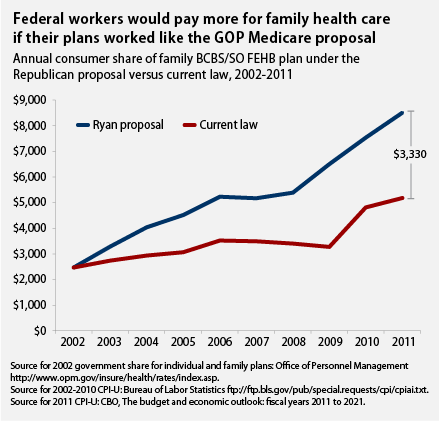
We examined what would happen if FEHBP had operated like the Republican Medicare proposal over the last decade. We used data from the Office of Personnel and Management to look at the annual premiums for federal workers enrolled in the Blue Cross Blue Shield Service Benefit Plan (Standard Family and Standard Individual). We chose this plan because nearly 60 percent of those enrolled in FEHBP have Blue Cross Blue Shield, and the Standard Option is the most popular FEHBP plan. We increased government support for the individual and family plans by the rate of growth in the CPI-U index from 2002 to 2011. We then compared the difference between the government’s share and the actual total premium in each year—which is the amount the beneficiary would pay—under the Republican proposal and the real FEHBP.

The result: A typical federal worker, or member of Congress, enrolled in family coverage in the Blue Cross Blue Shield Standard Option, would have had to pay an additional $3,330.36 for the same level of coverage they have today. Those with individual coverage would have had to pay $1,555 more.
By: Nicole Cafarella, Payment Reform Manager and Policy Analyst and Tony Clark, Policy Analyst, Center for American Progress, April 27, 2011
Share This Blog


 Unknown Feed
- An error has occurred; the feed is probably down. Try again later.
 mykeystrokes.com
You must be logged in to post a comment.