In Cantor, Hedge Funds And Private Equity Firms Have Voice At Debt Ceiling Negotiations
As the debt-ceiling talks tick down to the Aug. 2 deadline, leading the opposition to any deal that includes higher taxes is the new tribune of rank-and-file House Republicans: Majority Leader Eric Cantor of Virginia.
Cantor’s pivotal role marks a rapid rise for the 48-year-old from the Richmond suburbs. It also represents a major coup for sectors of the investment community that Cantor has been striving to assist for years — on the same tax issues that have been at stake this month. And so far, he has prevailed on those issues.
Among the White House’s top demands for new revenue are changes in the tax code affecting hedge funds, private equity firms and real estate partnerships, which would raise an estimated $20 billion over 10 years.
For the past four years, Cantor has taken the lead in the House on fighting the same changes. He also has been one of the top recipients of contributions from those industries — last year, his two fundraising committees took in nearly $2 million from securities and investment firms and real estate companies, more than double the figure for Boehner (R-Ohio).
The hedge fund and private equity proposals were at the center of Cantor’s decision to exit talks with Vice President Biden this month. Since then, the prospect for any immediate tax increases has declined, with the focus turning to spending cuts and broader tax reform postponed.
This dismays Democrats, in part because Cantor has cast his defense of the investment tax treatment as part of the broader tea party-fueled anti-tax orthodoxy. To Democrats, Cantor embodies the convergence of tea party and business interests, which is often obscured by the movement’s anti-Wall Street rhetoric.
“This [anti-tax stance] isn’t all coming up from the grass roots,” said Rep. Chris Van Hollen (D-Md.). “This goes to some longtime cozy relationships between House Republicans and hedge fund managers in the financial sector.”
A spokesman for Cantor noted that he always has opposed raising the investment taxes in question but declined to comment further.
Cantor has said repeatedly that Obama and other Democrats are exaggerating the value of closing tax loopholes for financiers. Although Cantor opposes closing them to raise revenue, he says he is open to doing so as part of broader tax reform that lowers overall rates.
“So I know it makes for good politics to throw the shiny ball out there . . . that somehow Republicans are wed to that kind of policy to sustain these preferences, when all along, in our budget and in our plan, we have said we’re for tax reform, we have said we’re for bringing down rates on everybody,” he said on the House floor last week.
Jennifer Thompson, a political science professor at Virginia Commonwealth University and former Republican campaign operative, said Cantor’s longtime opposition to the investment tax provisions is a sincere reflection of his conservatively inclined district.
“Eric Cantor is a Virginian and you can’t separate too much from that fact,” she said. “His constituents are very much aligned with the no taxes and being back in the black and that’s what Eric Cantor represents.”
Lawmakers from both parties have cultivated the investment community, but Cantor, whose wife is a former Goldman Sachs vice president, has had particularly strong connections. In 2006, his campaign committee and his leadership PAC, established to support other Republicans, collected $682,500 from securities and investment and real estate firms, far more than any other Republican on the Ways and Means Committee and nearly double the take of then-Chairman Charles B. Rangel (D-N.Y.).
Cantor sprang into action in 2007, when Democrats proposed the two major tax code changes that have been at the center of the debt talks. He formed the Coalition for the Freedom of American Investors and Retirees and invited several dozen industry groups to the opening meeting.
One of the changes revolves around “carried interest” — the pay managers receive for gains they produce for investors — which is taxed at the long-term capital gains rate of 15 percent. Many tax experts argue that it should be taxed at the 35 percent rate for ordinary income because it is the managers’ compensation for services performed, not the result of their own capital investment.
Another proposal would tax profits from the sale of hedge funds as ordinary income.
Since 2007, Cantor has railed against the proposals, saying that the carried interest proposal would “raise taxes on innovation and opportunity in America” and harm “mom and pop” businesses.
Democrats dismiss that argument. “There is virtually no evidence that having these people pay ordinary income would inhibit business development,” said Rep. Sander M. Levin (Mich.).
The proposals passed the House, which was then under Democratic control, but fell short of a filibuster-proof majority in the Senate last year.
Cantor’s support from the industries soared. Contributions to his two campaign committees from the real estate and securities and investment sectors jumped to $916,307 in 2008 and doubled to $1.85 million in 2010, according to the Center for Responsive Politics.
The top 10 contributors to Cantor’s two committees in 2010 included three investment firms: employees at SAC Capitol Advisers, the hedge fund founded by Steven Cohen, gave $64,964; those at the private equity firm KKR gave $52,600; and those at Elliott Management, the hedge fund founded by Paul Singer, gave $44,198. The Blackstone Group, the hedge fund run by Steve Schwarzman, and its employees gave $26,100.
The main private equity and hedge fund trade groups have ramped up their lobbying amid the debt talks, spending $4.2 million this year.
By: Alec MacGillis, The Washington Post, July 25, 2011
Are Members Of Congress Engaged In Insider Trading?
When Congress isn’t sending billions in taxpayer money to bail out Wall Street firms, some of its legislators appear to be using information unavailable to the general public to personally profit on stock trades.
So says a study just published in Business and Politics. A portfolio that imitates the stock purchases of House members outperforms the market by more than 6 percent in the course of a year, its authors found. “A previous study of the stock returns of U.S. Senators in a leading finance journal indicates that their portfolios show some of the highest excess returns ever recorded over a long period of time, significantly outperforming even hedge fund managers,” they wrote. “Until now, there has been no similar study of Members of the U.S. House of Representatives.”
Now we know that from 1985 to 2001, the specific interval used to generate the data, senators do the best, House members follow, and the average American investor brings up the rear. In defense of Congress, however, most legislators weren’t exploiting their advantage: on average only 27 percent of senators and 16 percent of House members bought and sold common stock. Interestingly, in the House “by far the most successful traders were those Representatives with the least seniority.” The authors acknowledge that result is counterintuitive, and posit this explanation:
Whereas Representatives with the longest seniority (in this case more than 16 years), have no trouble raising funds for campaigns, junkets and whatever other causes they may deem desirable owed to the power they wield, the financial condition of a freshman Congressman is far more precarious. His or her position is by no means secure, financially or otherwise. House Members with the least seniority may have fewer opportunities to trade on privileged information, but they may be the most highly motivated to do so when the opportunities arise.
So what should be done?
It’s presented as a thorny problem. “To restrain Members from taking personal advantage of non-public information and using their positions for personal gain, Congress has decided that such unethical behavior is best discouraged by the public disclosure of financial investments by Representatives and the discipline of the electoral process,” the authors point out, but “to form a reasonable opinion of a Representative’s conflicts of interest, voters must familiarize themselves with their Representative’s personal asset holdings, the details of each law under consideration in the House and the voting record of the Representative. This could be difficult for any voter.”
That’s why faster disclosure would work best here. Forget filing periodic reports. Just force Members of Congress to be transparent about their stock trades in real time. Voter oversight wouldn’t even be needed — the idea is that self-interested traders would closely monitor the buying and selling of stock by legislators, who’d thereby lose a lot of their ability to get a jump on other investors.
Right?
By: Conor Friedersdorf, The Atlantic, May 27, 2011
GOP Desperate to Sink Finance Reform — Sound Familiar?
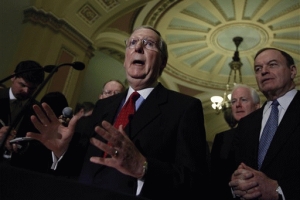
Sen Mitch "Let's scrap this one too" McConnell
Senate Minority Leader Mitch McConnell (R-Ky.) flew to New York two weeks ago for a private, behind-closed-doors meeting with hedge fund managers, bankers, and other Wall Street elites. It was after this meeting — where McConnell reportedly sought campaign contributions — that the Republican Senate leader returned to D.C. determined to kill the legislation that would bring some accountability to the same industry whose recklessness nearly destroyed the global financial system.
McConnell was asked on CNN this morning what, specifically, was said at the gathering about the Wall Street reform bill. The conservative Kentuckian was evasive — imagine that — and instead of answering the questions, he talked about scrapping the legislation altogether.
“We ought to go back to the drawing board and fix it.”
It’s like deja vu all over again — Democrats tackle a pressing national issue, negotiate with Republicans in good faith, craft a reasonable, middle-of-the-road legislative package that deserves bipartisan support, lobbyists tell Republicans to kill it, and McConnell voices his support for killing the legislation and going “back to the drawing board.”
Is it me or does this sound familiar?
McConnell’s principal (but not principled) concern is over the legislation’s liquidation fund, which would impose a fee on large financial institutions, collecting money that would be used to cover the costs of closing firms that fail. McConnell, who doesn’t know what he’s talking about, has characterized this provision as “institutionalizing bailouts.”
Fine, the Obama administration said. If it will help create bipartisan support for the bill, and end talk of a Republican filibuster, the provision on the liquidation fund can be scuttled. So, problem solved? Hardly.
[W]hen asked if he would support the bill if Democrats removed that fund, McConnell told CNN’s “State of the Union” he would still have other issues with the legislation, though he did not say what those qualms were.
Again, we’ve seen these genuinely stupid tactics before.
“Republicans can’t support the reasonable legislation Democrats want because it has a provision we’re pretending not to like.”
“Fine, we’ll get rid of the provision.”
“Republicans still can’t support the legislation, and we don’t want to tell you why.”
I know Republicans want to be taken seriously on public policy, but I can’t figure out why anyone would.
By: Steve Benen-Washington Monthly-April 18, 2010
Share This Blog


 Unknown Feed
- An error has occurred; the feed is probably down. Try again later.
 mykeystrokes.com
You must be logged in to post a comment.