“Give ’Em Hell Barry”: An Engaged President With The Strength To Fight
Progressives have yearned for President Obama to follow Harry Truman’s strategy from the 1948 campaign by giving his Republican opponents hell. Now that Obama is doing just that, his critics say he’s not looking presidential.
As a longtime advocate of the Truman approach (and a fan of Give ’Em Hell Harry and his way of doing politics), I think Obama is doing the right thing. Critics of the battling style miss what Obama needs to get done in this campaign and also ignore the extent to which so many of his foes refuse to treat him in a presidential way. Far better for him to be a fully engaged fighter with passion for what he’s saying than a distant, regal figure pretending that the other side is playing by a dainty set of rules.
But if 1948 is to be the model, what can we learn from Truman’s experience, and how does that election relate to the one we’re having in 2012?
The similarities are important. Truman in 1946, like Obama in 2010 (and, for that matter, Bill Clinton in 1994), suffered a severe setback in midterm elections that substantially strengthened the hands of his congressional adversaries. Truman’s opponent, Thomas E. Dewey, was a Northeastern Republican governor who, like Mitt Romney, was not a favorite of the most conservative wing of his party. But unlike Romney, Dewey was a genuine moderate trying hard not be ensnared in the agenda of the GOP Congress.
For Truman, tying the “do-nothing” Republican Congress around Dewey’s neck was essential to reminding the many New Dealers in the electorate of the identity of FDR’s true heir. Dewey spent the whole campaign in a box. If he danced away from congressional Republicans, he looked unprincipled. If he embraced them, he put himself right where Truman wanted him.
To the extent that Romney can be tied to an unpopular Republican House and an obstructionist minority in the Senate, their unpopularity will rub off on him. But unlike Dewey, Romney has largely endorsed his congressional colleagues’ agenda. Obama’s task is to argue that whatever moderate sounds Romney made during his career in Massachusetts politics, these are irrelevant to how he would govern with the GOP likely to be in the congressional saddle. Obama wants to paint Romney as someone who would be a pawn of a runaway right-wing Congress, thus challenging both Romney’s strength of conviction and his ideology. As Truman did with Dewey, Obama wants to offer Romney the unpalatable choice of offending his party or offending swing voters.
There is also an advantage in Obama directly taking on Romney’s background in private equity at Bain Capital. By raising these questions himself, Obama signaled that he would not let criticisms from such Democrats as Newark Mayor Cory Booker force him to back down from a challenge he knows he needs to lodge against Romney’s claims as a “job creator.” By the end of last week, Booker had eased off while the Bain issue was still alive, to the point that even Rush Limbaugh was forced to acknowledge that private equity was about profit-making, not job creation.
And if Republicans wish to argue that Obama’s vigorous anti-Romney campaigning is un-presidential, they have to answer for George W. Bush’s unashamed attacks against Democrat John Kerry in 2004. Sara Fagen, an adviser to Bush in that campaign, recently told Peter Baker of the New York Times that Bush “almost never mentioned” Kerry, “certainly not this early.”
The truth of this depends on what the meaning of the word “almost” is. In February 2004, for example, Bush mocked Kerry — he referred to him as “one senator from Massachusetts” — as being “for tax cuts and against them. For NAFTA and against NAFTA. For the Patriot Act and against the Patriot Act. In favor of liberating Iraq and opposed to it.” The next month, Bush accused Kerry by name of being “willing to gut the intelligence services” with a “deeply irresponsible” proposal to cut intelligence spending. There is no record of Republicans complaining that these political assaults were beneath a president.
Like Truman — and, for that matter, like Bush — Obama confronts a sharply divided country, the need to rally his own supporters and the imperative of convincing undecided voters that electing his opponent would be a dangerous risk. What Truman taught is that Americans would rather see a president with the strength to fight than a politician with such sensitive sensibilities that he leaves all the tough stuff to others.
BY: E. J. Dionne, Jr., Opinion Writer, The Washington Post, May 27, 2012
“That’s Why They’re Called Leaders”: Congressional Republicans Need To Do Their Job
One of the more common Republican criticisms of President Obama, at least in the context of the debt-reduction talks, is that he hasn’t shown enough “leadership.” Senate Minority Leader Mitch McConnell (R-Ky.) took to the floor late last week to cry, “Where in the world has the president been for the last month? … He’s the one in charge.”
One of the parts of Obama’s press conference this morning that I especially liked was the president’s pushback against the notion that he’s been a passive observer in this process.
“I’ve got to say, I’m very amused when I start hearing comments about, ‘Well, the president needs to show more leadership on this.’ Let me tell you something. Right after we finished dealing with the government shutdown, averting a government shutdown, I called the leaders here together. I said we’ve got to get this done. I put Vice President Biden in charge of a process — that, by the way, has made real progress — but these guys have met, worked through all of these issues. I met with every single caucus for an hour to an hour and a half each — Republican senators, Democratic senators; Republican House, Democratic House. I’ve met with the leaders multiple times. At a certain point, they need to do their job.
“And so, this thing, which is just not on the level, where we have meetings and discussions, and we’re working through process, and when they decide they’re not happy with the fact that at some point you’ve got to make a choice, they just all step back and say, ‘Well, you know, the president needs to get this done.’ They need to do their job.
“Now is the time to go ahead and make the tough choices. That’s why they’re called leaders…. They’re in one week, they’re out one week. And then they’re saying, ‘Obama has got to step in.’ You need to be here. I’ve been here. I’ve been doing Afghanistan and bin Laden and the Greek crisis. You stay here. Let’s get it done.”
I’m glad the president pressed this, not just because he sounded a bit like Truman slamming the do-nothing Congress, but because many in the media have bought into the notion that lawmakers have dug in on this, and the president hasn’t. That’s nonsense.
Congressional Republicans haven’t been slaving away, trying to strike a credible deal. They’ve been making threats, drawing lines in the sand, and barking orders about what is and is not allowed to be on the negotiating table.
“They need to do their job.” Part of those responsibilities includes working in good faith to find an equitable compromise with a Democratic Senate and a Democratic White House, and then doing what they must do, but what the president cannot do: passing the damn debt-ceiling increase.
Tick tock.
By: Steve Benen, Contributing Writer, Political Animal, The Washington Monthly, June 29, 2011
Historic Achievement For A More Perfect Union
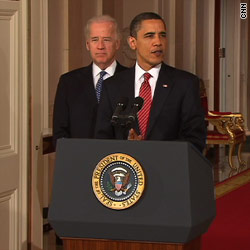
President Obama speaking on passage of Historic Health Reform Bill
“Mr. Speaker, I ask unanimous consent to revise and extend my remarks in opposition to this flawed health care bill”….We heard this canned statement over and over and over again tonight. We heard about the “Cornhusker kickback, the Louisiana Purchase, the Gator aid. We heard that this bill, if it passes, will make Americans less free. We heard that members of the military would loose their health coverage, that abortions would be paid for, that Medicare would be slashed. We heard from John Boehner that this was not the time to create bureaucracies, that there was no transparency, that there was not time to read the bill, that the people do not want this bill. His remarks continued to accent his distress over the process. If I had not been watching and only listening to his remarks over the radio, one would certainly have gotten the distinct impression that he was a very, very angry man. The tone and inflections in his voice gave one to believe that John Boehner just might be a little bit concerned that history was about to pass him by.
Health reform has been talked about and debated dating back to Theodore Roosevelt’s Bull Moose party which called for health insurance for industry. In his first term, President Roosevelt appointed a committee which was to report a program that addressed old-age and unemployment issues, medical care and health insurance. President Truman proposed a single insurance system that would cover all Americans with public subsidies to pay for the poor.
During nearly every Presidential election cycle since those days, every candidate has campaigned on the slogan of “health care for all”. At the end of that cycle, nothing gets done and the cycle continues. We immediately resort back to the status quo. The numbers of uninsured rise, the cost of insurance premiums skyrocket, rescissions continue, out of pocket expenses increase, denials for pre-existing conditions fall off the scales and even children are dropped from coverage.
Well, the time for change is long overdue. Republicans, for too long, have played politics with the lives of all Americans. At every turn, they have denied, delayed, obstructed, lied outright and instilled fear in the hearts and minds of the populace. As Speaker Pelosi said tonight, “all politics are personal”. After tonight, there will be no more politics of fear, no more politics of intimidation, no more threats of personal destruction. All of the talk about process, and all of the whining from republicans with bruised egos, don’t mean a heck of a lot now. What matters to those with no insurance, to those who are uninsured and those who have been bankrupted or lost their homes because of medical bills, simply stated, are results.
Many had given up on health reform with the Senate election results in Massachusetts earlier this year. Many have talked wildly about the upcoming November elections. The insurance companies became emboldened and Sen. Mitch McConnell and Rep. John Boehner actually began to believe their own words. Their repeated echo’s of “No” with the brazen 30-60% premium increases by Anthem and other insurers, re-awakened a cautious Democratic party. I want to personally thank Sen McConnell, Rep. Boehner and the insurance companies for their inadvertent contributions to the cause of health care reform.
In November 2008, America elected a President who said that he would get health reform done. For this President, it was not just a “slogan”. He took flack from all sides…Republicans and Democrats alike. With a determined Speaker of the House in Nancy Pelosi, President Obama and the U.S. House of Representatives delivered for the good of the American people.
When the sun rises in the east tomorrow, the earth will still be turning on it‘s axis, the American economy will not have collapsed, America will still be free, and there will be no Waterloo….the only thing that will be different tomorrow is that historic health reform for all Americans was passed tonight. History is now on the side of the American people.
Share This Blog


 Unknown Feed
- An error has occurred; the feed is probably down. Try again later.
 mykeystrokes.com

You must be logged in to post a comment.